
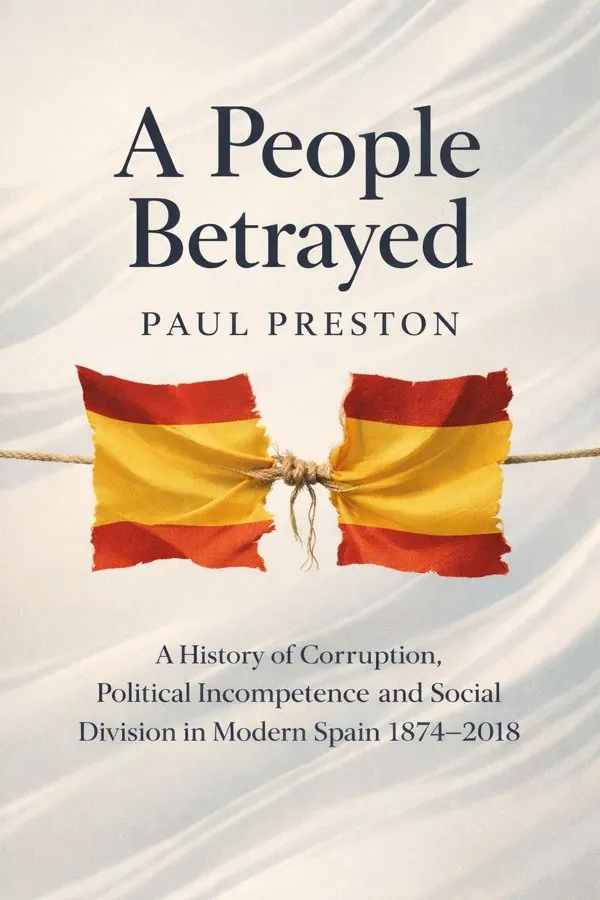
A People Betrayed: A History of Corruption, Political Incompetence and Social Division in Modern Spain 1874–2018: Summary & Key Insights
by Paul Preston
 10 min10 chaptersAudio available
Key Takeaways from A People Betrayed: A History of Corruption, Political Incompetence and Social Division in Modern Spain 1874–2018
A political system can look orderly while rotting from within.
Regimes rarely collapse because of one mistake; they collapse when too many people stop believing they can be repaired.
Civil wars do not begin when societies disagree; they begin when political opponents are recast as enemies who must be destroyed.
Authoritarian regimes often promise order, honesty, and national renewal, yet they frequently combine violence with private enrichment.
Economic modernization can transform a country without reforming its political culture.
What Is A People Betrayed: A History of Corruption, Political Incompetence and Social Division in Modern Spain 1874–2018 About?
A People Betrayed: A History of Corruption, Political Incompetence and Social Division in Modern Spain 1874–2018 by Paul Preston is a world_history book spanning 10 pages. Paul Preston’s A People Betrayed is a sweeping, deeply researched history of modern Spain that argues one theme has linked monarchy, republic, dictatorship, and democracy alike: the repeated betrayal of ordinary citizens by corrupt elites, self-serving institutions, and chronically inadequate political leadership. Covering the period from the Bourbon Restoration in 1874 to the aftermath of the financial crisis in 2018, the book shows how graft, patronage, incompetence, and social polarization repeatedly weakened Spain’s attempts at reform and reconciliation. What makes this book so powerful is that it is not simply a catalog of scandals. Preston explains how corruption became structural, how political systems were designed to protect insiders, and how unresolved conflicts over class, region, religion, and memory kept returning in new forms. He connects palace intrigue, military intervention, business favoritism, authoritarian violence, and democratic-era scandals into one long historical pattern. Preston is one of the foremost historians of Spain, especially of the Civil War and Francoism, and his authority gives this narrative unusual depth. For readers seeking to understand Spain’s modern history—and the broader costs of elite failure in any democracy—this book is both essential and unsettling.
This FizzRead summary covers all 10 key chapters of A People Betrayed: A History of Corruption, Political Incompetence and Social Division in Modern Spain 1874–2018 in approximately 10 minutes, distilling the most important ideas, arguments, and takeaways from Paul Preston's work. Also available as an audio summary and Key Quotes Podcast.
A People Betrayed: A History of Corruption, Political Incompetence and Social Division in Modern Spain 1874–2018
Paul Preston’s A People Betrayed is a sweeping, deeply researched history of modern Spain that argues one theme has linked monarchy, republic, dictatorship, and democracy alike: the repeated betrayal of ordinary citizens by corrupt elites, self-serving institutions, and chronically inadequate political leadership. Covering the period from the Bourbon Restoration in 1874 to the aftermath of the financial crisis in 2018, the book shows how graft, patronage, incompetence, and social polarization repeatedly weakened Spain’s attempts at reform and reconciliation.
What makes this book so powerful is that it is not simply a catalog of scandals. Preston explains how corruption became structural, how political systems were designed to protect insiders, and how unresolved conflicts over class, region, religion, and memory kept returning in new forms. He connects palace intrigue, military intervention, business favoritism, authoritarian violence, and democratic-era scandals into one long historical pattern.
Preston is one of the foremost historians of Spain, especially of the Civil War and Francoism, and his authority gives this narrative unusual depth. For readers seeking to understand Spain’s modern history—and the broader costs of elite failure in any democracy—this book is both essential and unsettling.
Who Should Read A People Betrayed: A History of Corruption, Political Incompetence and Social Division in Modern Spain 1874–2018?
This book is perfect for anyone interested in world_history and looking to gain actionable insights in a short read. Whether you're a student, professional, or lifelong learner, the key ideas from A People Betrayed: A History of Corruption, Political Incompetence and Social Division in Modern Spain 1874–2018 by Paul Preston will help you think differently.
- ✓Readers who enjoy world_history and want practical takeaways
- ✓Professionals looking to apply new ideas to their work and life
- ✓Anyone who wants the core insights of A People Betrayed: A History of Corruption, Political Incompetence and Social Division in Modern Spain 1874–2018 in just 10 minutes
Want the full summary?
Get instant access to this book summary and 100K+ more with Fizz Moment.
Get Free SummaryAvailable on App Store • Free to download
Key Chapters
A political system can look orderly while rotting from within. Preston shows that the Bourbon Restoration, established in 1874 after years of upheaval, presented itself as a constitutional solution to instability, but in practice it rested on manipulation, exclusion, and patronage. Elections were not meaningful contests of public will. Instead, local political bosses, known as caciques, managed outcomes through intimidation, bribery, and administrative pressure. Two major parties alternated in power through a controlled arrangement rather than genuine competition.
This mattered because it taught Spain’s elites that institutions did not need to represent citizens; they only needed to preserve order and elite privilege. Rural poverty, labor unrest, regional grievances, and demands for reform were not addressed seriously. They were contained, postponed, or repressed. The monarchy, the army, landowners, and sections of the Church all benefited from a system that equated stability with immobility.
Preston’s analysis helps readers see corruption not as a series of isolated scandals but as a governing method. When public office becomes a network of favors, state legitimacy slowly erodes. Spain’s later crises did not emerge from nowhere; they were incubated in these decades of managed politics and fake constitutionalism.
A practical lesson follows from this history. Modern democracies should not be judged only by whether they hold elections, but by whether elections are competitive, institutions are accountable, and citizens can challenge entrenched interests. Whenever politics becomes a private arrangement among insiders, long-term instability is already taking root.
Actionable takeaway: look beyond formal democratic structures and ask who really controls access to power, information, and economic opportunity.
Regimes rarely collapse because of one mistake; they collapse when too many people stop believing they can be repaired. Preston argues that the fall of Alfonso XIII’s monarchy in 1931 resulted from accumulated discredit: military failures, social inequality, institutional dishonesty, and the king’s own support for General Primo de Rivera’s dictatorship. The monarchy had tied itself to repression rather than reform, and when that dictatorship failed, the crown was left politically naked.
The birth of the Second Republic inspired enormous hope. Reformers wanted to modernize Spain through secular education, land reform, military restructuring, regional accommodation, and a more democratic political culture. Yet these ambitions collided with entrenched interests and impossible expectations. Conservatives feared national disintegration and anti-clerical revolution. Radicals often underestimated the resistance of the army, landlords, and Church. Moderates struggled to maintain legitimacy while facing attacks from both left and right.
Preston presents the Republic neither as a utopia nor as a simple prelude to war. It was a serious effort to democratize a deeply unequal society whose institutions had long avoided change. Its tragedy lay partly in timing: reforms came when polarization was already intense and when many powerful actors preferred sabotage to compromise.
This section has broad relevance today. Political reform often fails not because reform is unnecessary, but because old power structures remain strong enough to obstruct change while public patience runs out. Democratic transitions require both institutional courage and social trust.
Actionable takeaway: when evaluating reform movements, ask not only whether their goals are noble, but whether they have realistic strategies for overcoming entrenched resistance without losing public legitimacy.
Civil wars do not begin when societies disagree; they begin when political opponents are recast as enemies who must be destroyed. Preston treats the Spanish Civil War as the catastrophic outcome of cumulative polarization, elite irresponsibility, military conspiracy, and social fear. The 1936 military uprising against the Republic was not an unfortunate misunderstanding between extremes. It was a deliberate attempt by anti-democratic forces to crush reform and restore a hierarchical vision of Spain.
At the same time, Preston does not sanitize the violence, disorder, and revolutionary excess that unfolded in Republican territory. He shows how state weakness, class hatred, anti-clerical fury, and wartime improvisation led to atrocities and fragmentation. Yet a crucial distinction remains: the Republic was the legitimate government under assault, while the insurgents consciously built a machinery of terror to eliminate political pluralism.
The war also revealed how foreign intervention can intensify domestic fracture. Nazi Germany and Fascist Italy materially aided Franco, while the democracies largely abandoned the Republic under the banner of non-intervention. The Soviet Union’s involvement was more limited and politically costly. Spain became both a national tragedy and a rehearsal stage for wider European conflict.
For contemporary readers, Preston’s account is a warning about the dangers of dehumanizing rhetoric, institutional breakdown, and military politicization. Polarization becomes deadly when constitutional rules lose authority and powerful actors decide coexistence is intolerable.
Actionable takeaway: defend democratic norms early, especially judicial independence, civilian control of the military, and the legitimacy of political opposition, because once these collapse, compromise becomes vastly harder.
Authoritarian regimes often promise order, honesty, and national renewal, yet they frequently combine violence with private enrichment. Preston shows that Franco’s dictatorship, established after victory in 1939, relied not only on terror and censorship but also on favoritism, patronage, and economic exploitation. The regime imprisoned, executed, and silenced opponents while rewarding loyalists with positions, contracts, land, and protection. Repression and corruption were mutually reinforcing: fear prevented scrutiny, and privilege bought allegiance.
Franco cultivated the image of austere patriotism, but the system around him enriched military figures, bureaucrats, financiers, black market operators, and politically connected families. During the years of autarky, when Spain pursued economic self-sufficiency, ordinary people suffered shortages and hardship while insiders profited from scarcity, licenses, and state-controlled access. Mismanagement was not accidental; it was built into a system where loyalty mattered more than competence.
Preston’s broader point is that dictatorship does not eliminate corruption. It often hides it better by destroying transparency. Without a free press, independent courts, or opposition parties, abuses become harder to expose. Public myths of discipline can mask deeply inefficient and predatory governance.
This insight is highly practical. Citizens sometimes become tempted by strongman politics during periods of democratic frustration, believing authoritarian rule will cut through chaos and clean up public life. Spain under Franco demonstrates the opposite: unaccountable power usually deepens corruption while stripping society of the means to resist it.
Actionable takeaway: treat claims that liberty must be sacrificed for efficiency with skepticism; accountability, not coercion, is the real antidote to systemic corruption.
Economic modernization can transform a country without reforming its political culture. Preston examines the technocratic era of the later Franco regime, especially from the 1950s onward, when Spain moved away from failed autarky and embraced development, tourism, foreign investment, and industrial expansion. Living standards rose, infrastructure improved, and a new middle class emerged. To many observers, this looked like proof that the regime had found a formula for stability and success.
But Preston insists that growth did not resolve the dictatorship’s core defects. Development occurred within an authoritarian framework that still denied political freedom, protected entrenched interests, and tolerated influence-peddling and opaque decision-making. Economic opening changed Spain socially, but institutions remained undemocratic. Prosperity also had uneven effects, leaving regional imbalances, labor tensions, and unresolved demands for participation.
This period illustrates an important historical pattern: modernization does not automatically produce justice. New wealth can coexist with old hierarchies. Roads, factories, and rising consumption can make a system look healthier than it is, especially if political dissent remains dangerous. By the time Franco died in 1975, Spain was more urban, educated, and economically dynamic, but it still carried the burdens of censorship, historical trauma, and elite habits formed under dictatorship.
For readers today, the lesson is to distinguish between economic indicators and institutional quality. A country can post impressive growth while its legal system, media environment, or political accountability remain fragile.
Actionable takeaway: when assessing national progress, measure not only income and infrastructure but also transparency, rights, equal opportunity, and the distribution of power.
Transitions to democracy are rarely clean moral victories; they are often negotiated escapes from dangerous pasts. Preston portrays Spain’s transition after Franco’s death as both an extraordinary achievement and a source of lasting tensions. Political leaders, reform-minded officials, opposition figures, and King Juan Carlos helped steer the country away from dictatorship, legalize parties, draft a democratic constitution, and avoid the slide into renewed conflict. In a society haunted by civil war, moderation had real value.
Yet compromise came with costs. The so-called pacto del olvido, or pact of forgetting, encouraged silence about many crimes of the dictatorship in order to facilitate peaceful coexistence. Former regime networks were not entirely dismantled. The army remained a latent threat, as shown by the attempted coup of 1981. Regional issues, especially in Catalonia and the Basque Country, were managed but not definitively resolved. Corruption habits inherited from earlier systems did not disappear simply because elections became free.
Preston’s account avoids easy cynicism. He does not deny the transition’s success, particularly given the risks of the period. But he argues that democratic consolidation was limited by the decision to postpone deeper moral and institutional reckoning. That unresolved legacy later resurfaced in debates about memory, justice, and national identity.
This helps readers understand that peaceful change often requires compromise, but compromise should not become a permanent substitute for accountability. Stable democracies need more than procedural legitimacy; they also need trust that the past has been confronted honestly.
Actionable takeaway: support democratic compromise in fragile moments, but pair it with long-term efforts toward truth, institutional reform, and civic education.
The arrival of democracy does not magically create clean government. Preston traces how Spain’s democratic era, including both Socialist and Conservative administrations, delivered major successes—European integration, modernization, expanded freedoms, and improved public services—while also reproducing patterns of cronyism, illicit financing, influence networks, and misuse of office. Corruption changed style, not essence. Instead of caciques or dictatorship-era patronage alone, scandals now involved party machines, public contracts, urban development, and relationships between business and political elites.
Under Felipe González’s Socialist governments, Spain underwent rapid transformation, but the period was also tainted by scandals and by the dirty war against ETA through the GAL. Under José María Aznar and later Mariano Rajoy, economic growth and administrative confidence were accompanied by controversies involving real estate speculation, party financing, and major corruption cases. Preston’s point is not that one side was uniquely guilty. Rather, a bipartisan pattern emerged in which political competition coexisted with weak ethical standards and institutional loopholes.
This is one of the book’s most contemporary themes. Democracies can normalize corruption when voters become resigned, parties close ranks, and prosperity masks malpractice. Even where courts and journalists eventually expose wrongdoing, damage accumulates: public trust falls, cynicism rises, and populist reactions become more likely.
The practical implication is clear. Democratic health depends not only on alternation in power but on internal party democracy, transparent procurement, prosecutorial independence, and media freedom. Without these, elections can rotate elites without changing political culture.
Actionable takeaway: judge democratic systems by how well they investigate allies as well as opponents, because impartial accountability is the test of institutional maturity.
A society can feel prosperous right before its weaknesses become impossible to ignore. Preston treats the years from the economic expansion of the late 1990s and 2000s through the post-2008 crisis as a decisive exposure of Spain’s structural vulnerabilities. The property boom generated jobs, tax revenue, and a mood of success, but it also encouraged reckless lending, speculative construction, municipal corruption, and dependence on unsustainable growth. Politicians, developers, banks, and local power brokers often benefited together.
When the global financial crisis hit, the consequences were severe: unemployment soared, especially among the young; evictions multiplied; austerity deepened social pain; and many citizens concluded that ordinary people were paying for elite irresponsibility. The indignados movement captured this discontent by challenging not only economic inequality but the broader legitimacy of a political class seen as insulated, complacent, and compromised.
Preston links this period to the book’s central argument. Spain’s crisis was not just economic. It was moral and institutional. Corruption scandals undercut confidence in established parties, while unresolved territorial tensions and anger over cuts intensified fragmentation. The democratic system survived, but the aura of post-transition consensus weakened dramatically.
For modern readers, this chapter offers a familiar lesson with wide applicability: asset booms often conceal governance failures. If regulation is weak and elites profit from short-term expansion, the eventual crash can turn economic pain into political rupture.
Actionable takeaway: during periods of rapid growth, pay closest attention to debt, housing speculation, regulatory capture, and local-level corruption, because those are often the fault lines beneath apparent prosperity.
Nations do not escape the past by refusing to talk about it. One of Preston’s most significant contributions is to show how unresolved historical memory continued to shape Spain long after dictatorship ended. The violence of the Civil War, the repression of Francoism, and the compromises of the transition left many wounds only partially acknowledged. Families searched for mass graves, survivors demanded recognition, and political actors argued over whether revisiting the past healed the country or reopened divisions.
Preston strongly suggests that silence favored the powerful. Those who suffered dispossession, imprisonment, torture, or execution were often expected to accept democratic normality without full truth or justice. At the same time, the mythology of Francoist order and the simplification of the Republic’s failures persisted in parts of public culture. Memory was not a secondary issue; it shaped civic identity, institutional legitimacy, and the moral boundaries of democracy.
This has relevance far beyond Spain. Every society emerging from repression faces a difficult question: how can it balance stability with truth? Preston’s answer, implicit throughout the book, is that democracy becomes stronger when it confronts difficult history honestly rather than outsourcing it to private grief or partisan mythmaking.
In practical terms, this means supporting archives, public history, victim recognition, school curricula grounded in evidence, and legal frameworks that treat past abuses seriously. Memory work is not simply symbolic. It influences whether future generations inherit a culture of accountability or amnesia.
Actionable takeaway: treat historical truth as democratic infrastructure; societies that document past abuses clearly are better equipped to resist their repetition.
The most disturbing insight in Preston’s book is that Spain’s problems were not confined to one ideology or one constitutional form. Monarchy, republic, dictatorship, and parliamentary democracy all struggled with versions of the same deeper issue: elites who repeatedly placed self-preservation above public service. Some used electoral fraud, some military force, some censorship, some party patronage, and some financial collusion, but the pattern of betrayal endured.
This does not mean all regimes were morally equivalent. Preston is clear about the brutality of Francoism and the democratic legitimacy of the Republic and later constitutional order. Still, his larger historical argument is that institutional design matters only if political culture supports accountability, competence, and solidarity. Without those, systems become vulnerable to capture, and citizens are asked once again to bear the costs of elite failure.
That is why the book resonates beyond Spanish history. It offers a framework for understanding how corruption persists across changing political labels. Formal reforms can matter greatly, but if transparency is weak, inequality is high, and public memory is manipulated, old habits return in new clothes. A people is betrayed not only by spectacular scandals, but by decades of normalized mediocrity, unexamined privilege, and routine evasions of responsibility.
Readers can apply this insight to any national context. Instead of asking only which party or leader is corrupt, ask what systems reward opacity, what institutions fail to punish abuse, and what narratives excuse it.
Actionable takeaway: focus political attention on durable safeguards—independent courts, free media, civic education, transparent finance, and enforceable ethics rules—rather than relying on supposedly virtuous leaders alone.
All Chapters in A People Betrayed: A History of Corruption, Political Incompetence and Social Division in Modern Spain 1874–2018
About the Author
Paul Preston is a leading British historian of modern Spain and one of the most respected English-language scholars of the Spanish Civil War, Francoism, and twentieth-century Spanish politics. He has spent decades researching Spain’s political and social history, combining archival rigor with a strong concern for the human consequences of power, violence, and institutional failure. Preston served as a professor at the London School of Economics and has been recognized for his major contributions to Hispanic studies, including election to the British Academy. His books are widely read for their depth, clarity, and moral seriousness. In A People Betrayed, he brings together his longstanding expertise to examine how corruption, incompetence, and division shaped Spain from the late nineteenth century to the modern democratic era.
Get This Summary in Your Preferred Format
Read or listen to the A People Betrayed: A History of Corruption, Political Incompetence and Social Division in Modern Spain 1874–2018 summary by Paul Preston anytime, anywhere. FizzRead offers multiple formats so you can learn on your terms — all free.
Available formats: App · Audio · PDF · EPUB — All included free with FizzRead
Download A People Betrayed: A History of Corruption, Political Incompetence and Social Division in Modern Spain 1874–2018 PDF and EPUB Summary
Key Quotes from A People Betrayed: A History of Corruption, Political Incompetence and Social Division in Modern Spain 1874–2018
“A political system can look orderly while rotting from within.”
“Regimes rarely collapse because of one mistake; they collapse when too many people stop believing they can be repaired.”
“Civil wars do not begin when societies disagree; they begin when political opponents are recast as enemies who must be destroyed.”
“Authoritarian regimes often promise order, honesty, and national renewal, yet they frequently combine violence with private enrichment.”
“Economic modernization can transform a country without reforming its political culture.”
Frequently Asked Questions about A People Betrayed: A History of Corruption, Political Incompetence and Social Division in Modern Spain 1874–2018
A People Betrayed: A History of Corruption, Political Incompetence and Social Division in Modern Spain 1874–2018 by Paul Preston is a world_history book that explores key ideas across 10 chapters. Paul Preston’s A People Betrayed is a sweeping, deeply researched history of modern Spain that argues one theme has linked monarchy, republic, dictatorship, and democracy alike: the repeated betrayal of ordinary citizens by corrupt elites, self-serving institutions, and chronically inadequate political leadership. Covering the period from the Bourbon Restoration in 1874 to the aftermath of the financial crisis in 2018, the book shows how graft, patronage, incompetence, and social polarization repeatedly weakened Spain’s attempts at reform and reconciliation. What makes this book so powerful is that it is not simply a catalog of scandals. Preston explains how corruption became structural, how political systems were designed to protect insiders, and how unresolved conflicts over class, region, religion, and memory kept returning in new forms. He connects palace intrigue, military intervention, business favoritism, authoritarian violence, and democratic-era scandals into one long historical pattern. Preston is one of the foremost historians of Spain, especially of the Civil War and Francoism, and his authority gives this narrative unusual depth. For readers seeking to understand Spain’s modern history—and the broader costs of elite failure in any democracy—this book is both essential and unsettling.
You Might Also Like
The Age of Capital
Eric Hobsbawm
10 min
The Gulag Archipelago
Aleksandr Solzhenitsyn
10 min
Jerusalem: The Biography
Simon Sebag Montefiore
10 min
The Anglo-Saxons
James Campbell
10 min
The Boer War
Thomas Pakenham
10 min
The Industrial Revolutionaries: The Making of the Modern World 1776–1914
Gavin Weightman
10 minFeatured In
Browse by Category
Ready to read A People Betrayed: A History of Corruption, Political Incompetence and Social Division in Modern Spain 1874–2018?
Get the full summary and 100K+ more books with Fizz Moment.