
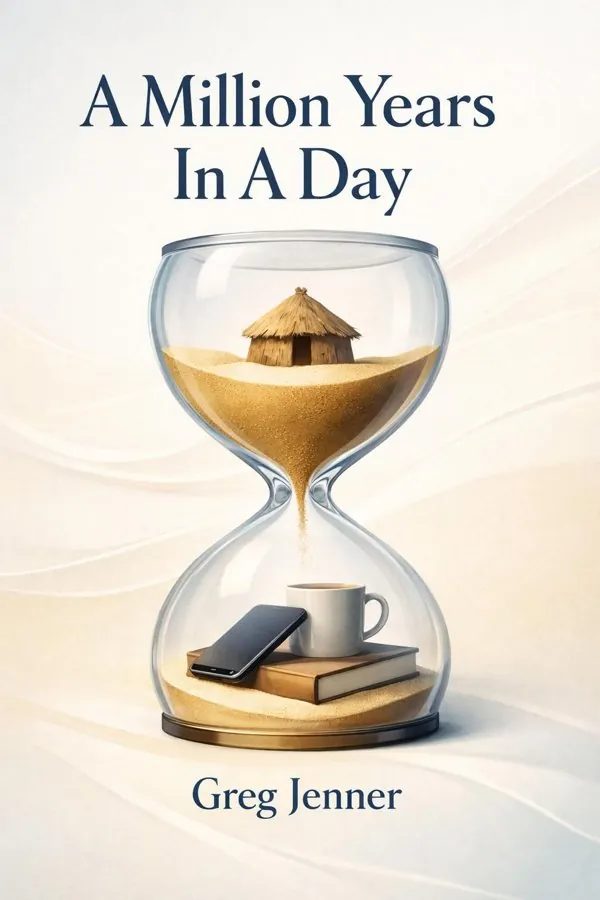
A Million Years In A Day: A Curious History Of Everyday Life From The Stone Age To The Phone Age: Summary & Key Insights
by Greg Jenner
 10 min11 chaptersAudio available
What Is A Million Years In A Day: A Curious History Of Everyday Life From The Stone Age To The Phone Age About?
A Million Years In A Day: A Curious History Of Everyday Life From The Stone Age To The Phone Age by Greg Jenner is a world_history book spanning 11 pages. A witty and engaging exploration of how ordinary daily routines evolved through history—from waking up, eating breakfast, and brushing teeth to commuting and using technology. Greg Jenner, a public historian, traces the fascinating origins of modern habits, showing how centuries of innovation and cultural change shaped the way we live today.
This FizzRead summary covers all 11 key chapters of A Million Years In A Day: A Curious History Of Everyday Life From The Stone Age To The Phone Age in approximately 10 minutes, distilling the most important ideas, arguments, and takeaways from Greg Jenner's work. Also available as an audio summary and Key Quotes Podcast.
A Million Years In A Day: A Curious History Of Everyday Life From The Stone Age To The Phone Age
A witty and engaging exploration of how ordinary daily routines evolved through history—from waking up, eating breakfast, and brushing teeth to commuting and using technology. Greg Jenner, a public historian, traces the fascinating origins of modern habits, showing how centuries of innovation and cultural change shaped the way we live today.
Who Should Read A Million Years In A Day: A Curious History Of Everyday Life From The Stone Age To The Phone Age?
This book is perfect for anyone interested in world_history and looking to gain actionable insights in a short read. Whether you're a student, professional, or lifelong learner, the key ideas from A Million Years In A Day: A Curious History Of Everyday Life From The Stone Age To The Phone Age by Greg Jenner will help you think differently.
- ✓Readers who enjoy world_history and want practical takeaways
- ✓Professionals looking to apply new ideas to their work and life
- ✓Anyone who wants the core insights of A Million Years In A Day: A Curious History Of Everyday Life From The Stone Age To The Phone Age in just 10 minutes
Want the full summary?
Get instant access to this book summary and 100K+ more with Fizz Moment.
Get Free SummaryAvailable on App Store • Free to download
Key Chapters
When we wake to the shrill cry of an alarm clock—or worse, a smartphone—we rarely think about what a miracle it is that we sleep in peace at all. For most of human history, slumber was a precarious business. Our Stone Age ancestors huddled near fires or in trees, where predators and cold were constant threats. It wasn’t until thousands of years later that we devised something resembling a proper bed. Ancient Egyptians elevated wooden frames off the ground, both for status and to dodge pests. Romans preferred bedsteads of bronze or rope, while medieval peasants barely had straw pallets to lie on.
Even the way we think of sleep—one continuous block—would have bewildered many of our ancestors. Historical studies suggest that before artificial lighting, people often experienced two sleeps: they’d drift off after dusk, wake in the middle of the night for a few hours, and then return to slumber until dawn. This divided sleep pattern allowed time for prayer, quiet chores, or intimate conversation in the dark hush before morning.
And what about alarm systems? Long before digital tones, we had knocker-uppers—Victorian workers who tapped on windows with long poles to wake laborers for early shifts. Before them came sundials, rooster crows, and even servants tasked solely with waking the household. Each innovation, from candles to clockwork, reflects a gradual conquering of time itself. To wake up on schedule was to assert control over one’s day—an idea at the heart of the modern world.
Splashing water on your face in the morning may seem universal, but it stands on centuries of cultural evolution. The ancients bathed religiously: Egyptians prized cleanliness, while Romans engineered aqueducts and public baths not just for hygiene but for social life. Yet, when Rome fell, so did the idea of daily washing. In medieval Europe, bathing was viewed with suspicion—water was thought to open the body’s pores to miasmas and disease. Instead, people relied on linen shifts to 'absorb impurities,' and perfumed potions replaced soap.
Soap itself has an impressive lineage, first appearing among the Babylonians nearly five thousand years ago. Early formulas used animal fat and ashes—a humble start that eventually gave us the fine-scented bars of today. Tooth care, too, was nothing new: ancient Egyptians used abrasive pastes made from crushed shells, while the Chinese invented the first bristle toothbrush in the fifteenth century, using boar hair. The habit of brushing teeth daily, though, came much later—popularized only after World War II, when returning soldiers brought it home from army routines.
Every rinse, scrub, and brush we take now is the result of thousands of tiny revolutions in hygiene. What was once ritual became medicine, and later, marketing. The gleaming bathroom we retreat to each morning tells the story of how humans learned not just to wash away dirt, but to redefine cleanliness itself as a moral virtue.
+ 9 more chapters — available in the FizzRead app
All Chapters in A Million Years In A Day: A Curious History Of Everyday Life From The Stone Age To The Phone Age
About the Author
Greg Jenner is a British public historian and author known for his work on the BBC series 'Horrible Histories'. He specializes in making history accessible and entertaining for general audiences, blending humor with scholarly insight.
Get This Summary in Your Preferred Format
Read or listen to the A Million Years In A Day: A Curious History Of Everyday Life From The Stone Age To The Phone Age summary by Greg Jenner anytime, anywhere. FizzRead offers multiple formats so you can learn on your terms — all free.
Available formats: App · Audio · PDF · EPUB — All included free with FizzRead
Download A Million Years In A Day: A Curious History Of Everyday Life From The Stone Age To The Phone Age PDF and EPUB Summary
Key Quotes from A Million Years In A Day: A Curious History Of Everyday Life From The Stone Age To The Phone Age
“When we wake to the shrill cry of an alarm clock—or worse, a smartphone—we rarely think about what a miracle it is that we sleep in peace at all.”
“Splashing water on your face in the morning may seem universal, but it stands on centuries of cultural evolution.”
Frequently Asked Questions about A Million Years In A Day: A Curious History Of Everyday Life From The Stone Age To The Phone Age
A Million Years In A Day: A Curious History Of Everyday Life From The Stone Age To The Phone Age by Greg Jenner is a world_history book that explores key ideas across 11 chapters. A witty and engaging exploration of how ordinary daily routines evolved through history—from waking up, eating breakfast, and brushing teeth to commuting and using technology. Greg Jenner, a public historian, traces the fascinating origins of modern habits, showing how centuries of innovation and cultural change shaped the way we live today.
You Might Also Like
The Age of Capital
Eric Hobsbawm
10 min
The Gulag Archipelago
Aleksandr Solzhenitsyn
10 min
Jerusalem: The Biography
Simon Sebag Montefiore
10 min
The Anglo-Saxons
James Campbell
10 min
The Boer War
Thomas Pakenham
10 min
The Industrial Revolutionaries: The Making of the Modern World 1776–1914
Gavin Weightman
10 minFeatured In
Browse by Category
Ready to read A Million Years In A Day: A Curious History Of Everyday Life From The Stone Age To The Phone Age?
Get the full summary and 100K+ more books with Fizz Moment.