
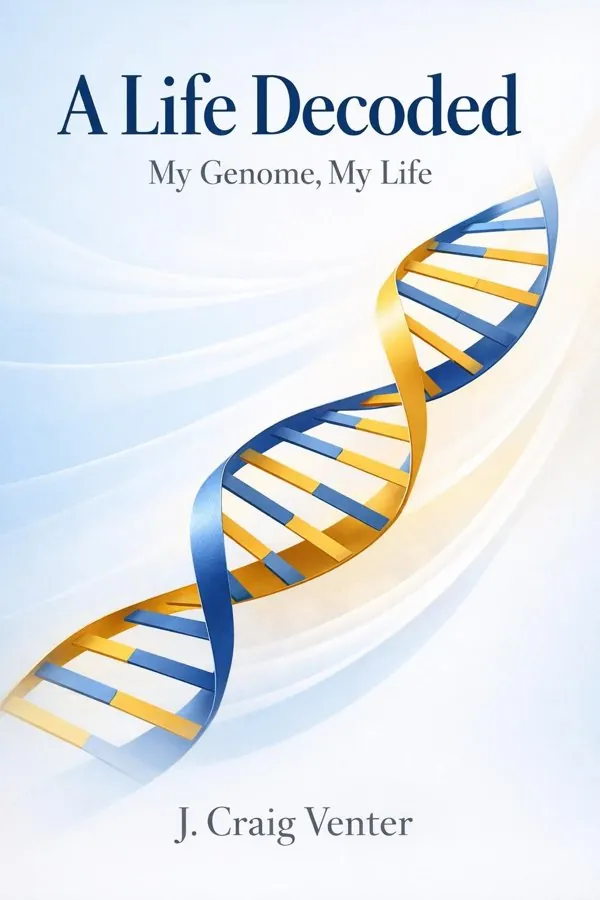
A Life Decoded: My Genome, My Life: Summary & Key Insights
 10 min6 chaptersAudio available
What Is A Life Decoded: My Genome, My Life About?
A Life Decoded: My Genome, My Life by J. Craig Venter is a biographies book spanning 6 pages. In this groundbreaking memoir, geneticist J. Craig Venter recounts his pioneering work in sequencing the human genome and his personal journey through science, competition, and discovery. The book offers an insider’s view of the race to decode DNA, the ethical and scientific challenges of genomics, and Venter’s reflections on the meaning of life as revealed through biology.
This FizzRead summary covers all 6 key chapters of A Life Decoded: My Genome, My Life in approximately 10 minutes, distilling the most important ideas, arguments, and takeaways from J. Craig Venter's work. Also available as an audio summary and Key Quotes Podcast.
A Life Decoded: My Genome, My Life
In this groundbreaking memoir, geneticist J. Craig Venter recounts his pioneering work in sequencing the human genome and his personal journey through science, competition, and discovery. The book offers an insider’s view of the race to decode DNA, the ethical and scientific challenges of genomics, and Venter’s reflections on the meaning of life as revealed through biology.
Who Should Read A Life Decoded: My Genome, My Life?
This book is perfect for anyone interested in biographies and looking to gain actionable insights in a short read. Whether you're a student, professional, or lifelong learner, the key ideas from A Life Decoded: My Genome, My Life by J. Craig Venter will help you think differently.
- ✓Readers who enjoy biographies and want practical takeaways
- ✓Professionals looking to apply new ideas to their work and life
- ✓Anyone who wants the core insights of A Life Decoded: My Genome, My Life in just 10 minutes
Want the full summary?
Get instant access to this book summary and 100K+ more with Fizz Moment.
Get Free SummaryAvailable on App Store • Free to download
Key Chapters
My childhood and early youth were not predestined for scientific greatness—they were marked instead by restlessness and rebellion. Growing up in California, I was no prodigy lying awake dreaming of genes; I was more likely to be surfing, testing limits, questioning authority. That questioning mindset, however, was the seed of something deeper: an unwillingness to accept boundaries. Later, when I finally turned toward biology, that same instinct—to resist dogma—would drive nearly every bold decision I made.
It was during my service as a hospital corpsman in the U.S. Navy in Vietnam that science found its true meaning for me. I saw pain and survival up close—young lives hanging on the thin thread of biology and chance. The experience burned into me the desire to understand life, not in poetic terms but in molecular ones. I realized that medicine’s limits were defined by what we didn’t know about our own cells, our own DNA. If we could see deeply enough into biology’s code, perhaps we could extend those limits.
Returning home, I resolved to study biology from the ground up. I had faced death too directly to waste time on mediocrity. These formative years planted the seed of urgency—a conviction that scientific discovery must move faster, that the pace of understanding life was bound to the value we attached to life itself.
When I entered graduate school, molecular biology was beginning to unfold new frontiers, yet it remained methodical and slow, constrained by the tools of the time. I immersed myself in biochemistry at the University of California, San Diego, joining the laboratory of Nathan Kaplan, where I learned not only molecular methods but also the temperament of persistence. Science was tedious work, requiring long days of meticulous experimentation. But I found an intellectual excitement in the details—the elegance of nucleotide metabolism, the kinetics of enzymes—it all pointed toward something grand: how life writes and rewrites itself at the molecular level.
Eventually, my work led me to focus on DNA expression, which would culminate years later in the concept of expressed sequence tags (ESTs). These snippets of genetic information could act as shortcuts to identifying genes rapidly without the cumbersome full sequencing process. That early insight would revolutionize genomics. But before it did, I had to learn the art of scientific risk-taking—of pursuing an idea that seemed too radical for the conservative culture of academia.
While many researchers were comfortable mapping genes slowly, I became convinced that new technology could—and should—change everything. I had seen in Vietnam what delay could cost; in science, delay meant lives lost to ignorance. With that conviction, I began to develop the mindset that science should race ahead, not crawl.
+ 4 more chapters — available in the FizzRead app
All Chapters in A Life Decoded: My Genome, My Life
About the Author
J. Craig Venter is an American geneticist, biotechnologist, and entrepreneur best known for leading the private effort to sequence the human genome. He founded Celera Genomics, the J. Craig Venter Institute, and several biotechnology companies focused on synthetic biology and genomics research.
Get This Summary in Your Preferred Format
Read or listen to the A Life Decoded: My Genome, My Life summary by J. Craig Venter anytime, anywhere. FizzRead offers multiple formats so you can learn on your terms — all free.
Available formats: App · Audio · PDF · EPUB — All included free with FizzRead
Download A Life Decoded: My Genome, My Life PDF and EPUB Summary
Key Quotes from A Life Decoded: My Genome, My Life
“My childhood and early youth were not predestined for scientific greatness—they were marked instead by restlessness and rebellion.”
“When I entered graduate school, molecular biology was beginning to unfold new frontiers, yet it remained methodical and slow, constrained by the tools of the time.”
Frequently Asked Questions about A Life Decoded: My Genome, My Life
A Life Decoded: My Genome, My Life by J. Craig Venter is a biographies book that explores key ideas across 6 chapters. In this groundbreaking memoir, geneticist J. Craig Venter recounts his pioneering work in sequencing the human genome and his personal journey through science, competition, and discovery. The book offers an insider’s view of the race to decode DNA, the ethical and scientific challenges of genomics, and Venter’s reflections on the meaning of life as revealed through biology.
More by J. Craig Venter
You Might Also Like

An American Marriage
Tayari Jones
10 min
Benjamin Franklin: An American Life
Walter Isaacson
10 min
I Know Why The Caged Bird Sings
Maya Angelou
10 min
Long Walk to Freedom
Nelson Mandela
10 min
Persepolis
Marjane Satrapi
10 min
Surely You're Joking, Mr. Feynman!
Richard P. Feynman
10 minBrowse by Category
Ready to read A Life Decoded: My Genome, My Life?
Get the full summary and 100K+ more books with Fizz Moment.