
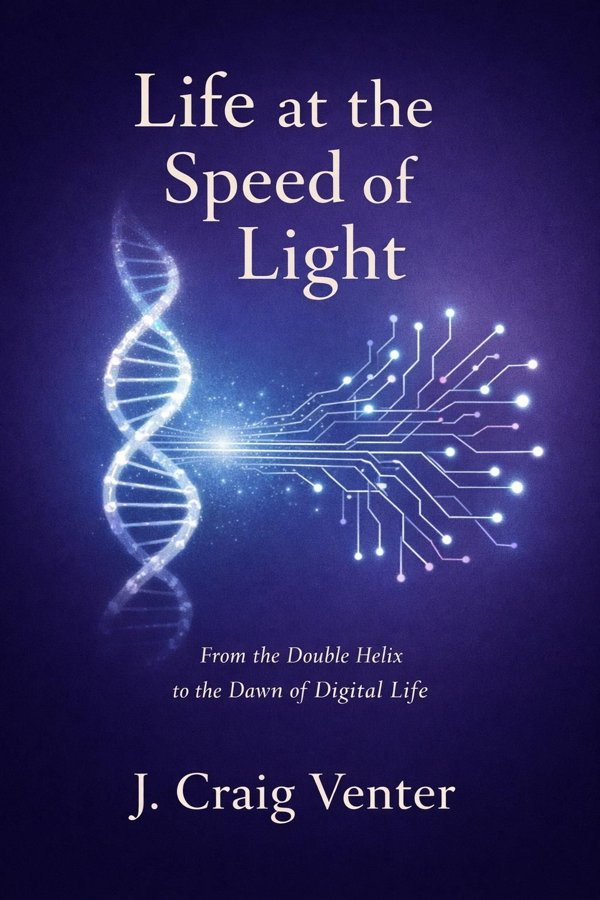
Life at the Speed of Light: From the Double Helix to the Dawn of Digital Life: Summary & Key Insights
 10 min8 chaptersAudio available
What Is Life at the Speed of Light: From the Double Helix to the Dawn of Digital Life About?
Life at the Speed of Light: From the Double Helix to the Dawn of Digital Life by J. Craig Venter is a life_science book spanning 8 pages. In this groundbreaking work, geneticist and biotechnologist J. Craig Venter explores the creation of synthetic life and the future of biology in the digital age. He recounts his pioneering work in sequencing the human genome and synthesizing the first self-replicating cell, offering insights into how life can be designed, built, and transformed through science. The book examines the philosophical, ethical, and practical implications of creating life from scratch, bridging biology and information technology.
This FizzRead summary covers all 8 key chapters of Life at the Speed of Light: From the Double Helix to the Dawn of Digital Life in approximately 10 minutes, distilling the most important ideas, arguments, and takeaways from J. Craig Venter's work. Also available as an audio summary and Key Quotes Podcast.
Life at the Speed of Light: From the Double Helix to the Dawn of Digital Life
In this groundbreaking work, geneticist and biotechnologist J. Craig Venter explores the creation of synthetic life and the future of biology in the digital age. He recounts his pioneering work in sequencing the human genome and synthesizing the first self-replicating cell, offering insights into how life can be designed, built, and transformed through science. The book examines the philosophical, ethical, and practical implications of creating life from scratch, bridging biology and information technology.
Who Should Read Life at the Speed of Light: From the Double Helix to the Dawn of Digital Life?
This book is perfect for anyone interested in life_science and looking to gain actionable insights in a short read. Whether you're a student, professional, or lifelong learner, the key ideas from Life at the Speed of Light: From the Double Helix to the Dawn of Digital Life by J. Craig Venter will help you think differently.
- ✓Readers who enjoy life_science and want practical takeaways
- ✓Professionals looking to apply new ideas to their work and life
- ✓Anyone who wants the core insights of Life at the Speed of Light: From the Double Helix to the Dawn of Digital Life in just 10 minutes
Want the full summary?
Get instant access to this book summary and 100K+ more with Fizz Moment.
Get Free SummaryAvailable on App Store • Free to download
Key Chapters
Every new science begins with a revelation. For molecular biology, that revelation was the discovery of DNA’s double helix in 1953 by James Watson and Francis Crick, based on Rosalind Franklin’s critical diffraction images. This was more than an elegant structure—it was an alphabet, a code for life. Once we knew that life’s instructions were written in a sequence of four chemical bases, it became possible to imagine life as information. This vision crystalized over decades as researchers learned to manipulate that code, cutting and pasting genes, cloning sequences, and eventually reading the entire genetic repertoire of organisms.
I entered this field during a period when sequencing was still slow and painstaking. The processes were manual and chemical; each new genome took years. My early work focused on sequencing microbial genomes to understand what minimal set of genes sustains life. Microbes, particularly those of the genus Mycoplasma, became our evolutionary Rosetta stones. Their simplicity allowed us to glimpse what makes a cell viable and what functions are expendable.
Out of these early insights came the conviction that life could, in principle, be written as code. If a genome is just an information set driving cellular machinery, then rewriting the code could redefine life itself. The double helix had given us the script, but now we needed a way to copy, modify, and synthesize it—transforming biology from a descriptive to a creative science.
For decades, biologists dreamed of reading the full script of human life. I had the privilege of helping that dream become reality. The Human Genome Project was one of the most ambitious undertakings in modern science: an effort to map every gene in our 3 billion-base-pair genome. At Celera Genomics, my team took a bold new approach—whole-genome shotgun sequencing—which broke the genome into fragments, sequenced them all at once, then reassembled them using computational algorithms. This strategy, controversial at the time, dramatically accelerated the pace of genomics.
When we announced the draft human genome in 2000, standing alongside Francis Collins at the White House, it was more than a scientific milestone. It marked the beginning of an era in which biology would be driven not only by laboratory experiments but by data analysis. The human genome turned out not to be a static list of genes but a dynamic, complex system with regulatory layers, polymorphisms, and environmental interactions that shaped who we are.
This was a revelation that changed everything. The genome was not destiny, but a text that could be edited, interpreted, and—eventually—rewritten. If sequencing allowed us to read biology’s book, synthetic biology would allow us to write new chapters.
+ 6 more chapters — available in the FizzRead app
All Chapters in Life at the Speed of Light: From the Double Helix to the Dawn of Digital Life
About the Author
J. Craig Venter is an American geneticist, biochemist, and entrepreneur known for sequencing the human genome and creating the first synthetic organism. He founded the J. Craig Venter Institute and has been a leading figure in genomics and synthetic biology, contributing to advances in personalized medicine and biological engineering.
Get This Summary in Your Preferred Format
Read or listen to the Life at the Speed of Light: From the Double Helix to the Dawn of Digital Life summary by J. Craig Venter anytime, anywhere. FizzRead offers multiple formats so you can learn on your terms — all free.
Available formats: App · Audio · PDF · EPUB — All included free with FizzRead
Download Life at the Speed of Light: From the Double Helix to the Dawn of Digital Life PDF and EPUB Summary
Key Quotes from Life at the Speed of Light: From the Double Helix to the Dawn of Digital Life
“Every new science begins with a revelation.”
“For decades, biologists dreamed of reading the full script of human life.”
Frequently Asked Questions about Life at the Speed of Light: From the Double Helix to the Dawn of Digital Life
Life at the Speed of Light: From the Double Helix to the Dawn of Digital Life by J. Craig Venter is a life_science book that explores key ideas across 8 chapters. In this groundbreaking work, geneticist and biotechnologist J. Craig Venter explores the creation of synthetic life and the future of biology in the digital age. He recounts his pioneering work in sequencing the human genome and synthesizing the first self-replicating cell, offering insights into how life can be designed, built, and transformed through science. The book examines the philosophical, ethical, and practical implications of creating life from scratch, bridging biology and information technology.
More by J. Craig Venter
You Might Also Like
The Selfish Gene
Richard Dawkins
10 min
Awakenings
Oliver Sacks
10 min
Parasite Rex: Inside the Bizarre World of Nature's Most Dangerous Creatures
Carl Zimmer
10 min
The Atlas of Life on Earth
Various
10 min
The Book of Humans: The Story of How We Became Us
Adam Rutherford
10 min
The Horse
Wendy Williams
10 minBrowse by Category
Ready to read Life at the Speed of Light: From the Double Helix to the Dawn of Digital Life?
Get the full summary and 100K+ more books with Fizz Moment.