
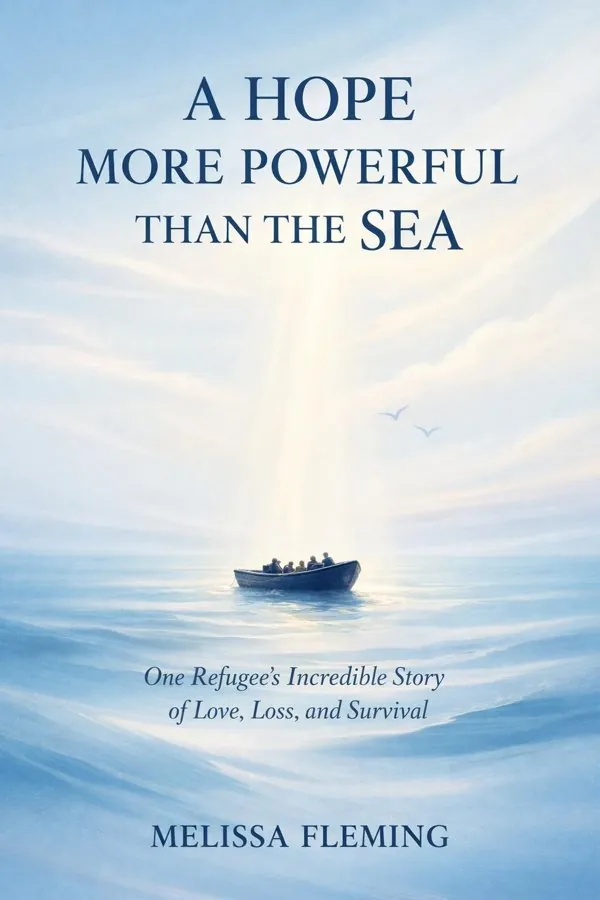
A Hope More Powerful Than the Sea: One Refugee's Incredible Story of Love, Loss, and Survival: Summary & Key Insights
 10 min10 chaptersAudio available
Key Takeaways from A Hope More Powerful Than the Sea: One Refugee's Incredible Story of Love, Loss, and Survival
The most unsettling truth in Doaa Al Zamel’s story is how quickly an ordinary life can become unrecognizable.
One of the book’s deepest insights is that home is more than a physical place.
Leaving Syria did not mean that Doaa’s family had found safety; it meant they had entered a new stage of uncertainty.
Refugee life in Egypt reveals an important truth: escaping war is only the first step.
In the middle of instability, Doaa’s relationship with Bassem offers one of the book’s most moving insights: love is not a distraction from crisis but a form of resistance to it.
What Is A Hope More Powerful Than the Sea: One Refugee's Incredible Story of Love, Loss, and Survival About?
A Hope More Powerful Than the Sea: One Refugee's Incredible Story of Love, Loss, and Survival by Melissa Fleming is a world_history book spanning 9 pages. A Hope More Powerful Than the Sea tells the unforgettable true story of Doaa Al Zamel, a Syrian teenager whose ordinary life was shattered by war, exile, and one of the deadliest migration routes in the world. Melissa Fleming follows Doaa from her childhood in Daraa, where family, faith, and community gave life its shape, through the violence of the Syrian uprising, the uncertainty of refugee life in Egypt, and the catastrophic Mediterranean crossing that changed everything. What makes this book so powerful is not only the scale of suffering it reveals, but the intimacy with which it restores a human face to a global crisis too often reduced to statistics. Doaa is not presented as a symbol alone, but as a daughter, fiancée, survivor, and witness. Fleming writes with unusual authority: as a senior United Nations official and longtime advocate for refugees, she has spent years listening to displaced people and bringing their stories to the world. The result is a deeply moving narrative that illuminates the refugee experience while asking readers to confront what survival, dignity, and hope really mean.
This FizzRead summary covers all 10 key chapters of A Hope More Powerful Than the Sea: One Refugee's Incredible Story of Love, Loss, and Survival in approximately 10 minutes, distilling the most important ideas, arguments, and takeaways from Melissa Fleming's work. Also available as an audio summary and Key Quotes Podcast.
A Hope More Powerful Than the Sea: One Refugee's Incredible Story of Love, Loss, and Survival
A Hope More Powerful Than the Sea tells the unforgettable true story of Doaa Al Zamel, a Syrian teenager whose ordinary life was shattered by war, exile, and one of the deadliest migration routes in the world. Melissa Fleming follows Doaa from her childhood in Daraa, where family, faith, and community gave life its shape, through the violence of the Syrian uprising, the uncertainty of refugee life in Egypt, and the catastrophic Mediterranean crossing that changed everything. What makes this book so powerful is not only the scale of suffering it reveals, but the intimacy with which it restores a human face to a global crisis too often reduced to statistics. Doaa is not presented as a symbol alone, but as a daughter, fiancée, survivor, and witness. Fleming writes with unusual authority: as a senior United Nations official and longtime advocate for refugees, she has spent years listening to displaced people and bringing their stories to the world. The result is a deeply moving narrative that illuminates the refugee experience while asking readers to confront what survival, dignity, and hope really mean.
Who Should Read A Hope More Powerful Than the Sea: One Refugee's Incredible Story of Love, Loss, and Survival?
This book is perfect for anyone interested in world_history and looking to gain actionable insights in a short read. Whether you're a student, professional, or lifelong learner, the key ideas from A Hope More Powerful Than the Sea: One Refugee's Incredible Story of Love, Loss, and Survival by Melissa Fleming will help you think differently.
- ✓Readers who enjoy world_history and want practical takeaways
- ✓Professionals looking to apply new ideas to their work and life
- ✓Anyone who wants the core insights of A Hope More Powerful Than the Sea: One Refugee's Incredible Story of Love, Loss, and Survival in just 10 minutes
Want the full summary?
Get instant access to this book summary and 100K+ more with Fizz Moment.
Get Free SummaryAvailable on App Store • Free to download
Key Chapters
The most unsettling truth in Doaa Al Zamel’s story is how quickly an ordinary life can become unrecognizable. Before war defined her future, Doaa grew up in Daraa, a city in southern Syria where life centered on school, family routines, religious values, and neighborhood ties. Her father worked as a barber, her mother cared for the household, and the family’s ambitions were humble but meaningful: education, stability, and a decent life. This normality matters because it challenges a common misunderstanding about refugees. People often imagine refugees as fundamentally different from themselves, when in reality many were living familiar, structured lives until violence destroyed the conditions that made such lives possible.
As protests spread through Syria and the government responded with force, daily life in Daraa transformed. Fear replaced predictability. Streets that once held social life became dangerous. Homes no longer guaranteed safety. The emotional impact was as severe as the physical one: children matured too fast, parents made impossible decisions, and families learned to measure risk in every outing, conversation, and night’s sleep.
This chapter of the book invites readers to see conflict not as an abstract geopolitical event but as a collapse of everyday life. That perspective has practical value. When we read news about war, we can ask more humane questions: What routines are being lost? What future is being interrupted? What would it take to rebuild a sense of normal life?
Actionable takeaway: When you encounter stories about displacement, begin by imagining the ordinary life that existed before the crisis. That shift builds empathy and leads to more informed, compassionate judgment.
One of the book’s deepest insights is that home is more than a physical place. Long before Doaa’s family left Syria, war had already begun tearing apart the emotional and social fabric that made Daraa feel like home. Bombs, gunfire, arrests, and intimidation damaged more than streets and shops; they eroded trust, freedom, and belonging. In this sense, displacement begins before a family crosses a border. It starts the moment home stops feeling safe.
For Doaa, the Syrian uprising was not merely a political event unfolding in the background. It entered family conversations, shaped movement, fueled anxiety, and narrowed the future. Her father, like many parents in conflict zones, had to weigh competing obligations: stay and preserve dignity, or leave and preserve life. There is no clean moral answer to such decisions. Fleming shows that fleeing is rarely an impulsive act. It usually follows repeated shocks, mounting fear, and the painful realization that survival may require abandoning everything familiar.
This idea has broader application beyond the book. It helps explain why refugees often carry grief that outsiders underestimate. Even when they survive physically, they may lose identity, social standing, language comfort, profession, and community memory. Understanding this makes us more sensitive to what resettlement actually demands.
A practical way to apply this insight is in how we speak about migration. Instead of asking, “Why didn’t they stay and fight?” a more thoughtful question is, “What conditions made staying impossible?” That reframing recognizes the complexity of forced migration.
Actionable takeaway: Think of home as safety, trust, and belonging—not just property. This will help you better understand why leaving can be both devastating and necessary.
Leaving Syria did not mean that Doaa’s family had found safety; it meant they had entered a new stage of uncertainty. In 2012, as violence intensified, they fled Daraa and eventually made their way to Egypt, joining countless Syrians searching for stability outside their homeland. Their departure was not a bold adventure but an act of survival. The journey itself involved stress, financial strain, and the pain of separation from everything familiar.
Fleming captures a crucial reality about exile: it is built on impossible choices. Families must decide what to carry, whom to trust, where to go, and how much risk to accept. They often rely on rumors, informal networks, or fragile assumptions about which country will be welcoming. Egypt initially seemed to offer possibility. Syrians could find community there, rent apartments, and try to restart life. But this temporary relief was never the same as belonging.
The lesson is clear: becoming a refugee does not solve a crisis; it changes its form. Instead of bombs and shelling, people face legal insecurity, economic hardship, xenophobia, and the constant fear that the next place of refuge may also turn hostile. This has practical implications for how host societies and policymakers think about refugee support. Housing, legal status, language access, work permits, and education are not luxuries. They are the infrastructure of dignity.
For readers, the story also offers a personal application. It reminds us that when people make difficult decisions under pressure, those decisions often reflect constrained options rather than poor judgment. Compassion requires understanding context.
Actionable takeaway: When evaluating migrants’ choices, look at the options they actually had, not the ideal options you imagine they should have had.
Refugee life in Egypt reveals an important truth: escaping war is only the first step. Once Doaa’s family reached Egypt, they were no longer under immediate bombardment, but they were still vulnerable. They had to navigate poverty, insecurity, uncertain legal standing, and the social fragility that comes with being outsiders. The family tried to rebuild a routine, but exile kept reminding them that safety without stability is incomplete.
Doaa’s experience shows how displacement affects identity and aspiration. Young refugees do not simply need shelter; they need the chance to imagine a future. Education, work, relationships, and community become crucial. Without them, exile becomes a suspended life, where survival is possible but flourishing is not. This is why humanitarian aid alone cannot fully address displacement. Food and emergency support matter, but so do pathways to purpose.
The Egyptian period of Doaa’s life also illustrates how political climates can shift suddenly. A place that feels relatively welcoming can become threatening when public attitudes change or governments tighten policies. Refugees live with that instability constantly. Their emotional energy is spent not just surviving the present, but anticipating the next rupture.
This insight has practical relevance for anyone involved in community support, education, social services, or policy. Helping displaced people means creating opportunities for continuity: school enrollment, job training, language access, and local relationships. On a personal level, it reminds us that a humane response to suffering includes restoring agency, not just relieving immediate pain.
Actionable takeaway: If you want to support displaced people meaningfully, think beyond emergency aid and ask what would help them rebuild a future with dignity and direction.
In the middle of instability, Doaa’s relationship with Bassem offers one of the book’s most moving insights: love is not a distraction from crisis but a form of resistance to it. Their bond grows during exile in Egypt, where both are trying to make sense of uprooted lives. They dream of marriage, stability, and a future together. These hopes may seem simple, yet in a refugee context they become profoundly defiant. To plan a wedding, imagine children, or talk seriously about tomorrow is to refuse despair’s claim that life has ended.
Fleming uses their relationship to remind readers that refugees are not defined solely by trauma. They fall in love, argue, make plans, worry about appearances, and long for ordinary happiness. This matters because public narratives often flatten displaced people into victims alone. Doaa and Bassem restore complexity. Their affection humanizes the refugee story in a way that statistics never can.
There is also a practical lesson here about resilience. People endure crisis not only through courage in dramatic moments, but through attachment, commitment, and meaning. Relationships provide emotional structure when institutions fail. For families, aid workers, and communities supporting people under stress, this suggests that preserving social bonds is as important as meeting material needs.
For everyday readers, the chapter encourages a broader understanding of hope. Hope is not blind optimism; it is the decision to invest emotionally in a future that is still uncertain. That idea applies far beyond war zones—in illness, unemployment, grief, or major transition.
Actionable takeaway: In times of uncertainty, protect the relationships and commitments that help you imagine a future. They are often the strongest defense against despair.
Perhaps the most sobering lesson in the book is that people rarely choose dangerous migration routes because they are reckless. They choose them because safer options have been closed. As conditions worsened for Syrians in Egypt and prospects for legal resettlement remained slim, Doaa and Bassem made the agonizing decision to attempt the sea crossing to Europe. It was not a casual gamble. It was the result of shrinking options, fear, and the belief that staying put offered no viable future.
This part of the story exposes a harsh reality about migration systems. When legal pathways are too few, too slow, or inaccessible, smugglers and unseaworthy boats fill the gap. The danger is not accidental; it is built into a world that makes protection difficult to reach. Fleming does not romanticize the decision. She shows the uncertainty, the dread, and the false promises that surround such journeys.
The practical significance is enormous. Public debates often focus on whether migrants should travel irregularly, but the more important question is why lawful, humane routes are unavailable to so many. If governments want fewer deaths at sea, they must create realistic alternatives: resettlement, humanitarian visas, family reunification, and fair asylum procedures.
On an individual level, the story warns against simplistic moral judgments. When people endure chronic danger and legal dead ends, they may accept risks outsiders find unthinkable. Understanding that dynamic fosters empathy and sharper civic thinking.
Actionable takeaway: When you hear about dangerous migration journeys, ask not only why people boarded the boat, but what failures of policy and protection left them feeling they had no better choice.
The sea voyage in A Hope More Powerful Than the Sea is not just a physical journey; it is a moral indictment of a world that allows vulnerable people to drift into catastrophe. Packed onto an overcrowded vessel with hundreds of others, Doaa enters a floating space of fear, exhaustion, and false hope. The conditions are inhumane from the start. There is little comfort, little certainty, and no genuine protection. Every hour at sea exposes how fragile refugee lives become when entrusted to smugglers and neglected by international systems.
Fleming’s narrative turns the Mediterranean into more than a setting. It becomes a symbol of global failure. The sea separates war from safety, but it also separates rhetoric from action. Nations may speak of human rights while people drown trying to reach them. This contradiction gives the book much of its ethical force.
At the same time, the voyage reveals human behavior under pressure. Fear spreads quickly, but so do small acts of care: sharing water, comforting children, watching each other for signs of collapse. Even in extreme conditions, people remain capable of generosity. That detail matters because it prevents the story from becoming only an account of cruelty; it is also an account of human interdependence.
The application for readers is civic as well as personal. We are challenged to examine whether our political beliefs about borders and migration also account for human life. Principles are easy to defend in comfort; they are tested when strangers are desperate.
Actionable takeaway: Let stories of perilous migration sharpen your moral attention. Support policies and institutions that reduce lethal journeys rather than normalizing them.
The shipwreck at the center of Doaa’s story is almost unbearable to read, yet it reveals the book’s defining idea: courage is not always dramatic heroism; often it is the refusal to let go. When the boat is attacked and sinks, chaos replaces even the fragile order of the voyage. Hundreds are thrown into the water. In the midst of terror, grief, and physical collapse, Doaa finds herself responsible for two small children entrusted to her by a dying mother. What follows is an extraordinary ordeal of endurance.
For days, Doaa clings to life in the open sea, carrying not just her own fear but the lives of the children as well. Her actions are heroic, but Fleming presents them with emotional honesty. Doaa is not fearless. She is exhausted, traumatized, grieving for Bassem and countless others. Her courage lies in continuing despite all that. This distinction matters because it makes courage feel human rather than mythical.
There is a universal lesson here. In many lives, bravery does not look like victory or confidence. It looks like persistence when outcomes are uncertain, when help is absent, and when grief is immediate. This is true for caregivers, survivors of violence, families in crisis, and anyone carrying responsibility under impossible conditions.
The practical application is to broaden our definition of strength. Instead of admiring only spectacular acts, we can learn to honor sustained endurance, emotional labor, and the decision to keep protecting others even when one is breaking.
Actionable takeaway: Redefine courage in your own life as steady endurance under pressure. That perspective helps you recognize strength in yourself and others, even in the bleakest moments.
When Doaa is finally rescued, the event brings relief but not closure. One of the book’s most important contributions is its insistence that survival is only the beginning of a longer, more complicated aftermath. Rescue saves the body; it does not instantly heal the mind, restore the dead, or answer the question of how to live after catastrophe. Doaa must carry grief for Bassem, memories of the drowning, and the weight of having lived when so many others did not.
This challenges a common narrative pattern in stories of crisis. Audiences often expect a clean ending: danger, rescue, recovery. Fleming resists that simplification. The emotional consequences of trauma continue through interviews, medical care, legal processes, and the painful retelling of what happened. Survivors are often asked to become witnesses before they have had time to grieve.
This has practical importance in humanitarian work, journalism, healthcare, and ordinary relationships. To support survivors well, we must understand that safety is not the same as restoration. Trauma-informed care requires patience, listening, privacy, and respect for the survivor’s pace. It also requires avoiding the tendency to turn survival stories into inspirational spectacles while neglecting ongoing needs.
For readers, Doaa’s aftermath offers a more mature understanding of resilience. Resilience does not mean being untouched by suffering. It means carrying suffering forward without being entirely defined by it.
Actionable takeaway: When someone survives a crisis, do not assume the hardest part is over. Offer support that recognizes grief, trauma, and healing as long-term processes.
Melissa Fleming’s larger purpose in telling Doaa’s story is to challenge the way the world talks about refugees. Numbers matter, but they can also numb us. Millions displaced, thousands drowned, countless families separated—statistics inform the mind while often bypassing the heart. By focusing closely on one young woman’s life, Fleming restores individuality to a crisis that had become abstract for many global audiences.
This is not a sentimental strategy; it is an ethical one. When people are discussed only as masses, they become easier to fear, dismiss, or politicize. A single detailed story can interrupt that process by forcing readers to confront personality, history, desire, and pain. Doaa is not just “a refugee.” She is a daughter who laughed with her family, a fiancée who planned a future, and a survivor who carried children at sea. Through her, readers gain access to the lived reality behind public debate.
The broader application is significant in media literacy and civic life. Whether the subject is migration, poverty, war, or injustice, we need both scale and specificity. Statistics tell us how large a problem is. Stories tell us why it matters. The wisest public understanding combines both.
For readers, this final insight invites responsibility. Once we have truly seen the humanity behind a crisis, indifference becomes harder to justify. The appropriate response may include learning more, supporting refugee organizations, advocating humane policies, or simply refusing dehumanizing language.
Actionable takeaway: Whenever a crisis is discussed in numbers alone, seek out one real human story. It will sharpen your empathy, your judgment, and your sense of responsibility.
All Chapters in A Hope More Powerful Than the Sea: One Refugee's Incredible Story of Love, Loss, and Survival
About the Author
Melissa Fleming is an American author, journalist, and global communications leader who has built her career around telling the stories behind major humanitarian crises. She has served in senior communications roles within the United Nations system, including as the UN Under-Secretary-General for Global Communications, and has long been involved in bringing public attention to the experiences of refugees and displaced people. Before and during her UN career, she worked extensively on issues of conflict, migration, and human rights, helping translate complex global events into narratives that wider audiences could understand. In A Hope More Powerful Than the Sea, Fleming draws on both her institutional knowledge and her deep commitment to refugee voices, creating a work that is as informed as it is emotionally compelling.
Get This Summary in Your Preferred Format
Read or listen to the A Hope More Powerful Than the Sea: One Refugee's Incredible Story of Love, Loss, and Survival summary by Melissa Fleming anytime, anywhere. FizzRead offers multiple formats so you can learn on your terms — all free.
Available formats: App · Audio · PDF · EPUB — All included free with FizzRead
Download A Hope More Powerful Than the Sea: One Refugee's Incredible Story of Love, Loss, and Survival PDF and EPUB Summary
Key Quotes from A Hope More Powerful Than the Sea: One Refugee's Incredible Story of Love, Loss, and Survival
“The most unsettling truth in Doaa Al Zamel’s story is how quickly an ordinary life can become unrecognizable.”
“One of the book’s deepest insights is that home is more than a physical place.”
“Leaving Syria did not mean that Doaa’s family had found safety; it meant they had entered a new stage of uncertainty.”
“Refugee life in Egypt reveals an important truth: escaping war is only the first step.”
“In the middle of instability, Doaa’s relationship with Bassem offers one of the book’s most moving insights: love is not a distraction from crisis but a form of resistance to it.”
Frequently Asked Questions about A Hope More Powerful Than the Sea: One Refugee's Incredible Story of Love, Loss, and Survival
A Hope More Powerful Than the Sea: One Refugee's Incredible Story of Love, Loss, and Survival by Melissa Fleming is a world_history book that explores key ideas across 10 chapters. A Hope More Powerful Than the Sea tells the unforgettable true story of Doaa Al Zamel, a Syrian teenager whose ordinary life was shattered by war, exile, and one of the deadliest migration routes in the world. Melissa Fleming follows Doaa from her childhood in Daraa, where family, faith, and community gave life its shape, through the violence of the Syrian uprising, the uncertainty of refugee life in Egypt, and the catastrophic Mediterranean crossing that changed everything. What makes this book so powerful is not only the scale of suffering it reveals, but the intimacy with which it restores a human face to a global crisis too often reduced to statistics. Doaa is not presented as a symbol alone, but as a daughter, fiancée, survivor, and witness. Fleming writes with unusual authority: as a senior United Nations official and longtime advocate for refugees, she has spent years listening to displaced people and bringing their stories to the world. The result is a deeply moving narrative that illuminates the refugee experience while asking readers to confront what survival, dignity, and hope really mean.
You Might Also Like
The Age of Capital
Eric Hobsbawm
10 min
The Gulag Archipelago
Aleksandr Solzhenitsyn
10 min
Jerusalem: The Biography
Simon Sebag Montefiore
10 min
The Anglo-Saxons
James Campbell
10 min
The Boer War
Thomas Pakenham
10 min
The Industrial Revolutionaries: The Making of the Modern World 1776–1914
Gavin Weightman
10 minFeatured In
Browse by Category
Ready to read A Hope More Powerful Than the Sea: One Refugee's Incredible Story of Love, Loss, and Survival?
Get the full summary and 100K+ more books with Fizz Moment.