
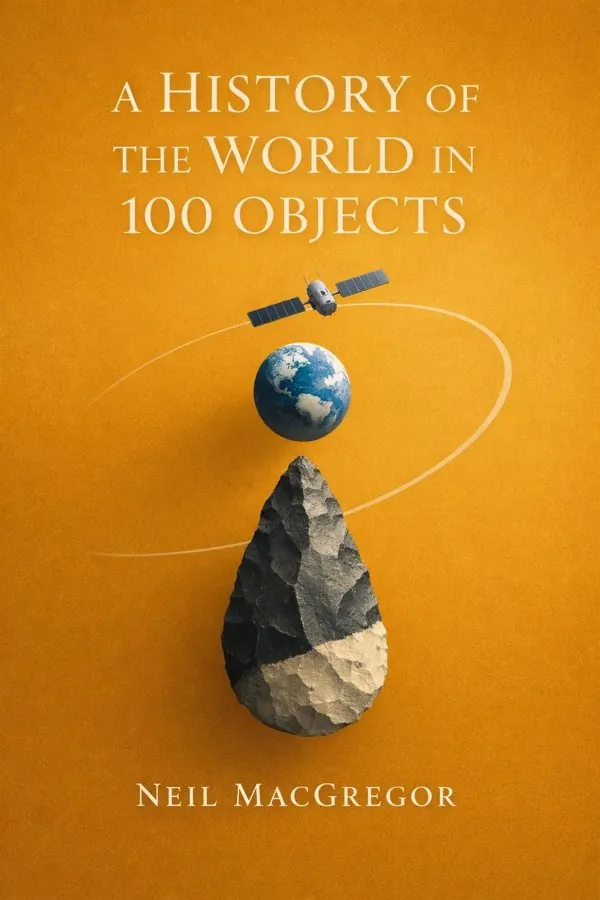
A History of the World in 100 Objects: Summary & Key Insights
 10 min12 chaptersAudio available
What Is A History of the World in 100 Objects About?
A History of the World in 100 Objects by Neil MacGregor is a world_history book spanning 12 pages. Based on the acclaimed BBC Radio 4 series, this book tells the story of humanity through one hundred objects from the British Museum’s collection. From the earliest tools made by humans to modern technological artifacts, Neil MacGregor explores how these objects reveal the shared experiences, beliefs, and innovations that have shaped our world.
This FizzRead summary covers all 12 key chapters of A History of the World in 100 Objects in approximately 10 minutes, distilling the most important ideas, arguments, and takeaways from Neil MacGregor's work. Also available as an audio summary and Key Quotes Podcast.
A History of the World in 100 Objects
Based on the acclaimed BBC Radio 4 series, this book tells the story of humanity through one hundred objects from the British Museum’s collection. From the earliest tools made by humans to modern technological artifacts, Neil MacGregor explores how these objects reveal the shared experiences, beliefs, and innovations that have shaped our world.
Who Should Read A History of the World in 100 Objects?
This book is perfect for anyone interested in world_history and looking to gain actionable insights in a short read. Whether you're a student, professional, or lifelong learner, the key ideas from A History of the World in 100 Objects by Neil MacGregor will help you think differently.
- ✓Readers who enjoy world_history and want practical takeaways
- ✓Professionals looking to apply new ideas to their work and life
- ✓Anyone who wants the core insights of A History of the World in 100 Objects in just 10 minutes
Want the full summary?
Get instant access to this book summary and 100K+ more with Fizz Moment.
Get Free SummaryAvailable on App Store • Free to download
Key Chapters
Our story begins not with written words, but with skillful hands chipping stone. The first object I chose for the radio series, and for the book, was a simple yet transformational tool: the Olduvai Gorge hand axe. It stands as a testament to humanity’s earliest triumph of imagination. Two million years ago, our ancestors looked at a lump of rock and saw potential—they could foresee its shape and function before striking a single blow. In that moment, our species crossed a threshold, proving we were capable not only of reacting to the world but of reshaping it.
What fascinates me about such early technology is how it speaks to universal human needs—shelter, nourishment, cooperation. Making tools required foresight and planning, but also teaching and communication. The hand axe therefore embodies the beginnings of culture itself. Other artifacts, such as bone needles or carved figurines, continue this tale of ingenuity. The Venus of Willendorf, for instance, carries the marks of symbolic thinking—a representation of fertility and survival that reveals how humans began to imagine meaning beyond immediate utility.
Each of these innovations tells us that progress rarely comes from solitary genius. Rather, it emerges through communities passing down knowledge, refining techniques, and adapting to new landscapes. The earliest human objects are not crude relics; they are evidence of shared intelligence, an early globalization born of movement and exchange among small groups caught within vast environments. In those primitive hands rested the beginnings of every art, science, and city that would follow.
The shift from wandering to settling was perhaps the greatest revolution in human history. This transformation is chronicled not in written decrees but in pottery shards, stone sickles, and storage jars. They reveal the moment when humans realized that the land could be persuaded to yield food predictably. Farming demanded continuity, discipline, and faith in cycles of time—all concepts that would later give birth to religion and governance.
Consider a humble clay bowl from ancient Mesopotamia: its utilitarian shape hides profound innovation. The bowl embodied surplus, the idea that food could be stored rather than immediately consumed. This concept required community cooperation and introduced notions of property and inheritance. The Neolithic villages that produced such containers mark humanity’s first experiments in domestic architecture—houses, granaries, and walls. These objects show how the rhythms of agriculture altered the human imagination, leading societies to conceive of permanence and belonging.
But agriculture was not universally liberating. It imposed new hierarchies and duties. Grinding stones and grain measures suggest labor, taxation, and the emergence of social inequality. When I reflect on these objects in the Museum, I see both the delight of abundance and the burden of order: pottery fragments that whisper stories of the first cities incubating their bureaucracies, and the prayers of farmers hoping for rain. Every seed cast into soil has a shadow—the birth of civilization was simultaneously the birth of constraint.
+ 10 more chapters — available in the FizzRead app
All Chapters in A History of the World in 100 Objects
About the Author
Neil MacGregor is a British art historian and museum director, best known for his tenure as Director of the British Museum from 2002 to 2015. He has been widely recognized for his work in making art and history accessible to the public through exhibitions, radio, and television.
Get This Summary in Your Preferred Format
Read or listen to the A History of the World in 100 Objects summary by Neil MacGregor anytime, anywhere. FizzRead offers multiple formats so you can learn on your terms — all free.
Available formats: App · Audio · PDF · EPUB — All included free with FizzRead
Download A History of the World in 100 Objects PDF and EPUB Summary
Key Quotes from A History of the World in 100 Objects
“Our story begins not with written words, but with skillful hands chipping stone.”
“The shift from wandering to settling was perhaps the greatest revolution in human history.”
Frequently Asked Questions about A History of the World in 100 Objects
A History of the World in 100 Objects by Neil MacGregor is a world_history book that explores key ideas across 12 chapters. Based on the acclaimed BBC Radio 4 series, this book tells the story of humanity through one hundred objects from the British Museum’s collection. From the earliest tools made by humans to modern technological artifacts, Neil MacGregor explores how these objects reveal the shared experiences, beliefs, and innovations that have shaped our world.
You Might Also Like
The Age of Capital
Eric Hobsbawm
10 min
The Gulag Archipelago
Aleksandr Solzhenitsyn
10 min
Jerusalem: The Biography
Simon Sebag Montefiore
10 min
The Anglo-Saxons
James Campbell
10 min
The Boer War
Thomas Pakenham
10 min
The Industrial Revolutionaries: The Making of the Modern World 1776–1914
Gavin Weightman
10 minFeatured In
Browse by Category
Ready to read A History of the World in 100 Objects?
Get the full summary and 100K+ more books with Fizz Moment.