
Flaubert’s Parrot: Summary & Key Insights
 10 min8 chaptersAudio available
Key Takeaways from Flaubert’s Parrot
Sometimes a minor mystery attracts us because it hides a major wound.
A life is never recovered whole; it is assembled from leftovers.
Writers often turn life into form, but living itself refuses neat composition.
A parrot repeats human speech, but repetition is not the same as understanding.
We often treat ambiguity as a problem to be solved, but Barnes suggests it may be a condition to be lived with.
What Is Flaubert’s Parrot About?
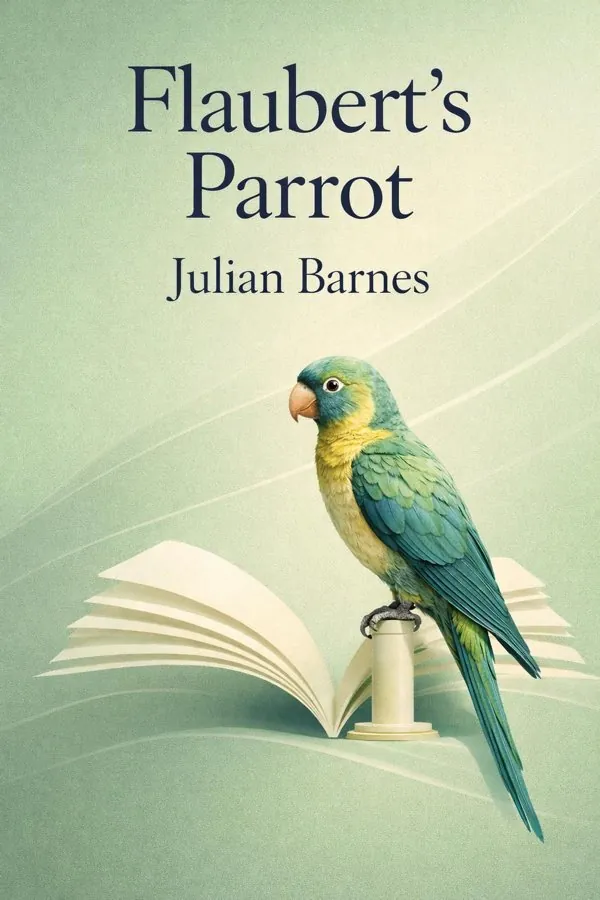
Flaubert’s Parrot by Julian Barnes is a classics book spanning 5 pages. Julian Barnes’s Flaubert’s Parrot is a rare kind of novel: playful and mournful, intellectually agile and deeply human. On the surface, it follows Geoffrey Braithwaite, a retired English doctor who becomes absorbed in the life of the French novelist Gustave Flaubert. His quest begins with a seemingly trivial mystery—which stuffed parrot inspired Flaubert while writing “A Simple Heart”?—but quickly expands into something much larger. As Braithwaite sifts through museums, letters, timelines, gossip, and literary history, he discovers that facts do not line up neatly, memory is unreliable, and biography can never fully capture a person. What makes the book matter is the way Barnes turns literary obsession into an inquiry about grief, truth, and interpretation. Braithwaite is not simply researching Flaubert; he is also trying to understand loss, disappointment, and the limits of knowledge in his own life. Barnes, one of contemporary Britain’s most celebrated novelists, brings extraordinary wit, formal inventiveness, and critical intelligence to the task. The result is a modern classic that asks why readers chase authors at all—and what that pursuit reveals about ourselves.
This FizzRead summary covers all 8 key chapters of Flaubert’s Parrot in approximately 10 minutes, distilling the most important ideas, arguments, and takeaways from Julian Barnes's work. Also available as an audio summary and Key Quotes Podcast.
Flaubert’s Parrot
Julian Barnes’s Flaubert’s Parrot is a rare kind of novel: playful and mournful, intellectually agile and deeply human. On the surface, it follows Geoffrey Braithwaite, a retired English doctor who becomes absorbed in the life of the French novelist Gustave Flaubert. His quest begins with a seemingly trivial mystery—which stuffed parrot inspired Flaubert while writing “A Simple Heart”?—but quickly expands into something much larger. As Braithwaite sifts through museums, letters, timelines, gossip, and literary history, he discovers that facts do not line up neatly, memory is unreliable, and biography can never fully capture a person.
What makes the book matter is the way Barnes turns literary obsession into an inquiry about grief, truth, and interpretation. Braithwaite is not simply researching Flaubert; he is also trying to understand loss, disappointment, and the limits of knowledge in his own life. Barnes, one of contemporary Britain’s most celebrated novelists, brings extraordinary wit, formal inventiveness, and critical intelligence to the task. The result is a modern classic that asks why readers chase authors at all—and what that pursuit reveals about ourselves.
Who Should Read Flaubert’s Parrot?
This book is perfect for anyone interested in classics and looking to gain actionable insights in a short read. Whether you're a student, professional, or lifelong learner, the key ideas from Flaubert’s Parrot by Julian Barnes will help you think differently.
- ✓Readers who enjoy classics and want practical takeaways
- ✓Professionals looking to apply new ideas to their work and life
- ✓Anyone who wants the core insights of Flaubert’s Parrot in just 10 minutes
Want the full summary?
Get instant access to this book summary and 100K+ more with Fizz Moment.
Get Free SummaryAvailable on App Store • Free to download
Key Chapters
Sometimes a minor mystery attracts us because it hides a major wound. That is how Geoffrey Braithwaite’s journey begins. He travels to Rouen, the city most closely associated with Gustave Flaubert, intending to investigate which stuffed parrot may have sat before the author while he wrote “A Simple Heart.” The question sounds quaint, even absurd. Yet Barnes uses it to show how obsession often grows from loneliness, grief, and the desire to impose order on a world that resists explanation.
Rouen is not just a setting; it becomes a landscape of competing versions. Museums preserve artifacts, guides repeat stories, and curators assign certainty to objects that may not deserve it. Braithwaite moves through these spaces as both tourist and detective, but also as a mourner looking for structure. The parrot mystery gives him a problem he can pursue, unlike the painful ambiguities of his own past.
This idea matters beyond literature. People often fixate on details after a loss: an old photograph, a final message, a remembered phrase. The detail becomes manageable in a way that sorrow is not. In research, work, and relationships, we do something similar when we focus on solvable puzzles instead of harder emotional truths.
Barnes’s brilliance is to make the search entertaining while gradually revealing its emotional stakes. The quest for the “real” parrot becomes a lesson in how we approach history: we want a single answer, but the evidence may only give us competing possibilities. The deeper story is not whether Braithwaite finds the right bird. It is why he needs the answer at all.
Actionable takeaway: Notice the small puzzles you become fixated on, and ask what larger uncertainty or emotion they might be helping you avoid.
A life is never recovered whole; it is assembled from leftovers. Braithwaite’s research into Flaubert unfolds as a collage of dates, quotations, letters, travel notes, anecdotes, and contradictions. Instead of presenting a smooth biographical narrative, Barnes gives us fragments. This form is essential to the novel’s argument: no matter how diligently we research, we do not gain a total person, only traces arranged into a pattern.
Braithwaite follows Flaubert through childhood, friendship, literary scandal, travel in Egypt, family ties, and romantic entanglements. He studies the writer’s correspondence with Louise Colet, his bond with George Sand, his disciplined devotion to style, and his distaste for bourgeois stupidity. But each fact opens further uncertainty. Which details matter most? Which are distorted by gossip, vanity, or hindsight? The biographer must choose, and every choice becomes interpretation.
This insight applies widely. Think of how we form opinions about public figures, relatives, or even ourselves. We rely on selected memories and available documents, then mistake our arrangement for complete truth. Social media intensifies this habit by offering fragments that look like full identities.
Barnes refuses simplification. He shows that knowledge often expands complexity rather than reducing it. To know more about Flaubert is not to pin him down but to discover how much remains unknowable. Braithwaite’s archive grows, but certainty does not.
The lesson is not that facts are useless. Facts matter deeply. But facts do not interpret themselves, and they do not automatically add up to wisdom. The shape of a life emerges through selection, emphasis, and the emotions of the observer.
Actionable takeaway: When forming a judgment about a person or event, separate the facts you know from the story you are constructing around them.
Writers often turn life into form, but living itself refuses neat composition. One of Barnes’s central tensions lies between artistic detachment and personal involvement. Flaubert famously championed impersonality in art. He wanted the author to be present everywhere in the work yet visible nowhere, and he pursued stylistic perfection with near-religious intensity. Braithwaite admires this discipline, but his own life reminds us that human beings do not experience pain from an aesthetic distance.
As the novel progresses, it becomes increasingly clear that Braithwaite’s study of Flaubert is intertwined with unresolved grief over his wife Ellen. Her illness, infidelity, and death hover behind his narration. He approaches Flaubert with the cool tools of scholarship—classification, quotation, chronology—but his motives are emotionally charged. He is not detached, and neither are we as readers.
This contrast illuminates a broader truth. Art can refine suffering into pattern, irony, or beauty. Real life arrives as confusion, contradiction, embarrassment, rage, and regret. Many people cope by intellectualizing pain: analyzing a breakup instead of grieving it, researching a diagnosis instead of sitting with fear, discussing emotions in theory while resisting them in practice. Braithwaite’s method is sophisticated, but it is also defensive.
Barnes does not condemn artistic distance. In fact, the novel honors the power of style, structure, and close reading. But it also suggests that literature cannot replace emotional reckoning. Interpretation may illuminate grief, yet it cannot abolish it.
This makes Flaubert’s Parrot especially moving. It is not simply a game about literary criticism; it is a portrait of a man using culture to survive sorrow, and slowly revealing the limits of that strategy.
Actionable takeaway: Use art and analysis to understand your feelings, but do not mistake understanding for fully experiencing or healing them.
A parrot repeats human speech, but repetition is not the same as understanding. That deceptively simple image sits at the center of the novel. The stuffed parrot Braithwaite seeks is an artifact, a relic, a museum object—but it is also a metaphor for reading, criticism, and biography. How much of what we say about authors is genuine understanding, and how much is elegant repetition?
Barnes uses the parrot to question imitation on several levels. Critics repeat established judgments. Biographers repeat anecdotes until they harden into “truth.” Readers quote favorite lines and imagine they have captured the author’s essence. Even Braithwaite, for all his intelligence, risks becoming a kind of parrot—echoing Flaubert’s letters, style, and worldview in an effort to feel close to him.
This idea has practical force today. In any field, it is easy to mimic expertise. People adopt the language of psychology, politics, leadership, or art without deeply examining what the words mean. Repetition can create the appearance of knowledge. Barnes warns that borrowed insight is not the same as earned understanding.
At the same time, the parrot is not a purely negative symbol. All reading begins with listening, receiving, and repeating. Apprenticeship often starts in imitation. The danger lies in stopping there. True engagement requires asking where a phrase came from, what context shaped it, and whether it still means what we think it means.
The parrot therefore becomes a challenge to readers: do not merely recite literary opinions; test them. Do not confuse proximity to culture with comprehension. A relic may inspire thought, but it cannot deliver certainty.
Actionable takeaway: Whenever you repeat a familiar idea, pause and ask yourself whether you truly understand it or are only reproducing someone else’s interpretation.
We often treat ambiguity as a problem to be solved, but Barnes suggests it may be a condition to be lived with. By the end of Braithwaite’s search, the mystery of the parrot remains unresolved in any satisfying final sense. Rather than offering a clean answer, the novel leaves us with alternatives, doubts, and overlapping versions. This is not narrative weakness. It is the point.
Braithwaite confronts the same uncertainty in his personal life. His memories of Ellen cannot be arranged into a simple verdict. Love, betrayal, pity, illness, resentment, and tenderness coexist. Just as Flaubert’s life resists definitive biography, Ellen resists definitive moral judgment. Human experience is messy, and closure is often an aesthetic fantasy rather than an emotional reality.
This insight is useful far beyond the novel. Many decisions in life happen without complete information: choosing a career, evaluating a relationship, remembering a family conflict, or trying to understand why something ended badly. We long for final explanations because they promise relief. Yet oversimplified certainty can be more damaging than honest incompleteness.
Barnes models another approach: disciplined ambiguity. Facts still matter. Thought still matters. But maturity includes accepting what cannot be fully known. Such acceptance is not passivity. It is a way of continuing without the false comfort of total resolution.
The novel’s emotional power comes from this refusal to tidy experience. Braithwaite does not “solve” grief by solving the parrot mystery. He merely learns, and teaches us, that meaning can survive even when certainty does not.
Actionable takeaway: When you reach an unresolved question in your life, try asking not only “How do I solve this?” but also “How do I live wisely with what I cannot settle?”
Every biography contains two subjects: the person being studied and the person doing the studying. Flaubert’s Parrot makes this visible with unusual honesty. Braithwaite appears to be writing, cataloging, and investigating Flaubert, but gradually we understand that his choices—what he notices, what he emphasizes, what irritates him, what he defends—tell us just as much about him.
He is drawn to Flaubert’s skepticism, his disdain for cliché, and his fierce commitment to artistic exactness. These preferences are not neutral. They reflect Braithwaite’s own sensibility, disappointments, and defenses. His scholarly procedures become a form of self-portraiture. The more he explains Flaubert, the more he exposes his own loneliness, pride, bitterness, and need for control.
This is a profound insight about all acts of interpretation. Teachers reveal themselves in what they assign. Managers reveal themselves in what they praise. Friends reveal themselves in the stories they repeatedly tell about others. Even when we think we are being objective, our values and wounds shape attention.
Barnes does not claim that objectivity is impossible in a trivial sense. Rather, he shows that objectivity is never free from perspective. Our interpretations can be careful, informed, and disciplined, but they are still ours. Recognizing this does not destroy criticism; it improves it by adding humility.
For readers, this means asking a second-order question whenever someone offers a strong interpretation: what does this reading reveal about the interpreter? In Braithwaite’s case, the answer is heartbreaking. His Flaubert obsession is not just admiration. It is a way of speaking indirectly about himself.
Actionable takeaway: The next time you analyze a person, book, or event, ask what your interpretation says about your own values, fears, and desires.
Barnes’s novel insists that style is not decoration; it is a way of thinking truthfully. Flaubert appears throughout the book as a writer obsessed with le mot juste, the exact word. His pursuit of precision can seem excessive, even comic, but Barnes treats it as a serious moral commitment. Sloppy language encourages sloppy thought. Cliché deadens perception. Precision is a form of respect—for reality, for readers, and for feeling.
This matters because Flaubert’s Parrot is full of competing stories, partial evidence, and emotional evasions. In such a world, language becomes one of the few tools available for honesty. Braithwaite may not be able to know everything, but he can try to say what he knows with care. Barnes’s own formal inventiveness—lists, mock examinations, biographical fragments, chronology games—demonstrates that style can expose complexity rather than conceal it.
In everyday life, the principle holds. Vague speech often protects us from confronting difficult truths: “things happened,” “it got complicated,” “we grew apart.” More exact language can be uncomfortable, but it clarifies responsibility and emotion. In professional contexts, precision also improves judgment, whether in medicine, law, management, or education.
The novel does not pretend that exact words will eliminate ambiguity. They will not. But careful language narrows distortion and forces us to look harder. Flaubert’s artistic rigor becomes, in Barnes’s hands, a model of intellectual seriousness.
To read this book well is to feel challenged not just to think more clearly about literature, but to speak more carefully in one’s own life. Style is not vanity here. It is ethics in miniature.
Actionable takeaway: Replace one habitual vague phrase in your speech or writing this week with a more exact description, and notice how precision changes your thinking.
Books do not save us in a magical way, but they often give shape to endurance. Beneath its wit and formal play, Flaubert’s Parrot is a novel about reading as a survival strategy. Braithwaite turns to Flaubert not merely out of scholarly enthusiasm, but because literature offers him companionship, structure, and a language for feelings he cannot directly confess.
His attachment to Flaubert demonstrates how reading can become intensely personal. We often seek authors who appear to articulate our own hidden moods: anger at stupidity, distrust of sentimentality, fascination with disappointment, or reverence for craft. Such reading can be restorative because it breaks isolation. Someone else, far away in time, seems to have known what we know.
Yet Barnes is too subtle to offer a sentimental celebration of literary consolation. Reading helps Braithwaite, but it also enables avoidance. He can quote Flaubert more easily than discuss Ellen. He can investigate nineteenth-century letters more comfortably than revisit his own marriage. Literature is both refuge and screen.
This duality makes the novel especially valuable for serious readers. It honors the deep importance of books while warning against using culture as emotional camouflage. The healthiest relation to reading is not escape alone, nor self-display, but dialogue. A book should enlarge our capacity to face life, not only postpone it.
In practical terms, many people already read this way without naming it. They return to certain novels after bereavement, heartbreak, retirement, or disillusionment because those works provide form when life feels shapeless. Braithwaite’s example invites us to do so consciously.
Actionable takeaway: Choose one book you return to in difficult times, and write down not just what it says, but what need in you it seems to answer.
All Chapters in Flaubert’s Parrot
About the Author
Julian Barnes is a British novelist, essayist, and short story writer celebrated for his precision, wit, and philosophical depth. Born in Leicester in 1946 and educated in London and Oxford, he began his literary career as a critic and journalist before gaining recognition as a novelist. His breakthrough works include Metroland and Flaubert’s Parrot, both of which established his reputation for blending formal innovation with emotional intelligence. Barnes’s writing often examines memory, love, mortality, art, and the instability of truth. Later works such as Arthur & George, Nothing to Be Frightened Of, and The Sense of an Ending further confirmed his status as one of Britain’s most distinguished contemporary authors. In 2011, he won the Man Booker Prize for The Sense of an Ending.
Get This Summary in Your Preferred Format
Read or listen to the Flaubert’s Parrot summary by Julian Barnes anytime, anywhere. FizzRead offers multiple formats so you can learn on your terms — all free.
Available formats: App · Audio · PDF · EPUB — All included free with FizzRead
Download Flaubert’s Parrot PDF and EPUB Summary
Key Quotes from Flaubert’s Parrot
“Sometimes a minor mystery attracts us because it hides a major wound.”
“A life is never recovered whole; it is assembled from leftovers.”
“Writers often turn life into form, but living itself refuses neat composition.”
“A parrot repeats human speech, but repetition is not the same as understanding.”
“We often treat ambiguity as a problem to be solved, but Barnes suggests it may be a condition to be lived with.”
Frequently Asked Questions about Flaubert’s Parrot
Flaubert’s Parrot by Julian Barnes is a classics book that explores key ideas across 8 chapters. Julian Barnes’s Flaubert’s Parrot is a rare kind of novel: playful and mournful, intellectually agile and deeply human. On the surface, it follows Geoffrey Braithwaite, a retired English doctor who becomes absorbed in the life of the French novelist Gustave Flaubert. His quest begins with a seemingly trivial mystery—which stuffed parrot inspired Flaubert while writing “A Simple Heart”?—but quickly expands into something much larger. As Braithwaite sifts through museums, letters, timelines, gossip, and literary history, he discovers that facts do not line up neatly, memory is unreliable, and biography can never fully capture a person. What makes the book matter is the way Barnes turns literary obsession into an inquiry about grief, truth, and interpretation. Braithwaite is not simply researching Flaubert; he is also trying to understand loss, disappointment, and the limits of knowledge in his own life. Barnes, one of contemporary Britain’s most celebrated novelists, brings extraordinary wit, formal inventiveness, and critical intelligence to the task. The result is a modern classic that asks why readers chase authors at all—and what that pursuit reveals about ourselves.
More by Julian Barnes


You Might Also Like





Browse by Category
Ready to read Flaubert’s Parrot?
Get the full summary and 100K+ more books with Fizz Moment.