
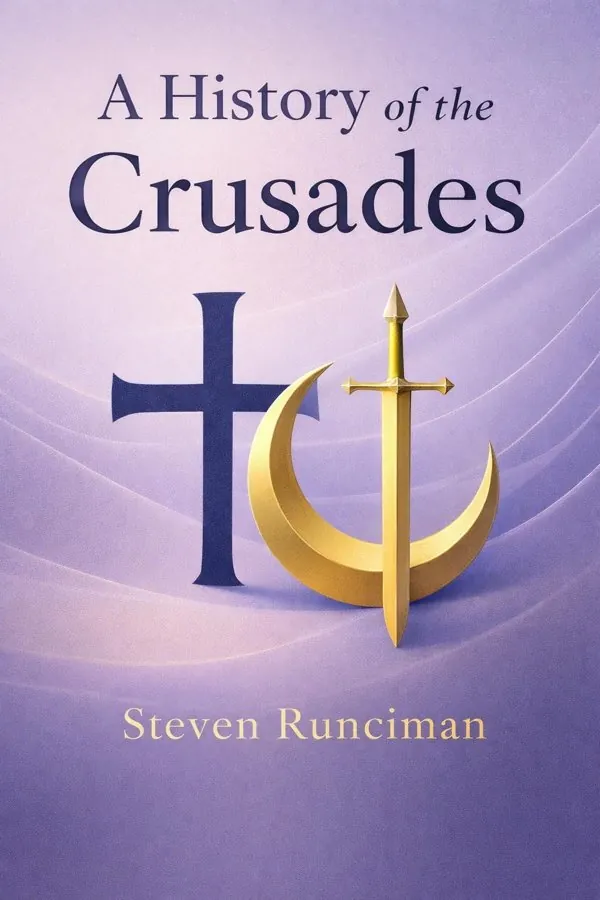
A History of the Crusades: Summary & Key Insights
 10 min9 chaptersAudio available
What Is A History of the Crusades About?
A History of the Crusades by Steven Runciman is a world_history book spanning 9 pages. Sir Steven Runciman’s monumental three-volume work, first published between 1951 and 1954, offers a sweeping narrative of the Crusades from the late 11th to the 13th century. Written in elegant prose, it combines rigorous scholarship with literary grace, tracing the complex interplay of religion, politics, and culture that shaped medieval Christendom and the Islamic world. The trilogy remains one of the most influential and readable accounts of the Crusading era.
This FizzRead summary covers all 9 key chapters of A History of the Crusades in approximately 10 minutes, distilling the most important ideas, arguments, and takeaways from Steven Runciman's work. Also available as an audio summary and Key Quotes Podcast.
A History of the Crusades
Sir Steven Runciman’s monumental three-volume work, first published between 1951 and 1954, offers a sweeping narrative of the Crusades from the late 11th to the 13th century. Written in elegant prose, it combines rigorous scholarship with literary grace, tracing the complex interplay of religion, politics, and culture that shaped medieval Christendom and the Islamic world. The trilogy remains one of the most influential and readable accounts of the Crusading era.
Who Should Read A History of the Crusades?
This book is perfect for anyone interested in world_history and looking to gain actionable insights in a short read. Whether you're a student, professional, or lifelong learner, the key ideas from A History of the Crusades by Steven Runciman will help you think differently.
- ✓Readers who enjoy world_history and want practical takeaways
- ✓Professionals looking to apply new ideas to their work and life
- ✓Anyone who wants the core insights of A History of the Crusades in just 10 minutes
Want the full summary?
Get instant access to this book summary and 100K+ more with Fizz Moment.
Get Free SummaryAvailable on App Store • Free to download
Key Chapters
The beginning of the Crusading era was marked by a tremendous surge of popular faith and political opportunity. When Pope Urban II issued his call at Clermont, he promised remission of sins for those who would venture forth to liberate Jerusalem. This message appealed not only to knights eager for divine sanction but also to peasants, monks, and outcasts seeking a sense of destiny. Runciman portrays the First Crusade as a paradoxical triumph—a spiritual enterprise that accomplished its immediate aim but sowed seeds of future discord.
Amidst chaotic enthusiasm, ragged bands of pilgrims embarked on their march eastward. The so-called People’s Crusade, led by Peter the Hermit, perished disastrously in Anatolia, a tragic foreshadowing of how zeal without discipline leads to ruin. Yet the barons’ armies, commanded by princes such as Bohemond of Taranto, Godfrey of Bouillon, and Raymond of Toulouse, advanced methodically, facing grueling deprivation and complex alliances. Byzantine Emperor Alexios I, more calculating than pious, sought to use these Western crusaders to reclaim his own lost territories. Runciman paints Byzantium not as an ally but as a misunderstood partner—a civilization both sophisticated and wary of Latin barbarity.
The march through Anatolia to Antioch and ultimately Jerusalem was a tale of both courage and cruelty. Each city besieged—Nicaea, Antioch—became a stage for distrust among the crusaders, who quarreled over spoils even as they professed divine purpose. The horrors inflicted at Antioch, the treachery within, and the starvation endured all led to a grim purification of their army. And yet, against all odds, the crusaders reached Jerusalem in 1099. The city fell after fierce fighting, and what followed remains one of history’s darkest moments—the indiscriminate massacre of its inhabitants. In Runciman’s telling, the capture of Jerusalem was a victory steeped in sin, a crime against the very faith it claimed to serve. The First Crusade, glorious in legend, thus introduced the tragic contradiction that would haunt every expedition thereafter: the corruption of sanctity by violence.
In the aftermath of conquest, the crusaders attempted to carve permanence out of fleeting triumph. The establishment of the Latin Kingdom of Jerusalem brought a strange hybrid polity into being—a Frankish aristocracy ruling over a largely Eastern populace, surrounded by Byzantine, Muslim, and Armenian neighbors. Runciman describes this realm as fragile and artificial, a Western enclave in an Eastern world. Though outwardly Christian, it was sustained as much by diplomacy as by devotion.
Godfrey of Bouillon, refusing to wear a crown in the city of Christ, symbolized the Crusaders’ initial purity of purpose. But his successors were less restrained. Baldwin I, Baldwin II, and later kings turned Jerusalem into a court of knights and clerics, erecting cathedrals where mosques had stood and dividing the land into feudal lordships. The new rulers relied heavily on reconciliation with local Christians and occasional accommodations with Muslim emirs. The military orders—the Templars and Hospitallers—emerged during this period as disciplined embodiments of crusading sanctity. They were both warriors and monks, bound by vows of chastity and obedience yet wielding formidable temporal power.
The kingdom prospered for a time, not through conquest but through commerce and cultural exchange. Runciman highlights how Frankish settlers adopted Eastern customs, clothing, and foods; how intermarriage and trade blurred religious boundaries. But beneath this uneasy coexistence lay tension and arrogance. The Crusader states depended on constant reinforcement from Europe and were surrounded by peoples they neither understood nor respected. This failure of empathy, more than military weakness, was their undoing. To Runciman, the Latin Kingdom represented the West’s encounter with the East—a moment of great possibility extinguished by intolerance and the brittle pride of faith that refused to see humanity in the other.
+ 7 more chapters — available in the FizzRead app
All Chapters in A History of the Crusades
About the Author
Sir Steven Runciman (1903–2000) was a British historian and scholar of Byzantine studies. Educated at Eton and Trinity College, Cambridge, he became one of the foremost interpreters of the medieval Eastern Mediterranean world. His works, including 'A History of the Crusades' and 'The Fall of Constantinople 1453', are celebrated for their narrative style and deep understanding of Byzantine and Islamic civilizations.
Get This Summary in Your Preferred Format
Read or listen to the A History of the Crusades summary by Steven Runciman anytime, anywhere. FizzRead offers multiple formats so you can learn on your terms — all free.
Available formats: App · Audio · PDF · EPUB — All included free with FizzRead
Download A History of the Crusades PDF and EPUB Summary
Key Quotes from A History of the Crusades
“The beginning of the Crusading era was marked by a tremendous surge of popular faith and political opportunity.”
“In the aftermath of conquest, the crusaders attempted to carve permanence out of fleeting triumph.”
Frequently Asked Questions about A History of the Crusades
A History of the Crusades by Steven Runciman is a world_history book that explores key ideas across 9 chapters. Sir Steven Runciman’s monumental three-volume work, first published between 1951 and 1954, offers a sweeping narrative of the Crusades from the late 11th to the 13th century. Written in elegant prose, it combines rigorous scholarship with literary grace, tracing the complex interplay of religion, politics, and culture that shaped medieval Christendom and the Islamic world. The trilogy remains one of the most influential and readable accounts of the Crusading era.
You Might Also Like
The Age of Capital
Eric Hobsbawm
10 min
The Gulag Archipelago
Aleksandr Solzhenitsyn
10 min
Jerusalem: The Biography
Simon Sebag Montefiore
10 min
The Anglo-Saxons
James Campbell
10 min
The Boer War
Thomas Pakenham
10 min
The Industrial Revolutionaries: The Making of the Modern World 1776–1914
Gavin Weightman
10 minFeatured In
Browse by Category
Ready to read A History of the Crusades?
Get the full summary and 100K+ more books with Fizz Moment.