
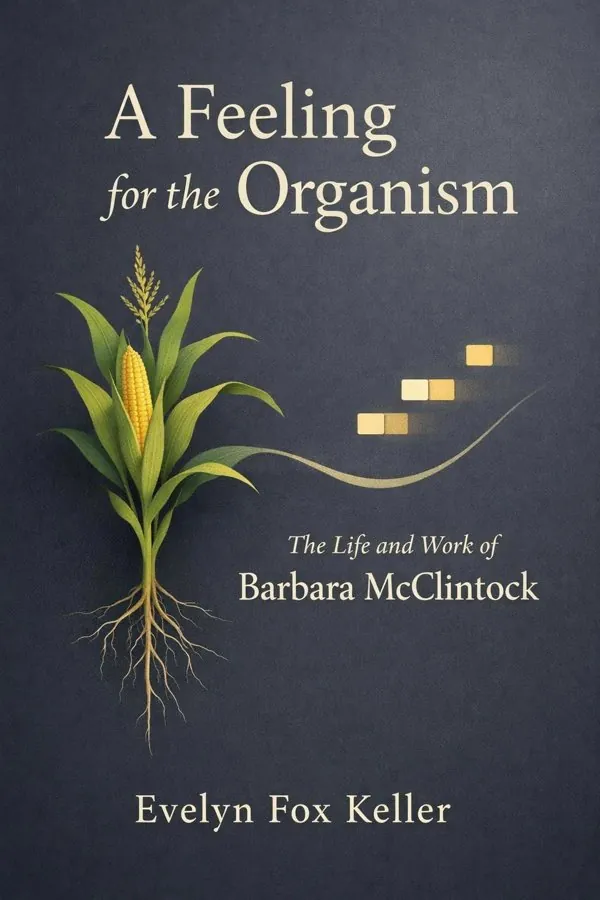
A Feeling for the Organism: The Life and Work of Barbara McClintock: Summary & Key Insights
 10 min9 chaptersAudio available
Key Takeaways from A Feeling for the Organism: The Life and Work of Barbara McClintock
Great scientific originality often begins as a personality before it becomes a method.
Raw curiosity matters, but without technique it rarely changes a field.
Discovery often begins when someone learns to read motion where others see static structure.
Not all isolation is a setback; sometimes it is the price of intellectual freedom.
The most revolutionary discoveries often begin as attempts to explain stubborn exceptions.
What Is A Feeling for the Organism: The Life and Work of Barbara McClintock About?
A Feeling for the Organism: The Life and Work of Barbara McClintock by Evelyn Fox Keller is a biographies book spanning 11 pages. A Feeling for the Organism is far more than a scientific biography. In this elegant and influential book, Evelyn Fox Keller reconstructs the life of Barbara McClintock, the brilliant geneticist whose work on maize chromosomes led to the discovery of transposable elements, later known as “jumping genes.” But Keller’s deeper purpose is to show how McClintock thought: with extraordinary patience, intimacy, and responsiveness to the living systems she studied. Rather than portraying science as cold detachment, the book presents discovery as a disciplined form of attention shaped by empathy, intuition, and long immersion in complexity. The book matters because it reframes both scientific creativity and scientific history. McClintock’s breakthroughs were initially misunderstood, then celebrated decades later with a Nobel Prize, making her story a powerful case study in how transformative ideas can arrive before a field is ready to receive them. Keller brings unusual authority to this task as a physicist, historian of science, and leading feminist thinker who examined how language, gender, and culture shape knowledge. The result is a biography that illuminates one scientist’s life while challenging readers to rethink what genuine understanding looks like.
This FizzRead summary covers all 9 key chapters of A Feeling for the Organism: The Life and Work of Barbara McClintock in approximately 10 minutes, distilling the most important ideas, arguments, and takeaways from Evelyn Fox Keller's work. Also available as an audio summary and Key Quotes Podcast.
A Feeling for the Organism: The Life and Work of Barbara McClintock
A Feeling for the Organism is far more than a scientific biography. In this elegant and influential book, Evelyn Fox Keller reconstructs the life of Barbara McClintock, the brilliant geneticist whose work on maize chromosomes led to the discovery of transposable elements, later known as “jumping genes.” But Keller’s deeper purpose is to show how McClintock thought: with extraordinary patience, intimacy, and responsiveness to the living systems she studied. Rather than portraying science as cold detachment, the book presents discovery as a disciplined form of attention shaped by empathy, intuition, and long immersion in complexity.
The book matters because it reframes both scientific creativity and scientific history. McClintock’s breakthroughs were initially misunderstood, then celebrated decades later with a Nobel Prize, making her story a powerful case study in how transformative ideas can arrive before a field is ready to receive them. Keller brings unusual authority to this task as a physicist, historian of science, and leading feminist thinker who examined how language, gender, and culture shape knowledge. The result is a biography that illuminates one scientist’s life while challenging readers to rethink what genuine understanding looks like.
Who Should Read A Feeling for the Organism: The Life and Work of Barbara McClintock?
This book is perfect for anyone interested in biographies and looking to gain actionable insights in a short read. Whether you're a student, professional, or lifelong learner, the key ideas from A Feeling for the Organism: The Life and Work of Barbara McClintock by Evelyn Fox Keller will help you think differently.
- ✓Readers who enjoy biographies and want practical takeaways
- ✓Professionals looking to apply new ideas to their work and life
- ✓Anyone who wants the core insights of A Feeling for the Organism: The Life and Work of Barbara McClintock in just 10 minutes
Want the full summary?
Get instant access to this book summary and 100K+ more with Fizz Moment.
Get Free SummaryAvailable on App Store • Free to download
Key Chapters
Great scientific originality often begins as a personality before it becomes a method. Barbara McClintock’s early life reveals a child marked by restlessness, self-possession, and a willingness to think apart from the crowd. Born in 1902, she grew up in a family that did not consistently encourage intellectual ambition in a daughter, yet she developed a fierce inner confidence that later defined her work. Keller shows that McClintock’s independence was not merely rebelliousness. It was the capacity to trust her own perceptions even when external approval was absent.
That trait mattered because scientific research is full of uncertainty. A person who relies too heavily on consensus may never pursue an unconventional question long enough to discover anything new. McClintock’s ability to stand alone helped her persist through skepticism, professional isolation, and periods when her findings were ignored. Her early character formed the emotional infrastructure for her later discoveries.
This insight applies far beyond science. In creative work, entrepreneurship, or scholarship, people often face environments that reward conformity before originality. The lesson is not to reject all feedback, but to cultivate a stable inner standard strong enough to sustain difficult work. McClintock’s childhood suggests that independence becomes most valuable when paired with discipline and curiosity.
A practical example is how students or professionals can protect time for their own observations before checking what others think. Instead of rushing to compare every idea with established opinion, first ask what the evidence actually suggests. McClintock did this instinctively.
Actionable takeaway: Build a habit of intellectual self-trust by recording your own observations and interpretations before seeking outside validation.
Raw curiosity matters, but without technique it rarely changes a field. McClintock’s scientific beginnings at Cornell came at a moment when cytogenetics was emerging as a powerful way to connect visible chromosome behavior with inherited traits. Keller shows how McClintock quickly distinguished herself not because she simply worked hard, but because she developed unusual technical mastery. She learned how to prepare maize chromosomes so clearly that she could track structural changes with a precision few others could match.
This combination of patience and craftsmanship is central to the book’s portrait of scientific excellence. McClintock was not a romantic genius floating above detail. Her intuitive insights were grounded in repeated observation, painstaking comparison, and deep familiarity with her organism. Keller emphasizes that originality often appears mysterious only because outsiders do not see the years of immersion underneath it.
There is a practical lesson here for any complex field. We often celebrate ideas while overlooking the disciplined routines that make insight possible. Whether in data analysis, design, medicine, or writing, people notice the breakthrough but not the long apprenticeship. McClintock’s career shows that method and imagination reinforce each other: better tools allow subtler questions, and subtler questions demand better tools.
A modern analogy would be a researcher who spends years understanding a dataset so thoroughly that patterns become visible before formal modeling confirms them. Expertise changes perception itself. McClintock could see what others missed because she had trained herself to notice.
Actionable takeaway: Treat technical skill as a path to deeper insight, and invest in mastering the basic tools of your field until careful observation becomes second nature.
Discovery often begins when someone learns to read motion where others see static structure. One of McClintock’s major early achievements was revealing how chromosomes behave during cell division and how that behavior explains inheritance. Keller presents these studies as more than narrow technical advances. They demonstrated McClintock’s gift for linking visible cellular events with abstract genetic consequences, turning chromosomes into dynamic participants rather than inert carriers.
Her work helped establish key relationships between chromosome breakage, crossing over, and genetic change. By correlating microscopic observation with inherited traits in maize, she made the case that chromosome structure and behavior could explain genetic phenomena with remarkable clarity. This mattered because genetics in the early twentieth century was still becoming a coherent science. McClintock contributed evidence that tied theory to physically observable processes.
The broader significance is methodological. She did not force data into preconceived categories. Instead, she watched carefully enough to let patterns emerge from the organism’s own behavior. This orientation is useful in any investigative setting. In organizations, for example, people often impose explanations too quickly: a declining metric must be a marketing problem, a team conflict must be interpersonal. McClintock’s example suggests first tracing how the system actually behaves over time.
Practical application means learning to connect visible indicators with hidden mechanisms. If a manager notices recurring delays, the goal is not merely to label them but to understand the process dynamics producing them. McClintock excelled at that kind of disciplined inference.
Actionable takeaway: Before reaching for a theory, spend more time observing how a system behaves and ask what recurring patterns reveal about the underlying mechanism.
Not all isolation is a setback; sometimes it is the price of intellectual freedom. McClintock’s career included long stretches of professional marginality. As a woman in a male-dominated scientific world and as a researcher pursuing questions others did not fully understand, she often worked at a distance from the center of institutional power. Keller does not romanticize this isolation, but she shows that it also protected McClintock from the pressure to produce fashionable results.
This independence allowed her to stay loyal to the evidence as she saw it. Because she was less invested in pleasing a dominant school, she could follow anomalies others ignored. Yet the book also makes clear that such independence came at a cost: reduced recognition, fewer secure positions early on, and the burden of carrying insights without a ready audience. Solitude helped preserve her originality, but it also contributed to the delayed reception of her work.
The idea resonates today in workplaces that value visibility, speed, and consensus. Innovation often requires periods of withdrawal from constant commentary. People can become so embedded in expectations that they stop noticing what does not fit. McClintock’s example suggests that strategic distance can be productive when it creates room for deep attention.
A practical example is setting aside uninterrupted time to think through difficult problems without immediately converting them into presentations or social updates. In research, writing, and product development, premature exposure can flatten ideas before they mature. The point is not permanent isolation but protected incubation.
Actionable takeaway: Create deliberate spaces of solitude in your work so you can pursue difficult observations long enough to develop ideas that are not yet socially legible.
The most revolutionary discoveries often begin as attempts to explain stubborn exceptions. McClintock’s maize experiments led her to investigate chromosome breakage and unusual patterns of pigmentation in corn kernels. From these observations she identified controlling elements—genetic sequences capable of changing position and influencing the activity of nearby genes. At a time when genes were largely imagined as fixed units arranged in stable order, this insight was startling. Keller carefully explains that McClintock was not chasing novelty for its own sake. She was following the evidence wherever it led.
Her discovery of transposable elements transformed genetics, even though the field took decades to absorb its significance. The genome was no longer just a static archive but an active, responsive system. This was a profound conceptual shift. It implied that genetic regulation could be dynamic, context-dependent, and structurally fluid. Later developments in molecular biology would confirm and extend this view, but McClintock saw it first through meticulous work with maize.
The practical lesson is that anomalies deserve respect. In business, medicine, or policy, organizations often treat outliers as noise to be cleaned away. Yet unusual cases may reveal the real structure of a system more clearly than average cases do. McClintock’s kernels with unexpected color patterns were not distractions. They were clues.
A useful application is to review edge cases in any project: customer complaints, atypical failures, rare exceptions. Instead of dismissing them, ask whether they expose hidden rules or interactions the main model misses.
Actionable takeaway: Pay special attention to anomalies, because what looks like an exception may contain the seed of a new understanding.
The book’s most famous phrase expresses a radical idea: deep knowledge is not achieved only by distance, but also by intimacy. Keller uses “a feeling for the organism” to describe McClintock’s distinctive way of working. She immersed herself so completely in maize that she developed a responsive, almost conversational relation to the material. This was not mysticism or anti-science. It was disciplined attentiveness carried to an unusual depth, where repeated observation, empathy, and imagination allowed the organism’s own logic to become legible.
Keller contrasts this mode with a more aggressively reductionist style that seeks control by breaking systems into isolated parts. McClintock certainly used analysis, but she never lost sight of the organism as an integrated whole. She believed that understanding emerged from entering the pattern of relations within a living system, not merely extracting fragments from it. Her approach anticipated later systems thinking and challenged simplistic notions of objectivity.
This concept has broad applications. In leadership, teaching, therapy, design, and even parenting, people often misread situations because they focus on categories instead of relationships. To have a “feeling” for a team, classroom, or patient is not to abandon rigor. It is to develop enough attentive familiarity that patterns become meaningful in context.
Practically, this may mean spending more time observing real users before redesigning a product, or listening longer before solving a conflict. McClintock’s style reminds us that respectful attention can itself be a method of inquiry.
Actionable takeaway: When trying to understand a complex system, move beyond detached analysis and spend enough time with the whole situation that its internal relationships become visible.
Truth alone does not guarantee recognition; a community must also be ready to hear it. One of the most compelling themes in Keller’s biography is the scientific resistance McClintock faced when presenting her findings on controlling elements. Her results were difficult, conceptually unfamiliar, and expressed in a language shaped by years of close work with maize rather than by the dominant molecular framework that later emerged. Many peers did not know what to do with what she was saying.
Keller’s analysis is subtle. McClintock was not simply a victim of ignorance, though she was certainly underestimated. Part of the problem was epistemic timing: her discoveries exceeded the conceptual equipment available to many listeners. Scientific communities rely on shared assumptions and accepted models; when evidence challenges those too deeply, it may be ignored even if it is sound. McClintock gradually stopped trying to persuade those who could not follow her, turning instead toward work that interested her intrinsically.
This has relevance in any field where institutions reward what is easily measurable or already familiar. Novel ideas often fail first because they cannot yet be translated into existing categories. Innovators need both conviction and strategic communication. Audiences, meanwhile, need humility about the limits of current frameworks.
A practical application is to ask, when a proposal seems confusing, whether the problem lies in the idea, the explanation, or the receiving culture. Sometimes a concept needs reframing; sometimes an organization must evolve before it can understand.
Actionable takeaway: When encountering an unfamiliar idea, resist dismissing it too quickly and ask whether your current framework is broad enough to evaluate it fairly.
Every method carries an image of what knowledge is. Keller uses McClintock’s career to explore larger philosophical questions about objectivity, explanation, and the role of the observer in science. McClintock challenged the assumption that detachment is the only path to valid knowledge. Her work suggested that involvement, care, and interpretive sensitivity can sharpen rather than distort perception. In this sense, the book is not only about genetics but about competing visions of science itself.
Keller argues that scientific understanding depends on language, metaphor, and style of attention as much as on data alone. The metaphors scientists choose—code, control, program, mechanism—shape what they notice and what they overlook. McClintock’s descriptions of genomes as responsive systems opened possibilities that a rigidly mechanical vocabulary obscured. This philosophical layer gives the book its enduring importance: it invites readers to examine how assumptions about life guide inquiry.
In practical terms, this matters whenever people mistake their models for reality. Analysts, consultants, and policymakers often work with abstractions that simplify a problem enough to make it manageable. But simplification can also erase essential features. McClintock reminds us to revisit the living complexity beneath the model.
A useful application is to audit the language used in your field. Are the metaphors helping you see or trapping you in a narrow frame? For example, calling employees “resources” may encourage efficiency but obscure motivation, dignity, and creativity.
Actionable takeaway: Examine the assumptions and metaphors behind your methods, because the way you frame a problem shapes the kind of answers you can find.
History often rewards persistence long after the lonely work is done. Decades after McClintock first proposed transposable elements, molecular biology caught up with her observations. As evidence accumulated across species, the scientific world finally recognized the significance of her discoveries, culminating in the 1983 Nobel Prize in Physiology or Medicine. Keller presents this not as a neat triumphal ending, but as a lesson in how science actually progresses: unevenly, socially, and with frequent delays between discovery and acceptance.
The rediscovery of McClintock’s insights reoriented biology. Genes could no longer be seen simply as fixed beads on a string. Regulation, mobility, and genomic rearrangement became central themes. Her work anticipated later understandings of gene expression, genome plasticity, and the dynamic architecture of hereditary systems. Recognition validated her findings, but more importantly, it confirmed the power of her approach.
Keller also links this late recognition to questions of gender and authority. McClintock’s achievements were easier to honor once the field had independent ways to verify them. This pattern is familiar in many domains: unconventional contributors are often celebrated only after institutions can absorb their ideas without changing their own self-image too abruptly.
For readers today, the practical lesson is to separate meaningful work from immediate applause. External recognition can be delayed for reasons that have little to do with quality. That does not eliminate the need for communication and community, but it does caution against equating visibility with value.
Actionable takeaway: Judge important work by the depth of its contribution, not by how quickly it is recognized, and keep building patiently when the evidence supports your direction.
All Chapters in A Feeling for the Organism: The Life and Work of Barbara McClintock
About the Author
Evelyn Fox Keller (1936–2023) was an American physicist, historian, and philosopher of science whose work reshaped conversations about biology, gender, and scientific knowledge. Trained initially in theoretical physics, she later turned to the history and philosophy of science, where she became a major voice in feminist science studies. Keller was especially interested in how metaphors, language, and cultural assumptions influence scientific thought. She taught at leading institutions, including MIT, and wrote widely on genetics, development, objectivity, and the social dimensions of science. Her biography of Barbara McClintock became one of her best-known works because it combined scientific sophistication with literary grace and philosophical depth. Keller’s writing remains influential for readers seeking a richer, more humane understanding of how science works.
Get This Summary in Your Preferred Format
Read or listen to the A Feeling for the Organism: The Life and Work of Barbara McClintock summary by Evelyn Fox Keller anytime, anywhere. FizzRead offers multiple formats so you can learn on your terms — all free.
Available formats: App · Audio · PDF · EPUB — All included free with FizzRead
Download A Feeling for the Organism: The Life and Work of Barbara McClintock PDF and EPUB Summary
Key Quotes from A Feeling for the Organism: The Life and Work of Barbara McClintock
“Great scientific originality often begins as a personality before it becomes a method.”
“Raw curiosity matters, but without technique it rarely changes a field.”
“Discovery often begins when someone learns to read motion where others see static structure.”
“Not all isolation is a setback; sometimes it is the price of intellectual freedom.”
“The most revolutionary discoveries often begin as attempts to explain stubborn exceptions.”
Frequently Asked Questions about A Feeling for the Organism: The Life and Work of Barbara McClintock
A Feeling for the Organism: The Life and Work of Barbara McClintock by Evelyn Fox Keller is a biographies book that explores key ideas across 9 chapters. A Feeling for the Organism is far more than a scientific biography. In this elegant and influential book, Evelyn Fox Keller reconstructs the life of Barbara McClintock, the brilliant geneticist whose work on maize chromosomes led to the discovery of transposable elements, later known as “jumping genes.” But Keller’s deeper purpose is to show how McClintock thought: with extraordinary patience, intimacy, and responsiveness to the living systems she studied. Rather than portraying science as cold detachment, the book presents discovery as a disciplined form of attention shaped by empathy, intuition, and long immersion in complexity. The book matters because it reframes both scientific creativity and scientific history. McClintock’s breakthroughs were initially misunderstood, then celebrated decades later with a Nobel Prize, making her story a powerful case study in how transformative ideas can arrive before a field is ready to receive them. Keller brings unusual authority to this task as a physicist, historian of science, and leading feminist thinker who examined how language, gender, and culture shape knowledge. The result is a biography that illuminates one scientist’s life while challenging readers to rethink what genuine understanding looks like.
You Might Also Like

An American Marriage
Tayari Jones
10 min
Benjamin Franklin: An American Life
Walter Isaacson
10 min
I Know Why The Caged Bird Sings
Maya Angelou
10 min
Long Walk to Freedom
Nelson Mandela
10 min
Persepolis
Marjane Satrapi
10 min
Surely You're Joking, Mr. Feynman!
Richard P. Feynman
10 minBrowse by Category
Ready to read A Feeling for the Organism: The Life and Work of Barbara McClintock?
Get the full summary and 100K+ more books with Fizz Moment.