
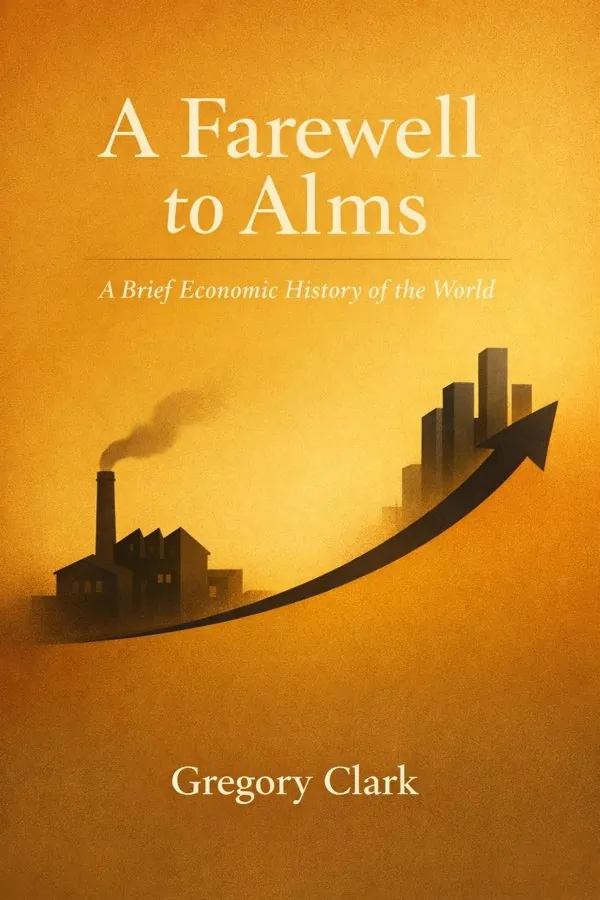
A Farewell to Alms: A Brief Economic History of the World: Summary & Key Insights
 10 min10 chaptersAudio available
Key Takeaways from A Farewell to Alms: A Brief Economic History of the World
The most unsettling idea in the book is that for most of human history, economic progress did not make ordinary people meaningfully richer.
Big arguments about world history become persuasive only when they rest on stubborn facts, and Clark builds his case through an extraordinary amount of historical evidence.
A society can be full of effort and still remain poor if its production system cannot generate self-reinforcing growth.
One of Clark’s most controversial claims is that the roots of the Industrial Revolution may lie partly in long-term changes in behavior.
History often tells the Industrial Revolution as a dramatic breakthrough: inventions appear, factories rise, and the world changes.
What Is A Farewell to Alms: A Brief Economic History of the World About?
A Farewell to Alms: A Brief Economic History of the World by Gregory Clark is a economics book spanning 10 pages. Why did humanity remain desperately poor for thousands of years, only to experience a dramatic explosion in wealth over the last two centuries? In A Farewell to Alms, economic historian Gregory Clark tackles one of the biggest questions in social science: why some societies escaped stagnation while others did not. Rather than treating the Industrial Revolution as a mysterious miracle or a simple triumph of institutions, Clark argues that modern growth emerged from much deeper historical forces shaped over centuries. Drawing on wage records, birth and death data, estate accounts, and other long-run evidence, Clark reconstructs the logic of preindustrial life with unusual precision. He shows how most societies were trapped in a Malthusian world where any productivity gain eventually translated into larger populations, not permanently better living standards. He then explores why England broke out first and how that escape transformed the global economy. The book matters because it challenges comforting explanations about progress, culture, and development. Whether you agree with Clark or not, his argument is bold, data-driven, and impossible to ignore. For readers interested in economics, inequality, history, and the origins of modern prosperity, this is a provocative and deeply influential work.
This FizzRead summary covers all 10 key chapters of A Farewell to Alms: A Brief Economic History of the World in approximately 10 minutes, distilling the most important ideas, arguments, and takeaways from Gregory Clark's work. Also available as an audio summary and Key Quotes Podcast.
A Farewell to Alms: A Brief Economic History of the World
Why did humanity remain desperately poor for thousands of years, only to experience a dramatic explosion in wealth over the last two centuries? In A Farewell to Alms, economic historian Gregory Clark tackles one of the biggest questions in social science: why some societies escaped stagnation while others did not. Rather than treating the Industrial Revolution as a mysterious miracle or a simple triumph of institutions, Clark argues that modern growth emerged from much deeper historical forces shaped over centuries.
Drawing on wage records, birth and death data, estate accounts, and other long-run evidence, Clark reconstructs the logic of preindustrial life with unusual precision. He shows how most societies were trapped in a Malthusian world where any productivity gain eventually translated into larger populations, not permanently better living standards. He then explores why England broke out first and how that escape transformed the global economy.
The book matters because it challenges comforting explanations about progress, culture, and development. Whether you agree with Clark or not, his argument is bold, data-driven, and impossible to ignore. For readers interested in economics, inequality, history, and the origins of modern prosperity, this is a provocative and deeply influential work.
Who Should Read A Farewell to Alms: A Brief Economic History of the World?
This book is perfect for anyone interested in economics and looking to gain actionable insights in a short read. Whether you're a student, professional, or lifelong learner, the key ideas from A Farewell to Alms: A Brief Economic History of the World by Gregory Clark will help you think differently.
- ✓Readers who enjoy economics and want practical takeaways
- ✓Professionals looking to apply new ideas to their work and life
- ✓Anyone who wants the core insights of A Farewell to Alms: A Brief Economic History of the World in just 10 minutes
Want the full summary?
Get instant access to this book summary and 100K+ more with Fizz Moment.
Get Free SummaryAvailable on App Store • Free to download
Key Chapters
The most unsettling idea in the book is that for most of human history, economic progress did not make ordinary people meaningfully richer. Clark revives the logic of Thomas Malthus and argues that before around 1800, nearly all societies operated under the same brutal rule: when productivity rose, population eventually rose with it, pushing wages and living standards back down toward subsistence.
In a Malthusian economy, better harvests, improved tools, or more land might create temporary abundance. But this relief did not last. Families had more surviving children, populations expanded, and the extra labor supply reduced income per person. The result was a strange form of long-run stability: output could grow, but average well-being barely improved. This is why ancient Rome, medieval England, imperial China, and Mughal India could all display periods of sophistication and wealth at the elite level while the mass of people remained near subsistence.
Clark’s point has major implications for how we interpret history. It suggests that preindustrial societies were not necessarily failing because they lacked effort, intelligence, or trade. They were caught in a demographic-economic system that absorbed gains. A village might become more productive, but if its population doubled over generations, living standards could end up no better than before.
A practical modern application is to question simplistic measures of progress. Total GDP growth alone tells us little if population growth absorbs the gains. Development analysts, policymakers, and even business leaders still need to ask whether rising output is translating into lasting per-person improvements.
Actionable takeaway: whenever you evaluate growth, focus on sustainable gains in productivity per person, not just increases in total output.
Big arguments about world history become persuasive only when they rest on stubborn facts, and Clark builds his case through an extraordinary amount of historical evidence. He mines English parish registers, wills, probate inventories, farm records, wages, rents, and prices to show that preindustrial life was not a story of gradual improvement for most people, but of repeated cycles that returned society to the same hard baseline.
One of Clark’s strengths is that he does not rely on philosophical speculation alone. He compares real wages over centuries, tracks changes in body size and nutrition, studies life expectancy, and examines the prices of basic goods. These indicators consistently suggest that before modern growth, most people lived close to subsistence. There were better decades and worse decades, but no sustained upward climb like the one modern populations have come to expect.
This empirical approach also helps Clark challenge romantic views of the past. Medieval craft skill, imperial splendor, or urban commerce did not necessarily mean broad prosperity. A kingdom could build cathedrals, support scholars, or expand trade while peasants remained malnourished and vulnerable. Historical glamour often hides mass poverty.
The broader lesson is methodological. We are often tempted to explain economic success or failure using attractive stories about institutions, values, or leadership. Clark reminds us that serious analysis begins with measurement. If we want to know whether life improved, we must examine wages, mortality, fertility, nutrition, and consumption, not rhetoric.
This has obvious relevance today. Governments announce development plans, companies celebrate expansion, and communities praise revitalization, but the real question remains: are people actually better off in durable ways?
Actionable takeaway: when assessing any claim of progress, look for concrete long-term indicators such as real income, health, and life outcomes rather than surface narratives.
A society can be full of effort and still remain poor if its production system cannot generate self-reinforcing growth. Clark emphasizes that preindustrial economies were constrained not simply by low effort, but by the structure of agriculture, land use, technology, and energy. Most people worked the land, output depended heavily on nature, and even modest technological improvements spread slowly and yielded limited long-run benefits.
Land mattered enormously because it was finite. As population increased, more labor had to be applied to the same soil, often producing diminishing returns. Energy was also constrained. Before fossil fuels, economies ran on muscle, wood, wind, and water. That sharply limited how much output could be expanded. A village blacksmith, a water mill, or a better plow could increase efficiency, but they did not transform the entire productive base in the way steam engines and industrial machinery later would.
Clark’s analysis helps explain why commerce alone could not create modern prosperity. Trade improved specialization and distribution, but if the underlying production technology remained tied to land and low-energy inputs, the economy still faced severe ceilings. This is why even economically sophisticated preindustrial societies rarely achieved sustained mass affluence.
A modern parallel appears in organizations that optimize old systems without changing their core production logic. A company can improve scheduling, tighten costs, or speed communication, but if its fundamental technology remains weak, gains may plateau quickly. Real transformation often requires a shift in the production base itself.
Clark encourages readers to distinguish between efficiency improvements within a system and breakthroughs that change the system’s constraints. That distinction is essential for understanding both the past and the future.
Actionable takeaway: ask whether a change merely improves performance at the margin or actually removes a structural limit to growth.
One of Clark’s most controversial claims is that the roots of the Industrial Revolution may lie partly in long-term changes in behavior. He suggests that in England, over many generations, traits associated with patience, literacy, work discipline, and calculation spread more widely through society, helping prepare the ground for sustained economic growth.
His argument is not that culture changed overnight or that any nation possessed an inherent superiority. Instead, he proposes a demographic mechanism. In preindustrial England, the richer segments of society tended to leave more surviving children than the poor. Because not all of those children could remain in elite positions, many moved downward into the broader population. Over centuries, habits favorable to market society may have diffused socially and behaviorally.
Clark uses evidence such as naming patterns, literacy, violence rates, and work practices to suggest a gradual civilizing and disciplining process. This is a bold thesis, and many scholars dispute parts of it. Still, it forces readers to consider an important possibility: growth may depend not only on machines and laws, but also on widespread everyday behaviors that support cooperation, savings, punctuality, and future-oriented thinking.
The practical relevance is significant. Economic development is not driven solely by infrastructure or regulation. Trust, self-control, human capital, and social norms also matter. Schools, workplaces, and families all shape these capacities. A factory full of advanced machinery still needs workers and managers who can coordinate, maintain quality, and think beyond immediate consumption.
Whether or not one accepts Clark’s full demographic story, the broader point stands: prosperity is partly behavioral. Societies and institutions function better when long-term thinking and reliability become common.
Actionable takeaway: invest in habits that compound over time—literacy, punctuality, planning, and self-discipline—because economic progress often rests on everyday behaviors before it shows up in headline growth.
History often tells the Industrial Revolution as a dramatic breakthrough: inventions appear, factories rise, and the world changes. Clark pushes back against this simple narrative. His argument is that the escape from the Malthusian trap was more gradual, more puzzling, and less obviously tied to sudden technological genius than many accounts suggest.
He notes that measured productivity growth in the early phases of the Industrial Revolution was modest. Many famous inventions did not immediately transform living standards for the average person. Early industrial workers often endured harsh conditions, long hours, and only slowly rising real wages. What changed, however, was the underlying relationship between productivity and population. For the first time, gains in output increasingly translated into persistent increases in income per person rather than being swallowed by demographic growth.
This matters because it reframes how great transformations occur. Revolutions in economic life are not always explosive at first. They may begin with subtle shifts in incentives, energy use, organization, and capital accumulation, only later producing obvious and broad-based prosperity. In other words, what looks like a sudden leap from a distance may feel like a slow, uneven grind to those living through it.
Modern innovators can learn from this. New technologies such as artificial intelligence, biotechnology, or clean energy may not instantly deliver dramatic welfare gains across society. Their largest effects may depend on complementary systems, institutions, skills, and scaling processes that take years or decades.
Clark teaches patience without complacency. Structural transformation is real, but it often unfolds in stages and produces delayed benefits.
Actionable takeaway: do not judge transformative change only by its earliest visible results; pay attention to whether it is quietly altering the long-term mechanics of growth.
A profound puzzle of modern history is not just why industrialization began, but why it spread so unevenly. Clark shows that once one society escaped the Malthusian world, others did not automatically follow at the same speed. Some nations industrialized rapidly, while others lagged for generations despite access to trade, capital, or foreign examples.
This uneven spread suggests that copying machines is easier than copying the deeper conditions that make machines productive. Countries differ in labor discipline, political order, human capital, social trust, and the ability to sustain complex organizations. Infrastructure can be imported; stable routines, credible enforcement, and mass skills are harder to replicate quickly.
Clark’s discussion helps explain why economic convergence is not automatic. If poor countries simply needed access to technology, modern globalization should have closed income gaps far more rapidly than it has. Instead, some societies have achieved spectacular catch-up growth, while others remain stuck. The difference often lies in how successfully they adopt not just industrial tools, but industrial systems.
A practical example can be seen in manufacturing policy. Building an industrial park or attracting foreign investment does not guarantee broad development. Firms also need dependable electricity, trained workers, legal predictability, transport networks, and management capacity. Without these complements, factories remain islands rather than engines of national transformation.
This idea also applies at smaller scales. Within companies, teams often fail to replicate the performance of top units because they imitate surface features without rebuilding the underlying routines and standards that generate results.
Actionable takeaway: when trying to reproduce success, identify and develop the full supporting system—skills, norms, institutions, and infrastructure—not just the visible technology.
The modern gap between rich and poor nations did not emerge simply because some countries got lucky in the nineteenth century. Clark argues that the Great Divergence reflects deeper historical processes that shaped who escaped the old equilibrium and who remained trapped by it. This makes global inequality both more understandable and more troubling.
Before modern growth, differences between societies often existed, but they were narrower in terms of ordinary living standards than people assume. Elites in different civilizations might display dramatic differences in wealth and refinement, yet the masses across Eurasia often lived under broadly similar material conditions. What changed after industrialization was not just that some countries became richer, but that growth became cumulative. Once sustained productivity gains began, the compounding effects across decades and centuries produced staggering differences in income, power, health, and life expectancy.
Clark’s framework helps readers see why present-day inequality cannot be explained entirely by recent policy mistakes. Colonialism, institutions, geography, and politics all matter, but the divergence also reflects timing: countries that entered modern growth earlier gained cumulative advantages in capital, knowledge, urbanization, education, and state capacity.
For modern readers, this reinforces the importance of compounding. Small annual differences in growth rates can create enormous long-run gaps. A nation growing at 2 percent per capita for a century becomes unrecognizably richer than one growing at near zero. The same principle applies to organizations and personal finance.
Clark’s historical lens does not excuse inequality, but it warns against shallow solutions. Deep gaps are often the result of long accumulation, and closing them requires long, sustained progress rather than isolated interventions.
Actionable takeaway: treat time and compounding as central forces in development, and focus on durable systems that can raise productivity consistently over decades.
What makes the modern economy historically unique is not just that it is richer, but that it broke the old law linking better production to unchanged living standards. Clark shows that once economies escaped the Malthusian trap, productivity increases began to yield lasting gains in income, health, education, comfort, and life expectancy for broad populations.
This shift transformed the meaning of work, family, and social aspiration. In the old world, parents could strive relentlessly and still leave children in conditions not very different from their own. In the modern world, sustained growth creates the possibility of cumulative improvement across generations. Better nutrition supports learning, education raises productivity, higher income finances innovation, and innovation generates further gains. Growth becomes self-reinforcing rather than self-canceling.
Clark’s discussion also clarifies why modern people often underestimate the magnitude of this break. We take for granted indoor heating, antibiotics, mass schooling, abundant clothing, rapid transport, and instant communication. Yet for most of history, even the affluent lacked many comforts ordinary people now consider basic. Modern growth radically expanded what normal life can include.
The practical lesson is that productivity is not an abstract statistic. It is the foundation of social possibility. Debates about wages, welfare, housing, education, and healthcare all become easier to address when societies generate sustained output growth. Distribution matters enormously, but there is more to distribute when productivity rises.
For individuals, this perspective also encourages gratitude and responsibility. We live inside a historically unusual system that creates abundance but depends on continued innovation, institutional maintenance, and social cooperation.
Actionable takeaway: support policies and habits that raise long-term productivity, because modern well-being ultimately rests on a society’s ability to keep producing more value per person.
Economic growth does not automatically eliminate hierarchy; it often changes its form. Clark argues that although the modern world escaped mass subsistence, inequality remains deeply persistent across nations and within them. The mechanisms are different from the Malthusian era, but the uneven distribution of opportunity, wealth, and capability continues to shape outcomes.
In preindustrial societies, inequality existed alongside general poverty. In modern economies, average living standards are far higher, yet differences in education, savings, inheritance, health, and institutional quality still create wide gaps. Some countries benefit from centuries of accumulated capital and stable governance; others begin from much weaker foundations. Likewise, within countries, families do not pass on only money. They also pass on habits, networks, expectations, and knowledge.
Clark’s broader contribution is to show that history leaves long shadows. Current outcomes are often path dependent. A nation with strong schools, trust, legal order, and capital markets enjoys advantages that compound over time. A nation facing corruption, weak infrastructure, and low state capacity confronts obstacles that are equally cumulative. This makes inequality resilient even in a world of global trade and technological diffusion.
For policymakers, the implication is sobering. Redistribution may relieve hardship, but it does not by itself create the underlying conditions for mass prosperity. Long-run equality requires building capabilities: education, public health, infrastructure, credible institutions, and access to productive work.
For individuals and organizations, the message is similar. Fair outcomes require more than equal slogans; they require systems that help people develop and use their talents effectively.
Actionable takeaway: address inequality at its roots by investing in capability-building institutions, not just short-term transfers or symbolic reforms.
One of the most provocative implications of A Farewell to Alms is that development policy often promises far more than it can deliver quickly. Clark is skeptical of the idea that poor countries can become rich simply by importing the right policy package, copying Western institutions on paper, or receiving external aid. Deep economic change, in his view, depends on long historical processes that shape behavior, productivity, and institutional effectiveness.
This does not mean policy is useless. Rather, it means policymakers should be humbler and more realistic. You cannot legislate modern prosperity into existence overnight. If a society lacks administrative capacity, broad literacy, trust in contracts, or work routines suited to complex production, formal reforms may have weak effects. A modern commercial code means little if courts are unreliable and firms cannot depend on enforcement.
Clark’s skepticism is valuable because it pushes against development theater: ambitious plans with weak foundations. A country may announce industrial targets, technology zones, or anti-poverty strategies, but unless these are paired with improvements in education, infrastructure, public order, health, and incentives, the results may disappoint.
The practical application is to think in layers. Sustainable development usually requires patient institution-building, investment in human capital, and support for productive sectors that can actually learn and scale. Short-term aid and policy borrowing can help, but they are rarely enough.
For leaders in any field, the lesson generalizes well. Lasting transformation comes from changing underlying capabilities and norms, not just reorganizing charts or issuing ambitious declarations.
Actionable takeaway: design development efforts around long-term capacity building—skills, institutions, trust, and infrastructure—rather than expecting quick fixes from imported models.
All Chapters in A Farewell to Alms: A Brief Economic History of the World
About the Author
Gregory Clark is a British economic historian and economist known for his research on long-run growth, social mobility, and the historical origins of modern prosperity. He has served as a professor of economics at the University of California, Davis, where he became widely recognized for using quantitative evidence to answer major historical questions. His work draws on unusual sources such as parish records, wills, estate documents, and surname data to study how economies and social structures evolve over centuries. Clark is especially noted for his bold interpretations of the Industrial Revolution and the persistence of inequality. Although some of his arguments have sparked debate, his scholarship has had a major influence on economic history by pushing readers to think more rigorously about wealth, poverty, and the deep roots of development.
Get This Summary in Your Preferred Format
Read or listen to the A Farewell to Alms: A Brief Economic History of the World summary by Gregory Clark anytime, anywhere. FizzRead offers multiple formats so you can learn on your terms — all free.
Available formats: App · Audio · PDF · EPUB — All included free with FizzRead
Download A Farewell to Alms: A Brief Economic History of the World PDF and EPUB Summary
Key Quotes from A Farewell to Alms: A Brief Economic History of the World
“The most unsettling idea in the book is that for most of human history, economic progress did not make ordinary people meaningfully richer.”
“Big arguments about world history become persuasive only when they rest on stubborn facts, and Clark builds his case through an extraordinary amount of historical evidence.”
“A society can be full of effort and still remain poor if its production system cannot generate self-reinforcing growth.”
“One of Clark’s most controversial claims is that the roots of the Industrial Revolution may lie partly in long-term changes in behavior.”
“History often tells the Industrial Revolution as a dramatic breakthrough: inventions appear, factories rise, and the world changes.”
Frequently Asked Questions about A Farewell to Alms: A Brief Economic History of the World
A Farewell to Alms: A Brief Economic History of the World by Gregory Clark is a economics book that explores key ideas across 10 chapters. Why did humanity remain desperately poor for thousands of years, only to experience a dramatic explosion in wealth over the last two centuries? In A Farewell to Alms, economic historian Gregory Clark tackles one of the biggest questions in social science: why some societies escaped stagnation while others did not. Rather than treating the Industrial Revolution as a mysterious miracle or a simple triumph of institutions, Clark argues that modern growth emerged from much deeper historical forces shaped over centuries. Drawing on wage records, birth and death data, estate accounts, and other long-run evidence, Clark reconstructs the logic of preindustrial life with unusual precision. He shows how most societies were trapped in a Malthusian world where any productivity gain eventually translated into larger populations, not permanently better living standards. He then explores why England broke out first and how that escape transformed the global economy. The book matters because it challenges comforting explanations about progress, culture, and development. Whether you agree with Clark or not, his argument is bold, data-driven, and impossible to ignore. For readers interested in economics, inequality, history, and the origins of modern prosperity, this is a provocative and deeply influential work.
You Might Also Like
Business Adventures
John Brooks
10 min
Nudge
Richard H. Thaler, Cass R. Sunstein
10 min
The Hitchhiker"s Guide to the Galaxy
Douglas Adams
10 minThe Muqaddimah
Ibn Khaldun
10 minThe Outsiders
William N. Thorndike
10 min
A Little History of Economics
Niall Kishtainy
10 minFeatured In
Browse by Category
Ready to read A Farewell to Alms: A Brief Economic History of the World?
Get the full summary and 100K+ more books with Fizz Moment.