
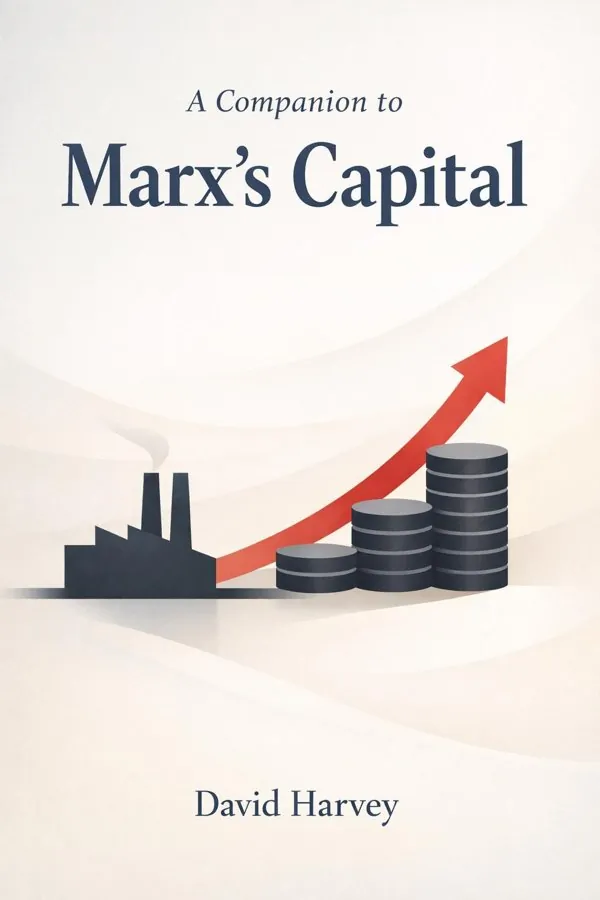
A Companion to Marx’s Capital: Summary & Key Insights
by David Harvey
 10 min12 chaptersAudio available
What Is A Companion to Marx’s Capital About?
A Companion to Marx’s Capital by David Harvey is a economics book spanning 12 pages. This book is a detailed guide to Karl Marx’s *Capital, Volume I*, written by the renowned Marxist scholar David Harvey. It provides a chapter-by-chapter commentary that helps readers understand Marx’s critique of political economy, the logic of capital accumulation, and the dynamics of capitalist production. Harvey contextualizes Marx’s ideas within both historical and contemporary frameworks, making the text accessible to students, activists, and scholars interested in critical theory and political economy.
This FizzRead summary covers all 12 key chapters of A Companion to Marx’s Capital in approximately 10 minutes, distilling the most important ideas, arguments, and takeaways from David Harvey's work. Also available as an audio summary and Key Quotes Podcast.
A Companion to Marx’s Capital
This book is a detailed guide to Karl Marx’s *Capital, Volume I*, written by the renowned Marxist scholar David Harvey. It provides a chapter-by-chapter commentary that helps readers understand Marx’s critique of political economy, the logic of capital accumulation, and the dynamics of capitalist production. Harvey contextualizes Marx’s ideas within both historical and contemporary frameworks, making the text accessible to students, activists, and scholars interested in critical theory and political economy.
Who Should Read A Companion to Marx’s Capital?
This book is perfect for anyone interested in economics and looking to gain actionable insights in a short read. Whether you're a student, professional, or lifelong learner, the key ideas from A Companion to Marx’s Capital by David Harvey will help you think differently.
- ✓Readers who enjoy economics and want practical takeaways
- ✓Professionals looking to apply new ideas to their work and life
- ✓Anyone who wants the core insights of A Companion to Marx’s Capital in just 10 minutes
Want the full summary?
Get instant access to this book summary and 100K+ more with Fizz Moment.
Get Free SummaryAvailable on App Store • Free to download
Key Chapters
When Marx wrote *Capital*, Europe was convulsed by the industrial revolution. Factories multiplied, cities grew, and workers were drawn into conditions of mechanical discipline unknown to earlier generations. Classical political economists — Adam Smith, David Ricardo, and others — had tried to explain how wealth was produced, but Marx saw deeper contradictions in their thinking. They described laws of market equilibrium while ignoring the violence of class relations that sustained them.
The intellectual backdrop was one of confidence in progress. Machines promised abundance; markets promised freedom. Marx approached this optimism with skepticism, asking: whose freedom, and at what cost? His critique was not only economic but historical. Capitalism, he argued, was a specific mode of production — not a natural order but a social system built on exploitation. The industrial revolution brought enormous productivity, but it also brought misery, poverty, and alienation. The factory became the crucial symbol of this new reality: a site where living labor was harnessed to dead machinery, and the worker became a component of capital’s self-expansion.
In my reading, it is vital to remember that Marx wrote amid these transformations. His analysis is therefore historical in its foundation — a study of how a new economic system emerged out of feudal ruins, swept the globe, and from the start carried within it the seeds of crises that would never disappear.
Marx begins *Capital* not with the factory or the worker but with the commodity — the seemingly simple unit of capitalist life. A commodity, as he explains, has both use-value and exchange-value. It fulfills human needs but also exists as an object of trade. The mystery lies in how these two aspects become unified in the act of exchange, producing the notion of value.
Value, for Marx, is not about utility; it is about socially necessary labor time. What gives commodities equivalence in the market is the average amount of labor required to produce them under normal conditions. This insight overturns classical economics. In bourgeois theory, value reflects supply and demand; in Marx’s critique, value is a social relation. The commodity is therefore the cell form of capitalism, containing in miniature the contradictions between concrete labor and abstract labor, between human creativity and economic abstraction.
As I guide you through these pages, I want you to notice how Marx slowly exposes the fetishism of commodities. In capitalist society, relations between people appear as relations between things. Social power and human labor hide behind the dazzling surface of price and exchange. To understand value properly is to pierce that veil — to recognize that behind every commodity stands a network of lives, factories, and historical processes that make its existence possible.
+ 10 more chapters — available in the FizzRead app
All Chapters in A Companion to Marx’s Capital
About the Author
David Harvey is a British geographer and social theorist known for his influential work in Marxist theory, urban studies, and political economy. He is a Distinguished Professor of Anthropology and Geography at the Graduate Center of the City University of New York (CUNY) and has authored numerous books on capitalism, neoliberalism, and social justice.
Get This Summary in Your Preferred Format
Read or listen to the A Companion to Marx’s Capital summary by David Harvey anytime, anywhere. FizzRead offers multiple formats so you can learn on your terms — all free.
Available formats: App · Audio · PDF · EPUB — All included free with FizzRead
Download A Companion to Marx’s Capital PDF and EPUB Summary
Key Quotes from A Companion to Marx’s Capital
“When Marx wrote *Capital*, Europe was convulsed by the industrial revolution.”
“Marx begins *Capital* not with the factory or the worker but with the commodity — the seemingly simple unit of capitalist life.”
Frequently Asked Questions about A Companion to Marx’s Capital
A Companion to Marx’s Capital by David Harvey is a economics book that explores key ideas across 12 chapters. This book is a detailed guide to Karl Marx’s *Capital, Volume I*, written by the renowned Marxist scholar David Harvey. It provides a chapter-by-chapter commentary that helps readers understand Marx’s critique of political economy, the logic of capital accumulation, and the dynamics of capitalist production. Harvey contextualizes Marx’s ideas within both historical and contemporary frameworks, making the text accessible to students, activists, and scholars interested in critical theory and political economy.
More by David Harvey
You Might Also Like

Business Adventures
John Brooks
10 min
Nudge
Richard H. Thaler, Cass R. Sunstein
10 min
The Hitchhiker"s Guide to the Galaxy
Douglas Adams
10 minThe Muqaddimah
Ibn Khaldun
10 minThe Outsiders
William N. Thorndike
10 min
A Little History of Economics
Niall Kishtainy
10 minFeatured In
Browse by Category
Ready to read A Companion to Marx’s Capital?
Get the full summary and 100K+ more books with Fizz Moment.