
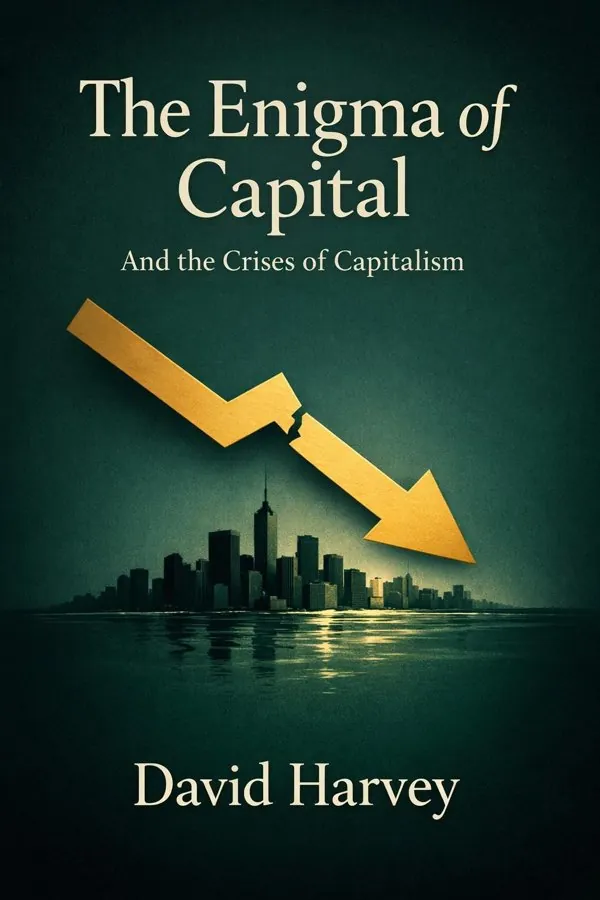
The Enigma of Capital: And the Crises of Capitalism: Summary & Key Insights
by David Harvey
 10 min12 chaptersAudio available
What Is The Enigma of Capital: And the Crises of Capitalism About?
The Enigma of Capital: And the Crises of Capitalism by David Harvey is a economics book spanning 12 pages. In this influential work, David Harvey explores the internal contradictions of capitalism and how they lead to recurring crises. He examines the 2008 financial collapse as part of a broader pattern of systemic instability, arguing that capital’s need for perpetual growth inevitably produces social inequality and environmental degradation. Harvey combines Marxist theory with contemporary economic analysis to reveal how capital reshapes geography, politics, and everyday life.
This FizzRead summary covers all 12 key chapters of The Enigma of Capital: And the Crises of Capitalism in approximately 10 minutes, distilling the most important ideas, arguments, and takeaways from David Harvey's work. Also available as an audio summary and Key Quotes Podcast.
The Enigma of Capital: And the Crises of Capitalism
In this influential work, David Harvey explores the internal contradictions of capitalism and how they lead to recurring crises. He examines the 2008 financial collapse as part of a broader pattern of systemic instability, arguing that capital’s need for perpetual growth inevitably produces social inequality and environmental degradation. Harvey combines Marxist theory with contemporary economic analysis to reveal how capital reshapes geography, politics, and everyday life.
Who Should Read The Enigma of Capital: And the Crises of Capitalism?
This book is perfect for anyone interested in economics and looking to gain actionable insights in a short read. Whether you're a student, professional, or lifelong learner, the key ideas from The Enigma of Capital: And the Crises of Capitalism by David Harvey will help you think differently.
- ✓Readers who enjoy economics and want practical takeaways
- ✓Professionals looking to apply new ideas to their work and life
- ✓Anyone who wants the core insights of The Enigma of Capital: And the Crises of Capitalism in just 10 minutes
Want the full summary?
Get instant access to this book summary and 100K+ more with Fizz Moment.
Get Free SummaryAvailable on App Store • Free to download
Key Chapters
Capital is not a thing—it’s a process. This is the first barrier most of us must overcome. We are used to equating capital with money or physical assets, but capital only comes alive when it flows. It moves through circuits of production, exchange, and consumption. It must be invested, produce surplus value, and then reinvested again. This perpetual motion defines its existence. In my investigation, I draw deeply from Marx’s concept of the circulation of capital: money becomes commodities, commodities produce more money, and the cycle continues. But the moment that movement halts—when surplus value cannot find a profitable outlet—the system convulses.
Understanding this dynamic helps explain capitalism’s inherent volatility. A capitalist must continually seek profitable reinvestment; idle money is, by definition, uncapitalized. This need for expansion creates a relentless pressure to transform social life, labor, and nature into opportunities for accumulation. Factories, cities, education systems, and even art become spaces through which capital pursues its endless self-replication.
Yet this circulation depends on delicate balances. It requires an environment that can sustain production, markets that can absorb commodities, and consumers with sufficient wages—or credit—to keep buying. When any of these elements falter, capital’s momentum breaks, triggering crisis. What makes capitalism so resilient, paradoxically, is also what makes it perpetually unstable: its capacity to reshape space, labor, and technology to reignite growth, even if that means deepening inequality or environmental destruction. That, in essence, is the nature of capital—it is restless by design.
Once we recognize that capital must expand continuously, we can begin to understand crisis as an inevitable outcome. The problem begins with overaccumulation—too much capital chasing too few profitable opportunities. Historically, we can trace this tendency through every epoch of industrial development. Periods of intense innovation and expansion give way to saturation. Factories overproduce, markets saturate, and profits fall. Surplus capital accumulates, unable to find outlets that yield the expected return.
This overaccumulation drives transformations in the organization of labor and production. Entrepreneurs seek cheaper labor abroad or new technologies that reduce costs. Governments open markets or privatize public assets to create investment opportunities. Financial systems devise instruments to channel idle funds into speculative ventures. Each of these moves postpones crisis; none eliminates it. Overaccumulation always returns—because the system’s engine runs on perpetual growth.
Capital’s crises, then, are not failures of management or state intervention but expressions of its internal contradictions. The paradox of accumulation is stark: to maintain profits, capital must expand production; but that expansion eventually undermines profitability by producing too much. The subsequent crashes—whether in the dot-com era, housing bubbles, or currency markets—are the system’s self-correcting fits, periodic destructions that clear the ground for a renewed cycle. Accumulation breeds crisis; crisis reconfigures accumulation. And through that cycle, human lives are reshaped, often violently, by forces far larger than themselves.
+ 10 more chapters — available in the FizzRead app
All Chapters in The Enigma of Capital: And the Crises of Capitalism
About the Author
David Harvey is a British geographer and social theorist known for his critical analysis of capitalism and urbanization. A Distinguished Professor of Anthropology and Geography at the City University of New York (CUNY), he has written extensively on Marxist theory, political economy, and social justice.
Get This Summary in Your Preferred Format
Read or listen to the The Enigma of Capital: And the Crises of Capitalism summary by David Harvey anytime, anywhere. FizzRead offers multiple formats so you can learn on your terms — all free.
Available formats: App · Audio · PDF · EPUB — All included free with FizzRead
Download The Enigma of Capital: And the Crises of Capitalism PDF and EPUB Summary
Key Quotes from The Enigma of Capital: And the Crises of Capitalism
“This is the first barrier most of us must overcome.”
“Once we recognize that capital must expand continuously, we can begin to understand crisis as an inevitable outcome.”
Frequently Asked Questions about The Enigma of Capital: And the Crises of Capitalism
The Enigma of Capital: And the Crises of Capitalism by David Harvey is a economics book that explores key ideas across 12 chapters. In this influential work, David Harvey explores the internal contradictions of capitalism and how they lead to recurring crises. He examines the 2008 financial collapse as part of a broader pattern of systemic instability, arguing that capital’s need for perpetual growth inevitably produces social inequality and environmental degradation. Harvey combines Marxist theory with contemporary economic analysis to reveal how capital reshapes geography, politics, and everyday life.
More by David Harvey
You Might Also Like
Business Adventures
John Brooks
10 min
Nudge
Richard H. Thaler, Cass R. Sunstein
10 min
The Hitchhiker"s Guide to the Galaxy
Douglas Adams
10 minThe Muqaddimah
Ibn Khaldun
10 minThe Outsiders
William N. Thorndike
10 min
A Little History of Economics
Niall Kishtainy
10 minBrowse by Category
Ready to read The Enigma of Capital: And the Crises of Capitalism?
Get the full summary and 100K+ more books with Fizz Moment.