
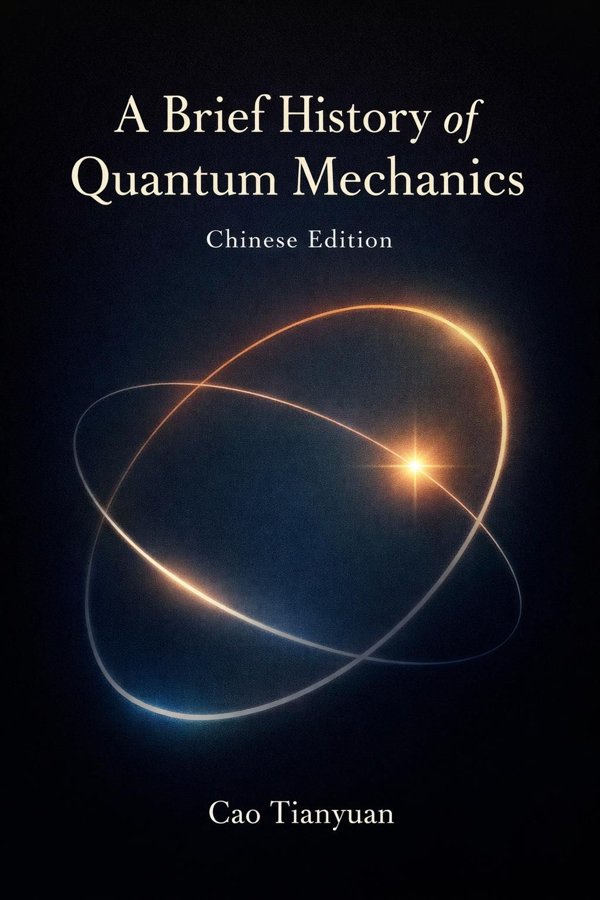
A Brief History of Quantum Mechanics (Chinese Edition): Summary & Key Insights
by Cao Tianyuan
 10 min4 chaptersAudio available
What Is A Brief History of Quantum Mechanics (Chinese Edition) About?
A Brief History of Quantum Mechanics (Chinese Edition) by Cao Tianyuan is a popular_sci book spanning 4 pages. A popular science book that narrates the development of quantum mechanics from Planck’s quantum hypothesis to the ideas of Einstein, Bohr, Heisenberg, and Schrödinger. Written in a lively and accessible style, it transforms complex scientific concepts into engaging stories, allowing readers to appreciate the passion and philosophy behind scientific exploration.
This FizzRead summary covers all 4 key chapters of A Brief History of Quantum Mechanics (Chinese Edition) in approximately 10 minutes, distilling the most important ideas, arguments, and takeaways from Cao Tianyuan's work. Also available as an audio summary and Key Quotes Podcast.
A Brief History of Quantum Mechanics (Chinese Edition)
A popular science book that narrates the development of quantum mechanics from Planck’s quantum hypothesis to the ideas of Einstein, Bohr, Heisenberg, and Schrödinger. Written in a lively and accessible style, it transforms complex scientific concepts into engaging stories, allowing readers to appreciate the passion and philosophy behind scientific exploration.
Who Should Read A Brief History of Quantum Mechanics (Chinese Edition)?
This book is perfect for anyone interested in popular_sci and looking to gain actionable insights in a short read. Whether you're a student, professional, or lifelong learner, the key ideas from A Brief History of Quantum Mechanics (Chinese Edition) by Cao Tianyuan will help you think differently.
- ✓Readers who enjoy popular_sci and want practical takeaways
- ✓Professionals looking to apply new ideas to their work and life
- ✓Anyone who wants the core insights of A Brief History of Quantum Mechanics (Chinese Edition) in just 10 minutes
Want the full summary?
Get instant access to this book summary and 100K+ more with Fizz Moment.
Get Free SummaryAvailable on App Store • Free to download
Key Chapters
The story begins at the turn of the 20th century. Classical physics was triumphant yet troubled. The laws of thermodynamics and electromagnetism had unified vast phenomena, but the problem of blackbody radiation stubbornly resisted explanation. Experiments showed that as objects were heated, their radiation spectrum did not align with predictions. The ultraviolet catastrophe loomed — the classical equations predicted infinite energy at short wavelengths. Planck, meticulous and conservative, tried to fix the theory, not overthrow it. Yet the mathematics led him to something shocking: energy could not be exchanged continuously, but only in discrete packets, quanta.
Imagine Planck’s hesitation. He did not intend to start a revolution; he wanted to save classical physics. But this simple assumption — that energy comes in multiples of hν — cracked open the door to quantum theory. Here was the first whisper of nature’s granularity.
Einstein stepped through that door with boldness. In 1905, he proposed that light itself consists of discrete quanta, photons, and used this idea to explain the photoelectric effect. When light strikes a metal surface, electrons are ejected — but only if the light’s frequency exceeds a specific threshold. Classical wave theory could not account for this sharp cutoff. Einstein’s photon model did. He showed that each photon carries an energy quantum that can liberate an electron. This was not just a tweak; it was a new conception of light and matter.
At that moment, physics entered a new domain. Planck and Einstein’s quantum ideas were seeds from which the forest of modern physics would grow. Yet both physicists felt the weight of their own discoveries — Planck saw his quanta as a temporary hypothesis, while Einstein struggled for decades to reconcile the quantum with his beloved vision of a deterministic universe. Still, the transformation had begun, quietly and irreversibly.
When Niels Bohr introduced his atomic model in 1913, he combined daring imagination with empirical pragmatism. He took Rutherford’s vision of a nuclear atom and anchored it with Planck’s quantum hypothesis. Electrons, Bohr proposed, cannot orbit the nucleus at arbitrary distances. Their angular momenta are quantized, and transitions between orbits correspond to discrete energy emissions — the very lines observed in hydrogen spectra.
Bohr’s atom was a triumph, yet it raised unsettling questions. Why could electrons occupy only certain orbits? What physical mechanism underlay quantization? The model worked experimentally, but its foundations were shaky. Bohr knew this, but he respected the power of phenomenology: if a model explained what nature showed us, it deserved our serious contemplation.
A decade later, Louis de Broglie extended Bohr’s intuition into an elegant symmetry. If light could act as particles, perhaps matter could act as waves. De Broglie proposed that every material particle, from electrons to atoms, has a wavelength associated with its momentum. This was a breathtaking unification: the wave-particle duality became a universal principle. Experiments soon confirmed that electrons indeed diffract and interfere like light.
This moment was a pivot point. Physics shifted from viewing particles and waves as distinct entities to seeing them as two faces of one deeper reality. The electron became a field of possibilities, a vibrating probability rather than a localized marble traveling through space. For us, as observers of this story, de Broglie’s insight embodies a profound lesson — that truth often lies not in choosing between contradictions, but in embracing their coexistence.
+ 2 more chapters — available in the FizzRead app
All Chapters in A Brief History of Quantum Mechanics (Chinese Edition)
About the Author
Cao Tianyuan is a Chinese science writer known for his accessible and engaging approach to explaining complex scientific theories. His works, including 'Does God Play Dice?—A History of Quantum Physics,' are widely appreciated by readers for their clarity and storytelling.
Get This Summary in Your Preferred Format
Read or listen to the A Brief History of Quantum Mechanics (Chinese Edition) summary by Cao Tianyuan anytime, anywhere. FizzRead offers multiple formats so you can learn on your terms — all free.
Available formats: App · Audio · PDF · EPUB — All included free with FizzRead
Download A Brief History of Quantum Mechanics (Chinese Edition) PDF and EPUB Summary
Key Quotes from A Brief History of Quantum Mechanics (Chinese Edition)
“The story begins at the turn of the 20th century.”
“When Niels Bohr introduced his atomic model in 1913, he combined daring imagination with empirical pragmatism.”
Frequently Asked Questions about A Brief History of Quantum Mechanics (Chinese Edition)
A Brief History of Quantum Mechanics (Chinese Edition) by Cao Tianyuan is a popular_sci book that explores key ideas across 4 chapters. A popular science book that narrates the development of quantum mechanics from Planck’s quantum hypothesis to the ideas of Einstein, Bohr, Heisenberg, and Schrödinger. Written in a lively and accessible style, it transforms complex scientific concepts into engaging stories, allowing readers to appreciate the passion and philosophy behind scientific exploration.
You Might Also Like

Structures: Or Why Things Don"t Fall Down
J.E. Gordon
10 min
The Road to Wigan Pier
George Orwell
10 min
Bonk: The Curious Coupling of Science and Sex
Mary Roach
10 min
First Bite: How We Learn to Eat
Bee Wilson
10 min
In Pursuit Of The Unknown: 17 Equations That Changed The World
Ian Stewart
10 min
Napoleon's Buttons: 17 Molecules That Changed History
Penny Le Couteur and Jay Burreson
10 minFeatured In
Browse by Category
Ready to read A Brief History of Quantum Mechanics (Chinese Edition)?
Get the full summary and 100K+ more books with Fizz Moment.