
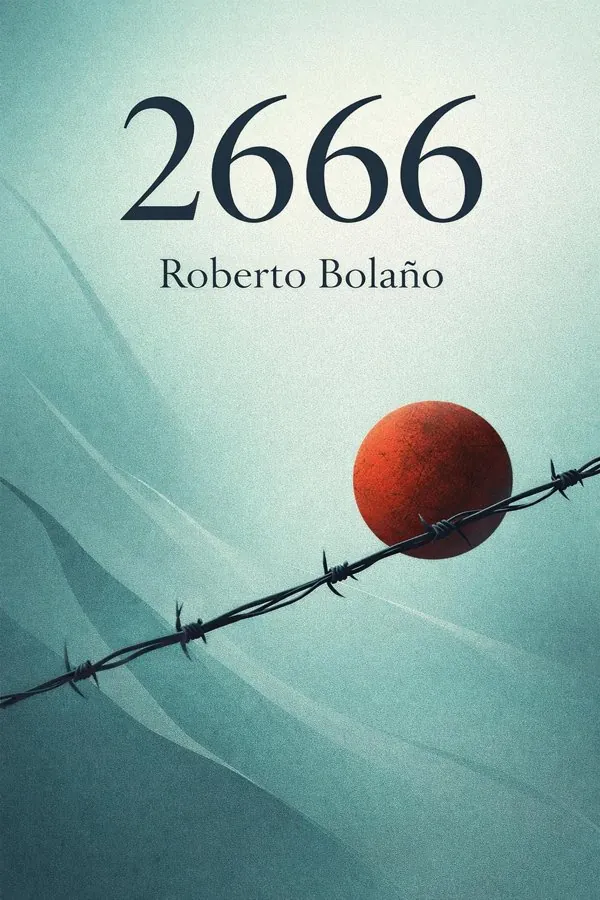
2666: Summary & Key Insights
 10 min9 chaptersAudio available
Key Takeaways from 2666
A shared passion can unite people just as powerfully as love, ambition, or fear.
Sometimes the most accurate response to a broken world is not clarity but disorientation.
The outsider often sees what insiders have learned not to notice.
Horror becomes most terrifying when it is repeated so often that society stops reacting.
Behind every mystery lies another life, and behind every life lies history.
What Is 2666 About?
2666 by Roberto Bolaño is a classics book spanning 5 pages. Roberto Bolaño’s 2666 is one of the most ambitious novels of the modern era: vast in scope, unsettling in mood, and unforgettable in its moral force. Published posthumously in 2004, the book unfolds in five interconnected parts that move from European literary circles to the haunted border city of Santa Teresa, a fictional stand-in for Ciudad Juárez. Along the way, Bolaño explores obsession, exile, intellectual vanity, historical violence, and the brutal murders of women that form the novel’s dark center. Rather than offering a neat plot, 2666 builds an entire landscape of fear, mystery, and human contradiction. Its power lies in how it links art and atrocity, private desire and public catastrophe, showing how culture can illuminate evil while also failing to stop it. Bolaño writes with the authority of a novelist who lived through political upheaval, migration, and marginal artistic life, and his work carries the urgency of lived experience. 2666 matters because it refuses simplification: it asks how we go on thinking, reading, and loving in a world where horror is both ordinary and unbearable.
This FizzRead summary covers all 9 key chapters of 2666 in approximately 10 minutes, distilling the most important ideas, arguments, and takeaways from Roberto Bolaño's work. Also available as an audio summary and Key Quotes Podcast.
2666
Roberto Bolaño’s 2666 is one of the most ambitious novels of the modern era: vast in scope, unsettling in mood, and unforgettable in its moral force. Published posthumously in 2004, the book unfolds in five interconnected parts that move from European literary circles to the haunted border city of Santa Teresa, a fictional stand-in for Ciudad Juárez. Along the way, Bolaño explores obsession, exile, intellectual vanity, historical violence, and the brutal murders of women that form the novel’s dark center. Rather than offering a neat plot, 2666 builds an entire landscape of fear, mystery, and human contradiction. Its power lies in how it links art and atrocity, private desire and public catastrophe, showing how culture can illuminate evil while also failing to stop it. Bolaño writes with the authority of a novelist who lived through political upheaval, migration, and marginal artistic life, and his work carries the urgency of lived experience. 2666 matters because it refuses simplification: it asks how we go on thinking, reading, and loving in a world where horror is both ordinary and unbearable.
Who Should Read 2666?
This book is perfect for anyone interested in classics and looking to gain actionable insights in a short read. Whether you're a student, professional, or lifelong learner, the key ideas from 2666 by Roberto Bolaño will help you think differently.
- ✓Readers who enjoy classics and want practical takeaways
- ✓Professionals looking to apply new ideas to their work and life
- ✓Anyone who wants the core insights of 2666 in just 10 minutes
Want the full summary?
Get instant access to this book summary and 100K+ more with Fizz Moment.
Get Free SummaryAvailable on App Store • Free to download
Key Chapters
A shared passion can unite people just as powerfully as love, ambition, or fear. The opening section of 2666 introduces four European critics—Jean-Claude Pelletier, Manuel Espinoza, Piero Morini, and Liz Norton—whose lives become intertwined through their scholarly devotion to the elusive German writer Benno von Archimboldi. At first, their world seems almost comic: conferences, rivalries, affairs, and literary debates. Yet Bolaño gradually reveals something darker beneath this cultivated surface. Their search for Archimboldi is not just an academic quest; it becomes an obsession that exposes vanity, dependency, cruelty, and longing. The critics believe literature gives life meaning, but their behavior often shows how intellectual passion can become a form of self-deception.
This section matters because Bolaño questions whether culture truly civilizes us. The critics can analyze novels with precision, yet they remain emotionally immature, morally inconsistent, and capable of pettiness and violence. Their journey eventually points toward Santa Teresa, suggesting that aesthetic curiosity can lead directly into historical darkness, whether or not the seekers understand what they are approaching.
In practical terms, this idea applies far beyond literary study. People often build identities around expertise—books, politics, art, careers, even social causes—while ignoring the gap between what they admire and how they live. A person may speak eloquently about justice, truth, or beauty and still behave selfishly in ordinary life. Bolaño invites readers to examine that contradiction honestly.
Actionable takeaway: ask yourself where admiration has become identity. What ideas, creators, or institutions do you defend automatically, and how closely do your actions reflect the values you claim to honor?
Sometimes the most accurate response to a broken world is not clarity but disorientation. In the second part of 2666, Bolaño turns to Oscar Amalfitano, a Chilean philosophy professor living in Santa Teresa with his daughter Rosa. Amalfitano is educated, reflective, and morally alert, yet he is slowly unraveling. He hears voices, drifts into abstraction, and becomes preoccupied with inexplicable signs, including the haunting image of a geometry book hanging from a clothesline outside his house. His mental state is fragile, but Bolaño does not present madness as mere pathology. Instead, Amalfitano’s instability mirrors the instability of the world around him.
Santa Teresa is a city where normal categories fail. Violence is present but often unspoken, institutions are ineffective, and danger circulates beneath daily routine. Amalfitano senses this more acutely than those who remain numb. He worries for Rosa, for himself, and for the very possibility of meaning. In that sense, he functions as one of the novel’s consciences: a man whose intelligence cannot protect him from fear, and whose fear may be a realistic response to the conditions he inhabits.
This idea has wide relevance. When environments become morally chaotic—whether in families, workplaces, communities, or nations—people often experience confusion, anxiety, or estrangement. We tend to treat these feelings as private weakness, but Bolaño suggests they may also be forms of perception. To feel unsettled in a violent or absurd system can mean you still recognize that something is wrong.
Actionable takeaway: do not dismiss your discomfort too quickly. If a place, institution, or relationship consistently makes you feel disoriented, pause to ask whether your unease is revealing a truth that habit has taught others to ignore.
The outsider often sees what insiders have learned not to notice. In “The Part About Fate,” Bolaño follows Oscar Fate, an African American journalist from New York who travels to Santa Teresa to cover a boxing match. What begins as an accidental assignment becomes an encounter with a much larger horror: the ongoing murders of women in and around the city. Fate is not a detective, scholar, or local resident. He arrives without context, and that distance becomes crucial. Because he does not yet accept the city’s routines, he perceives the abnormality that many others treat as background noise.
Bolaño uses Fate to examine journalism, race, masculinity, and the ethics of attention. Reporting can expose hidden realities, but it can also trivialize them, package them, or move on too quickly. Fate senses that the boxing event is insignificant beside the violence surrounding it, yet he is also uncertain how to respond responsibly. His growing concern for Rosa Amalfitano gives this section urgency, linking private rescue to public catastrophe.
The practical lesson is that institutions often normalize suffering by isolating it into categories: crime pages, statistics, specialized reports, local problems. People outside those categories may overlook the issue entirely, while those inside them may become desensitized. Fate reminds us that moral attention frequently begins when someone refuses that compartmentalization.
In everyday life, this can mean noticing what your environment has normalized: bullying at work, neglect in a family, exploitation in a neighborhood, cruelty online, or indifference toward the vulnerable. You may not be able to solve the whole system, but recognizing the mismatch between what is happening and how people talk about it is a powerful first step.
Actionable takeaway: when you encounter a situation that feels disturbingly “normal,” resist passive acceptance. Ask better questions, seek context, and consider one concrete act of witness—speaking up, documenting, helping, or refusing to look away.
Horror becomes most terrifying when it is repeated so often that society stops reacting. “The Part About the Crimes,” the longest and most harrowing section of 2666, catalogs the murders of women in Santa Teresa in relentless, often procedural detail. Case after case is described with forensic bluntness: names, injuries, locations, police failures, social circumstances, and dead ends. This accumulation can feel numbing, and that is part of Bolaño’s design. He refuses to transform violence into elegant mystery or emotional spectacle. Instead, he confronts the reader with repetition, bureaucracy, and abandonment.
The effect is devastating. Each woman is an individual, yet the system absorbs her into a pattern. Investigators are overwhelmed or indifferent, institutions are corrupt or incompetent, and the broader culture continues. The murders do not organize themselves into a satisfying narrative because real structural evil rarely does. Bolaño’s achievement here is moral as much as artistic: he forces literature to linger where society prefers distraction.
This section offers an important insight for contemporary life. Large-scale injustice often becomes invisible not because it is hidden, but because it is continuous. Repetition drains urgency. People tire of hearing about the same abuse, the same war, the same victims, the same failures. Yet repetition is precisely what should alarm us. When a problem keeps happening, it is no longer accidental; it is systemic.
Applied practically, this means learning to read patterns rather than isolated incidents. One missed promotion may be random; a repeated pattern may reveal discrimination. One ignored complaint may be negligence; dozens suggest institutional collapse. One act of public cruelty may shock; its recurrence indicates normalization.
Actionable takeaway: pay attention to repeated harm. When a tragedy keeps recurring, stop asking only who did it and begin asking what system allows it to continue.
Catastrophe rarely arrives as a single dramatic event; more often, it settles in gradually until people adjust to it. One of the deepest lessons of 2666 is that evil often appears first as atmosphere: neglected streets, evasive officials, jokes that conceal contempt, institutions that fail quietly, and daily routines that continue beside suffering. Bolaño does not present evil as a cartoon villain or a metaphysical abstraction. He shows it as something distributed across systems, habits, and silences.
This is why the novel is so unsettling. Many characters are not monsters. They are distracted, compromised, vain, frightened, tired, or self-absorbed. Yet such ordinary limitations become part of a larger machinery that permits atrocity. The murders in Santa Teresa are not only the work of individual perpetrators; they are enabled by corruption, misogyny, economic exploitation, police indifference, and cultural fatigue. Evil, in Bolaño’s world, is not just what someone does. It is also what everyone else learns to live around.
This insight applies directly to modern life. Harmful workplaces, abusive relationships, propaganda, discrimination, and public cruelty often survive because they become routine. People tell themselves nothing can be done, that the problem is too complex, or that someone else is responsible. Over time, moral imagination shrinks.
Recognizing ordinary evil means paying attention to warning signs before they harden into destiny: repeated dehumanizing language, institutional secrecy, unresolved abuse, normalization of fear, and the casual dismissal of vulnerable people. Moral collapse is usually incremental.
Actionable takeaway: train yourself to notice the small permissions that make larger harm possible. Interrupt contempt early, challenge indifference, and refuse the comforting belief that only spectacular wrongdoing deserves a response.
To be displaced is not only to lose a home; it is to live in a permanent state of incompletion. Throughout 2666, characters move across countries, languages, professions, and emotional allegiances. Amalfitano is an exile. The critics are intellectual travelers. Fate enters a foreign landscape uneasily. Archimboldi passes through war and reinvention. Even Santa Teresa itself feels like a space built from transit, labor flows, porous identities, and unstable belonging. Bolaño, who lived across Chile, Mexico, and Spain, writes displacement not as a theme added from outside but as a condition of consciousness.
Exile in the novel is rarely romantic. It produces freedom, but also vulnerability. Characters become observant because they are out of place, yet they also become isolated, suspicious, or fragmented. They do not fully belong where they are, and often cannot return to where they came from. This unsettled identity sharpens their perceptions while eroding their certainty.
The relevance of this idea goes beyond migration. Many people today experience versions of exile without crossing borders: moving between classes, professions, belief systems, relationships, or digital selves. A person may feel estranged from family, culture, or earlier identity, carrying the knowledge that belonging can be partial and temporary.
Bolaño suggests that this condition, painful as it is, can produce a deeper honesty. Those who stand at the edge of systems often see their structure more clearly than those comfortably inside. The challenge is to transform alienation into attention rather than despair.
Actionable takeaway: if you feel between worlds, treat that distance as a source of insight. Reflect on what your displacement allows you to perceive, and use that perspective to make more deliberate choices about where and how you want to belong.
We often turn to art for redemption, but 2666 asks whether literature can truly confront suffering without also exposing its own limits. Books matter intensely in this novel. The critics devote their lives to them. Archimboldi writes them. Readers search them for meaning, coherence, and transcendence. Yet the novel repeatedly places literature beside war, murder, madness, and institutional collapse. The result is not a dismissal of art, but a severe test of its value.
Bolaño seems to argue that literature can illuminate reality, preserve memory, sharpen moral perception, and connect isolated lives. But it cannot, by itself, stop violence. A brilliant interpretation does not rescue the dead. A literary career does not purify character. A masterpiece does not dissolve corruption. In this sense, 2666 resists the comforting fantasy that culture is automatically ethical. People may read deeply and still fail morally.
At the same time, the novel itself proves that art remains necessary. By making readers inhabit uncertainty, grief, obsession, and historical depth, Bolaño creates a form capable of resisting simplification. Literature may not save the world, but it can refuse lies, preserve complexity, and keep attention alive where denial would be easier.
This matters practically because many people expect too much or too little from art. Some treat books as decoration; others expect them to provide total wisdom. A better approach is to see reading as training in seriousness: a way to enlarge awareness while accepting that awareness must lead to action outside the page.
Actionable takeaway: let literature deepen your perception, but do not confuse understanding with intervention. After encountering a powerful work, ask what it changes in how you see, speak, choose, or respond in real life.
Some books tell a story; 2666 builds a world large enough to hold the fractures of an era. Across its five parts, Bolaño creates a vast network linking European intellectual life, World War II, Latin American exile, border capitalism, misogynistic violence, and the failure of institutions to protect the vulnerable. The novel’s unusual structure can feel disorienting at first, but that fragmentation is essential to its vision. The modern world does not arrive in a single perspective. It is experienced through shards, crossings, omissions, and unfinished connections.
What makes 2666 extraordinary is the way those fragments echo each other. The critics’ search, Amalfitano’s dread, Fate’s witness, the catalog of murders, and Archimboldi’s buried past all belong to one moral landscape. Bolaño suggests that to understand the present, we must think across borders and timescales. The violence of Santa Teresa is local, but it is also tied to histories of war, patriarchy, industrial exploitation, and cultural evasion.
This broader vision is useful beyond literature. Complex problems—climate crisis, migration, inequality, political extremism, institutional mistrust—cannot be understood from one angle alone. They require layered thinking: personal, historical, structural, and ethical. 2666 trains readers to tolerate that complexity without retreating into simplistic answers.
The novel therefore rewards patience. Instead of asking only “What happens next?” the reader learns to ask “How are these realities connected?” That shift from plot-consumption to pattern-recognition is one of Bolaño’s greatest gifts.
Actionable takeaway: when facing any difficult issue, resist single-cause explanations. Map the connections—historical, personal, economic, and cultural—before deciding what the problem really is.
All Chapters in 2666
About the Author
Roberto Bolaño (1953–2003) was a Chilean novelist, short story writer, and poet whose work reshaped contemporary world literature. Born in Santiago, he spent formative years in Mexico and later settled in Spain, experiences that deeply influenced his writing about exile, artistic ambition, political violence, and life on the margins. Bolaño first gained major recognition with The Savage Detectives, but his posthumously published 2666 established him as one of the most important literary voices of his generation. His fiction is known for its bold structures, restless intelligence, dark humor, and moral intensity. Drawing on Latin American history, European catastrophe, and the fragile lives of writers and wanderers, Bolaño created books that are both intellectually daring and emotionally haunting.
Get This Summary in Your Preferred Format
Read or listen to the 2666 summary by Roberto Bolaño anytime, anywhere. FizzRead offers multiple formats so you can learn on your terms — all free.
Available formats: App · Audio · PDF · EPUB — All included free with FizzRead
Download 2666 PDF and EPUB Summary
Key Quotes from 2666
“A shared passion can unite people just as powerfully as love, ambition, or fear.”
“Sometimes the most accurate response to a broken world is not clarity but disorientation.”
“The outsider often sees what insiders have learned not to notice.”
“Horror becomes most terrifying when it is repeated so often that society stops reacting.”
“Behind every mystery lies another life, and behind every life lies history.”
Frequently Asked Questions about 2666
2666 by Roberto Bolaño is a classics book that explores key ideas across 9 chapters. Roberto Bolaño’s 2666 is one of the most ambitious novels of the modern era: vast in scope, unsettling in mood, and unforgettable in its moral force. Published posthumously in 2004, the book unfolds in five interconnected parts that move from European literary circles to the haunted border city of Santa Teresa, a fictional stand-in for Ciudad Juárez. Along the way, Bolaño explores obsession, exile, intellectual vanity, historical violence, and the brutal murders of women that form the novel’s dark center. Rather than offering a neat plot, 2666 builds an entire landscape of fear, mystery, and human contradiction. Its power lies in how it links art and atrocity, private desire and public catastrophe, showing how culture can illuminate evil while also failing to stop it. Bolaño writes with the authority of a novelist who lived through political upheaval, migration, and marginal artistic life, and his work carries the urgency of lived experience. 2666 matters because it refuses simplification: it asks how we go on thinking, reading, and loving in a world where horror is both ordinary and unbearable.
More by Roberto Bolaño
You Might Also Like




Featured In
Browse by Category
Ready to read 2666?
Get the full summary and 100K+ more books with Fizz Moment.