
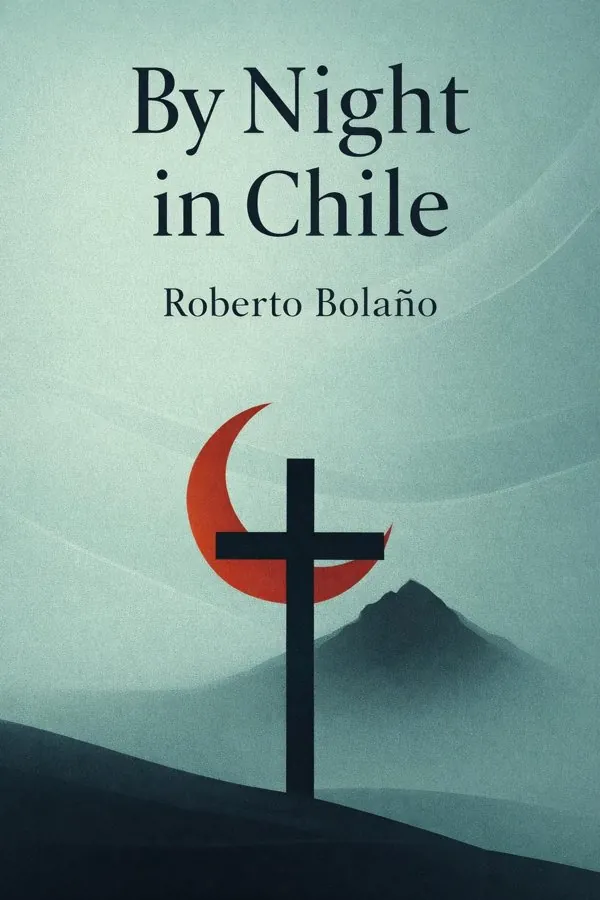
By Night in Chile: Summary & Key Insights
 10 min9 chaptersAudio available
Key Takeaways from By Night in Chile
A life can begin in sincerity and still end in self-deception.
Complicity rarely begins with a grand betrayal; more often, it begins with admiration.
Travel can broaden the mind, but it can also furnish elegant excuses.
Language does not only reveal thought; it can also conceal responsibility.
The most horrifying evil is often not hidden completely; it is merely placed one floor below respectable life.
What Is By Night in Chile About?
By Night in Chile by Roberto Bolaño is a classics book spanning 5 pages. By Night in Chile is a short, mesmerizing novel that reads like a confession delivered in the final hours of a dying man. Roberto Bolaño gives us the voice of Father Sebastián Urrutia Lacroix, a Chilean priest, literary critic, and man of culture who looks back on a life shaped by ambition, refinement, and moral compromise. As his memories move through poetry circles, church influence, European travels, and the years of Augusto Pinochet’s dictatorship, the novel gradually reveals how intellectuals and institutions can become entangled with violence while pretending to remain above it. What makes this book so powerful is its form: a single feverish monologue that circles, evades, justifies, and finally exposes itself. Bolaño does not offer a neat political lesson or a simple moral judgment. Instead, he shows how corruption often thrives in elegant rooms, polished language, and cultivated taste. Widely regarded as one of the essential literary voices of the late twentieth century, Bolaño brings extraordinary authority to this subject through his deep engagement with Latin American history, art, power, and memory.
This FizzRead summary covers all 9 key chapters of By Night in Chile in approximately 10 minutes, distilling the most important ideas, arguments, and takeaways from Roberto Bolaño's work. Also available as an audio summary and Key Quotes Podcast.
By Night in Chile
By Night in Chile is a short, mesmerizing novel that reads like a confession delivered in the final hours of a dying man. Roberto Bolaño gives us the voice of Father Sebastián Urrutia Lacroix, a Chilean priest, literary critic, and man of culture who looks back on a life shaped by ambition, refinement, and moral compromise. As his memories move through poetry circles, church influence, European travels, and the years of Augusto Pinochet’s dictatorship, the novel gradually reveals how intellectuals and institutions can become entangled with violence while pretending to remain above it. What makes this book so powerful is its form: a single feverish monologue that circles, evades, justifies, and finally exposes itself. Bolaño does not offer a neat political lesson or a simple moral judgment. Instead, he shows how corruption often thrives in elegant rooms, polished language, and cultivated taste. Widely regarded as one of the essential literary voices of the late twentieth century, Bolaño brings extraordinary authority to this subject through his deep engagement with Latin American history, art, power, and memory.
Who Should Read By Night in Chile?
This book is perfect for anyone interested in classics and looking to gain actionable insights in a short read. Whether you're a student, professional, or lifelong learner, the key ideas from By Night in Chile by Roberto Bolaño will help you think differently.
- ✓Readers who enjoy classics and want practical takeaways
- ✓Professionals looking to apply new ideas to their work and life
- ✓Anyone who wants the core insights of By Night in Chile in just 10 minutes
Want the full summary?
Get instant access to this book summary and 100K+ more with Fizz Moment.
Get Free SummaryAvailable on App Store • Free to download
Key Chapters
A life can begin in sincerity and still end in self-deception. That is one of the most unsettling truths at the heart of Father Sebastián Urrutia Lacroix’s story. In his youth, he believes he has been called by both God and literature. He does not see these as competing loyalties. Instead, he imagines they can be joined into a single elevated purpose: to serve truth, beauty, and culture. This fusion gives him identity, status, and a sense of destiny. Yet Bolaño slowly shows how dangerous that self-image can become. When someone believes his refinement proves his virtue, he may stop questioning what he is helping to preserve.
Urrutia’s early life is shaped by books, ritual, and intellectual ambition. His priesthood gives him authority; literary criticism gives him prestige. He learns to move comfortably among elite circles, where taste and intelligence function almost like moral credentials. The tragedy is that he mistakes these credentials for innocence. Rather than asking whether art should confront power, he assumes art itself is a higher realm, untouched by politics. That belief allows him to avoid uncomfortable truths.
This tension remains deeply relevant. Many people still combine noble ideals with personal ambition and fail to notice when the second begins to distort the first. A professor may speak of knowledge while protecting corrupt institutions. A journalist may claim devotion to truth while becoming dependent on access and status. A religious leader may preach morality while overlooking injustice committed by those in his own circle.
Bolaño’s insight is not that faith or art are false, but that they become dangerous when used as shields against self-examination. Urrutia’s calling is real, but he gradually turns it into a justification for passivity and vanity.
Actionable takeaway: Regularly ask whether your highest values are guiding your actions or merely flattering your self-image.
Complicity rarely begins with a grand betrayal; more often, it begins with admiration. Urrutia’s relationship with the influential literary figure Farewell introduces him to the world of Chile’s intellectual aristocracy, where culture, class, and power are closely intertwined. Farewell’s estate feels pastoral, elegant, and almost timeless. It is a place of conversation, poetry, wine, and cultivated manners. For the young priest-critic, it represents arrival. Here he can imagine himself not merely as a student of literature, but as someone admitted into its inner sanctum.
Yet Bolaño makes the estate more than a setting. It becomes a training ground in social submission. Urrutia learns how privilege reproduces itself through hospitality, taste, and selective inclusion. The environment flatters him. It teaches him that belonging to the cultural elite feels like moral elevation, even when it really means adapting oneself to hierarchy. The sadness and beauty of the estate conceal the fact that such spaces often depend on exclusion, deference, and silence.
Farewell himself embodies both mentorship and seduction. He opens doors, offers recognition, and shapes Urrutia’s sense of literary seriousness. But he also draws him into a world where class power appears natural and criticism loses its edge. The lesson Urrutia absorbs is subtle but lasting: one can preserve one’s conscience by speaking elegantly, avoiding scandal, and remaining close to influence.
This pattern appears far beyond Bolaño’s Chile. Young professionals are often socialized in similar ways. An ambitious employee joins an admired institution and slowly adopts its evasions. A writer enters prestigious circles and learns what topics are acceptable. A student seeks mentorship and discovers that advancement often requires tactful blindness.
Bolaño shows that corruption often arrives wrapped in beauty. The estate is seductive precisely because it feels civilized. Urrutia’s downfall is not that he enters this world, but that he never develops the courage to stand apart from it.
Actionable takeaway: When entering elite spaces, pay attention not only to what they celebrate, but also to what they quietly require you to ignore.
Travel can broaden the mind, but it can also furnish elegant excuses. In one of the novel’s most darkly ironic episodes, Urrutia is sent to Europe on a mission connected to preserving churches from bird damage. On the surface, the journey appears practical, even absurdly specific. At a deeper level, it confirms his place within institutional networks of church authority, cultural prestige, and inherited civilization. Europe represents the old world of cathedrals, scholarship, and legitimacy. By moving through it, Urrutia strengthens his belief that he serves something larger and nobler than politics.
Bolaño uses this journey to expose how culture can be mobilized as self-justification. Urrutia encounters ancient buildings, techniques, and traditions that seem to affirm continuity and order. Everything points upward: architecture, doctrine, history, authority. Such symbols give him the reassuring sense that civilization is fragile and must be protected by cultivated men like himself. But this noble framing also distracts from the moral crises unfolding elsewhere. Preservation becomes a way of avoiding confrontation. One can dedicate oneself to protecting roofs while failing to notice the people suffering beneath them.
The metaphor is powerful. Institutions often focus on maintenance when they should be asking harder questions about justice. A university may invest in heritage and branding while ignoring exploitation. A company may protect reputation while tolerating abuse. A government may praise national culture while enabling repression. In each case, the guardians of civilization tell themselves they are doing necessary work. Sometimes they are. But necessity can also become a moral blindfold.
For Urrutia, Europe does not simply expand his world. It trains him in abstraction. He becomes more skilled at speaking of values than embodying them. The trip gives him legitimacy without deepening his courage.
Actionable takeaway: Whenever your work seems noble or civilizing, pause and ask what urgent human realities that noble mission might be helping you overlook.
Language does not only reveal thought; it can also conceal responsibility. Urrutia is not just a priest but a literary critic, and this dual role matters enormously. Criticism allows him to judge style, rank authors, defend standards, and shape cultural memory. It gives him authority without demanding direct action. He can speak brilliantly about form, tradition, and genius while remaining strangely absent from the ethical realities around him. Bolaño presents criticism not as worthless, but as a discipline vulnerable to becoming a mask.
Urrutia’s habits of interpretation help him survive psychologically. He translates conflict into aesthetics, discomfort into nuance, and danger into distance. Even his own life becomes something he narrates rather than confronts. The polished flow of his monologue reveals a man who has spent decades arranging his memories like texts to be interpreted, not wrongs to be admitted. He is eloquent because eloquence is his defense.
This makes the novel especially relevant for anyone who works with ideas. Intellectual life can create a temptation to substitute commentary for accountability. We analyze systems instead of acting within them. We become experts in contradiction, ambiguity, and complexity, and then use those concepts to evade judgment. A cultural critic may write brilliantly about injustice while preserving comfortable relationships with the unjust. A thoughtful manager may explain organizational failure with sophistication while doing nothing to change it.
Bolaño’s challenge is subtle: intelligence does not guarantee moral seriousness. In fact, intelligence can help people rationalize cowardice more effectively. Urrutia is dangerous not because he is crude, but because he is articulate. His words allow him to inhabit a version of himself that seems humane, discerning, and blameless.
The novel does not condemn criticism outright. Rather, it asks whether our interpretations sharpen our ethical perception or merely refine our excuses.
Actionable takeaway: If you are skilled at explaining events, make sure that skill is also leading you toward clearer responsibility, not better self-protection.
The most horrifying evil is often not hidden completely; it is merely placed one floor below respectable life. One of the novel’s most unforgettable episodes centers on gatherings at the home of María Canales, where writers, artists, and intellectuals meet to discuss literature while political prisoners are being tortured in the basement. This image has become central to the book’s reputation because it captures Bolaño’s vision of complicity with devastating precision. The guests are not all executioners. Many may not know the full extent of what is happening. But the structure of the scene matters: culture literally takes place above brutality.
Bolaño is not making a narrow historical point about one house in Chile. He is dramatizing a broader social truth. Refined conversation can coexist with atrocity when people accept insulation as innocence. The artists at the party treat literature as a realm apart, a sanctuary of sensitivity. Yet that very belief allows them to remain in the house. Whether through ignorance, suspicion, denial, or convenience, they continue participating in normality while horror supports it from below.
This image translates chillingly into modern life. We may enjoy comfort, prestige, or entertainment while systems of exploitation remain deliberately out of sight. Consumers benefit from labor abuses hidden in supply chains. Institutions celebrate values while burying internal violence. Citizens live ordinary lives above political structures that crush others in their name. The issue is not that everyone knows everything. It is that many learn enough to ask questions and then choose not to.
For Urrutia, the party scene becomes an emblem of his whole life. He wants to claim distance from cruelty, but he was present in the world that accommodated it. Bolaño insists that proximity matters. To remain elegantly detached is itself a moral position.
Actionable takeaway: When a situation allows you comfort alongside another person’s suffering, do not ask only whether you caused it; ask what your continued presence is permitting.
Not speaking can be a form of speech. Throughout By Night in Chile, Urrutia tries to present himself as someone essentially devoted to literature and religion, not politics. He did not see himself as a tyrant, propagandist, or fanatic. He simply moved through his world, writing, teaching, traveling, attending gatherings, and preserving culture. Bolaño’s great moral intervention is to show that this self-description is inadequate. Under dictatorship, especially, silence is not a clean space outside power. It often functions as one of power’s conditions.
The novel shows how authoritarian systems depend not only on direct perpetrators but on networks of accommodation: critics who continue praising beauty, priests who bless order, scholars who prefer complexity to clarity, hosts who maintain social rituals, and bystanders who fear scandal more than injustice. Urrutia belongs to this class. He does not usually command violence, but he helps sustain the atmosphere in which violence can be normalized, denied, and outlived.
This has practical importance beyond the historical setting. In workplaces, communities, and governments, harmful behavior is often enabled by people who consider themselves uninvolved. A team member witnesses abuse and says nothing because speaking would be awkward. A board member avoids confronting misconduct to protect institutional stability. A public figure refuses to comment because neutrality seems safer than moral risk. In each case, silence helps determine what remains possible.
Bolaño does not suggest that every silent person is equally guilty or equally free to act. Fear, dependence, and uncertainty are real. But he does insist that neutrality can become a fiction, especially when one benefits from the surrounding order. Urrutia’s tragedy lies partly in his refusal to understand that he was never outside history.
Actionable takeaway: In moments of visible injustice, stop asking whether the issue is technically your domain and start asking what responsibility comes with your position, knowledge, and silence.
Confession does not always tell the truth; sometimes it is the last strategy of self-defense. The entire novel unfolds as Urrutia’s dying monologue, and this form is essential. He speaks because he feels accused, haunted by what he calls the wizened youth, a troubling figure who seems to embody his conscience, his critics, and perhaps the younger self he betrayed. As he recalls his life, his memories do not move cleanly from event to event. They circle, hesitate, justify, revise, and suddenly sharpen. Bolaño captures the mind under pressure, trying to make a coherent story out of a compromised life.
What makes this so powerful is that Urrutia may be revealing himself most clearly when he is attempting to excuse himself. He insists on nuance, on context, on the complexity of circumstances. Some of what he says is surely true. But the very texture of his narration shows how memory protects identity. Human beings rarely remember themselves as villains. We reinterpret choices, minimize omissions, and emphasize noble motives. The result is not always deliberate lying. Often it is a subtler process of survival.
This dynamic is familiar in everyday life. After a failed relationship, a person recounts events in a way that preserves self-respect. After organizational wrongdoing, leaders describe mistakes as misunderstandings. After years in a morally compromised environment, individuals remember themselves as powerless observers rather than willing participants. The stories may contain facts, but their arrangement serves a need.
Bolaño invites readers to listen skeptically and compassionately at once. Urrutia is not simply a monster; he is a recognizable human mind trying to live with itself. That is what makes the book disturbing. It suggests that moral failure is often accompanied by narrative intelligence.
Actionable takeaway: When reviewing your past, pay special attention to the stories that make you appear consistently noble, passive, or misunderstood; they may conceal the truths you most need to face.
Sometimes the harshest judge is not society but the part of the self that never accepted the compromise. The mysterious figure of the wizened youth haunts Urrutia’s final monologue and gives the novel much of its psychological tension. This youth is not a fully realistic character in the conventional sense. He operates more like a symbolic presence: a critic, a witness, a conscience, an embodiment of resentment, perhaps even the spirit of the younger generation. However we interpret him, his function is clear. He prevents Urrutia from resting inside his polished version of events.
The youth matters because he punctures the authority of the speaker. Urrutia wants to control the narrative, but the presence of this accusing figure means he is never alone with his memories. Every elegant explanation trembles under implied accusation. Was he innocent, or merely insulated? Was he cultured, or evasive? Was he loyal to literature, or loyal to his own comfort? The youth forces these questions without offering easy answers.
In practical terms, the wizened youth represents the voices that institutions and individuals often try to dismiss: younger critics, moral outsiders, inconvenient witnesses, or our own suppressed unease. In organizations, such voices may be mocked as naive or extreme. In families, they may be called ungrateful. In political life, they may be branded disruptive. Yet these are often the voices that detect corruption before it becomes undeniable.
Bolaño resists sentimentalizing the youth. Accusation can be messy, angry, and imperfect. Still, the novel suggests that without such disturbance, self-justifying systems remain intact. Urrutia does not collapse because he suddenly discovers objective truth. He collapses because the accusatory pressure will not let his carefully curated identity remain undisturbed.
Actionable takeaway: Do not dismiss the uncomfortable voice that questions your integrity too quickly; whether it comes from others or from within, it may be pointing toward the moral reality your polished story excludes.
The dream of pure art is one of the novel’s most beautiful and most dangerous illusions. Urrutia loves literature deeply, and Bolaño never mocks that love outright. Poetry, criticism, and intellectual conversation are sources of real pleasure and meaning in the book. Yet By Night in Chile relentlessly asks what happens when art imagines itself above history. The answer is bleak: art does not become pure, only politically useful to those who benefit from its supposed purity.
Throughout the novel, literary life appears both exalted and compromised. Writers gather to discuss form and genius while the nation suffers. Critics defend standards while social reality grows catastrophic. Cultural prestige survives regime change more easily than moral credibility. Bolaño’s point is not that artists must become propagandists or abandon aesthetic seriousness. Rather, he argues that art always exists inside structures of power, privilege, and violence, whether it admits that fact or not.
This lesson applies widely. Creative professionals often face pressure to treat their work as separate from institutions, money, politics, or labor conditions. A filmmaker may focus on artistry while ignoring exploitative production practices. A museum may celebrate masterpieces while benefiting from dubious patronage. A novelist may claim detachment from politics while enjoying systems that silence others. The insistence on purity can itself become an ideological convenience.
What Bolaño preserves, however, is the importance of art’s moral risk. Literature matters precisely because it can expose hidden relations between culture and violence. By Night in Chile is itself proof. It uses style, ambiguity, irony, and voice not to evade ethics, but to deepen them.
Actionable takeaway: If you value art, do not protect it by isolating it from the world; protect it by asking how it is shaped by power and how it might illuminate what power wants hidden.
All Chapters in By Night in Chile
About the Author
Roberto Bolaño (1953–2003) was a Chilean novelist, poet, and essayist whose work transformed contemporary Latin American literature. Born in Santiago, he spent parts of his life in Chile, Mexico, and Spain, and those experiences of movement, exile, and political upheaval deeply shaped his fiction. Bolaño first devoted himself to poetry before gaining international recognition as a novelist. His major works include The Savage Detectives, 2666, Amulet, and By Night in Chile, books celebrated for their experimental structures, intellectual intensity, and probing treatment of violence, art, and memory. Bolaño often wrote about writers, critics, outsiders, and the moral failures hidden inside cultural life. Though he died at age fifty, his influence expanded rapidly after his death, and he is now widely regarded as one of the essential literary voices of the modern era.
Get This Summary in Your Preferred Format
Read or listen to the By Night in Chile summary by Roberto Bolaño anytime, anywhere. FizzRead offers multiple formats so you can learn on your terms — all free.
Available formats: App · Audio · PDF · EPUB — All included free with FizzRead
Download By Night in Chile PDF and EPUB Summary
Key Quotes from By Night in Chile
“A life can begin in sincerity and still end in self-deception.”
“Complicity rarely begins with a grand betrayal; more often, it begins with admiration.”
“Travel can broaden the mind, but it can also furnish elegant excuses.”
“Language does not only reveal thought; it can also conceal responsibility.”
“The most horrifying evil is often not hidden completely; it is merely placed one floor below respectable life.”
Frequently Asked Questions about By Night in Chile
By Night in Chile by Roberto Bolaño is a classics book that explores key ideas across 9 chapters. By Night in Chile is a short, mesmerizing novel that reads like a confession delivered in the final hours of a dying man. Roberto Bolaño gives us the voice of Father Sebastián Urrutia Lacroix, a Chilean priest, literary critic, and man of culture who looks back on a life shaped by ambition, refinement, and moral compromise. As his memories move through poetry circles, church influence, European travels, and the years of Augusto Pinochet’s dictatorship, the novel gradually reveals how intellectuals and institutions can become entangled with violence while pretending to remain above it. What makes this book so powerful is its form: a single feverish monologue that circles, evades, justifies, and finally exposes itself. Bolaño does not offer a neat political lesson or a simple moral judgment. Instead, he shows how corruption often thrives in elegant rooms, polished language, and cultivated taste. Widely regarded as one of the essential literary voices of the late twentieth century, Bolaño brings extraordinary authority to this subject through his deep engagement with Latin American history, art, power, and memory.
More by Roberto Bolaño
You Might Also Like



Browse by Category
Ready to read By Night in Chile?
Get the full summary and 100K+ more books with Fizz Moment.