
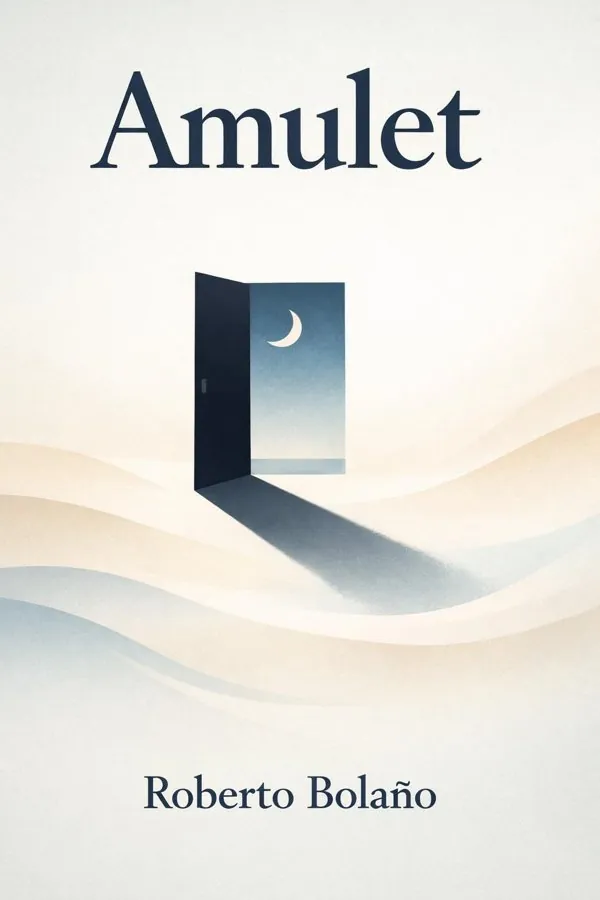
Amulet: Summary & Key Insights
 10 min8 chaptersAudio available
Key Takeaways from Amulet
Exile is not only a loss of homeland; it can also become a way of seeing.
When the world becomes unbearable, memory can function as both shelter and resistance.
There are truths that sober realism cannot easily reach.
One of the most haunting ideas in Amulet is that youth can appear radiant precisely when it is moving toward danger.
History is often recorded by officials, institutions, and public heroes, but some of its deepest truths are preserved by marginal figures.
What Is Amulet About?
Amulet by Roberto Bolaño is a classics book spanning 4 pages. Roberto Bolaño’s Amulet is a brief novel with the force of a prophecy. First published in Spanish in 1999, it is narrated by Auxilio Lacouture, a Uruguayan exile in Mexico City who calls herself “the mother of Mexican poetry.” Her story begins with a historical event: in 1968, when the Mexican army occupied the National Autonomous University of Mexico, Auxilio hid for days in a bathroom in the Faculty of Philosophy and Letters. From that cramped refuge, memory opens outward into a vast meditation on youth, literature, violence, friendship, and the strange duty of surviving. What follows is not a conventional plot so much as a lyrical act of witness, where private recollection and national trauma merge. The novel matters because it captures how history enters intimate life, and how art becomes both shelter and warning when politics turns brutal. Bolaño, one of the most important Latin American writers of the late twentieth century, brings to the book his signature obsessions—exile, poetry, wandering, and the doomed brilliance of young artists—creating a haunting, compact masterpiece that rewards both first-time readers and longtime admirers.
This FizzRead summary covers all 8 key chapters of Amulet in approximately 10 minutes, distilling the most important ideas, arguments, and takeaways from Roberto Bolaño's work. Also available as an audio summary and Key Quotes Podcast.
Amulet
Roberto Bolaño’s Amulet is a brief novel with the force of a prophecy. First published in Spanish in 1999, it is narrated by Auxilio Lacouture, a Uruguayan exile in Mexico City who calls herself “the mother of Mexican poetry.” Her story begins with a historical event: in 1968, when the Mexican army occupied the National Autonomous University of Mexico, Auxilio hid for days in a bathroom in the Faculty of Philosophy and Letters. From that cramped refuge, memory opens outward into a vast meditation on youth, literature, violence, friendship, and the strange duty of surviving. What follows is not a conventional plot so much as a lyrical act of witness, where private recollection and national trauma merge. The novel matters because it captures how history enters intimate life, and how art becomes both shelter and warning when politics turns brutal. Bolaño, one of the most important Latin American writers of the late twentieth century, brings to the book his signature obsessions—exile, poetry, wandering, and the doomed brilliance of young artists—creating a haunting, compact masterpiece that rewards both first-time readers and longtime admirers.
Who Should Read Amulet?
This book is perfect for anyone interested in classics and looking to gain actionable insights in a short read. Whether you're a student, professional, or lifelong learner, the key ideas from Amulet by Roberto Bolaño will help you think differently.
- ✓Readers who enjoy classics and want practical takeaways
- ✓Professionals looking to apply new ideas to their work and life
- ✓Anyone who wants the core insights of Amulet in just 10 minutes
Want the full summary?
Get instant access to this book summary and 100K+ more with Fizz Moment.
Get Free SummaryAvailable on App Store • Free to download
Key Chapters
Exile is not only a loss of homeland; it can also become a way of seeing. Auxilio Lacouture arrives in Mexico City as a poor Uruguayan outsider, but her marginal status gives her a special role inside the literary world. She has little money, no institutional power, and no stable place in society, yet she moves among students, poets, and dreamers with fierce loyalty. Rather than belonging through status, she belongs through attention. She listens, remembers, protects, and witnesses. That is why she becomes, in her own mythic phrase, “the mother of Mexican poetry.” Her motherhood is symbolic: she nourishes not bodies but fragile artistic lives.
Bolaño uses Auxilio’s exile to show how cultural belonging often comes from shared vision rather than nationality. She is not Mexican by birth, but she becomes central to a Mexican literary generation because she believes in it. Her life among poets is messy, improvised, and often comic, but it is also serious. She understands that artistic communities are built from conversation, admiration, generosity, and memory. In this sense, exile sharpens her sensitivity. Because she has no secure place, she learns to make a home out of voices, books, cafés, and friendships.
This idea applies beyond literature. Many people today build identity far from where they were born: immigrants, students, creatives, and professionals who live between cultures. Amulet suggests that belonging can be created through care for a community’s aspirations, not just through documents or geography. If you feel like an outsider in a new environment, notice where your loyalty and curiosity naturally go. Support the people and ideas that matter to you. Actionable takeaway: build your sense of home by becoming a meaningful witness and contributor to the communities you love.
When the world becomes unbearable, memory can function as both shelter and resistance. The central event of Amulet is Auxilio’s confinement in a university bathroom during the military occupation of the National Autonomous University of Mexico in 1968. Hidden in a stall while soldiers move through the building, she survives by waiting, thinking, remembering, and drifting into visions. The bathroom is a physical prison, but it also becomes a strange observatory from which she sees the fragility of an entire generation. Her body is trapped, yet her mind expands outward across years, friendships, and futures.
Bolaño transforms this episode into more than a survival story. Auxilio’s recollections are fragmented, repetitive, and dreamlike because trauma rarely arranges itself into neat chronology. Instead, memory circles, intensifies, distorts, and returns. The novel suggests that remembering is not passive. It is a labor. Auxilio must keep hold of language, names, scenes, and poetic life so that terror does not erase them. Her mental wandering is how she resists dehumanization. She cannot stop the army, but she can refuse to let the event become blankness.
This has practical relevance in any period of crisis. In hard moments, people often cling to routines of memory: journaling, naming what happened, speaking with trusted friends, preserving details before they disappear. Such acts are not sentimental. They help restore continuity when fear disrupts ordinary life. Auxilio’s survival depends on inner narration—the ability to keep telling a story, however unstable, while history bears down. Actionable takeaway: when facing confusion or fear, create a record of experience—through writing, reflection, or conversation—so memory becomes a tool of endurance rather than a source of silence.
There are truths that sober realism cannot easily reach. In Amulet, poetry and madness often seem to overlap, not because Bolaño romanticizes breakdown, but because extreme history fractures ordinary perception. Auxilio’s voice moves between anecdote, confession, prophecy, and hallucination. She sees patterns in the city, senses danger in youth, and feels that poetry itself is entangled with catastrophe. Her mind does not proceed logically from point A to point B; it swirls, leaps, and doubles back. Yet this instability reveals something essential: historical violence is itself irrational, and to represent it honestly may require a language that feels haunted.
Poetry in the novel is not simply literature on a page. It is a mode of heightened attention, of hearing hidden music beneath ordinary speech. It allows Auxilio to perceive how beauty and doom coexist. At the same time, the book refuses easy idealization. Many poets in Bolaño’s world are vulnerable, poor, immature, arrogant, or lost. Their sensitivity does not save them from history. If anything, it exposes them more acutely to it. The result is a vision in which art is precious but precarious.
Readers can apply this insight by recognizing that some experiences cannot be reduced to data or straightforward explanation. Grief, social upheaval, and moral confusion often require metaphor, art, and layered language to be understood. This does not mean abandoning clarity; it means allowing complexity. If a difficult experience resists tidy summary, try describing it indirectly through images, associations, or creative reflection. Actionable takeaway: use artistic forms—poetry, metaphor, sketching, or reflective writing—to explore realities that feel too complicated for plain statement alone.
One of the most haunting ideas in Amulet is that youth can appear radiant precisely when it is moving toward danger. Auxilio sees young poets not just as individuals but as a generation advancing through history. Her visions often feel prophetic: she senses futures of disappearance, disappointment, suffering, and death. The famous image of young people walking or singing into darkness condenses the novel’s emotional power. It is not merely nostalgia for a vanished bohemia; it is mourning in advance, a recognition that idealism is often crushed by politics, time, and reality.
This procession of poets also broadens the novel beyond one woman’s memory. Auxilio becomes a witness for many lives, especially those of students and artists marked by the violence surrounding 1968. Bolaño links the local tragedy of Mexico to a wider Latin American history of repression and shattered possibility. The young are full of talent, jokes, arguments, erotic energy, and literary ambition, yet they are not protected by any of it. The novel asks what it means to love a generation that may be doomed, and how one continues speaking after seeing that doom approach.
The idea resonates whenever communities invest hope in young people while failing to protect them—from political repression, economic despair, war, addiction, or neglect. Admiring youthful brilliance is not enough. It must be accompanied by structures of care, remembrance, and truth-telling. In practical terms, this means taking mentorship seriously, preserving testimonies, and refusing to dismiss early signs of harm. Actionable takeaway: if you are part of a community with younger members, do more than celebrate their potential—actively protect their future through guidance, advocacy, and honest remembrance.
History is often recorded by officials, institutions, and public heroes, but some of its deepest truths are preserved by marginal figures. Auxilio is not a politician, professor, or famous writer. She is an eccentric woman on the edges of literary life, sometimes dismissed, often underestimated. Yet she becomes the novel’s moral center because she sees what others overlook and remembers what power would rather forget. Her position at the margins allows her to hold fragments that official history might flatten or erase.
Bolaño’s choice of narrator is crucial. By giving voice to someone socially precarious, he challenges the assumption that authority belongs only to those with status. Auxilio’s testimony is imperfect, subjective, and unstable, but that very imperfection makes it humanly convincing. Large events are not experienced in abstract clarity. They are lived through fear, confusion, rumor, bodily discomfort, and partial understanding. Her witness reminds us that history is made not only of declarations and dates but of trembling individuals trying to stay alive.
This perspective matters in modern life, where public narratives are often shaped by media simplification, institutional language, and dominant voices. Whether in workplaces, families, communities, or nations, crucial realities are frequently best understood by listening to those on the edges: assistants, migrants, caretakers, students, the elderly, and the socially invisible. Their accounts may be messy, but they often reveal what polished summaries conceal. Actionable takeaway: when trying to understand a major event or conflict, deliberately seek out the voices of people without obvious power, and treat their lived experience as essential evidence rather than anecdotal background.
Books do not stop violence, but they can preserve human meaning inside it. Throughout Amulet, literature serves as both sanctuary and alarm. Auxilio and the poets around her live through reading, talking, reciting, and imagining. Poems offer companionship, identity, and a vocabulary for longing. In moments of danger, literary memory becomes a place to retreat inwardly. Yet Bolaño never presents literature as a safe escape detached from reality. On the contrary, poetry in the novel often intensifies awareness of danger. It teaches readers to hear omens, to recognize the vulnerability of beauty, and to sense how quickly culture can be threatened.
This dual role makes the novel especially powerful. Literature shelters by creating interior freedom; it warns by sharpening perception. Auxilio’s attachment to poetry allows her to endure isolation, but it also makes her acutely conscious of historical catastrophe. The educated space of the university, supposedly devoted to thought and culture, is violated by armed force. The message is stark: civilization is fragile, and art must not assume immunity from politics.
For contemporary readers, this insight can reshape how we value reading. Literature is not only entertainment or prestige; it can also be a practice of moral attention. A novel may help us notice patterns of cruelty, exclusion, and denial before they become normalized. At a personal level, reading can provide steadiness during loneliness or turmoil. At a civic level, it can deepen empathy and vigilance. Actionable takeaway: treat reading as both nourishment and training—choose books that comfort you, but also books that sharpen your ability to recognize moral danger in the world around you.
Some experiences refuse to stay in the past. Amulet is structured less like a linear narrative than like a spiral of recollection. Auxilio moves between decades, revisits the same moments, and slips from memory into premonition. This unusual treatment of time reflects the emotional truth of trauma and nostalgia. The past does not sit neatly behind us; it returns in flashes, associations, and repetitions. Likewise, the future can haunt the present when we sense consequences before they fully arrive.
Bolaño uses this spiral form to show that understanding is gradual and unstable. We do not grasp history in one clean glance. We circle it, reinterpret it, and discover new meanings as other events unfold. Auxilio’s storytelling therefore becomes an act of searching rather than reporting. She is not simply telling us what happened. She is trying to make contact with a reality too large and painful to hold all at once. The result is a novel where mood, recurrence, and resonance matter as much as plot progression.
This insight is useful in everyday reflection. People often pressure themselves to “move on” from major life events as if recovery were linear. But grief, upheaval, and transformation are usually cyclical. Memories return unexpectedly. Old episodes take on new significance. Progress can include repetition. Recognizing this can reduce shame and increase patience. Instead of demanding a straight narrative from your life, allow for revisiting and reinterpreting. Actionable takeaway: when reflecting on a difficult or formative experience, accept nonlinear understanding—return to it over time, and notice how each revisit reveals a different layer rather than a failure to move forward.
Care is not limited to family structures or biological roles. Auxilio calls herself the mother of Mexican poetry, and while the phrase is partly ironic and self-mythologizing, it also captures a serious ethical stance. She mothers through presence. She notices hungry students, drifting artists, lonely young men, and vulnerable dreamers. She offers encouragement, gossip, emotional shelter, and symbolic protection. In a world where many young poets are unstable or neglected, her voice tries to hold them together, even if only through memory.
Bolaño complicates the idea of motherhood by separating it from domestic normalcy. Auxilio is not an idealized caretaker in a secure home. She is poor, erratic, and often adrift herself. Yet she still performs a form of communal care. This suggests that nurturing can emerge from solidarity rather than convention. It can be intellectual, artistic, and spiritual. It can mean seeing promise in others before the world does, or refusing to let their names disappear after tragedy.
The relevance of this idea is broad. Many people become “parents” in nonliteral ways: teachers to students, older colleagues to new hires, community elders to emerging artists, friends to those who feel alone. Such care may not solve structural problems, but it can profoundly affect whether someone persists in their path. The novel invites us to value this kind of informal guardianship. Actionable takeaway: identify one younger or more vulnerable person in your orbit whom you can support through attention, encouragement, and practical kindness, and make that support consistent rather than occasional.
All Chapters in Amulet
About the Author
Roberto Bolaño (1953–2003) was a Chilean novelist, poet, and essayist whose work transformed contemporary Latin American literature. Born in Santiago, he spent parts of his youth in Mexico and later settled in Spain, experiences that deeply shaped his writing about exile, wandering, and literary subcultures. Bolaño first devoted himself to poetry, and that poetic sensibility remained central to his fiction, even in his most ambitious novels. He became internationally celebrated for works such as The Savage Detectives, By Night in Chile, and the posthumously published 2666. His books often explore violence, failed utopias, obscure writers, and the uneasy relationship between art and history. Though he died at just fifty, Bolaño left behind a body of work that continues to influence writers and readers around the world.
Get This Summary in Your Preferred Format
Read or listen to the Amulet summary by Roberto Bolaño anytime, anywhere. FizzRead offers multiple formats so you can learn on your terms — all free.
Available formats: App · Audio · PDF · EPUB — All included free with FizzRead
Download Amulet PDF and EPUB Summary
Key Quotes from Amulet
“Exile is not only a loss of homeland; it can also become a way of seeing.”
“When the world becomes unbearable, memory can function as both shelter and resistance.”
“There are truths that sober realism cannot easily reach.”
“One of the most haunting ideas in Amulet is that youth can appear radiant precisely when it is moving toward danger.”
“History is often recorded by officials, institutions, and public heroes, but some of its deepest truths are preserved by marginal figures.”
Frequently Asked Questions about Amulet
Amulet by Roberto Bolaño is a classics book that explores key ideas across 8 chapters. Roberto Bolaño’s Amulet is a brief novel with the force of a prophecy. First published in Spanish in 1999, it is narrated by Auxilio Lacouture, a Uruguayan exile in Mexico City who calls herself “the mother of Mexican poetry.” Her story begins with a historical event: in 1968, when the Mexican army occupied the National Autonomous University of Mexico, Auxilio hid for days in a bathroom in the Faculty of Philosophy and Letters. From that cramped refuge, memory opens outward into a vast meditation on youth, literature, violence, friendship, and the strange duty of surviving. What follows is not a conventional plot so much as a lyrical act of witness, where private recollection and national trauma merge. The novel matters because it captures how history enters intimate life, and how art becomes both shelter and warning when politics turns brutal. Bolaño, one of the most important Latin American writers of the late twentieth century, brings to the book his signature obsessions—exile, poetry, wandering, and the doomed brilliance of young artists—creating a haunting, compact masterpiece that rewards both first-time readers and longtime admirers.
More by Roberto Bolaño
You Might Also Like






Browse by Category
Ready to read Amulet?
Get the full summary and 100K+ more books with Fizz Moment.