
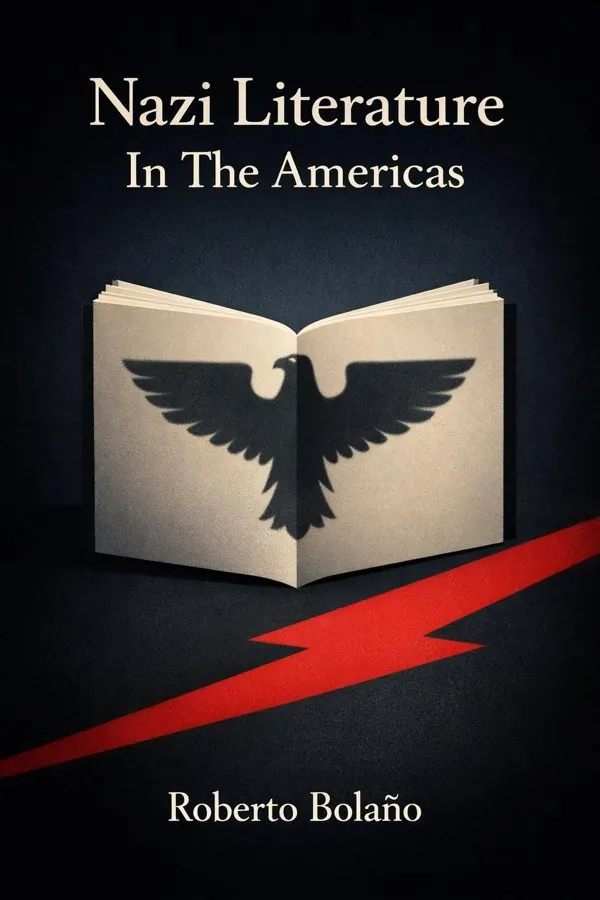
Nazi Literature In The Americas: Summary & Key Insights
 10 min9 chaptersAudio available
Key Takeaways from Nazi Literature In The Americas
A dark tradition rarely begins with monsters; it begins with people who make ugliness sound refined.
Some ideologies survive not because they persuade everyone, but because families teach them as culture.
Artistic ambition becomes dangerous when it mistakes grandiosity for greatness.
When aesthetics become tribal, culture turns into a recruiting tool.
Evil is easier to misunderstand when we imagine it always wearing the same face.
What Is Nazi Literature In The Americas About?
Nazi Literature In The Americas by Roberto Bolaño is a classics book spanning 9 pages. What if a literary encyclopedia could feel more dangerous than a novel? In Nazi Literature In The Americas, Roberto Bolaño invents an entire canon of fascist, reactionary, and delusional writers scattered across North and South America, then presents them with the calm authority of a reference book. The result is eerie, funny, and deeply unsettling. Each entry reads like a miniature biography, but together they form something larger: a portrait of how art can become entangled with vanity, extremism, mythmaking, and violence. What makes the book matter is not simply its satire of right-wing intellectuals. Bolaño is asking a harder question: what happens when literary ambition detaches itself from moral seriousness? The answer, in these pages, is often absurdity shading into horror. The book also anticipates many contemporary concerns, including ideological performance, cultish artistic scenes, and the seduction of cultural prestige. Bolaño, one of the most important Latin American writers of the late twentieth century, brings unusual authority to this project. As a poet, novelist, and sharp observer of political disillusionment, he transforms a fake encyclopedia into a haunting meditation on literature, power, and evil.
This FizzRead summary covers all 9 key chapters of Nazi Literature In The Americas in approximately 10 minutes, distilling the most important ideas, arguments, and takeaways from Roberto Bolaño's work. Also available as an audio summary and Key Quotes Podcast.
Nazi Literature In The Americas
What if a literary encyclopedia could feel more dangerous than a novel? In Nazi Literature In The Americas, Roberto Bolaño invents an entire canon of fascist, reactionary, and delusional writers scattered across North and South America, then presents them with the calm authority of a reference book. The result is eerie, funny, and deeply unsettling. Each entry reads like a miniature biography, but together they form something larger: a portrait of how art can become entangled with vanity, extremism, mythmaking, and violence.
What makes the book matter is not simply its satire of right-wing intellectuals. Bolaño is asking a harder question: what happens when literary ambition detaches itself from moral seriousness? The answer, in these pages, is often absurdity shading into horror. The book also anticipates many contemporary concerns, including ideological performance, cultish artistic scenes, and the seduction of cultural prestige.
Bolaño, one of the most important Latin American writers of the late twentieth century, brings unusual authority to this project. As a poet, novelist, and sharp observer of political disillusionment, he transforms a fake encyclopedia into a haunting meditation on literature, power, and evil.
Who Should Read Nazi Literature In The Americas?
This book is perfect for anyone interested in classics and looking to gain actionable insights in a short read. Whether you're a student, professional, or lifelong learner, the key ideas from Nazi Literature In The Americas by Roberto Bolaño will help you think differently.
- ✓Readers who enjoy classics and want practical takeaways
- ✓Professionals looking to apply new ideas to their work and life
- ✓Anyone who wants the core insights of Nazi Literature In The Americas in just 10 minutes
Want the full summary?
Get instant access to this book summary and 100K+ more with Fizz Moment.
Get Free SummaryAvailable on App Store • Free to download
Key Chapters
A dark tradition rarely begins with monsters; it begins with people who make ugliness sound refined. In the opening movement of Nazi Literature In The Americas, Bolaño introduces early twentieth-century proto-fascist poets, critics, and dreamers whose lives prepare the ground for later, more explicit extremism. These figures are not presented as cartoon villains. Instead, they are shown as ambitious, isolated, often ridiculous writers who slowly convert prejudice, elitism, and resentment into literary identity.
This matters because Bolaño is less interested in ideology as a set of slogans than in the atmosphere that allows ideology to become culturally respectable. The early figures admire order, hierarchy, racial mythology, and heroic decline. They often believe they are defending civilization. Yet their work reveals insecurity disguised as conviction. The encyclopedia format makes this especially effective: each biography sounds objective, as if literary history itself has absorbed these people and normalized them.
A practical way to understand these entries is to compare them with real cultural history. Many intellectual movements do not announce their worst intentions at first. They emerge through salons, magazines, small circles of influence, and arguments about standards or purity. Bolaño dramatizes how aesthetic posturing can quietly become political extremism.
For readers today, the lesson is clear: pay attention not only to open fanaticism but also to the stylish language that prepares its arrival. When a cultural scene becomes obsessed with purity, superiority, and exclusion, it may be building more than a literary movement. Actionable takeaway: examine how ideas are packaged, and never confuse sophistication of style with moral seriousness.
Some ideologies survive not because they persuade everyone, but because families teach them as culture. The Mendiluce clan, one of Bolaño’s most memorable inventions, turns fascist aesthetics into a dynastic project. Across generations in Argentina, the family pursues influence through poetry, publishing, social circles, and carefully cultivated myths about lineage and destiny. Their story demonstrates how extremism can be inherited not merely as belief, but as taste, ambition, and social performance.
What makes this section so compelling is Bolaño’s understanding that ideology often hides inside domestic life. The Mendiluces do not simply write offensive literature; they construct a family identity around literary authority. They use marriage, patronage, and reputation to preserve an intellectual caste. In this way, Bolaño shows that political corruption is not always dramatic. Sometimes it is embedded in rituals, education, and inherited self-importance.
A useful modern parallel can be found in any environment where cultural capital is passed down and treated as proof of worth. Whether in elite institutions, media circles, or artistic communities, families and networks can turn exclusion into tradition. Bolaño exaggerates this dynamic into satire, but the underlying mechanism is recognizable.
The deeper insight here is that literature is never only about books. It is also about who gets to define quality, who gets remembered, and who gets protected from scrutiny. The Mendiluce family weaponizes all three.
Actionable takeaway: whenever a cultural authority presents itself as natural, inherited, or beyond question, ask what values are being preserved underneath that confidence and who benefits from that preservation.
Artistic ambition becomes dangerous when it mistakes grandiosity for greatness. In the section often associated with the so-called Icarus School, Bolaño satirizes writers and artists who want transcendence so badly that they drift into self-destructive myth. These figures imagine themselves soaring above ordinary morality, politics, and even reality. Like Icarus, they fly toward an idealized sun, convinced that artistic destiny excuses everything.
Bolaño uses them to expose a recurring fantasy in literary culture: the belief that true art must be ruthless, pure, or above ethical judgment. The characters linked to this tendency often produce manifestos, cultivate disciples, and confuse theatrical extremity with originality. Their work may sound visionary, but behind the pose lies emptiness, vanity, or cruelty.
This idea has practical relevance well beyond fiction. In many creative fields, people are tempted to romanticize the troubled genius, the rule-breaker, or the provocateur who claims to offend in the name of art. Bolaño’s answer is sharp: transgression is not depth, and self-mythology is not talent. By wrapping these lives in encyclopedia prose, he strips away glamour and leaves only the pattern of obsession.
Readers can apply this insight whenever they encounter cultural figures who demand admiration for their audacity alone. Ask simple questions: Does the work illuminate anything? Does it deepen understanding? Or does it merely perform rebellion as a brand?
Actionable takeaway: resist the temptation to equate extremity with excellence. In art, as in politics, what looks daring from a distance may actually be a form of evasion, narcissism, or decay.
When aesthetics become tribal, culture turns into a recruiting tool. In the strand of the book that can be described as the Aryan Brotherhood of the Arts, Bolaño imagines artists and intellectuals who fuse racism, elitism, and literary aspiration into a shared subculture. They do not just write books; they build networks, magazines, alliances, and myths that make their politics feel like an artistic calling.
The brilliance of this section lies in how calmly Bolaño maps these circles. He shows how extremist scenes create legitimacy through small institutions: little journals, private readings, manifestos, mentorships, and feuds. None of these elements seems world-historical on its own. But together they create a self-reinforcing world in which ugliness feels noble and exclusion feels cultivated.
This pattern is highly recognizable. Harmful ideas often spread less through formal doctrine than through communities that make members feel chosen. In workplaces, online spaces, or artistic subcultures, people are often drawn in not by arguments first, but by belonging. Bolaño’s invented brotherhood captures that emotional logic with disturbing precision.
Another important point is that these networks thrive on imitation. Writers borrow one another’s obsessions, repeat coded language, and amplify each other’s status. The result is a counterfeit tradition: loud, self-referential, and eager for historical significance.
For contemporary readers, this section offers a practical method of analysis. Do not look only at individual statements; examine the ecosystem around them. Ask who platforms whom, what symbols are repeated, and how aesthetics are being used to hide coercion or hate.
Actionable takeaway: evaluate cultural movements as systems, not just as isolated works, because communities can normalize what individuals alone might hesitate to say openly.
Evil is easier to misunderstand when we imagine it always wearing the same face. Bolaño complicates that assumption by including women among his invented fascist and reactionary writers. These female figures are not simple exceptions in a male world. They reveal that ideological violence can be embraced, refined, and transmitted across gender lines, often through elegance, sentimentality, or intellectual poise.
This section is important because it dismantles comforting narratives. Readers may expect fascist literary culture to be entirely masculine, but Bolaño shows how women can also participate in authoritarian aesthetics, social exclusion, and mythmaking. Some do so as patrons, some as poets, some as public intellectuals, and some as emotional architects of reactionary culture. Their forms of influence may be subtler than those of overt demagogues, but they are no less consequential.
A practical application of this idea lies in how we study power today. It is a mistake to assume that representation alone guarantees justice or that participation by marginalized identities automatically humanizes institutions. Bolaño reminds us that people of any background can become guardians of cruelty if they align themselves with status, hierarchy, or resentment.
He also highlights how language associated with beauty, morality, family, or civilization can conceal ugly commitments. The female fascist voices in the book often sound cultivated, even tender, which makes their role more unsettling.
Actionable takeaway: judge political and artistic commitments by their effects and assumptions, not by the demographic identity or polished demeanor of the people expressing them.
Bad ideas do not disappear when history condemns them; they adapt, fragment, and go underground. In Bolaño’s portrayal of neo-fascist literary circles, the defeated become conspiratorial. The grand public ambitions of earlier generations shrink into small presses, coded references, obscure gatherings, private obsessions, and underground reputations. Yet defeat does not make them harmless. It often makes them stranger, more secretive, and in some ways more seductive to outsiders seeking forbidden intensity.
Bolaño captures a crucial truth: discredited ideologies can survive as subculture long before they attempt to return as politics. The underground in this book is full of failed poets, isolated editors, and eccentric visionaries who believe history has misunderstood them. That sense of marginality becomes fuel. They turn resentment into identity and obscurity into proof of purity.
This idea applies powerfully to contemporary life. Extremist beliefs frequently persist not in mainstream institutions first, but in niche communities that reward irony, transgression, and insider language. What looks fringe can function as a laboratory for future normalization. Bolaño understood this before digital platforms made such ecosystems more visible.
Another insight is psychological: the underground flatters its members. It offers them a role as guardians of hidden truth. For people who feel ignored or humiliated, that promise can be intoxicating.
Actionable takeaway: do not dismiss marginal cultural spaces simply because they seem small or ridiculous. Track how grievance, secrecy, and aesthetics combine, because the obscure corners of culture often incubate the myths that later seek public power.
Literature can seem distant from bloodshed until power decides to use culture as camouflage. The Chilean connection in Nazi Literature In The Americas brings Bolaño’s project closest to the political trauma that haunts much of his work. Here, the relationship between writers, authoritarianism, and real violence becomes more explicit. The joke grows colder. Satire starts to border on testimony.
For Bolaño, Chile is not just a setting; it is a moral pressure point. The biographies associated with this sphere suggest that literary ambition does not merely coexist with brutality. It can be entangled with it, excusing it, decorating it, or looking away from it. Some figures seek prestige under repressive conditions. Others treat political catastrophe as background noise for their careers. The effect is devastating because it exposes the cowardice and opportunism that can flourish in cultured environments.
Readers can apply this insight whenever art institutions claim neutrality in moments of social crisis. Bolaño asks us to question what neutrality really means when the surrounding world is marked by fear and violence. Silence can become collaboration. Style can become evasion.
This section also helps explain why Bolaño matters as more than a satirist. He is interested in the ethical burden of literary life, especially in Latin America, where dictatorship, exile, and disappearance shaped entire generations. The encyclopedia form lets him document these pressures indirectly, but the emotional truth is unmistakable.
Actionable takeaway: whenever a cultural scene presents itself as above politics, look closely at what realities it ignores, sanitizes, or quietly serves.
Obscurity is not innocence. Many of Bolaño’s invented writers belong to a lost generation spread across the Americas: failed novelists, provincial poets, ideological drifters, and desperate men and women who never achieve the greatness they imagine. Their lives are often comic in scale, but together they form one of the book’s most haunting insights: mediocrity, disappointment, and unrealized ambition can be fertile ground for reactionary fantasy.
These characters matter because Bolaño refuses to focus only on major villains or charismatic leaders. He is equally interested in the minor figures who populate literary history’s shadows. They run tiny journals, publish unread books, quarrel bitterly, and cling to impossible dreams of recognition. Their politics often seem like compensation for artistic failure. Fascism, in this world, offers not just doctrine but a way to feel important.
This is deeply relevant today. People do not always embrace extreme narratives because those narratives are intellectually compelling. Sometimes they do so because the narratives transform humiliation into destiny. A failed career, a sense of exclusion, or a hunger for significance can make dangerous ideas feel emotionally useful.
Bolaño is especially sharp on the Americas as a landscape of broken promises. The dream of reinvention curdles into bitterness. The desire for cultural greatness decays into parody. Yet even these pathetic lives deserve attention, because they help us see how grand ideologies are sustained by ordinary frustration.
Actionable takeaway: when analyzing extremism, look beyond leaders and doctrines to the emotional economies of failure, resentment, and longing that help keep harmful beliefs alive.
The most chilling revelations often arrive after we think the story is over. The final section of Nazi Literature In The Americas, often understood as an epilogue for monsters, shifts the book from satirical encyclopedia to something closer to a premonition. Here Bolaño points toward figures who are no longer merely ridiculous literary cranks. The atmosphere darkens into menace. Aesthetic fascism begins to connect more clearly with physical danger.
This ending is crucial because it reframes everything that came before. The absurd biographies were never just literary jokes. They were studies in incubation. The vanity, cruelty, elitism, and self-mythologizing scattered across earlier entries now appear as stages in the formation of something far worse. Bolaño suggests that evil rarely emerges fully formed. It is assembled through habits of mind, artistic masks, social networks, and tolerated absurdities.
One practical lesson from this structure is that tone can mislead us. We laugh at grotesque people because they seem too marginal or too pathetic to matter. But Bolaño uses laughter as a trap. By the end, readers recognize that mockery is not enough. One must also understand how the ridiculous becomes lethal.
This section also anticipates later Bolaño works, especially his fascination with hidden violence beneath cultural surfaces. The monster at the end is not only a character. It is a revelation about literary history itself.
Actionable takeaway: take seriously the small symptoms of dehumanization, vanity, and ideological theater, because what first appears farcical can become catastrophic when left unexamined.
All Chapters in Nazi Literature In The Americas
About the Author
Roberto Bolaño (1953–2003) was a Chilean novelist, short story writer, and poet whose work transformed contemporary Latin American literature. Born in Santiago, he spent parts of his life in Mexico and later Spain, experiences that shaped his recurring themes of exile, wandering, literary ambition, and political disillusionment. Bolaño first saw himself as a poet, but he became internationally famous for fiction that combines detective-like structures, intellectual play, and haunting meditations on violence and art. His most acclaimed books include The Savage Detectives, By Night in Chile, and the posthumously published 2666. Though he died at just fifty, Bolaño left behind a body of work that continues to influence readers and writers worldwide. His writing is known for its daring form, moral intensity, and fascination with the hidden lives of artists.
Get This Summary in Your Preferred Format
Read or listen to the Nazi Literature In The Americas summary by Roberto Bolaño anytime, anywhere. FizzRead offers multiple formats so you can learn on your terms — all free.
Available formats: App · Audio · PDF · EPUB — All included free with FizzRead
Download Nazi Literature In The Americas PDF and EPUB Summary
Key Quotes from Nazi Literature In The Americas
“A dark tradition rarely begins with monsters; it begins with people who make ugliness sound refined.”
“Some ideologies survive not because they persuade everyone, but because families teach them as culture.”
“Artistic ambition becomes dangerous when it mistakes grandiosity for greatness.”
“When aesthetics become tribal, culture turns into a recruiting tool.”
“Evil is easier to misunderstand when we imagine it always wearing the same face.”
Frequently Asked Questions about Nazi Literature In The Americas
Nazi Literature In The Americas by Roberto Bolaño is a classics book that explores key ideas across 9 chapters. What if a literary encyclopedia could feel more dangerous than a novel? In Nazi Literature In The Americas, Roberto Bolaño invents an entire canon of fascist, reactionary, and delusional writers scattered across North and South America, then presents them with the calm authority of a reference book. The result is eerie, funny, and deeply unsettling. Each entry reads like a miniature biography, but together they form something larger: a portrait of how art can become entangled with vanity, extremism, mythmaking, and violence. What makes the book matter is not simply its satire of right-wing intellectuals. Bolaño is asking a harder question: what happens when literary ambition detaches itself from moral seriousness? The answer, in these pages, is often absurdity shading into horror. The book also anticipates many contemporary concerns, including ideological performance, cultish artistic scenes, and the seduction of cultural prestige. Bolaño, one of the most important Latin American writers of the late twentieth century, brings unusual authority to this project. As a poet, novelist, and sharp observer of political disillusionment, he transforms a fake encyclopedia into a haunting meditation on literature, power, and evil.
More by Roberto Bolaño
You Might Also Like


Browse by Category
Ready to read Nazi Literature In The Americas?
Get the full summary and 100K+ more books with Fizz Moment.