
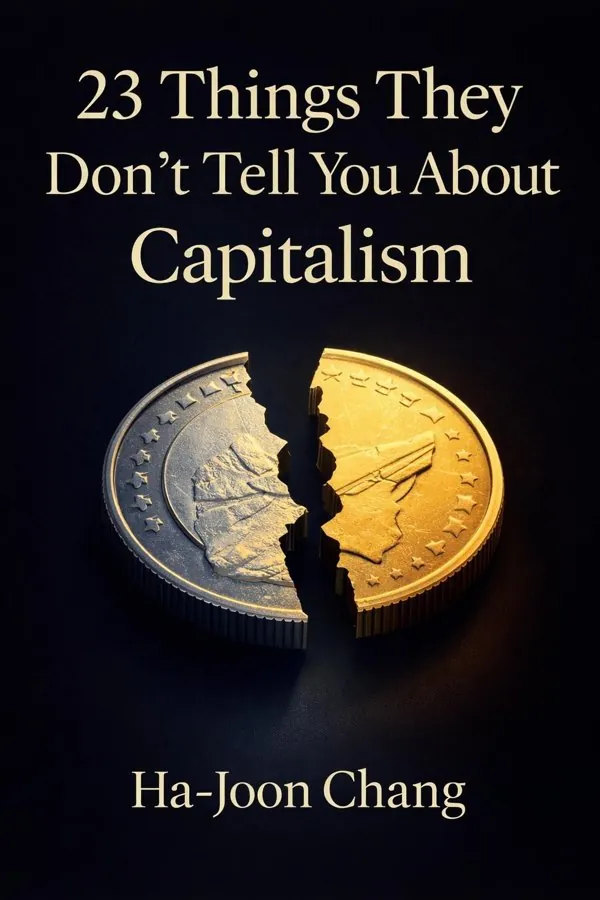
23 Things They Don’t Tell You About Capitalism: Summary & Key Insights
 10 min9 chaptersAudio available
Key Takeaways from 23 Things They Don’t Tell You About Capitalism
A market is never simply “there”; it is designed, protected, and limited by rules.
When companies focus only on maximizing shareholder returns, they often weaken the very foundations of long-term prosperity.
People in rich countries often believe their incomes mainly reflect superior individual productivity, but Chang argues that this is only a partial truth.
Some inventions transform societies not because they are glamorous, but because they reorganize daily life at scale.
If you assume people are selfish and design systems around that assumption, you often encourage more selfish behavior.
What Is 23 Things They Don’t Tell You About Capitalism About?
23 Things They Don’t Tell You About Capitalism by Ha-Joon Chang is a economics book spanning 13 pages. What if the economic “common sense” you hear every day is not neutral truth, but a set of stories designed to make one version of capitalism look inevitable? In 23 Things They Don’t Tell You About Capitalism, Ha-Joon Chang dismantles many of the most familiar claims about markets, globalization, corporations, wealth, and government. He argues that markets are never truly free, that business success depends on institutions and public support, and that rich nations often became rich through policies they now discourage poorer nations from using. Rather than rejecting capitalism outright, Chang asks readers to see it more honestly: as a political and social system shaped by law, power, history, and choices. The book matters because it gives non-specialists a way to think critically about economic debates that affect wages, jobs, inequality, development, and democracy. Chang writes with unusual clarity, using historical examples, everyday logic, and sharp comparisons instead of technical jargon. A Cambridge economist known for challenging neoliberal orthodoxy, he brings academic authority together with a public-minded style that makes complex ideas accessible. The result is a provocative guide to understanding how capitalism actually works—and how it could work better.
This FizzRead summary covers all 9 key chapters of 23 Things They Don’t Tell You About Capitalism in approximately 10 minutes, distilling the most important ideas, arguments, and takeaways from Ha-Joon Chang's work. Also available as an audio summary and Key Quotes Podcast.
23 Things They Don’t Tell You About Capitalism
What if the economic “common sense” you hear every day is not neutral truth, but a set of stories designed to make one version of capitalism look inevitable? In 23 Things They Don’t Tell You About Capitalism, Ha-Joon Chang dismantles many of the most familiar claims about markets, globalization, corporations, wealth, and government. He argues that markets are never truly free, that business success depends on institutions and public support, and that rich nations often became rich through policies they now discourage poorer nations from using. Rather than rejecting capitalism outright, Chang asks readers to see it more honestly: as a political and social system shaped by law, power, history, and choices.
The book matters because it gives non-specialists a way to think critically about economic debates that affect wages, jobs, inequality, development, and democracy. Chang writes with unusual clarity, using historical examples, everyday logic, and sharp comparisons instead of technical jargon. A Cambridge economist known for challenging neoliberal orthodoxy, he brings academic authority together with a public-minded style that makes complex ideas accessible. The result is a provocative guide to understanding how capitalism actually works—and how it could work better.
Who Should Read 23 Things They Don’t Tell You About Capitalism?
This book is perfect for anyone interested in economics and looking to gain actionable insights in a short read. Whether you're a student, professional, or lifelong learner, the key ideas from 23 Things They Don’t Tell You About Capitalism by Ha-Joon Chang will help you think differently.
- ✓Readers who enjoy economics and want practical takeaways
- ✓Professionals looking to apply new ideas to their work and life
- ✓Anyone who wants the core insights of 23 Things They Don’t Tell You About Capitalism in just 10 minutes
Want the full summary?
Get instant access to this book summary and 100K+ more with Fizz Moment.
Get Free SummaryAvailable on App Store • Free to download
Key Chapters
A market is never simply “there”; it is designed, protected, and limited by rules. One of Chang’s most important insights is that the so-called free market is a political construction. Every market depends on laws about property, contracts, bankruptcy, labor conditions, safety, pollution, intellectual property, and who is allowed to buy or sell what. Once you notice that, the idea of a perfectly free market starts to look less like reality and more like ideology.
Chang shows that what counts as acceptable market behavior changes across time and culture. Child labor was once legal in many countries. Long working hours without safety standards were normal. Today, most people accept restrictions in those areas, which means we already believe markets should be morally and socially regulated. The real question is never whether markets should be regulated, but whose interests the rules serve.
This matters in everyday life. When housing becomes unaffordable, medicines are overpriced, or gig workers lack protections, defenders of the status quo often say the market is merely “doing its job.” But Chang’s point is that the market is doing what its rules permit. If those outcomes are harmful, society can change the rules.
For citizens, investors, and workers, this is liberating. It means economic arrangements are not fixed laws of nature. They are public choices. Actionable takeaway: whenever someone says “the market demands it,” ask what legal and political rules created that result—and whether different rules would better serve society.
People in rich countries often believe their incomes mainly reflect superior individual productivity, but Chang argues that this is only a partial truth. Wages are shaped not just by talent or effort, but by institutions, bargaining power, immigration rules, education systems, and the historical advantages of wealthy economies. A bus driver in Stockholm may earn far more than a bus driver in Delhi, not because he personally works many times harder, but because he operates inside a richer social and economic system.
This insight cuts against the comforting belief that market incomes are a simple moral ranking of human worth. The productivity of workers depends heavily on roads, electricity, law enforcement, organizational know-how, public health, supply chains, and national industrial capacity. Even elite salaries at the top are influenced by corporate norms and power structures, not pure market justice.
Chang’s argument has broad implications for debates about migration, global inequality, and executive compensation. If income differences are socially produced, then poverty is not merely an individual failure, and high earnings are not always a clean proof of greater merit. It also means improving public institutions can raise productivity more effectively than endlessly telling individuals to work harder.
In practical terms, this changes how we think about fairness. Instead of idolizing winners and blaming losers, we can focus on building systems that expand capability for more people. Actionable takeaway: evaluate pay and success in context, and support policies—such as education, infrastructure, labor protections, and industrial development—that increase collective productivity rather than glorifying inequality as meritocracy.
Some inventions transform societies not because they are glamorous, but because they reorganize daily life at scale. Chang famously argues that the washing machine changed the world more than the internet, at least in one crucial sense: it dramatically reduced the time spent on unpaid domestic labor, especially by women. That freed millions of people to pursue education, employment, and public life. The lesson is that technological importance should not be measured only by excitement, media attention, or stock market valuation.
He also pushes back against the tendency to divide economies into “old” and “new” sectors, as if digital tools automatically matter more than manufacturing, logistics, energy, or sanitation. Many of the foundations of modern prosperity depend on mundane systems that are easy to overlook. A country obsessed with apps but neglectful of industrial capacity, transport, and basic services may look innovative while becoming economically fragile.
This perspective is useful for policymakers, entrepreneurs, and ordinary consumers. It reminds us to ask who benefits from technology, what problem it solves, and whether it increases broad human capability or merely creates convenience for a subset of users. A factory upgrade, a sewer system, or a vaccine supply chain may matter more to social welfare than the latest online platform.
The deeper point is that progress is social, not just technical. Good technology changes what people are able to do with their time and talents. Actionable takeaway: when evaluating innovation, look beyond hype and ask whether it improves everyday life, expands participation, and strengthens the productive foundations of society.
If you assume people are selfish and design systems around that assumption, you often encourage more selfish behavior. Chang challenges the narrow economic view that humans are motivated mainly by financial incentives and must be disciplined by competition. In reality, trust, reciprocity, professional pride, ethics, and social norms shape economic life just as much as money does. Organizations and societies perform better when they cultivate these motives rather than treating everyone as opportunistic by default.
This idea matters inside companies, schools, governments, and markets. For example, if employees are constantly monitored, ranked, and threatened, they may stop cooperating and focus on protecting themselves. If bankers are rewarded only for short-term deals, they may take reckless risks. If public servants are treated as lazy and corrupt no matter what they do, morale and service quality can deteriorate. Institutional design influences character.
Chang is not claiming people are saints. He is saying that human motivation is mixed and malleable. Policies built on cynicism can produce cynical outcomes, while systems that reward professionalism and responsibility can strengthen them. Countries with effective public services and productive firms often rely on cultures of trust supported by stable institutions, not just punishment and competition.
This has practical relevance in management and public policy. Incentives matter, but so do mission, belonging, and fairness. Actionable takeaway: whether you run a team or evaluate policy, avoid systems that assume the worst in people; build structures that encourage trust, competence, and long-term responsibility.
Periods of low inflation and calm financial indicators can create the illusion that an economy is safer, even when dangerous imbalances are building underneath. Chang argues that the preoccupation with macroeconomic stability—especially inflation control, balanced budgets, and central bank credibility—has often distracted from the real sources of instability: weak regulation, speculative finance, household debt, and underinvestment in productive sectors.
Before major financial crises, policymakers often congratulate themselves on creating a stable environment. But if banks are overleveraged, wages are stagnant, and growth depends on asset bubbles, that calm is deceptive. Chang’s critique became especially powerful after the global financial crisis, which exposed how a supposedly sophisticated and well-managed system could collapse because of financial excess. In other words, headline stability is not the same as systemic health.
This is relevant far beyond economics textbooks. A government may slash public spending to reassure markets while neglecting infrastructure, jobs, and industrial capacity. A household may appear financially fine while relying on debt. A company may hit smooth earnings targets by delaying necessary investment. Surface order can conceal structural weakness.
Chang’s broader message is that healthy economies need more than price stability. They need resilient institutions, productive investment, decent wages, and well-regulated finance. Actionable takeaway: when assessing economic strength, look beyond low inflation or stock market gains and ask whether the underlying system is building real productive capacity or merely postponing future instability.
The path to national prosperity has rarely been as simple as opening borders, shrinking government, and trusting global markets. Chang argues that today’s rich countries often used tariffs, subsidies, industrial policy, state-directed credit, and technology protection while they were developing. Once they became strong, many began telling poorer countries to avoid those same tools. This historical amnesia is one of the book’s sharpest critiques.
Free-market policies can expose fragile economies to overwhelming competition before local industries have had time to learn, scale, and innovate. A country that specializes too early in low-value commodities or cheap labor may remain stuck there. Development usually requires strategic support: education, infrastructure, export discipline, domestic capability building, and sometimes selective protection for infant industries.
Chang also rejects fatalistic stories about places like Africa being doomed by culture or geography. Institutions, policy choices, and international power relations matter enormously. Countries can industrialize and diversify, but they need room to experiment and support productive sectors instead of being forced into one-size-fits-all liberalization.
For readers today, this matters when evaluating trade agreements, development advice, and debates over reshoring or national industrial strategy. The issue is not whether trade is good or bad; it is whether countries are entering global markets from a position of strength or dependency.
Actionable takeaway: judge economic policy by whether it helps build domestic productive capabilities over time, not by how closely it conforms to abstract free-trade ideals.
Globalization has not erased national economies, and manufacturing remains far more important than many commentators admit. Chang challenges two popular beliefs at once: that capital is now fully global and detached from national interests, and that advanced economies have moved beyond industry into a superior post-industrial future. Both claims, he argues, are misleading.
Capital may cross borders, but firms still rely on national legal systems, education pipelines, infrastructure, diplomatic support, and home-country institutions. Governments often step in when major national firms are threatened, proving that capital still has a nationality when it really counts. Likewise, manufacturing continues to matter because it drives productivity growth, innovation spillovers, exports, and learning. Services are important, but many high-value services depend on a strong industrial base beneath them.
This helps explain why countries that let manufacturing hollow out can suffer wage stagnation, trade imbalances, and regional decline. It also explains why states that publicly celebrate free markets often quietly protect strategic industries, technology, finance, or energy. Industrial capability is not obsolete; it is a foundation of economic sovereignty.
At a personal level, this insight reshapes how we think about jobs, national competitiveness, and policy priorities. A software economy still needs chips, power grids, machines, logistics, and skilled production. Actionable takeaway: be skeptical of claims that nations no longer matter or that economies can thrive on services alone; support strategies that preserve and upgrade productive industrial capacity.
All Chapters in 23 Things They Don’t Tell You About Capitalism
About the Author
Ha-Joon Chang is a South Korean economist, author, and public intellectual known for his critiques of neoliberal economics and simplistic free-market thinking. He has taught economics at the University of Cambridge and is widely respected for combining serious scholarship with accessible writing for general audiences. Much of his work focuses on economic development, industrial policy, globalization, and the historical paths by which countries become wealthy. Chang argues that institutions, public investment, and strategic government action are far more important than orthodox economics often admits. In addition to 23 Things They Don’t Tell You About Capitalism, he is the author of influential books such as Bad Samaritans, Kicking Away the Ladder, and Economics: The User’s Guide. His writing has made him one of the most widely read heterodox economists in the world.
Get This Summary in Your Preferred Format
Read or listen to the 23 Things They Don’t Tell You About Capitalism summary by Ha-Joon Chang anytime, anywhere. FizzRead offers multiple formats so you can learn on your terms — all free.
Available formats: App · Audio · PDF · EPUB — All included free with FizzRead
Download 23 Things They Don’t Tell You About Capitalism PDF and EPUB Summary
Key Quotes from 23 Things They Don’t Tell You About Capitalism
“A market is never simply “there”; it is designed, protected, and limited by rules.”
“When companies focus only on maximizing shareholder returns, they often weaken the very foundations of long-term prosperity.”
“People in rich countries often believe their incomes mainly reflect superior individual productivity, but Chang argues that this is only a partial truth.”
“Some inventions transform societies not because they are glamorous, but because they reorganize daily life at scale.”
“If you assume people are selfish and design systems around that assumption, you often encourage more selfish behavior.”
Frequently Asked Questions about 23 Things They Don’t Tell You About Capitalism
23 Things They Don’t Tell You About Capitalism by Ha-Joon Chang is a economics book that explores key ideas across 9 chapters. What if the economic “common sense” you hear every day is not neutral truth, but a set of stories designed to make one version of capitalism look inevitable? In 23 Things They Don’t Tell You About Capitalism, Ha-Joon Chang dismantles many of the most familiar claims about markets, globalization, corporations, wealth, and government. He argues that markets are never truly free, that business success depends on institutions and public support, and that rich nations often became rich through policies they now discourage poorer nations from using. Rather than rejecting capitalism outright, Chang asks readers to see it more honestly: as a political and social system shaped by law, power, history, and choices. The book matters because it gives non-specialists a way to think critically about economic debates that affect wages, jobs, inequality, development, and democracy. Chang writes with unusual clarity, using historical examples, everyday logic, and sharp comparisons instead of technical jargon. A Cambridge economist known for challenging neoliberal orthodoxy, he brings academic authority together with a public-minded style that makes complex ideas accessible. The result is a provocative guide to understanding how capitalism actually works—and how it could work better.
You Might Also Like

Business Adventures
John Brooks
10 min
Nudge
Richard H. Thaler, Cass R. Sunstein
10 min
The Hitchhiker"s Guide to the Galaxy
Douglas Adams
10 minThe Muqaddimah
Ibn Khaldun
10 minThe Outsiders
William N. Thorndike
10 min
A Little History of Economics
Niall Kishtainy
10 minFeatured In
Browse by Category
Ready to read 23 Things They Don’t Tell You About Capitalism?
Get the full summary and 100K+ more books with Fizz Moment.