
Ray Huang Books
Ray Huang (1918–2000), born in Changsha, Hunan, was a Chinese-American historian and professor at the State University of New York. Known for his 'macro-history' approach, Huang emphasized understanding Chinese history through institutional and cultural frameworks.
Known for: 1587, A Year of No Significance
Books by Ray Huang
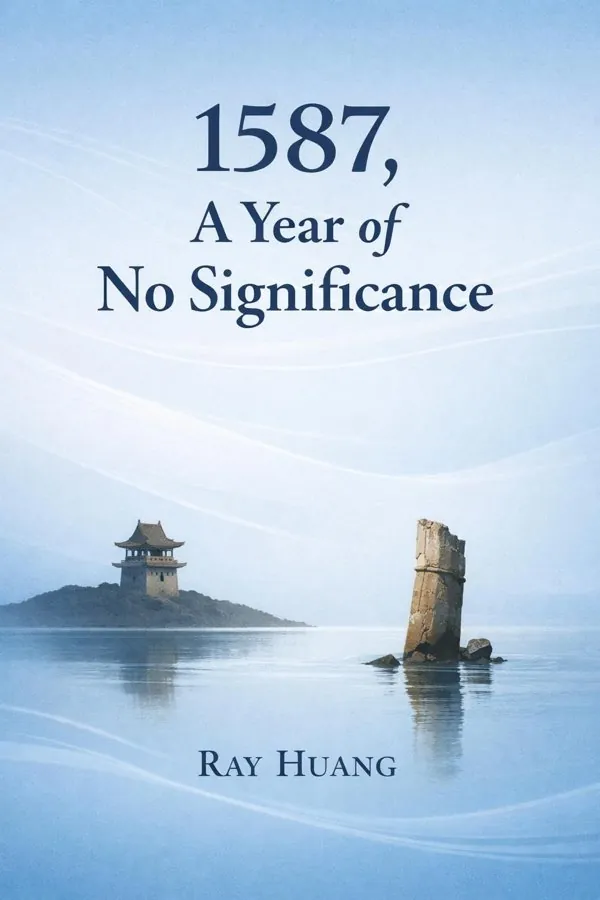
1587, A Year of No Significance
Ray Huang’s 1587, A Year of No Significance is one of the most influential works of modern Chinese history because it turns an apparently uneventful year into a lens for understanding the long decline of the Ming dynasty. Rather than recounting wars, rebellions, or dramatic turning points, Huang asks a more difficult question: what if empires often decay not through sudden catastrophe, but through administrative paralysis, moral rigidity, and institutional fatigue? By focusing on several emblematic figures in and around the year 1587—the Wanli Emperor, reformer Zhang Juzheng, the upright official Hai Rui, the general Qi Jiguang, the cautious statesman Shen Shixing, and the iconoclastic thinker Li Zhi—he reveals a political order unable to adapt to changing realities. Huang’s great strength lies in his “macro-history” approach, which connects personal careers to deeper structural forces such as bureaucracy, Confucian ideology, fiscal weakness, and the mismatch between moral ideals and practical governance. The result is a brilliant, accessible study that explains not only late Ming stagnation, but also how large institutions can fail while appearing outwardly stable.
Read SummaryKey Insights from Ray Huang
The Wanli Emperor and Silent Power
Sometimes the most damaging political decision is not a reckless action but a long withdrawal. In Huang’s account, the Wanli Emperor illustrates how an empire can be undermined when its ruler stops actively participating in governance, even while remaining formally supreme. Early in his reign, Wanli...
From 1587, A Year of No Significance
Zhang Juzheng’s Reform and Its Limits
A brilliant reformer can strengthen a state, but if reform depends too heavily on one extraordinary person, it may collapse as soon as he is gone. Huang presents Grand Secretary Zhang Juzheng as the Ming dynasty’s last serious attempt at disciplined, practical governance. Zhang pushed administrative...
From 1587, A Year of No Significance
Hai Rui and Moral Integrity’s Paradox
Integrity is admirable, but Huang asks a disturbing question: what happens when moral purity cannot be translated into effective governance? Hai Rui, one of late imperial China’s most celebrated upright officials, stands for incorruptibility, courage, and devotion to principle. He criticized abuses,...
From 1587, A Year of No Significance
Qi Jiguang and Neglected Military Realities
States often fail when they celebrate civil virtue while neglecting the practical foundations of security. General Qi Jiguang, famous for his military effectiveness, represents in Huang’s narrative a world of competence that the Ming political culture never fully knew how to honor. Qi achieved resul...
From 1587, A Year of No Significance
Shen Shixing and the Politics of Compromise
In rigid systems, moderation can look like weakness even when it is the last available form of governance. Scholar-official Shen Shixing appears in Huang’s book as a careful, conciliatory statesman trying to preserve workable politics in an environment dominated by faction, ritual disputes, and mora...
From 1587, A Year of No Significance
Li Zhi and the Crisis of Orthodoxy
When a society cannot question its dominant ideas, intellectual dissent becomes a warning sign of deeper institutional strain. Philosopher Li Zhi occupies a special place in Huang’s narrative because he embodied criticism of rigid orthodoxy at a time when official ideology still claimed unquestioned...
From 1587, A Year of No Significance
About Ray Huang
Ray Huang (1918–2000), born in Changsha, Hunan, was a Chinese-American historian and professor at the State University of New York. Known for his 'macro-history' approach, Huang emphasized understanding Chinese history through institutional and cultural frameworks. His major works include '1587, A Y...
Read more
Ray Huang (1918–2000), born in Changsha, Hunan, was a Chinese-American historian and professor at the State University of New York. Known for his 'macro-history' approach, Huang emphasized understanding Chinese history through institutional and cultural frameworks. His major works include '1587, A Y...
Ray Huang (1918–2000), born in Changsha, Hunan, was a Chinese-American historian and professor at the State University of New York. Known for his 'macro-history' approach, Huang emphasized understanding Chinese history through institutional and cultural frameworks. His major works include '1587, A Year of No Significance', 'China: A Macro History', and 'The Peasant Economy and Social Change in China'.
Frequently Asked Questions
Ray Huang (1918–2000), born in Changsha, Hunan, was a Chinese-American historian and professor at the State University of New York. Known for his 'macro-history' approach, Huang emphasized understanding Chinese history through institutional and cultural frameworks.
Read Ray Huang's books in 15 minutes
Get AI-powered summaries with key insights from 1 book by Ray Huang.