
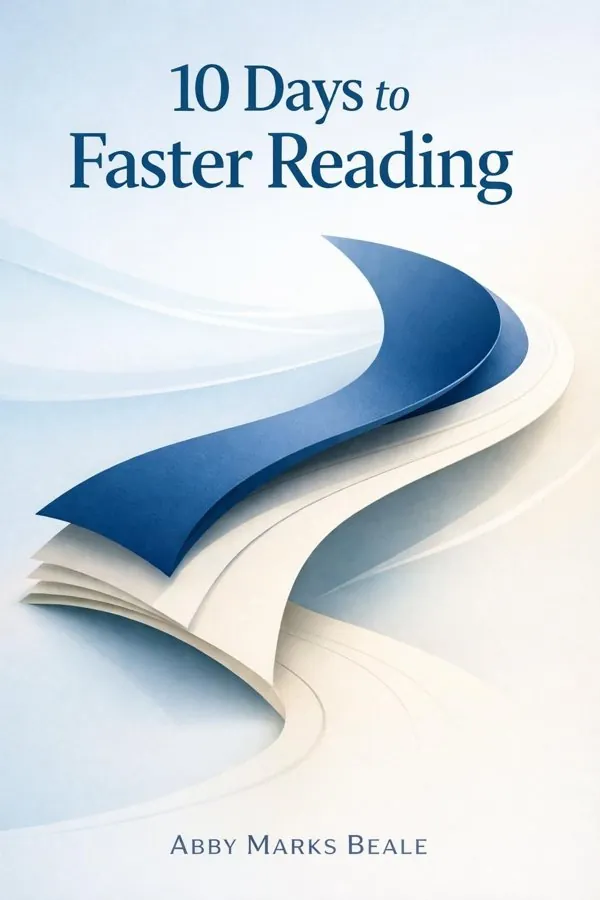
10 Days to Faster Reading: Summary & Key Insights
 10 min9 chaptersAudio available
Key Takeaways from 10 Days to Faster Reading
The biggest barrier to faster reading is often not a lack of ability but a pile of invisible habits that quietly slow you down.
Reading feels continuous, but your eyes do not move smoothly across a line of text.
A major hidden drag on reading speed is subvocalization, the habit of silently saying words in your head as you read them.
One of the costliest reading mistakes is treating every text as if it deserves full, linear attention from the first sentence to the last.
Many people blame slow reading on the material, when the real problem is fractured attention.
What Is 10 Days to Faster Reading About?
10 Days to Faster Reading by Abby Marks Beale is a productivity book spanning 7 pages. Most people assume that reading speed is fixed, as if it were a natural limit rather than a trainable skill. Abby Marks Beale challenges that belief in 10 Days to Faster Reading, a practical guide designed to help readers improve both speed and comprehension through focused daily practice. Rather than promoting gimmicks or unrealistic shortcuts, the book explains why many adults read inefficiently and how small adjustments in eye movement, attention, and reading strategy can produce dramatic gains. What makes this book especially valuable is its emphasis on purpose. Beale shows that faster reading is not about racing through every page at the same pace. It is about choosing the right approach for the material in front of you, whether you are reviewing email, studying a report, scanning research, or reading for learning. Her methods are grounded in years of teaching professionals, students, and lifelong learners how to manage information overload more effectively. In a world where reading demands are constant and time is limited, this book matters because it turns reading from a passive habit into an intentional productivity skill. It offers a realistic system for anyone who wants to read smarter, not just faster.
This FizzRead summary covers all 9 key chapters of 10 Days to Faster Reading in approximately 10 minutes, distilling the most important ideas, arguments, and takeaways from Abby Marks Beale's work. Also available as an audio summary and Key Quotes Podcast.
10 Days to Faster Reading
Most people assume that reading speed is fixed, as if it were a natural limit rather than a trainable skill. Abby Marks Beale challenges that belief in 10 Days to Faster Reading, a practical guide designed to help readers improve both speed and comprehension through focused daily practice. Rather than promoting gimmicks or unrealistic shortcuts, the book explains why many adults read inefficiently and how small adjustments in eye movement, attention, and reading strategy can produce dramatic gains.
What makes this book especially valuable is its emphasis on purpose. Beale shows that faster reading is not about racing through every page at the same pace. It is about choosing the right approach for the material in front of you, whether you are reviewing email, studying a report, scanning research, or reading for learning. Her methods are grounded in years of teaching professionals, students, and lifelong learners how to manage information overload more effectively.
In a world where reading demands are constant and time is limited, this book matters because it turns reading from a passive habit into an intentional productivity skill. It offers a realistic system for anyone who wants to read smarter, not just faster.
Who Should Read 10 Days to Faster Reading?
This book is perfect for anyone interested in productivity and looking to gain actionable insights in a short read. Whether you're a student, professional, or lifelong learner, the key ideas from 10 Days to Faster Reading by Abby Marks Beale will help you think differently.
- ✓Readers who enjoy productivity and want practical takeaways
- ✓Professionals looking to apply new ideas to their work and life
- ✓Anyone who wants the core insights of 10 Days to Faster Reading in just 10 minutes
Want the full summary?
Get instant access to this book summary and 100K+ more with Fizz Moment.
Get Free SummaryAvailable on App Store • Free to download
Key Chapters
The biggest barrier to faster reading is often not a lack of ability but a pile of invisible habits that quietly slow you down. Abby Marks Beale begins with self-awareness because most readers have never examined how they actually read. They assume that if they can get through a page, their method must be fine. But many common behaviors, such as rereading lines, losing focus, reading every word with equal attention, or approaching all material at the same pace, reduce both efficiency and comprehension.
Beale encourages readers to identify their baseline reading speed and notice when their attention drifts. This is important because improvement starts with measurement. If you do not know how long it takes you to read a chapter, how often you regress to earlier text, or which kinds of material cause you to slow down, it is hard to make meaningful changes. She also points out that poor reading habits often come from school, where careful word-by-word reading was rewarded, even though adult reading demands are much broader and more selective.
Consider a manager who reads emails, reports, and proposals in exactly the same way. That person may waste valuable time giving low-priority material the same effort as high-stakes decisions. Or imagine a student who rereads every paragraph because they fear missing something, only to discover that anxiety itself is what disrupts understanding.
The book’s first lesson is that faster reading begins by diagnosing what is getting in your way. Actionable takeaway: track your current reading speed, notice your most common slow-reading behaviors, and choose one bad habit to reduce this week.
Reading feels continuous, but your eyes do not move smoothly across a line of text. They stop, jump, stop again, and each pause takes in a chunk of words. One of Beale’s most important insights is that efficient readers do not necessarily have better eyes; they have trained their eyes to make fewer stops and gather more information at each fixation. This expanded visual span allows them to move through text more quickly without sacrificing meaning.
Many slow readers focus too narrowly, often seeing only one word at a time. That creates excessive eye movements and makes reading laborious. Beale teaches readers to widen their perceptual field so they can take in groups of words instead of treating each word as a separate event. This does not mean reading carelessly. It means trusting the brain’s ability to process language in meaningful clusters.
For example, the phrase “in the middle of the meeting” does not need to be decoded word by word. It can be recognized as a whole unit. The same applies to common sentence patterns in business writing, textbooks, and articles. By practicing wider eye sweeps, readers reduce fixation points and increase flow.
This principle also helps with line transitions. Many readers waste time starting too far left and finishing too far right, even though the eyes can capture text slightly beyond the central point of focus. Beale’s exercises retrain this movement so each line becomes more efficient.
The result is not just speed but smoother comprehension, because reading in phrases supports meaning better than reading in isolated words. Actionable takeaway: practice reading in word groups of three to five words at a time, and consciously reduce the number of stops your eyes make on each line.
A major hidden drag on reading speed is subvocalization, the habit of silently saying words in your head as you read them. Beale does not suggest that inner speech must disappear completely. Some level of mental voicing is natural, especially with difficult or technical material. But when every word is mentally pronounced, your reading speed becomes limited by how fast you can “speak” internally, which is much slower than how fast your brain can recognize meaning.
The alternative is to engage more visual thinking. Instead of translating every sentence into a silent voice, readers can learn to absorb ideas through images, patterns, and concepts. When you read a phrase like “a crowded airport terminal,” you do not need to hear each word one by one. You can see the scene. Likewise, in nonfiction, headings, statistics, examples, and argument structures can often be grasped conceptually rather than sounded out.
Beale’s approach is practical. She recommends using a faster external pace, such as a finger or pointer, to push the eyes forward so the inner voice has less time to dominate. She also encourages readers to focus on key ideas instead of perfect internal pronunciation. This is especially helpful for routine reading like memos, online articles, and background material.
For instance, a consultant reviewing a 20-page industry update does not need to “hear” every sentence to extract trends, risks, and opportunities. By focusing on meaning units and visual markers, they can process the information more quickly and still retain the essentials.
The goal is not to eliminate depth but to reserve slower internal narration for material that truly demands it. Actionable takeaway: during your next reading session, use a finger as a pacer and aim to think in images and ideas instead of mentally pronouncing every word.
One of the costliest reading mistakes is treating every text as if it deserves full, linear attention from the first sentence to the last. Beale argues that efficient readers always begin with purpose. Before diving in, they ask: Why am I reading this? What do I need from it? How much depth is necessary? These questions determine whether to preview, skim, scan, or read carefully.
Previewing gives you a map. By reviewing titles, headings, introductions, summaries, visuals, and highlighted terms, you create a framework for what follows. This reduces confusion because your brain already knows where the material is going. Skimming then helps you grasp the main ideas quickly, ideal for articles, reports, or books you need to evaluate before committing time. Scanning is even more targeted, used when you are searching for specific facts, names, dates, figures, or keywords.
Imagine a student assigned a chapter before class. Instead of plunging into page one and hoping for the best, they preview the chapter headings, note review questions, scan for diagrams, and identify the main concepts. When they then read more fully, comprehension improves because the structure is already familiar. Similarly, a professional preparing for a meeting might scan a long report for recommendations, deadlines, and budget figures rather than reading every paragraph with equal intensity.
Beale emphasizes that selective reading is not laziness. It is strategic attention. High-value reading means matching method to purpose and conserving effort for what matters most.
Actionable takeaway: before reading anything longer than a page, take two minutes to define your purpose and decide whether you should preview, skim, scan, or read deeply.
Many people blame slow reading on the material, when the real problem is fractured attention. Beale highlights concentration as a core ingredient of reading efficiency because speed and comprehension both collapse when the mind keeps drifting. Faster reading is not simply a mechanical skill. It also depends on creating conditions in which the brain can remain engaged.
Distraction comes from both the environment and the reader’s mental state. Noise, phone notifications, clutter, poor lighting, and physical discomfort all make sustained focus harder. Internal factors matter too: fatigue, stress, low motivation, and reading without a clear goal can cause the eyes to move across the page while the mind absorbs almost nothing. This leads to rereading, frustration, and the mistaken belief that one is a naturally poor reader.
Beale’s solution is refreshingly practical. Prepare the reading environment, limit interruptions, and work in short, focused blocks if long sessions feel overwhelming. Use active reading habits to keep attention engaged, such as setting a purpose, noting key points, or asking questions as you go. Even posture can matter. Sitting upright at a table often produces more alert reading than slouching on a couch with multiple distractions nearby.
Picture two scenarios. In one, someone tries to read a professional article while checking messages every few minutes. In the other, they silence notifications, set a 20-minute timer, and read with a question in mind. The second session is likely to feel easier and faster, even with the same material.
Concentration is not only about willpower. It is about design. Actionable takeaway: create one distraction-free reading block today by silencing devices, setting a clear purpose, and reading for 20 focused minutes without interruption.
Skill improvement rarely comes from insight alone. Beale’s ten-day framework works because it treats reading like any other trainable ability: progress requires repetition, feedback, and increasing awareness. Many readers expect a single trick to transform their speed overnight, but the book insists on something more realistic and more effective. Small daily exercises, consistently applied, build new habits that gradually replace old ones.
The value of a ten-day plan is psychological as much as practical. A short timeframe feels manageable, which reduces resistance and encourages action. Each day introduces a focused element, such as measuring speed, expanding visual span, reducing regression, or practicing skimming. Rather than overwhelming readers with theory, the structure creates momentum. You test, apply, observe results, and continue.
This matters because reading behavior is deeply ingrained. If you have spent years reading word by word, your eyes and attention patterns will not instantly change. But with repeated drills, your brain begins to accept a faster pace as normal. Progress may come in jumps rather than perfectly linear improvement. One day may feel awkward, and the next may feel surprisingly fluid. That is part of the learning process.
A professional might commit to 15 minutes each morning before opening email. A student could use the exercises before homework. In both cases, the routine matters more than intensity. Consistency teaches the body and mind to move differently through text.
The deeper lesson is that reading speed is a habit system, not a talent fixed at birth. Actionable takeaway: commit to a ten-day reading practice schedule, even if each session lasts only 10 to 15 minutes, and track your speed and comprehension after each session.
A common misunderstanding about speed reading is that the goal is to read everything fast. Beale rejects that simplistic view. Skilled readers do not use one pace for every text. They adjust speed according to difficulty, familiarity, purpose, and importance. In other words, effective reading is flexible reading.
This distinction is essential because not all material deserves equal treatment. A dense legal contract, a technical research article, a novel for pleasure, and a weekly newsletter each require a different approach. Trying to force maximum speed on highly complex material can reduce comprehension. But reading easy or repetitive content too slowly wastes time and mental energy. The real skill lies in knowing when to accelerate and when to slow down.
For example, an executive might skim a market overview to identify trends, scan a financial appendix for key figures, and then slow down significantly for the page containing strategic recommendations. A student may preview a chapter, read familiar sections quickly, and spend more time on formulas or difficult concepts. This kind of variation is not inconsistency. It is intelligent control.
Beale encourages readers to think of speed as a dial, not an on-off switch. Once you stop measuring success by one uniform pace, reading becomes more strategic and less stressful. You gain confidence because you are no longer trying to treat all words as equally valuable.
This idea also protects comprehension. Faster reading works best when paired with judgment about where deep attention is required. Actionable takeaway: for your next reading task, deliberately assign different speeds to different sections based on their value and difficulty instead of reading the entire piece at one pace.
People often assume that reading slowly guarantees understanding. Beale shows the opposite can be true. Slow, passive reading may feel careful, but if the mind is wandering, comprehension remains weak. Real understanding comes from active engagement with ideas, not simply from spending more time on each sentence.
Active readers interact with the text. They predict what is coming, ask questions, connect new information to prior knowledge, and mentally summarize major points. These behaviors strengthen memory and make meaning clearer. Faster reading can actually support comprehension when it keeps the brain alert and focused on larger ideas rather than trapped in word-by-word decoding.
Take a reader working through a business book. A passive approach might involve reading every page at the same steady pace, then forgetting most of it by the next day. An active approach would involve previewing the chapter, identifying the central argument, noting examples, and pausing briefly to summarize the author’s point. Even if the second method is faster overall, retention is likely to be stronger because the reader is mentally involved.
The same principle applies to studying. A student who asks, “What is this section trying to prove?” will usually understand more than one who just stares at the text longer. The brain remembers organized, meaningful ideas better than isolated words.
Beale’s broader message is that speed and comprehension are allies when reading is purposeful and engaged. Actionable takeaway: after each section you read today, pause for ten seconds and state the main idea in your own words before moving on.
The promise of faster reading is not merely academic improvement; it is relief from modern information overload. Beale’s methods are especially relevant in a world where professionals and students face endless streams of articles, reports, emails, updates, and digital content. The real productivity gain comes from learning how to process more information with less waste.
Many people feel buried not because they lack discipline but because they use outdated reading habits in a high-volume environment. They try to read everything thoroughly, start at the beginning of every document, and give too much attention to low-priority material. This creates decision fatigue and leaves little time for reflection or action.
By teaching purpose-driven reading, selective attention, and speed flexibility, Beale helps readers reclaim time. A team leader can review briefing materials faster and spend more energy on decision-making. A graduate student can sort relevant sources from irrelevant ones more efficiently. A lifelong learner can keep up with reading goals without feeling overwhelmed by the size of the stack.
Importantly, efficiency does not mean rushing through life. It means reducing friction between intention and action. When reading takes less unnecessary effort, you free up cognitive space for thinking, analysis, and creativity. Faster reading becomes a support skill for better work and clearer learning.
In that sense, the book is as much about productivity as it is about reading. Actionable takeaway: make a list of your common reading tasks this week and identify which ones deserve deep reading, quick skimming, or simple scanning so you can spend time where it matters most.
All Chapters in 10 Days to Faster Reading
About the Author
Abby Marks Beale is an American speed reading expert, educator, and author who has spent years teaching people how to read more efficiently in demanding academic and professional environments. Known for her practical and approachable methods, she has worked with students, corporate teams, and individual learners who want to handle large volumes of information without sacrificing comprehension. Her training programs focus on measurable improvement through better eye movement, concentration, and strategic reading techniques rather than flashy shortcuts. Beale has become a respected voice in the field of reading productivity by showing that faster reading is not a rare gift but a learnable skill. Through books, workshops, and seminars, she has helped readers transform reading from a slow, passive habit into a more intentional and effective tool for learning and performance.
Get This Summary in Your Preferred Format
Read or listen to the 10 Days to Faster Reading summary by Abby Marks Beale anytime, anywhere. FizzRead offers multiple formats so you can learn on your terms — all free.
Available formats: App · Audio · PDF · EPUB — All included free with FizzRead
Download 10 Days to Faster Reading PDF and EPUB Summary
Key Quotes from 10 Days to Faster Reading
“The biggest barrier to faster reading is often not a lack of ability but a pile of invisible habits that quietly slow you down.”
“Reading feels continuous, but your eyes do not move smoothly across a line of text.”
“A major hidden drag on reading speed is subvocalization, the habit of silently saying words in your head as you read them.”
“One of the costliest reading mistakes is treating every text as if it deserves full, linear attention from the first sentence to the last.”
“Many people blame slow reading on the material, when the real problem is fractured attention.”
Frequently Asked Questions about 10 Days to Faster Reading
10 Days to Faster Reading by Abby Marks Beale is a productivity book that explores key ideas across 9 chapters. Most people assume that reading speed is fixed, as if it were a natural limit rather than a trainable skill. Abby Marks Beale challenges that belief in 10 Days to Faster Reading, a practical guide designed to help readers improve both speed and comprehension through focused daily practice. Rather than promoting gimmicks or unrealistic shortcuts, the book explains why many adults read inefficiently and how small adjustments in eye movement, attention, and reading strategy can produce dramatic gains. What makes this book especially valuable is its emphasis on purpose. Beale shows that faster reading is not about racing through every page at the same pace. It is about choosing the right approach for the material in front of you, whether you are reviewing email, studying a report, scanning research, or reading for learning. Her methods are grounded in years of teaching professionals, students, and lifelong learners how to manage information overload more effectively. In a world where reading demands are constant and time is limited, this book matters because it turns reading from a passive habit into an intentional productivity skill. It offers a realistic system for anyone who wants to read smarter, not just faster.
You Might Also Like
Featured In
Browse by Category
Ready to read 10 Days to Faster Reading?
Get the full summary and 100K+ more books with Fizz Moment.