
Your Money or Your Life: Summary & Key Insights
by Vicki Robin
 10 min9 chaptersAudio available
Key Takeaways from Your Money or Your Life
Real financial change begins not with a spreadsheet, but with honesty.
Awareness is often more powerful than willpower.
Money problems often persist because spending remains blurry.
A budget tells you what you spent.
One of the book’s most memorable insights is that money is something far more intimate than numbers on a bank statement.
What Is Your Money or Your Life About?
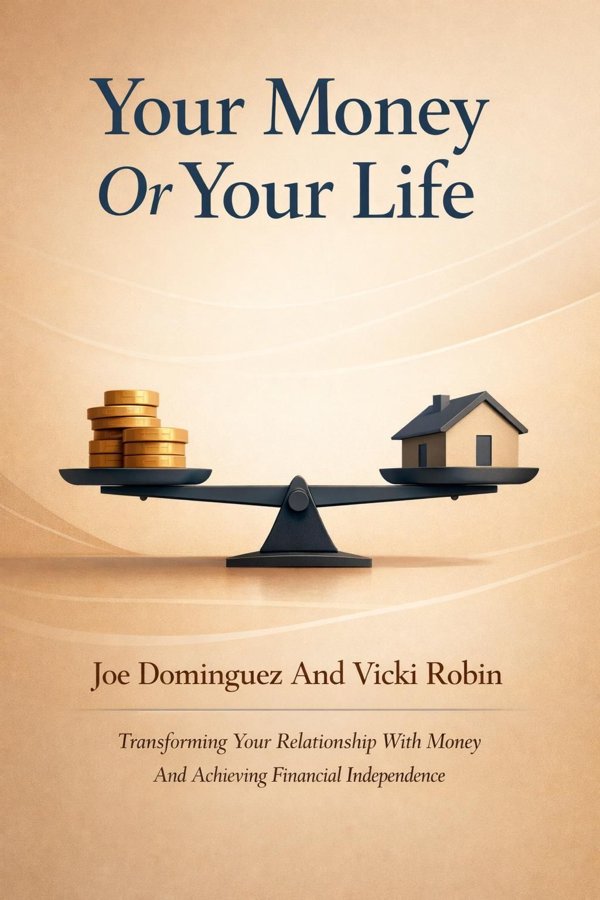
Your Money or Your Life by Vicki Robin is a finance book published in 1999 spanning 9 pages. Your Money or Your Life is one of the most influential personal finance books ever written because it asks a deeper question than most money guides: what are you trading your life for? Rather than focusing only on budgeting tricks or investment tactics, Vicki Robin and Joe Dominguez present a nine-step program for transforming your relationship with money at its roots. Their approach treats money as something earned with your finite life energy, making every financial decision a personal and ethical choice, not just a mathematical one. The book shows readers how to calculate their true earnings, track spending with honesty, reduce unnecessary expenses, save consistently, and build enough investment income to reach financial independence. What makes it powerful is that it links financial freedom with meaning, mindfulness, and deliberate living. Robin writes from decades of work in financial independence and sustainable living, while Dominguez brought the perspective of someone who retired early and taught others to do the same. Together, they created a framework that helps readers not only manage money better, but also reclaim time, purpose, and peace of mind.
This FizzRead summary covers all 9 key chapters of Your Money or Your Life in approximately 10 minutes, distilling the most important ideas, arguments, and takeaways from Vicki Robin's work. Also available as an audio summary and Key Quotes Podcast.
Your Money or Your Life
Your Money or Your Life is one of the most influential personal finance books ever written because it asks a deeper question than most money guides: what are you trading your life for? Rather than focusing only on budgeting tricks or investment tactics, Vicki Robin and Joe Dominguez present a nine-step program for transforming your relationship with money at its roots. Their approach treats money as something earned with your finite life energy, making every financial decision a personal and ethical choice, not just a mathematical one. The book shows readers how to calculate their true earnings, track spending with honesty, reduce unnecessary expenses, save consistently, and build enough investment income to reach financial independence. What makes it powerful is that it links financial freedom with meaning, mindfulness, and deliberate living. Robin writes from decades of work in financial independence and sustainable living, while Dominguez brought the perspective of someone who retired early and taught others to do the same. Together, they created a framework that helps readers not only manage money better, but also reclaim time, purpose, and peace of mind.
Who Should Read Your Money or Your Life?
This book is perfect for anyone interested in finance and looking to gain actionable insights in a short read. Whether you're a student, professional, or lifelong learner, the key ideas from Your Money or Your Life by Vicki Robin will help you think differently.
- ✓Readers who enjoy finance and want practical takeaways
- ✓Professionals looking to apply new ideas to their work and life
- ✓Anyone who wants the core insights of Your Money or Your Life in just 10 minutes
Want the full summary?
Get instant access to this book summary and 100K+ more with Fizz Moment.
Get Free SummaryAvailable on App Store • Free to download
Key Chapters
Real financial change begins not with a spreadsheet, but with honesty. Most people try to improve their money situation by looking only at this month’s bills or next year’s savings goals. Robin argues that before you can move forward, you must understand the full story of your financial life so far. That means calculating how much money has come into your life over the years, how much wealth you have accumulated, and how that compares with the amount of life energy you have spent earning it. This exercise can be emotional because it reveals whether years of work have actually translated into lasting security or meaningful satisfaction.
This step is not about guilt. It is about ending denial. If someone has earned hundreds of thousands of dollars over a career but has little savings and high stress to show for it, that realization becomes a turning point. Likewise, a person who has less money than expected but has built a modest, stable life can begin to appreciate what has gone right. The aim is to replace vague anxiety with clear awareness.
A practical way to apply this idea is to build a financial lifeline. Estimate total lifetime earnings, current net worth, and major patterns such as debt cycles, impulse spending, or periods of financial stability. Write down the lessons those patterns reveal. You may discover that your money habits are tied to identity, family beliefs, or attempts to buy comfort.
Actionable takeaway: Create a simple personal balance sheet and a lifetime earnings estimate, then reflect on the story those numbers tell about how you have used your life energy.
Awareness is often more powerful than willpower. One of the book’s central disciplines is tracking every cent that enters or leaves your life. This sounds tedious at first, but Robin presents it as a spiritual and practical exercise in presence. Most people leak money through unconscious habits: subscriptions they barely use, convenience purchases they forget, emotional spending that lasts only a moment. When you record every expense, money stops being abstract and starts becoming visible.
This process is not meant to shame you for buying coffee or enjoying life. It is meant to establish reality. Once spending is tracked accurately, patterns emerge. You may find that small daily purchases are less important than irregular spending on travel, gadgets, or eating out. You may also notice that certain purchases improve your life while others leave you feeling flat. Tracking turns financial management into observation rather than self-punishment.
A practical example is keeping a daily spending log in an app, notebook, or spreadsheet. Record income, bills, groceries, transportation, entertainment, and miscellaneous expenses. At the end of each month, total each category and compare it with previous months. This can be especially helpful for freelancers, couples, or anyone who feels money slips away without explanation.
The deeper benefit is psychological. Tracking gives you back agency. Instead of wondering where your money went, you know. Instead of reacting emotionally, you respond intelligently. Awareness lays the foundation for every later step in the program.
Actionable takeaway: For the next 30 days, record every expense without exception and review your totals weekly to identify the habits that deserve your attention.
Money problems often persist because spending remains blurry. After learning to track expenses, the next step is to organize them into meaningful categories so you can see not just what you spent, but what kind of life your spending is creating. Robin encourages readers to examine where money actually goes month after month, because categories reveal priorities more honestly than intentions do. You may say health matters, yet spend heavily on takeout and little on exercise or sleep-supporting choices. You may value freedom, yet commit large sums to debt and status purchases.
Categorizing expenses helps transform raw data into insight. Housing, food, transportation, health, entertainment, debt payments, gifts, and personal care can each become a mirror. Once grouped, expenses can be evaluated over time. Is your transportation cost justified by convenience? Is your housing aligned with your actual needs? Are you spending to express values or to soothe stress?
Consider a household that feels financially stuck despite decent income. A category review might reveal expensive car ownership, recurring online shopping, and a high grocery bill caused by food waste. Without categories, these costs feel random. With categories, they become manageable. The goal is not extreme austerity but intelligent alignment.
This step also helps in planning. Once you know where money typically goes, you can set realistic spending targets instead of imaginary budgets disconnected from real behavior. It becomes easier to cut what adds little value and protect what genuinely enriches life.
Actionable takeaway: Create 8 to 12 spending categories, total the last three months of expenses in each one, and identify the top two categories where your spending most contradicts your stated values.
A budget tells you what you spent. The three questions in Your Money or Your Life tell you whether it was worth your life. Robin invites readers to evaluate every expense through a simple but powerful lens: Did I receive fulfillment, satisfaction, and value in proportion to the life energy spent? Is this expenditure in alignment with my values and life purpose? How might this spending change if I did not have to work for money? These questions turn ordinary purchases into opportunities for self-knowledge.
The genius of this framework is that it replaces external rules with internal clarity. Instead of declaring that eating out is bad or thrift is always virtuous, the book asks whether a specific expense truly served you. A dinner with close friends may be deeply worth the cost. A trendy purchase made from insecurity may not be. The point is not to spend less at any cost, but to spend with consciousness.
Used consistently, the questions sharpen judgment. A person might realize their expensive apartment actually provides peace, convenience, and joy, while frequent online shopping provides only a brief hit of excitement. Another person might discover the reverse. Because the evaluation is personal, it builds a sustainable financial philosophy rather than a temporary restriction plan.
This step can be applied during a monthly review. Look at each category and mark expenses as high, medium, or low fulfillment. Over time, your spending naturally shifts toward what brings genuine satisfaction and away from what drains money and energy.
Actionable takeaway: During your next monthly money review, apply the three questions to your ten largest expenses and note which ones you would happily repeat and which ones you would eliminate.
One of the book’s most memorable insights is that money is something far more intimate than numbers on a bank statement. It is life energy. You exchange your time, attention, skill, health, and emotional effort for income. Once you see money this way, spending stops being casual. Every purchase becomes a trade: a portion of your finite life for an object, service, or experience. This reframing is what gives the entire program its moral and emotional force.
Robin pushes readers to calculate their real hourly wage, not just the amount on a paycheck. To do this honestly, you subtract work-related expenses such as commuting, professional clothing, meals out, childcare, decompression spending, and the time spent preparing for and recovering from work. Someone earning a seemingly strong salary may discover that their real hourly earnings are far lower after accounting for these hidden costs.
This can be eye-opening. Imagine someone earning $30 per hour on paper but only $18 in real terms after transportation, taxes, wardrobe, and stress-related spending. A $180 impulse purchase is no longer ten hours of work but perhaps a full day of life energy. That shift changes behavior. It does not make spending joyless; it makes spending conscious.
This perspective also invites compassion. If work is draining, then careless spending is not just a financial issue but a life issue. Protecting money becomes a way of protecting your days, your attention, and your health.
Actionable takeaway: Calculate your real hourly wage this week, then convert three recent purchases into hours of life energy to see whether they were truly worth the trade.
More income does not automatically mean a better life. In fact, Robin argues that many people become trapped by earning more while enjoying life less. Once you understand money as life energy, the next question is whether the way you earn money honors your well-being and purpose. Step six challenges the assumption that maximizing salary should be the goal. Instead, you evaluate whether your work and spending together create a life that feels whole.
This is not a simplistic call to quit your job and follow passion regardless of reality. It is a disciplined invitation to look at trade-offs. Does your higher-paying role demand stress, long hours, poor health habits, and expensive coping mechanisms? Would a lower-paying but more flexible role leave you happier and still financially stable if your expenses were aligned with your values? Financial intelligence includes understanding the quality of the life your income buys.
A practical example is comparing two job options. One pays more but requires a long commute, expensive meals, and chronic exhaustion. The other pays slightly less but offers remote work, lower costs, and more time with family. Traditional thinking may favor the larger salary. Robin’s framework asks which option delivers greater net life satisfaction after accounting for money, time, and energy.
This idea helps readers escape the earn-spend treadmill. By valuing fulfillment as well as cash flow, you begin to design a sustainable life instead of chasing an endless income target.
Actionable takeaway: Review your current work situation and write down whether your income, hours, stress level, and spending patterns together create a net gain or a net loss in life satisfaction.
Frugality is often misunderstood as deprivation, but Your Money or Your Life presents it as refinement. Once you know which expenses bring true fulfillment and which do not, reducing spending becomes less about sacrifice and more about removing what clutters your life. Robin’s version of frugality is not grim penny-pinching. It is the art of increasing satisfaction while decreasing waste.
This step asks you to become intelligent and creative. You can lower housing costs by house-sharing or moving to a smaller home if space is not adding real value. You can reduce food costs by planning meals, cooking more, and wasting less. You can cut transportation expenses by using a cheaper car, public transit, cycling, or combining errands. You can also reduce the social pressure to consume by redefining leisure around relationships, nature, reading, or community rather than constant spending.
The key distinction is that reductions should be guided by the earlier questions about fulfillment. A person who loves books may keep a healthy reading budget while cutting fashion spending they barely enjoy. Another person may happily spend on fitness classes while eliminating subscriptions and impulse shopping. The goal is not to reduce every category equally but to free money from low-value uses.
Over time, expense reduction creates something more valuable than monthly savings. It creates autonomy. Lower fixed costs mean less pressure, fewer work obligations, and greater resilience during job changes or emergencies.
Actionable takeaway: Choose one major expense category and one minor habit category to simplify this month, then redirect the saved money toward debt reduction, savings, or a purpose-driven goal.
Financial independence becomes real when your accumulated capital generates enough income to cover your living expenses. Robin calls this moment the crossover point. It is the stage at which your investments, savings, or other passive income sources can support your basic needs without requiring continual paid labor. This idea gives the book its long-term direction: money is not just for consumption, but for buying back your freedom.
The power of crossover lies in its simplicity. If your expenses are modest and your savings rate is high, the amount of capital needed to sustain you becomes smaller. If your expenses are inflated, the target moves farther away. This is why the earlier steps matter so much. Frugality, tracking, and values-based spending are not isolated habits; they accelerate independence.
A practical example helps. If a person needs $30,000 a year to live and can safely generate a portion of that income from invested capital, then every dollar saved and invested contributes to future freedom. The exact investment strategy may vary by risk tolerance and market conditions, but the principle remains: assets that produce income can eventually replace dependence on wages.
This step also changes motivation. Saving no longer feels like deprivation for some distant retirement. It becomes a visible path to autonomy. Every contribution to capital reduces the amount of future life energy that must be sold.
Actionable takeaway: Calculate your annual essential living expenses, estimate your current passive income, and define your personal crossover target so your financial plan points toward freedom rather than endless accumulation.
The final step of the program reminds readers that financial independence is not a one-time achievement but an ongoing relationship. Even after debt is reduced, spending is aligned, and investments are growing, the habits of awareness must continue. Robin encourages a lifelong practice of reviewing income, expenses, savings, and investment performance with calm attention. The goal is not obsession but stewardship.
This includes maintaining a wall chart or another visual tool to track monthly income and expenses over time. Such visual feedback helps readers see progress, spot trends, and stay emotionally connected to their goals. It also turns money into a dynamic system rather than a source of confusion. When markets shift or life circumstances change, a person grounded in regular review is less likely to panic or drift.
The broader lesson is that money management should support life, not dominate it. A financially mature person checks in consistently, adapts thoughtfully, and resists both reckless spending and fearful hoarding. They know enough to make informed investment choices, maintain emergency reserves, and live within values-based limits.
This step is especially relevant after reaching greater security. Without conscious habits, lifestyle inflation can return. So can anxiety. Lifelong financial practice protects both freedom and peace of mind. It keeps your use of money aligned with your purpose, relationships, and changing seasons of life.
Actionable takeaway: Set a recurring monthly money date to review spending, savings, net worth, and progress toward your goals, and treat that review as a permanent habit rather than a temporary fix.
All Chapters in Your Money or Your Life
About the Author
Vicki Robin is a bestselling author, speaker, and social innovator best known for co-authoring Your Money or Your Life, a landmark book that helped shape the modern financial independence movement. Her work brings together personal finance, mindful living, and social responsibility, encouraging readers to think more deeply about consumption, work, and what makes a meaningful life. Robin has spent decades exploring topics such as sustainable living, community resilience, aging, and economic change. Unlike many finance writers who focus narrowly on wealth-building, she emphasizes the connection between money and values. Her influence endures because she offers not just financial advice, but a broader philosophy for living with greater intention, freedom, and enough.
Get This Summary in Your Preferred Format
Read or listen to the Your Money or Your Life summary by Vicki Robin anytime, anywhere. FizzRead offers multiple formats so you can learn on your terms — all free.
Available formats: App · Audio · PDF · EPUB — All included free with FizzRead
Download Your Money or Your Life PDF and EPUB Summary
Key Quotes from Your Money or Your Life
“Real financial change begins not with a spreadsheet, but with honesty.”
“Awareness is often more powerful than willpower.”
“Money problems often persist because spending remains blurry.”
“The three questions in Your Money or Your Life tell you whether it was worth your life.”
“One of the book’s most memorable insights is that money is something far more intimate than numbers on a bank statement.”
Frequently Asked Questions about Your Money or Your Life
Your Money or Your Life by Vicki Robin is a finance book that explores key ideas across 9 chapters. Your Money or Your Life is one of the most influential personal finance books ever written because it asks a deeper question than most money guides: what are you trading your life for? Rather than focusing only on budgeting tricks or investment tactics, Vicki Robin and Joe Dominguez present a nine-step program for transforming your relationship with money at its roots. Their approach treats money as something earned with your finite life energy, making every financial decision a personal and ethical choice, not just a mathematical one. The book shows readers how to calculate their true earnings, track spending with honesty, reduce unnecessary expenses, save consistently, and build enough investment income to reach financial independence. What makes it powerful is that it links financial freedom with meaning, mindfulness, and deliberate living. Robin writes from decades of work in financial independence and sustainable living, while Dominguez brought the perspective of someone who retired early and taught others to do the same. Together, they created a framework that helps readers not only manage money better, but also reclaim time, purpose, and peace of mind.
More by Vicki Robin
You Might Also Like

Featured In
Browse by Category
Ready to read Your Money or Your Life?
Get the full summary and 100K+ more books with Fizz Moment.