
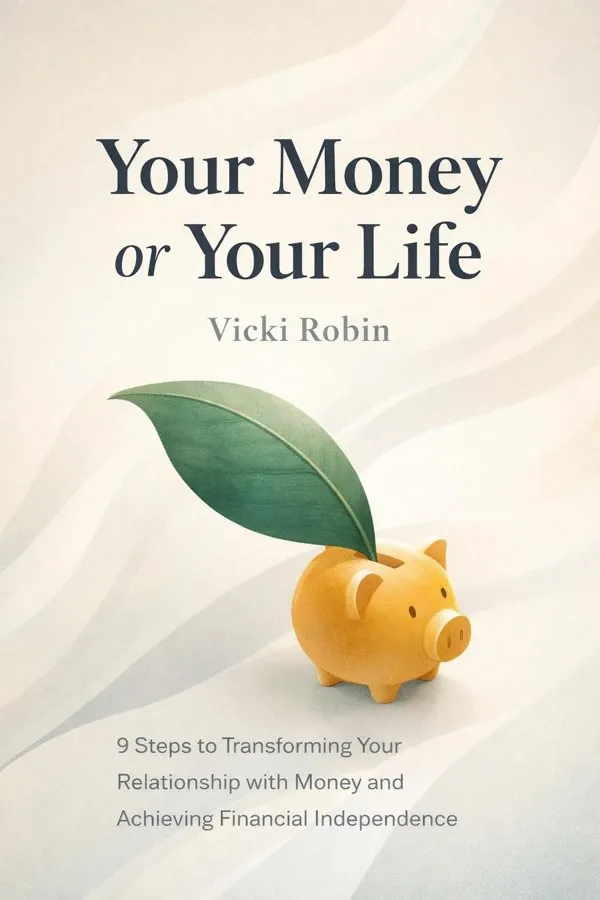
Your Money or Your Life: 9 Steps to Transforming Your Relationship with Money and Achieving Financial Independence: Summary & Key Insights
by Vicki Robin
 10 min9 chaptersAudio available
Key Takeaways from Your Money or Your Life: 9 Steps to Transforming Your Relationship with Money and Achieving Financial Independence
Financial change begins with honesty, and honesty usually starts in the rearview mirror.
That is why Robin makes careful tracking one of the foundational disciplines of financial freedom.
Spending is never just spending; it is a map of what your life is actually serving.
A fulfilling life is rarely built by spending more; it is built by spending with intention.
Every dollar has a hidden denominator: hours of your life.
What Is Your Money or Your Life: 9 Steps to Transforming Your Relationship with Money and Achieving Financial Independence About?
Your Money or Your Life: 9 Steps to Transforming Your Relationship with Money and Achieving Financial Independence by Vicki Robin is a finance book spanning 9 pages. Money problems are rarely just about math. They are about values, habits, identity, fear, desire, and the quiet assumptions we inherit about what a good life is supposed to look like. In Your Money or Your Life, Vicki Robin offers a powerful alternative to conventional personal finance advice: instead of asking only how to earn more or invest better, she asks what your money is costing you in time, attention, energy, and freedom. The result is a nine-step program that helps readers examine their financial past, track spending with honesty, align money with purpose, and build a path toward financial independence. What makes this book enduring is that it is not simply about budgeting or retiring early. It is about seeing money as a tool for living deliberately rather than as the measure of success. Robin, writing from years of teaching and refining these ideas with co-author Joe Dominguez, helped shape the modern financial independence movement long before it became mainstream. Her approach combines practicality with philosophy, making this a classic for anyone who wants not just more wealth, but a richer life.
This FizzRead summary covers all 9 key chapters of Your Money or Your Life: 9 Steps to Transforming Your Relationship with Money and Achieving Financial Independence in approximately 10 minutes, distilling the most important ideas, arguments, and takeaways from Vicki Robin's work. Also available as an audio summary and Key Quotes Podcast.
Your Money or Your Life: 9 Steps to Transforming Your Relationship with Money and Achieving Financial Independence
Money problems are rarely just about math. They are about values, habits, identity, fear, desire, and the quiet assumptions we inherit about what a good life is supposed to look like. In Your Money or Your Life, Vicki Robin offers a powerful alternative to conventional personal finance advice: instead of asking only how to earn more or invest better, she asks what your money is costing you in time, attention, energy, and freedom. The result is a nine-step program that helps readers examine their financial past, track spending with honesty, align money with purpose, and build a path toward financial independence.
What makes this book enduring is that it is not simply about budgeting or retiring early. It is about seeing money as a tool for living deliberately rather than as the measure of success. Robin, writing from years of teaching and refining these ideas with co-author Joe Dominguez, helped shape the modern financial independence movement long before it became mainstream. Her approach combines practicality with philosophy, making this a classic for anyone who wants not just more wealth, but a richer life.
Who Should Read Your Money or Your Life: 9 Steps to Transforming Your Relationship with Money and Achieving Financial Independence?
This book is perfect for anyone interested in finance and looking to gain actionable insights in a short read. Whether you're a student, professional, or lifelong learner, the key ideas from Your Money or Your Life: 9 Steps to Transforming Your Relationship with Money and Achieving Financial Independence by Vicki Robin will help you think differently.
- ✓Readers who enjoy finance and want practical takeaways
- ✓Professionals looking to apply new ideas to their work and life
- ✓Anyone who wants the core insights of Your Money or Your Life: 9 Steps to Transforming Your Relationship with Money and Achieving Financial Independence in just 10 minutes
Want the full summary?
Get instant access to this book summary and 100K+ more with Fizz Moment.
Get Free SummaryAvailable on App Store • Free to download
Key Chapters
Financial change begins with honesty, and honesty usually starts in the rearview mirror. Robin argues that no meaningful transformation can happen until you fully face your money history: what you have earned, what you have spent, what you have accumulated, and what emotional stories shaped those choices. Many people carry guilt about debt, shame about mistakes, or nostalgia for periods when they felt more secure. These feelings often remain hidden, but they quietly influence current behavior. If you do not reconcile with your financial past, you will keep repeating it.
This step asks you to calculate your lifetime earnings and your current net worth. At first, this may seem purely numerical, but it is really psychological. You are taking inventory of your life so far. If you earned a substantial amount over the years yet have little to show for it, that realization can be sobering. If you have survived hardship and still kept going, that can also become a source of strength. The point is not self-punishment. The point is awareness.
For example, someone who grew up in scarcity may overspend as an adult whenever they feel anxious, using purchases to create temporary safety. Another person may hoard money because they equate spending with danger. Looking back helps expose these patterns. It also allows gratitude to enter the picture: every dollar earned represented time and effort, every lesson learned can become useful wisdom.
An actionable takeaway: write a complete money autobiography and calculate your lifetime earnings, total assets, and debts. Treat the exercise not as a verdict, but as the starting line for a more conscious future.
What you ignore controls you. That is why Robin makes careful tracking one of the foundational disciplines of financial freedom. Step 2 asks you to become fully present to your current cash flow by recording every cent that comes into and goes out of your life. This is not busywork. It is a practice of attention. Just as food journaling can reveal hidden eating habits, expense tracking exposes the unconscious routines that shape your financial life.
Most people have a vague sense of where their money goes. They know the big categories, but not the daily leaks. Small purchases, recurring subscriptions, convenience spending, and emotional buying all disappear into mental fog. By documenting income and expenses monthly, you replace assumptions with facts. This creates calm because uncertainty is often more stressful than reality. Even difficult numbers are easier to handle once they are clear.
Imagine someone who believes they cannot save because rent is too high. After tracking for three months, they discover that restaurant meals, impulse online shopping, and ride-share trips consume hundreds of dollars a month. Another person may realize they are already living more intentionally than they thought, which builds confidence. In both cases, tracking creates a relationship with reality rather than with wishful thinking.
Robin also emphasizes that this step is not about judgment. The goal is not to become rigid or joyless. It is to wake up. When you know what is happening, you can make decisions instead of reacting by habit. Awareness itself becomes empowering.
An actionable takeaway: for the next 30 days, track every expense and every source of income daily. Use a notebook, spreadsheet, or app, but make sure nothing remains invisible.
Spending is never just spending; it is a map of what your life is actually serving. In this step, Robin asks you to organize your expenses into monthly categories so you can see patterns, priorities, and contradictions. This process transforms isolated purchases into meaningful data. A coffee here, a subscription there, a last-minute purchase after a stressful day: alone they seem harmless, but together they tell a story about your habits and values.
Categorizing expenses helps you move from confusion to comprehension. You begin to understand not only how much you spend, but on what kinds of needs and desires. Typical categories might include housing, food, transportation, health, entertainment, debt payments, clothing, gifts, and miscellaneous spending. Over time, these categories reveal where your financial energy flows most strongly.
The deeper point of this step is that money tends to drift toward whatever is unexamined. If you feel exhausted, you may spend heavily on convenience. If you feel lonely, you may spend on status or experiences that offer temporary stimulation. If you value security but spend mostly on lifestyle inflation, there is a mismatch worth exploring. The monthly category review creates a mirror. It shows whether your financial behavior reflects your stated priorities.
For example, someone who says family is most important may discover they spend more on gadgets than on experiences with loved ones. Another person may realize they are paying for a larger home largely to impress others, not because it improves daily life. Such insights can be uncomfortable, but they are liberating.
An actionable takeaway: group the past three months of spending into clear categories and review the totals. Ask yourself which categories reflect your deepest values and which ones represent drift, stress, or social pressure.
A fulfilling life is rarely built by spending more; it is built by spending with intention. Robin introduces three powerful questions to ask about every category of spending. First: Did I receive fulfillment, satisfaction, and value in proportion to the life energy spent? Second: Is this expenditure of life energy in alignment with my values and life purpose? Third: How might this change if I did not have to work for a living? These questions turn a budget into a philosophy of living.
The genius of these questions is that they are neither austere nor indulgent. They do not say all spending is bad. Instead, they ask whether your spending genuinely serves you. A costly concert that brings lasting joy and connection may be well worth it. An expensive habit that barely registers by the next day may not be. The standard shifts from price alone to true fulfillment.
The third question is especially revealing. If you did not need to earn money, would you still buy the same things? You might cook more, drive less, wear simpler clothes, or pursue low-cost pleasures like reading, walking, gardening, and time with friends. This thought experiment exposes how much spending is designed to compensate for a life shaped by overwork, stress, and lack of time.
For instance, a person who constantly buys takeout may realize the issue is not love of restaurant food but exhaustion from long hours. Another may see that shopping functions as entertainment because meaningful leisure is missing. Once the root issue is visible, better choices become possible.
An actionable takeaway: choose your top five spending categories and evaluate each one using Robin’s three questions. Reduce, redesign, or eliminate any category that does not provide real fulfillment or align with your values.
Every dollar has a hidden denominator: hours of your life. Robin’s most famous idea is that money should not be viewed simply as currency, but as something earned through your finite life energy. To make this visible, she asks readers to calculate their real hourly wage, not just their salary divided by work hours. This means subtracting work-related costs and including time spent commuting, recovering from stress, maintaining professional appearance, and engaging in other job-driven activities.
This calculation can be startling. Someone earning what looks like a strong income may discover that after taxes, commuting costs, meals out, wardrobe expenses, and long unpaid hours, their real hourly wage is far lower than expected. Once you know that number, every purchase takes on new meaning. A $120 item may no longer seem like a simple swipe of a card. It may represent six or eight hours of your life.
This reframing is not meant to make you fearful of spending. It is meant to restore proportion. When you see purchases in terms of life energy, you naturally ask better questions. Is this object worth an entire day of my effort? Is this service buying me back meaningful time, or am I paying to support habits that drain me? You become more capable of distinguishing value from impulse.
For example, someone might decide that a gym membership is worth several hours of life energy because it supports health and well-being. But they may decide an upgraded phone every year is not. The same framework can also justify spending on convenience that protects time for family, creativity, or rest.
An actionable takeaway: calculate your real hourly wage this week and translate your typical purchases into hours of life energy. Use that lens before making your next discretionary spending decision.
The real purpose of money is not accumulation. It is to support a life that feels whole, sufficient, and aligned. In this step, Robin encourages readers to create a monthly wall chart that tracks income, expenses, and investment income over time. The chart becomes a visual representation of your relationship with life energy. It lets you see whether your spending is declining, whether your savings are growing, and whether your dependence on paid work is changing.
Visual tracking matters because progress often feels invisible in day-to-day life. A graph can reveal trends that your emotions miss. You may notice that after reducing mindless spending, your expenses steadily fall without reducing quality of life. You may see that your investment income, though modest at first, is beginning to rise. These patterns strengthen motivation because they make the abstract concrete.
This step also invites a shift away from status-based definitions of success. Many people spend not to meet real needs but to signal competence, belonging, or prestige. The wall chart offers a different scorecard. Instead of asking, “How impressive does my life look?” you ask, “How much of my life energy am I retaining, and how much freedom am I gaining?” That is a profoundly different way to measure progress.
Consider two people with similar incomes. One continuously upgrades lifestyle to match peers. The other steadily lowers unnecessary expenses and invests the difference. Externally, the first may appear more successful. Internally and over time, the second may gain far more autonomy.
An actionable takeaway: create a simple monthly chart showing income, expenses, savings rate, and investment income. Review it each month as a reflection of freedom, not deprivation.
Many people assume work is something to endure until retirement. Robin challenges that assumption by asking a more radical question: what if work were redefined as any activity consistent with your values and life purpose? In this view, paid employment is only one kind of work. Caring for family, growing food, volunteering, creating art, building community, and learning practical skills can all be forms of meaningful work, even when they are not highly paid or paid at all.
This step matters because the pursuit of financial independence is not meant to be an escape into idleness. It is meant to free you from compulsory employment so you can choose work that feels purposeful. Robin also introduces the idea of “enough,” a concept that counters the endless expansion of desire encouraged by consumer culture. Without a clear sense of enough, income gains simply fuel lifestyle inflation and deeper dependence on the system you hoped would liberate you.
In practical terms, redefining work may mean downshifting from a stressful job to part-time consulting, starting a low-cost business aligned with your interests, or accepting lower pay in exchange for flexibility and meaning. It may also mean valuing nonmarket skills that reduce expenses, such as cooking, repairing, or sharing resources with neighbors. The less your life depends on purchased solutions, the more freedom you gain.
A person earning less in a lower-stress role may actually become richer in time, health, and satisfaction. That is the book’s broader definition of wealth.
An actionable takeaway: write your personal definition of enough for income, housing, possessions, and lifestyle. Then identify one way to redesign your work life so it reflects purpose rather than pure earning pressure.
Freedom requires structure. After examining values, spending, and work, Robin turns to the practical mechanics of managing finances responsibly. This step involves reducing debt, building savings, simplifying accounts, and directing money toward long-term security. The book is not obsessed with financial complexity; in fact, it favors simplicity. The goal is not to become a market genius but to create a stable system in which your money supports your life instead of destabilizing it.
Debt is especially important here because it represents claims on your future life energy. Interest payments consume time you have not yet lived. Paying down consumer debt can therefore feel like reclaiming pieces of your future. Alongside debt reduction, Robin emphasizes the importance of creating a cash cushion and investing with discipline. The exact tools may evolve over time, but the principle remains constant: financial independence rests on the gap between what you need and what your assets can provide.
A practical example might include automating transfers to savings, consolidating high-interest debt into a clear payoff plan, and choosing low-cost investments rather than chasing hot tips. Someone who simplifies their financial life often finds that anxiety drops even before net worth rises significantly. Clarity itself is valuable.
This step also encourages stewardship over passivity. You do not need to become consumed by money, but you do need to pay attention. Managed well, money becomes a servant. Managed poorly, it becomes a chronic source of stress.
An actionable takeaway: make a one-page money management plan that includes your debt payoff order, emergency savings target, monthly investing amount, and the few financial accounts you truly need.
Financial independence is not merely a number in an account. It is the moment when your investment income or other reliable passive income can cover your essential living expenses. Robin presents this as the final step, but also as a beginning. Once your basic needs can be met without compulsory work, your relationship to time changes. You no longer have to organize your life around earning a paycheck to survive. Choice expands.
This idea is often misunderstood as early retirement in the traditional sense. Robin’s vision is broader and more humane. Financial independence is not about escaping life. It is about being able to participate in it more fully. Some people continue working because they enjoy their work. Others shift to service, creativity, teaching, caregiving, activism, or simpler living. The real reward is autonomy.
Reaching this stage does not require extreme deprivation. It requires sustained awareness, a lower threshold for enough, and consistent alignment between income, expenses, and values. For someone with modest spending needs, financial independence may arrive much sooner than expected. For someone with a high-cost lifestyle, even a large income may never feel sufficient. That contrast is central to the book’s message: freedom depends as much on your needs as on your earnings.
Imagine two households earning very different incomes. The lower-income household that lives intentionally, invests steadily, and avoids lifestyle inflation may achieve freedom before the higher-income household that spends nearly everything it earns. Independence is therefore a design challenge, not just an income challenge.
An actionable takeaway: calculate your monthly essential expenses and estimate how much invested capital or passive income would be needed to cover them. Let that number guide your next financial decisions.
All Chapters in Your Money or Your Life: 9 Steps to Transforming Your Relationship with Money and Achieving Financial Independence
About the Author
Vicki Robin is an American author, speaker, and social innovator known for reshaping how people think about money, work, and the good life. She rose to international prominence as the co-author of Your Money or Your Life, written with Joe Dominguez, a landmark book that helped inspire the financial independence movement. Robin’s work blends personal finance with broader concerns such as sustainability, community, and purposeful living, making her voice distinctive in a field often focused only on accumulation. Over the years, she has written, taught, and spoken widely about voluntary simplicity, financial empowerment, and social change. Her enduring influence comes from showing readers that money is not just a financial tool, but a reflection of values, priorities, and the way we choose to spend our lives.
Get This Summary in Your Preferred Format
Read or listen to the Your Money or Your Life: 9 Steps to Transforming Your Relationship with Money and Achieving Financial Independence summary by Vicki Robin anytime, anywhere. FizzRead offers multiple formats so you can learn on your terms — all free.
Available formats: App · Audio · PDF · EPUB — All included free with FizzRead
Download Your Money or Your Life: 9 Steps to Transforming Your Relationship with Money and Achieving Financial Independence PDF and EPUB Summary
Key Quotes from Your Money or Your Life: 9 Steps to Transforming Your Relationship with Money and Achieving Financial Independence
“Financial change begins with honesty, and honesty usually starts in the rearview mirror.”
“That is why Robin makes careful tracking one of the foundational disciplines of financial freedom.”
“Spending is never just spending; it is a map of what your life is actually serving.”
“A fulfilling life is rarely built by spending more; it is built by spending with intention.”
“Every dollar has a hidden denominator: hours of your life.”
Frequently Asked Questions about Your Money or Your Life: 9 Steps to Transforming Your Relationship with Money and Achieving Financial Independence
Your Money or Your Life: 9 Steps to Transforming Your Relationship with Money and Achieving Financial Independence by Vicki Robin is a finance book that explores key ideas across 9 chapters. Money problems are rarely just about math. They are about values, habits, identity, fear, desire, and the quiet assumptions we inherit about what a good life is supposed to look like. In Your Money or Your Life, Vicki Robin offers a powerful alternative to conventional personal finance advice: instead of asking only how to earn more or invest better, she asks what your money is costing you in time, attention, energy, and freedom. The result is a nine-step program that helps readers examine their financial past, track spending with honesty, align money with purpose, and build a path toward financial independence. What makes this book enduring is that it is not simply about budgeting or retiring early. It is about seeing money as a tool for living deliberately rather than as the measure of success. Robin, writing from years of teaching and refining these ideas with co-author Joe Dominguez, helped shape the modern financial independence movement long before it became mainstream. Her approach combines practicality with philosophy, making this a classic for anyone who wants not just more wealth, but a richer life.
More by Vicki Robin
You Might Also Like
Browse by Category
Ready to read Your Money or Your Life: 9 Steps to Transforming Your Relationship with Money and Achieving Financial Independence?
Get the full summary and 100K+ more books with Fizz Moment.