
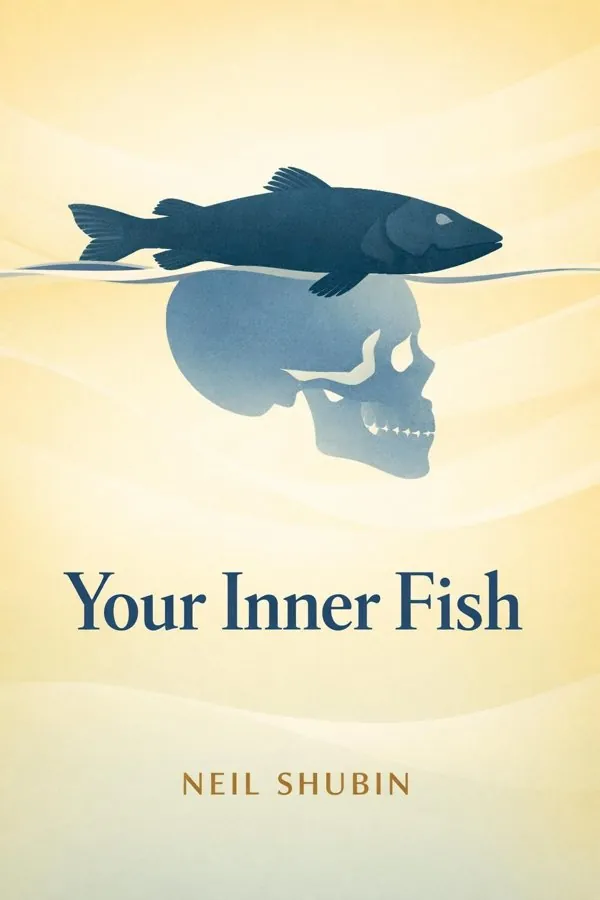
Your Inner Fish: A Journey Into the 3.5-Billion-Year History of the Human Body: Summary & Key Insights
by Neil Shubin
 10 min9 chaptersAudio available
Key Takeaways from Your Inner Fish: A Journey Into the 3.5-Billion-Year History of the Human Body
Some of the most important truths about being human were first uncovered in the bones of a creature buried in Arctic rock.
The human head feels like the seat of our uniqueness, yet much of it was assembled from structures inherited from ancient fish.
Shubin shows that the bones of the human arm and hand follow a basic design shared with the fins and limbs of many other vertebrates.
Long before animals had arms, legs, or skulls, evolution had already established the basic architectural rules of bodies.
Seeing, hearing, smelling, and balancing feel like refined human abilities, but their roots stretch back to far simpler organisms.
What Is Your Inner Fish: A Journey Into the 3.5-Billion-Year History of the Human Body About?
Your Inner Fish: A Journey Into the 3.5-Billion-Year History of the Human Body by Neil Shubin is a life_science book spanning 9 pages. What if the story of the human body began not with humans at all, but with fish, worms, and tiny ancient creatures that lived hundreds of millions of years ago? In Your Inner Fish, paleontologist and evolutionary biologist Neil Shubin takes readers on a fascinating tour through deep time to show how the human body carries the marks of its evolutionary past. Our hands, heads, teeth, senses, and even our tendency toward certain diseases all make more sense when seen as inherited modifications of older anatomical designs. At the heart of the book is Shubin’s landmark discovery of Tiktaalik, a fossil species that bridges the gap between fish and land animals. But this is far more than a fossil-hunting story. Shubin combines paleontology, anatomy, embryology, and genetics to reveal how evolution reuses old structures in new ways. The result is a vivid explanation of why our bodies work as they do—and why they sometimes fail. Written by one of the leading scientists in the field, Your Inner Fish matters because it turns evolution from an abstract theory into a personal story written into your own bones, nerves, and DNA.
This FizzRead summary covers all 9 key chapters of Your Inner Fish: A Journey Into the 3.5-Billion-Year History of the Human Body in approximately 10 minutes, distilling the most important ideas, arguments, and takeaways from Neil Shubin's work. Also available as an audio summary and Key Quotes Podcast.
Your Inner Fish: A Journey Into the 3.5-Billion-Year History of the Human Body
What if the story of the human body began not with humans at all, but with fish, worms, and tiny ancient creatures that lived hundreds of millions of years ago? In Your Inner Fish, paleontologist and evolutionary biologist Neil Shubin takes readers on a fascinating tour through deep time to show how the human body carries the marks of its evolutionary past. Our hands, heads, teeth, senses, and even our tendency toward certain diseases all make more sense when seen as inherited modifications of older anatomical designs.
At the heart of the book is Shubin’s landmark discovery of Tiktaalik, a fossil species that bridges the gap between fish and land animals. But this is far more than a fossil-hunting story. Shubin combines paleontology, anatomy, embryology, and genetics to reveal how evolution reuses old structures in new ways. The result is a vivid explanation of why our bodies work as they do—and why they sometimes fail. Written by one of the leading scientists in the field, Your Inner Fish matters because it turns evolution from an abstract theory into a personal story written into your own bones, nerves, and DNA.
Who Should Read Your Inner Fish: A Journey Into the 3.5-Billion-Year History of the Human Body?
This book is perfect for anyone interested in life_science and looking to gain actionable insights in a short read. Whether you're a student, professional, or lifelong learner, the key ideas from Your Inner Fish: A Journey Into the 3.5-Billion-Year History of the Human Body by Neil Shubin will help you think differently.
- ✓Readers who enjoy life_science and want practical takeaways
- ✓Professionals looking to apply new ideas to their work and life
- ✓Anyone who wants the core insights of Your Inner Fish: A Journey Into the 3.5-Billion-Year History of the Human Body in just 10 minutes
Want the full summary?
Get instant access to this book summary and 100K+ more with Fizz Moment.
Get Free SummaryAvailable on App Store • Free to download
Key Chapters
Some of the most important truths about being human were first uncovered in the bones of a creature buried in Arctic rock. Neil Shubin’s search for Tiktaalik was driven by a bold idea: if evolution is real and gradual, there should be fossils showing the transition from fish to land-dwelling animals. His team found exactly that. Tiktaalik lived about 375 million years ago and combined features of both fish and early tetrapods. It had scales and fins, but also a mobile neck, sturdy ribs, a flattened head, and limb bones inside its fins that resemble the basic architecture of an arm.
This discovery matters because it makes a large evolutionary change concrete. The transformation from fin to limb did not happen in a sudden leap. Instead, structures that originally helped fish navigate shallow water gradually became capable of supporting weight and movement on land. The same bones that helped Tiktaalik prop itself up are echoed in our own shoulders, elbows, and wrists.
Shubin uses Tiktaalik to show how science works at its best: researchers make predictions from theory, search in the right rocks of the right age, and test those predictions with evidence. That process has practical value beyond paleontology. It teaches us how to think historically about biology, medicine, and adaptation. Human anatomy becomes easier to understand when we see it as modified inheritance rather than perfect design.
A useful way to apply this idea is to look at your own body not as a machine built from scratch, but as a remodeled structure with ancient parts. Actionable takeaway: when studying biology, ask not only what a body part does, but what earlier structure it may have evolved from.
The human head feels like the seat of our uniqueness, yet much of it was assembled from structures inherited from ancient fish. Shubin explains that jaws, ears, skull bones, and even aspects of our facial architecture emerged through gradual evolutionary repurposing. What seems irreducibly human is often an updated version of something much older.
One striking example is the relationship between the jaw and the ear. In fish and early vertebrates, certain bones helped support the jaws and gills. Over evolutionary time, some of these bones changed function and became part of the middle ear in mammals. This means that when we hear, we are using structures with a deep anatomical history tied to feeding and respiration in our distant ancestors. The head is not a brand-new invention but a mosaic of old features transformed for new purposes.
Shubin also highlights how embryos preserve clues to this history. During development, human embryos briefly show pharyngeal arches, structures that echo the gill-supporting anatomy of fish. These do not become gills in us, but they contribute to parts of the jaw, throat, and ear. Embryology thus reveals evolution’s hidden continuity.
This perspective helps explain why human anatomy can seem awkward or counterintuitive. Evolution does not engineer from a blank slate; it modifies available materials. Understanding that can also deepen appreciation for comparative anatomy, medical training, and developmental biology.
A practical application is to treat anatomy as a historical narrative rather than a memorization task. When you learn where a structure came from, its form and function become easier to grasp. Actionable takeaway: connect major human head structures—jaw, ear, and throat—to their ancestral origins to make anatomy more meaningful and memorable.
Your hand is both ordinary and extraordinary: ordinary because it follows an ancient vertebrate pattern, extraordinary because evolution turned that pattern into a tool for writing, grasping, building, and healing. Shubin shows that the bones of the human arm and hand follow a basic design shared with the fins and limbs of many other vertebrates. One bone, then two, then many little bones, then digits—this is the recurring blueprint.
The power of this idea lies in its simplicity. A bat wing, a whale flipper, a horse leg, and a human hand look radically different, but underneath they are variations on the same structural theme. Evolution did not invent each appendage from scratch. It modified a common ancestral pattern to fit different environments and ways of life. In this view, our fingers are not isolated marvels but descendants of older limb structures that existed long before humans.
Shubin’s fossil and anatomical evidence also shows that key parts of the hand appeared before true hands did. In fish like Tiktaalik, the internal fin bones already resembled the bones later used in wrists and fingers. Evolution often prepares future possibilities by reshaping existing structures for intermediate functions. What later becomes useful for typing or playing piano may once have helped an animal push through mud or prop itself up in shallow water.
This concept has practical implications for learning, medicine, and biomechanics. It clarifies why injuries, joint arrangements, and limb development follow certain predictable patterns. It also reinforces the idea that form reflects historical constraint as much as present usefulness.
A practical way to use this insight is to compare your hand with the forelimbs of other animals and identify the shared pattern. Actionable takeaway: study the common bone plan across species to better understand both human dexterity and the logic of vertebrate design.
Long before animals had arms, legs, or skulls, evolution had already established the basic architectural rules of bodies. Shubin argues that many features of the human body plan—front and back, left and right, top and bottom, segmentation, and organ placement—arose deep in evolutionary time, often before vertebrates even existed. In other words, the map came before many of the specific structures built on it.
This is one of the book’s most profound ideas: humans inherit not only particular organs but also ancient developmental instructions for organizing a body. Worms, flies, fish, and humans differ dramatically in appearance, yet many use related genetic systems to lay out their bodies during embryonic development. This shared logic reveals that evolution conserves successful solutions at very deep levels.
Shubin explains how these old plans constrain what later evolution can do. Because new features must fit into existing developmental frameworks, innovation is usually a matter of modification rather than reinvention. That helps explain why vertebrates share similar overall organization and why major changes often occur through shifts in timing, growth, or emphasis rather than the creation of entirely new body maps.
For readers, this changes the way the human body is understood. We are not simply assembled from independent parts; we are patterned by ancient rules. This perspective can be useful in developmental biology, anatomy education, and even in appreciating congenital differences, which often arise when old developmental pathways vary or fail to coordinate.
A practical application is to think of the body as a historical blueprint layered over time. Actionable takeaway: when learning about any organ or structure, also ask how it fits into the deeper body plan that guides development from embryo to adult.
Seeing, hearing, smelling, and balancing feel like refined human abilities, but their roots stretch back to far simpler organisms. Shubin shows that the sensory systems we rely on every day evolved by modifying ancient mechanisms that originally served very different purposes. Evolution did not invent human senses from nothing; it adapted and integrated older biological tools.
Consider smell. Long before mammals developed complex noses, early organisms already had molecular systems for detecting chemicals in the environment. Those systems later became more specialized, helping animals find food, avoid danger, and communicate. Similarly, structures related to balance and hearing grew out of ancient anatomy connected to movement and orientation. Even the eye, often treated as a symbol of complexity, can be traced through a series of simpler light-detecting systems in earlier life forms.
Shubin’s point is not merely that senses evolved, but that their history explains their design. Human vision has blind spots and limitations; hearing depends on tiny bones repurposed from jaw structures; smell is deeply tied to emotion and memory because of how neural circuits developed. Our senses are powerful, but they are also patched together from older components.
This insight has practical relevance in medicine and daily life. It can help us better understand sensory disorders, developmental anomalies, and the comparative strengths of different species. Dogs, birds, fish, and insects often excel where we do not because evolution tuned the same broad problem—perception—to different environments.
A useful exercise is to compare how different animals sense the world and ask what environmental pressures shaped those systems. Actionable takeaway: use the evolutionary history of the senses to better understand both human limitations and the remarkable diversity of perception in nature.
One of evolution’s greatest tricks is not constant invention, but clever reuse. Shubin explains that many of the genes guiding human development are ancient and shared with organisms that look nothing like us. What differs is often not the existence of the genes themselves, but when, where, and how strongly they are activated. This is why a relatively small toolkit of genetic instructions can produce enormous biological diversity.
A central example involves developmental genes such as Hox genes, which help organize body regions in embryos. These genes are found across a wide range of animals, from insects to mammals. Their presence reveals a deep continuity in how bodies are built. But evolution creates novelty by redeploying these instructions in new contexts. A gene that helps pattern a fin in one lineage can, with changes in regulation, contribute to a limb in another.
This idea helps solve a common misconception: more complex creatures do not simply have completely new genes for every new feature. Instead, complexity often emerges through changes in regulation and interaction. The genome works less like a list of isolated blueprints and more like a dynamic toolkit. Development, then, becomes the arena where evolutionary history and genetic possibility meet.
This matters practically because many birth defects, diseases, and anatomical variations arise from disruptions in developmental pathways. Understanding those pathways requires seeing genes in historical context. It also explains why model organisms like fruit flies, mice, and zebrafish are so useful in biomedical research: they share core developmental machinery with us.
A practical way to apply this concept is to shift from asking “Which gene caused this?” to “How was a shared genetic toolkit used differently here?” Actionable takeaway: view genes as recycled instructions whose timing and regulation are often more important than their mere presence.
Many of the body’s weaknesses make more sense when we stop assuming the human form is optimally designed. Shubin argues that evolution helps explain why we are prone to back pain, hernias, choking, bad knees, and a host of structural problems. Natural selection produces workable solutions, not perfect ones, and it must build with inherited materials. As a result, the body is full of compromises.
Take the human back. Our spine evolved from structures suited to four-legged ancestors, then was modified for upright walking. Bipedalism brought major advantages, but it also created new stresses on vertebrae, discs, muscles, and joints. Similarly, the route of the recurrent laryngeal nerve, which loops downward before returning to the throat, seems absurd from an engineering perspective. Yet it makes sense historically because it was inherited from fishlike ancestors with very different neck anatomy.
The same principle applies to disease susceptibility. Some structures are vulnerable because they were adapted for one context and later co-opted for another. Others reflect trade-offs, where a trait that was beneficial under past conditions brings costs in modern environments. Evolutionary medicine does not replace standard medicine, but it adds a valuable explanatory layer.
This way of thinking is useful for patients, doctors, and anyone curious about health. It encourages humility about the body and helps us understand why “bad design” can still persist. The body is not a fresh prototype; it is a historical compromise.
A practical application is to ask of any common ailment, “What in our evolutionary history made this vulnerability likely?” Actionable takeaway: use an evolutionary lens to better understand health problems as inherited trade-offs rather than simple mechanical failures.
Human beings are not separate from other animals; we are layered versions of them. Shubin explores how our bodies and behaviors reflect the inheritance of older vertebrate stages, including features often associated with reptiles and mammals. This does not mean we literally contain miniature ancestral creatures inside us, but it does mean that evolution added new layers without fully erasing the old ones.
One place this is especially visible is in reproduction and physiology. Mammalian traits such as hair, mammary glands, warm-blooded metabolism, and specialized teeth all evolved on top of older vertebrate foundations. Reptilian and earlier features remain embedded in our anatomy as part of the underlying system. The same broad principle applies to the brain and behavior, though Shubin is careful not to reduce human psychology to simplistic “inner reptile” clichés. Instead, he shows that complex organisms often preserve older structures while elaborating new capabilities.
This layered view of life helps explain why comparative anatomy is so powerful. To understand any mammalian trait, it helps to ask what came before it. Our kidneys, skin, reproductive systems, and temperature regulation all make more sense when seen as modifications of older vertebrate designs. Evolution builds upward, keeping functional pieces while altering their roles and interactions.
The idea also has educational value. It reminds us that our kinship with animals is biological, not metaphorical. Learning about other vertebrates is therefore a way of learning about ourselves. What seems alien in a lizard, bird, or opossum may illuminate hidden aspects of our own anatomy.
A practical application is to compare one distinctly mammalian trait with its earlier vertebrate precursors. Actionable takeaway: understand human biology as a layered inheritance, where newer features are built onto much older anatomical foundations.
The deepest message of Your Inner Fish is that evolution is not just a story about the distant past; it is a living reality inside every human body. Shubin’s final lesson is that our anatomy, development, vulnerabilities, and capacities all bear the marks of a 3.5-billion-year history. To understand ourselves fully, we must see our bodies as archives of ancient change.
This legacy appears everywhere. Our cells use biochemical machinery shared with ancient life. Our embryos follow developmental pathways inherited from long-ago ancestors. Our skeleton reflects transitions from water to land, from quadrupedal movement to upright walking, and from generalized vertebrate limbs to human hands. Even traits we consider distinctly human are woven from older biological threads.
What makes this perspective so powerful is that it unifies many fields. Fossils reveal what once existed. Comparative anatomy shows structural continuity. Embryology uncovers developmental echoes. Genetics exposes the shared toolkit beneath diversity. Together, these disciplines tell one coherent story: life changes through descent with modification, and the human body is one of its most eloquent results.
For readers, this can inspire both wonder and intellectual clarity. It reframes human identity, not by diminishing us, but by situating us within a vast and connected natural history. It also encourages better scientific literacy by showing how independent lines of evidence reinforce each other.
A practical way to apply the book’s final insight is to use evolutionary thinking whenever you encounter a biological question, from anatomy to health to behavior. Actionable takeaway: see your body as a historical document and let that perspective guide how you learn, question, and appreciate biology.
All Chapters in Your Inner Fish: A Journey Into the 3.5-Billion-Year History of the Human Body
About the Author
Neil Shubin is an American paleontologist, evolutionary biologist, and professor of organismal biology and anatomy at the University of Chicago. He is best known for co-discovering Tiktaalik, the landmark fossil that illuminates the transition between fish and early land vertebrates. His research focuses on the origins of major anatomical features and the deep evolutionary history of the vertebrate body. Beyond academia, Shubin has become one of the most effective public communicators of evolutionary science, known for translating complex ideas into engaging, accessible stories. His work bridges paleontology, embryology, genetics, and comparative anatomy, helping readers see the human body as the product of an ancient and continuous history. Through his books and educational outreach, Shubin has made evolutionary biology vivid, personal, and understandable for a broad audience.
Get This Summary in Your Preferred Format
Read or listen to the Your Inner Fish: A Journey Into the 3.5-Billion-Year History of the Human Body summary by Neil Shubin anytime, anywhere. FizzRead offers multiple formats so you can learn on your terms — all free.
Available formats: App · Audio · PDF · EPUB — All included free with FizzRead
Download Your Inner Fish: A Journey Into the 3.5-Billion-Year History of the Human Body PDF and EPUB Summary
Key Quotes from Your Inner Fish: A Journey Into the 3.5-Billion-Year History of the Human Body
“Some of the most important truths about being human were first uncovered in the bones of a creature buried in Arctic rock.”
“The human head feels like the seat of our uniqueness, yet much of it was assembled from structures inherited from ancient fish.”
“Shubin shows that the bones of the human arm and hand follow a basic design shared with the fins and limbs of many other vertebrates.”
“Long before animals had arms, legs, or skulls, evolution had already established the basic architectural rules of bodies.”
“Seeing, hearing, smelling, and balancing feel like refined human abilities, but their roots stretch back to far simpler organisms.”
Frequently Asked Questions about Your Inner Fish: A Journey Into the 3.5-Billion-Year History of the Human Body
Your Inner Fish: A Journey Into the 3.5-Billion-Year History of the Human Body by Neil Shubin is a life_science book that explores key ideas across 9 chapters. What if the story of the human body began not with humans at all, but with fish, worms, and tiny ancient creatures that lived hundreds of millions of years ago? In Your Inner Fish, paleontologist and evolutionary biologist Neil Shubin takes readers on a fascinating tour through deep time to show how the human body carries the marks of its evolutionary past. Our hands, heads, teeth, senses, and even our tendency toward certain diseases all make more sense when seen as inherited modifications of older anatomical designs. At the heart of the book is Shubin’s landmark discovery of Tiktaalik, a fossil species that bridges the gap between fish and land animals. But this is far more than a fossil-hunting story. Shubin combines paleontology, anatomy, embryology, and genetics to reveal how evolution reuses old structures in new ways. The result is a vivid explanation of why our bodies work as they do—and why they sometimes fail. Written by one of the leading scientists in the field, Your Inner Fish matters because it turns evolution from an abstract theory into a personal story written into your own bones, nerves, and DNA.
More by Neil Shubin
You Might Also Like
The Selfish Gene
Richard Dawkins
10 min
Awakenings
Oliver Sacks
10 min
Parasite Rex: Inside the Bizarre World of Nature's Most Dangerous Creatures
Carl Zimmer
10 min
The Atlas of Life on Earth
Various
10 min
The Book of Humans: The Story of How We Became Us
Adam Rutherford
10 min
The Horse
Wendy Williams
10 minBrowse by Category
Ready to read Your Inner Fish: A Journey Into the 3.5-Billion-Year History of the Human Body?
Get the full summary and 100K+ more books with Fizz Moment.