
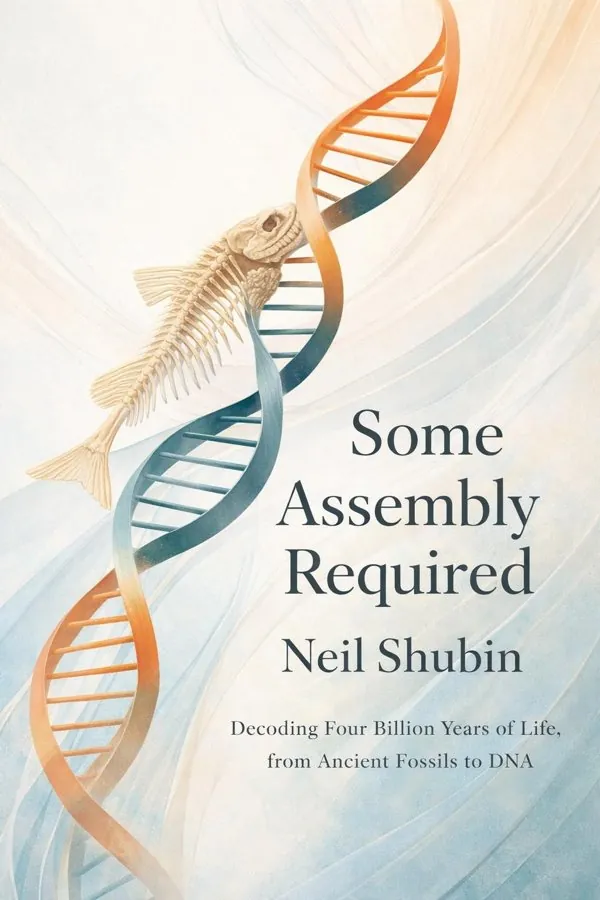
Some Assembly Required: Decoding Four Billion Years of Life, from Ancient Fossils to DNA: Summary & Key Insights
by Neil Shubin
 10 min9 chaptersAudio available
Key Takeaways from Some Assembly Required: Decoding Four Billion Years of Life, from Ancient Fossils to DNA
The history of life is not hidden in a single place; it is scattered through rocks like pages torn from an unimaginably old book.
Some discoveries change not only a field but the way the public imagines science, and Tiktaalik is one of them.
If fossils are the visible record of life’s transformations, DNA is the hidden archive that every organism carries within it.
Appearances can mislead, but DNA often reveals kinship with remarkable precision.
Nature rarely builds from scratch; it improvises with what is already available.
What Is Some Assembly Required: Decoding Four Billion Years of Life, from Ancient Fossils to DNA About?
Some Assembly Required: Decoding Four Billion Years of Life, from Ancient Fossils to DNA by Neil Shubin is a life_science book spanning 9 pages. Life did not appear all at once in finished form. It was assembled, piece by piece, over billions of years, with old parts reshaped into new functions and ancient innovations carried forward into modern bodies. In Some Assembly Required, paleontologist and evolutionary biologist Neil Shubin tells this story by weaving together two powerful records of life’s history: fossils in stone and genetic instructions in DNA. The result is a vivid account of how major evolutionary transitions unfolded, from the rise of limbs and lungs to the origins of feathers, mammalian hearing, and human traits. What makes the book especially compelling is Shubin’s ability to show that evolution is not an abstract theory but a detective story grounded in evidence. Fossils reveal changing anatomy across deep time, while genes expose the molecular toolkit that makes those changes possible. Shubin is uniquely qualified to guide readers through this terrain: he is a leading scientist, best known for co-discovering Tiktaalik, one of the most famous transitional fossils ever found. His book matters because it helps readers see that our bodies, like all life, are built from ancient biological parts with remarkably deep origins.
This FizzRead summary covers all 9 key chapters of Some Assembly Required: Decoding Four Billion Years of Life, from Ancient Fossils to DNA in approximately 10 minutes, distilling the most important ideas, arguments, and takeaways from Neil Shubin's work. Also available as an audio summary and Key Quotes Podcast.
Some Assembly Required: Decoding Four Billion Years of Life, from Ancient Fossils to DNA
Life did not appear all at once in finished form. It was assembled, piece by piece, over billions of years, with old parts reshaped into new functions and ancient innovations carried forward into modern bodies. In Some Assembly Required, paleontologist and evolutionary biologist Neil Shubin tells this story by weaving together two powerful records of life’s history: fossils in stone and genetic instructions in DNA. The result is a vivid account of how major evolutionary transitions unfolded, from the rise of limbs and lungs to the origins of feathers, mammalian hearing, and human traits.
What makes the book especially compelling is Shubin’s ability to show that evolution is not an abstract theory but a detective story grounded in evidence. Fossils reveal changing anatomy across deep time, while genes expose the molecular toolkit that makes those changes possible. Shubin is uniquely qualified to guide readers through this terrain: he is a leading scientist, best known for co-discovering Tiktaalik, one of the most famous transitional fossils ever found. His book matters because it helps readers see that our bodies, like all life, are built from ancient biological parts with remarkably deep origins.
Who Should Read Some Assembly Required: Decoding Four Billion Years of Life, from Ancient Fossils to DNA?
This book is perfect for anyone interested in life_science and looking to gain actionable insights in a short read. Whether you're a student, professional, or lifelong learner, the key ideas from Some Assembly Required: Decoding Four Billion Years of Life, from Ancient Fossils to DNA by Neil Shubin will help you think differently.
- ✓Readers who enjoy life_science and want practical takeaways
- ✓Professionals looking to apply new ideas to their work and life
- ✓Anyone who wants the core insights of Some Assembly Required: Decoding Four Billion Years of Life, from Ancient Fossils to DNA in just 10 minutes
Want the full summary?
Get instant access to this book summary and 100K+ more with Fizz Moment.
Get Free SummaryAvailable on App Store • Free to download
Key Chapters
The history of life is not hidden in a single place; it is scattered through rocks like pages torn from an unimaginably old book. Shubin argues that the fossil record is one of the clearest ways to see evolution in action because it preserves forms that bridge major transitions rather than simply displaying unrelated species. When we examine fossils across layers of time, we see bodies changing in patterned, intelligible ways: fins acquiring wrist-like bones, reptilian jaws reorganizing into mammalian ears, and dinosaur skeletons gradually displaying birdlike traits.
This matters because evolution is often misunderstood as a vague claim that "things changed." Fossils make that change concrete. They show that new structures often emerge by modifying old ones instead of appearing from nowhere. A limb is not an invention independent of the fin; it is a transformed fin. The mammalian middle ear is not a separate creation; it is built from bones that once served other purposes. These discoveries let us trace continuity through apparent novelty.
Shubin also emphasizes that fossils do more than confirm broad theory. They help scientists make predictions. If we know when a transition likely occurred and what environments existed then, we can search the right rocks for the right kinds of intermediate forms. That predictive power makes paleontology a deeply testable science.
A practical way to apply this idea is to look at scientific questions historically rather than statically. Whether in biology, medicine, or technology, ask: what earlier form did this grow out of? Actionable takeaway: train yourself to see complex systems as products of gradual modification, because that mindset makes both nature and change easier to understand.
Some discoveries change not only a field but the way the public imagines science, and Tiktaalik is one of them. Shubin recounts how he and his colleagues searched Arctic rocks about 375 million years old because those sediments represented exactly the period when vertebrates were beginning to move from water onto land. Their logic was simple but powerful: if evolutionary theory is right, transitional creatures should be found in rocks of the right age and environment. Tiktaalik roseae was the spectacular result.
Tiktaalik had features of both fish and early land animals. It possessed scales and fins, yet also had a mobile neck, sturdy ribs, and fin bones comparable to a shoulder, elbow, and wrist. It was not merely a fish or an amphibian, but a form that illuminates how one body plan became another. This is the core of Shubin’s message: major transformations are understandable when we find the intermediate steps.
The significance extends beyond this single fossil. Tiktaalik demonstrates how paleontology works as a predictive science guided by anatomy, geology, and evolutionary reasoning. Rather than stumbling onto random curiosities, scientists can use evidence to narrow their search. The discovery also gives readers a memorable example of how limbs, breathing, and movement on land were assembled from preexisting aquatic structures.
In practical terms, Tiktaalik teaches the value of searching where the evidence points, even when the destination is remote, difficult, or uncertain. Good discoveries often come from disciplined patience, not luck. Actionable takeaway: when solving a hard problem, identify the transitional stage you expect to exist, then go looking for evidence in the place and time where it should appear.
If fossils are the visible record of life’s transformations, DNA is the hidden archive that every organism carries within it. Shubin shows that genes allow scientists to trace relationships and developmental processes that fossils alone cannot fully reveal. Long after bones, feathers, or scales disappear from the rocks, the molecular machinery that helped build them can persist in descendants. In this sense, evolution leaves a double record: one external and one internal.
A central insight of the book is that many of the genes shaping modern bodies are astonishingly ancient. The same broad genetic toolkit helps pattern bodies across fish, birds, mammals, and humans. Genes are reused, repurposed, switched on in new locations, and combined in new ways. That helps explain why radically different creatures can share deep biological similarities. It also means that novelty often comes from tinkering with old instructions rather than inventing entirely new ones.
This perspective transforms how we think about biological change. Evolution is not only a story of anatomy; it is also a story of regulation, timing, and deployment. A gene associated with building an eye, limb, or feather may have roots far older than the structure we associate it with today. Molecular biology therefore extends the fossil record by showing how ancient tools were preserved and remodeled over time.
The practical application is broad. In medicine, developmental biology, and genetics, understanding shared molecular pathways across species helps researchers study human disease using model organisms. Actionable takeaway: whenever something in biology seems completely new, ask what older genetic system may have been modified to create it.
Appearances can mislead, but DNA often reveals kinship with remarkable precision. Shubin explains that molecular evidence has revolutionized our ability to reconstruct the history of life by comparing genetic sequences among organisms. These comparisons show which species share more recent common ancestors, which traits evolved independently, and how lineages branched across deep time. In many cases, DNA confirms patterns suggested by fossils; in others, it sharpens or corrects them.
This matters because evolution is not simply about arranging organisms by superficial similarity. Wings, for example, may look alike in birds and bats, but their underlying history differs. Molecular data help distinguish true shared inheritance from convergent evolution, where similar solutions arise separately in response to similar challenges. The genome can also reveal traces of ancient events such as gene duplications, viral insertions, and conserved regulatory elements that shaped major innovations.
Shubin presents DNA as a kind of time machine, though not a perfect one. Genetic evidence is strongest when interpreted alongside anatomy, embryology, and geology. A sequence by itself does not tell the whole story. But together, these lines of evidence create a far more detailed and reliable evolutionary map than earlier generations could have imagined.
For readers, the deeper lesson is methodological. The best explanations come from converging evidence, not from one data source in isolation. In everyday reasoning, that means resisting the temptation to rely on a single indicator. Actionable takeaway: when trying to understand origins or relationships, combine multiple kinds of evidence and look for patterns that align across them.
Nature rarely builds from scratch; it improvises with what is already available. One of Shubin’s most powerful themes is that complex traits such as limbs, feathers, hearing structures, and sophisticated sensory systems arise through the modification and recombination of older biological parts. Evolution is less like designing a machine from a blank page and more like renovating an ancient house whose original framework still shapes every new addition.
This helps explain why bodies contain quirks, constraints, and surprising workarounds. New functions often appear by reusing structures that initially evolved for something else. Feathers may have begun with roles in insulation or display before becoming essential for flight. Bones of the jaw in reptile-like ancestors were transformed into parts of the mammalian middle ear. What looks perfect today may bear unmistakable traces of an older job.
Shubin pairs this anatomical logic with developmental genetics. The genes and pathways used to construct complex traits are often deeply conserved, meaning they existed before the final trait took its modern form. Evolutionary novelty, then, often depends on shifting where, when, and how these pathways are activated. Small changes in regulation can produce large changes in anatomy over time.
This idea has practical force beyond biology. Innovation in business, art, and problem-solving often works the same way: old tools get recombined into new solutions. Truly novel outcomes may come from reusing familiar elements in unfamiliar contexts. Actionable takeaway: when facing a creative challenge, inventory the resources, skills, or structures you already have and ask how they might be repurposed instead of assuming you need entirely new materials.
Few scientific ideas are more startling to newcomers than the claim that birds are living dinosaurs and that mammals emerged through a long reptile-like ancestry. Shubin uses these examples to show how dramatic evolutionary shifts become far more understandable when seen as sequences of intermediates. Birds did not suddenly appear with fully formed wings, hollow bones, and flight-ready feathers. Mammals did not arrive instantly with warm-blooded metabolism, differentiated teeth, and uniquely sensitive hearing. Each lineage was assembled over immense spans of time.
In the case of birds, the fossil record reveals dinosaurs with feathers, wishbones, birdlike lungs, and altered forelimbs. These features accumulated before true flight as we know it. For mammals, fossils show transitions in teeth, posture, jaw structure, and ear anatomy across synapsid ancestors. Shubin highlights how these lineages demonstrate the layered nature of evolution: many hallmark traits arise before the lifestyle they later enable.
This perspective also changes how we classify life. Categories such as reptile, bird, and mammal can seem fixed and separate, but history shows they are branches in a continuous tree. Evolution does not respect the neat boxes people prefer. Instead, it produces nested relationships and mixed-feature organisms that reveal the process of becoming.
A useful application is learning to tolerate intermediate stages. Whether in personal growth, education, or organizational change, transformation often looks messy in the middle because old and new traits coexist. Actionable takeaway: do not dismiss transitional forms, in nature or life, as signs of failure; they are often the clearest evidence that meaningful change is underway.
Big changes in life’s history often feel sudden when viewed from a distance, but Shubin shows that even apparent leaps are grounded in molecular mechanisms. Evolutionary breakthroughs depend on innovations in genes, gene regulation, and developmental systems that open new possibilities for anatomy and behavior. A new body plan, sensory ability, or physiological capacity does not appear by magic; it emerges when underlying molecular tools are duplicated, modified, or deployed in novel ways.
One important mechanism is gene duplication. When a gene is copied, one version can keep performing its original job while the other is free to change. Over time, this can lead to specialized functions and increased complexity. Regulatory changes are equally important. The same gene can produce very different outcomes depending on where and when it is active in an embryo. This helps explain how major differences among species can arise without requiring entirely different sets of genes.
Shubin’s argument reframes evolution as a process of assembly and timing. Life’s major transitions depend not only on the presence of useful parts but on new ways of orchestrating them. This is why molecular biology is essential to understanding deep history: it reveals the mechanisms behind the forms found in fossils.
For modern readers, this offers a broader lesson about change in complex systems. Transformation often comes less from inventing entirely new components than from reorganizing relationships among existing ones. Actionable takeaway: when trying to improve a system, focus not only on adding new parts but on changing how existing parts interact, because coordination can be as powerful as invention.
One of the most humbling ideas in the book is that the human body is not a fresh design but a mosaic assembled from ancient evolutionary inheritances. Shubin invites readers to see their own anatomy as a record of deep time. Our limbs reflect ancient fish fins. Our hearing depends on bones repurposed from older jaw structures. Our genes contain instructions shared with creatures that lived long before humans existed. The body is less a finished masterpiece than a historical document.
This perspective matters because it explains both our strengths and our vulnerabilities. Evolution works well enough, not perfectly. Features inherited from earlier ancestors may be brilliantly adaptive in one context and awkward in another. The structure of the spine, the arrangement of nerves, and developmental quirks all make more sense once we recognize that natural selection modifies what is already there rather than engineering ideal solutions from scratch.
Shubin also shows that human uniqueness becomes more intelligible, not less, when placed within this broader framework. Language, dexterity, vision, and cognition are extraordinary, but they emerged from older systems shared with other animals. Understanding our continuity with the rest of life does not diminish humanity; it situates us in a richer and more evidence-based story.
Practically, this evolutionary view can deepen curiosity about health, development, and anatomy. Many medical questions become clearer when framed historically. Actionable takeaway: when learning about the human body, ask not just how a structure works, but why evolution left us with that particular arrangement in the first place.
Evolution is not a distant drama that ended with the arrival of humans; it is an ongoing process unfolding all around us. Shubin stresses that the same principles visible in fossils and DNA continue to shape life today. Organisms still adapt, populations still change, and genes still spread or disappear depending on environmental pressures. The deep past is essential, but it should train us to recognize change in the present.
Modern examples make this vivid. Bacteria evolve resistance to antibiotics. Viruses accumulate mutations that alter transmissibility or immune escape. Animals shift ranges and behaviors as climates change. Human populations carry genetic signatures of adaptation to altitude, diet, and disease. These cases remind us that evolution is neither random chaos nor a march toward perfection. It is a continual process of variation, selection, inheritance, and contingency.
Shubin’s broader point is that understanding evolution is practically important, not merely intellectually satisfying. Public health, conservation, agriculture, and medicine all depend on evolutionary thinking. If we ignore how organisms adapt, we make worse decisions about drug use, habitat management, and long-term planning. Evolutionary biology helps us anticipate change instead of merely reacting to it.
For readers, this idea offers a habit of mind that is useful far beyond science: systems respond to pressure, and those responses accumulate. Actionable takeaway: use evolutionary thinking in real life by asking what pressures are acting on a system now, what variation exists within it, and how those pressures may shape its future over time.
All Chapters in Some Assembly Required: Decoding Four Billion Years of Life, from Ancient Fossils to DNA
About the Author
Neil Shubin is an American paleontologist, evolutionary biologist, and educator known for showing how fossils, anatomy, and genetics fit together to explain the history of life. He is a professor at the University of Chicago, where his research has focused on major evolutionary transitions, especially the origin of vertebrate body structures. Shubin is best known for co-discovering Tiktaalik roseae, a landmark fossil that illuminates the shift from fish to early land animals. Beyond academia, he has become a prominent public voice for evolutionary science through bestselling books, television work, and lectures. His writing stands out for making deep time, developmental biology, and paleontology accessible to general readers while preserving scientific rigor and a strong sense of wonder.
Get This Summary in Your Preferred Format
Read or listen to the Some Assembly Required: Decoding Four Billion Years of Life, from Ancient Fossils to DNA summary by Neil Shubin anytime, anywhere. FizzRead offers multiple formats so you can learn on your terms — all free.
Available formats: App · Audio · PDF · EPUB — All included free with FizzRead
Download Some Assembly Required: Decoding Four Billion Years of Life, from Ancient Fossils to DNA PDF and EPUB Summary
Key Quotes from Some Assembly Required: Decoding Four Billion Years of Life, from Ancient Fossils to DNA
“The history of life is not hidden in a single place; it is scattered through rocks like pages torn from an unimaginably old book.”
“Some discoveries change not only a field but the way the public imagines science, and Tiktaalik is one of them.”
“If fossils are the visible record of life’s transformations, DNA is the hidden archive that every organism carries within it.”
“Appearances can mislead, but DNA often reveals kinship with remarkable precision.”
“Nature rarely builds from scratch; it improvises with what is already available.”
Frequently Asked Questions about Some Assembly Required: Decoding Four Billion Years of Life, from Ancient Fossils to DNA
Some Assembly Required: Decoding Four Billion Years of Life, from Ancient Fossils to DNA by Neil Shubin is a life_science book that explores key ideas across 9 chapters. Life did not appear all at once in finished form. It was assembled, piece by piece, over billions of years, with old parts reshaped into new functions and ancient innovations carried forward into modern bodies. In Some Assembly Required, paleontologist and evolutionary biologist Neil Shubin tells this story by weaving together two powerful records of life’s history: fossils in stone and genetic instructions in DNA. The result is a vivid account of how major evolutionary transitions unfolded, from the rise of limbs and lungs to the origins of feathers, mammalian hearing, and human traits. What makes the book especially compelling is Shubin’s ability to show that evolution is not an abstract theory but a detective story grounded in evidence. Fossils reveal changing anatomy across deep time, while genes expose the molecular toolkit that makes those changes possible. Shubin is uniquely qualified to guide readers through this terrain: he is a leading scientist, best known for co-discovering Tiktaalik, one of the most famous transitional fossils ever found. His book matters because it helps readers see that our bodies, like all life, are built from ancient biological parts with remarkably deep origins.
More by Neil Shubin
You Might Also Like
The Selfish Gene
Richard Dawkins
10 min
Awakenings
Oliver Sacks
10 min
Parasite Rex: Inside the Bizarre World of Nature's Most Dangerous Creatures
Carl Zimmer
10 min
The Atlas of Life on Earth
Various
10 min
The Book of Humans: The Story of How We Became Us
Adam Rutherford
10 min
The Horse
Wendy Williams
10 minBrowse by Category
Ready to read Some Assembly Required: Decoding Four Billion Years of Life, from Ancient Fossils to DNA?
Get the full summary and 100K+ more books with Fizz Moment.