
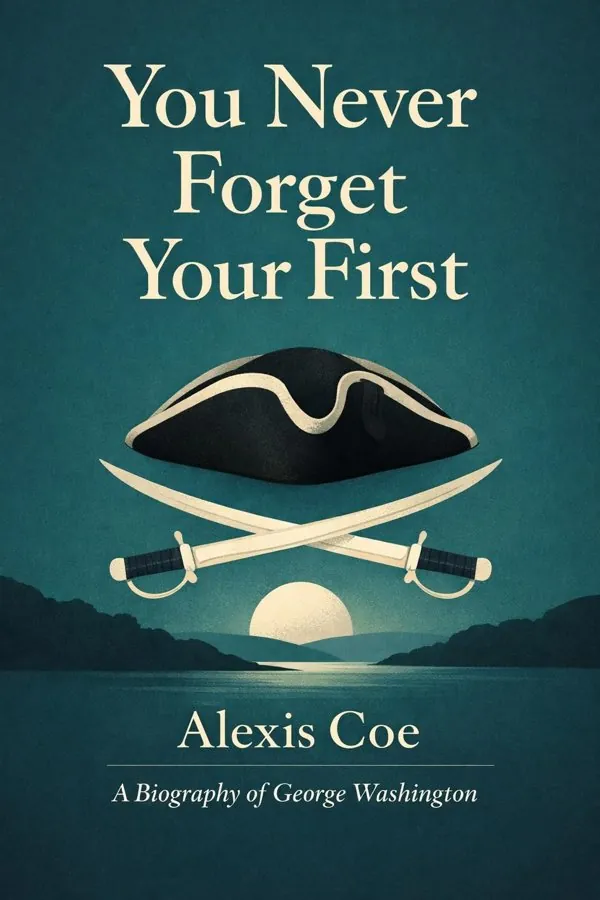
You Never Forget Your First: A Biography of George Washington: Summary & Key Insights
by Alexis Coe
 10 min9 chaptersAudio available
Key Takeaways from You Never Forget Your First: A Biography of George Washington
Greatness often begins not in certainty, but in insecurity.
The leaders we celebrate for composure are often shaped first by embarrassment.
A polished domestic image can hide an exploitative system underneath it.
Winning a revolution is often less about dramatic genius than about surviving long enough for your opponent to lose.
Public trust is rarely spontaneous; it is often carefully constructed.
What Is You Never Forget Your First: A Biography of George Washington About?
You Never Forget Your First: A Biography of George Washington by Alexis Coe is a biographies book spanning 6 pages. Alexis Coe’s You Never Forget Your First: A Biography of George Washington is not another reverent portrait of a marble founding father. Instead, it is a sharp, lively, and revisionist account that asks what happens when we look past the myths and examine Washington as a real person: ambitious, disciplined, insecure, calculating, and deeply shaped by the world of slavery, war, and political experimentation. Coe challenges the sanitized stories many readers inherit in school, replacing them with a more complicated and far more interesting man. The book matters because George Washington has often been treated as untouchable, a symbol rather than a subject. Coe argues that this hero worship obscures the realities of his life and the contradictions of the nation he helped create. She pays close attention to Washington’s failures, his dependence on enslaved labor, his management of public image, and the burdens of leadership during moments of national fragility. As a historian known for making biography accessible without sacrificing rigor, Coe brings both research and wit to the task. The result is an engaging reconsideration of one of America’s most over-familiar and least understood figures.
This FizzRead summary covers all 9 key chapters of You Never Forget Your First: A Biography of George Washington in approximately 10 minutes, distilling the most important ideas, arguments, and takeaways from Alexis Coe's work. Also available as an audio summary and Key Quotes Podcast.
You Never Forget Your First: A Biography of George Washington
Alexis Coe’s You Never Forget Your First: A Biography of George Washington is not another reverent portrait of a marble founding father. Instead, it is a sharp, lively, and revisionist account that asks what happens when we look past the myths and examine Washington as a real person: ambitious, disciplined, insecure, calculating, and deeply shaped by the world of slavery, war, and political experimentation. Coe challenges the sanitized stories many readers inherit in school, replacing them with a more complicated and far more interesting man.
The book matters because George Washington has often been treated as untouchable, a symbol rather than a subject. Coe argues that this hero worship obscures the realities of his life and the contradictions of the nation he helped create. She pays close attention to Washington’s failures, his dependence on enslaved labor, his management of public image, and the burdens of leadership during moments of national fragility.
As a historian known for making biography accessible without sacrificing rigor, Coe brings both research and wit to the task. The result is an engaging reconsideration of one of America’s most over-familiar and least understood figures.
Who Should Read You Never Forget Your First: A Biography of George Washington?
This book is perfect for anyone interested in biographies and looking to gain actionable insights in a short read. Whether you're a student, professional, or lifelong learner, the key ideas from You Never Forget Your First: A Biography of George Washington by Alexis Coe will help you think differently.
- ✓Readers who enjoy biographies and want practical takeaways
- ✓Professionals looking to apply new ideas to their work and life
- ✓Anyone who wants the core insights of You Never Forget Your First: A Biography of George Washington in just 10 minutes
Want the full summary?
Get instant access to this book summary and 100K+ more with Fizz Moment.
Get Free SummaryAvailable on App Store • Free to download
Key Chapters
Greatness often begins not in certainty, but in insecurity. Alexis Coe presents George Washington’s early life as the story of a young man who was never fully guaranteed status and therefore worked relentlessly to secure it. Born in 1732 into a Virginia planter family that was respectable but not among the colony’s top elite, Washington lost his father at a young age. That loss mattered. It left him without the educational pathway and inherited advantages that might have come with a stronger paternal network. In Coe’s telling, this early instability did not crush him; it sharpened him.
Washington learned quickly that reputation, land, and connections could be built, but only through discipline and self-fashioning. He became a surveyor, a profession that gave him practical knowledge of land, expansion, and opportunity. It also exposed him to the geography of power in colonial America. He observed the importance of property ownership and social standing, then pursued both with determination. His careful attention to manners, appearance, and conduct reflected not innate ease, but effort. He was creating himself.
Coe’s version of Washington helps readers understand ambition as both productive and revealing. His desire to rise shaped nearly every major decision he made, from military service to marriage to politics. This perspective also makes him more human. Rather than seeing him as destined for leadership, we see a young man constantly working to become worthy of notice.
In modern terms, Washington’s early years offer a reminder that people often compensate for vulnerability by becoming highly organized, strategic, and image-conscious. Many leaders today do the same, whether in business, public life, or personal advancement.
Actionable takeaway: Look closely at the insecurities behind ambition—your own or others’—because they often explain behavior more accurately than talent alone.
The leaders we celebrate for composure are often shaped first by embarrassment. Before Washington became the calm commander of popular memory, he was a young officer who made costly mistakes during the French and Indian War. Coe emphasizes that his military beginnings were marked less by brilliance than by overconfidence, confusion, and painful lessons. This matters because it dismantles the myth of Washington as naturally flawless and replaces it with a more useful story: he learned through failure.
As a militia officer, Washington entered a volatile frontier conflict involving British imperial interests, French forces, and Native nations. He was ambitious and eager for distinction, but he lacked experience. His involvement in incidents that escalated tensions, including the skirmish at Jumonville Glen and the disastrous surrender at Fort Necessity, exposed his limitations. He misread situations, trusted too much in his own judgment, and discovered that courage does not automatically produce good command.
Yet these defeats became formative. Washington learned the dangers of rash action, the fragility of military supply chains, and the importance of discipline. He also experienced the British military hierarchy from a subordinate position and resented how colonial officers were treated. That resentment later influenced his understanding of American military independence. Failure did not end his career; it refined his instincts.
Coe invites readers to see leadership as iterative rather than innate. In professional life, many people avoid risk because they fear visible mistakes. Washington’s early record suggests the opposite lesson: early failure can become a training ground if a person develops humility and adapts.
For readers, this chapter also reframes success. Washington’s later military endurance during the Revolution was built partly on memories of what had gone wrong before.
Actionable takeaway: Treat early failures as data, not verdicts; the most durable leadership often comes from carefully studied mistakes.
A polished domestic image can hide an exploitative system underneath it. Coe’s account of Washington’s marriage to Martha Custis and his life at Mount Vernon explores not only his rise in wealth and status, but also the plantation economy that made that rise possible. Washington’s marriage significantly improved his social and financial position. Martha brought connections, prestige, and substantial property interests, helping transform him into one of Virginia’s major landholders. But Coe insists that readers confront the source of that prosperity: enslaved labor.
Mount Vernon has often been romanticized as the serene home of a future founding father. Coe strips away that nostalgia. Washington was not simply a gentleman farmer experimenting with crops and hospitality; he was a plantation manager obsessed with productivity, efficiency, and control. He tracked output, supervised labor, pursued expansion, and made decisions within a system that depended on the forced labor of enslaved people. This reality is central, not incidental, to understanding him.
At the same time, domestic life did matter to Washington’s public identity. Marriage enhanced his respectability, and Mount Vernon became a stage on which he performed elite stability, competence, and authority. Coe shows how personal life and public image merged. His household was political before he ever held national office.
This section has contemporary relevance because it shows how easily institutions and individuals can be judged by surface refinement while the underlying labor system remains ignored. Whether discussing companies, families, or nations, comfort often rests on hidden structures of inequality.
Actionable takeaway: Whenever you admire someone’s success or stability, ask what systems, resources, and unseen labor made it possible.
Winning a revolution is often less about dramatic genius than about surviving long enough for your opponent to lose. Coe’s portrayal of Washington during the American Revolution pushes back against the simplistic image of a battlefield hero who prevailed through sheer strategic brilliance. Instead, she shows a commander whose most important strengths were persistence, self-control, and a grasp of symbolism. Washington was not consistently tactically superior, and the war was filled with setbacks, shortages, desertions, and frustration. His true achievement was holding the army and the cause together.
Valley Forge captures this dynamic well. Popular memory often turns it into a scene of noble suffering redeemed by patriotic resolve. Coe presents a more grounded reality: a brutal winter, poor supplies, weak administration, and an army whose survival was far from guaranteed. Washington’s leadership here was practical and psychological. He had to maintain morale, manage political pressures, and embody steadiness at a moment when collapse seemed possible.
Coe also highlights Washington’s gift for understanding appearances. He knew that the commander in chief was not merely directing troops; he was personifying the revolutionary cause. His restraint, visible commitment, and willingness to endure hardship helped create trust. In revolutionary politics, perception could be as important as tactical success.
This lesson extends beyond war. In organizations facing uncertainty, leaders are often judged less by perfection than by their ability to communicate resilience, absorb pressure, and prevent fragmentation. Teams rarely need mythology in a crisis; they need calm persistence.
Actionable takeaway: In difficult periods, focus first on sustaining morale, cohesion, and purpose—endurance is often the precondition for eventual success.
Public trust is rarely spontaneous; it is often carefully constructed. One of Coe’s most valuable insights is that Washington understood the power of image long before modern public relations existed. He cultivated dignity, restraint, and controlled visibility in ways that made him appear uniquely suited for leadership. This was not simple vanity. It was a political strategy.
Washington paid close attention to presentation: how he dressed, how he carried himself, how often he spoke, and when silence might be more powerful than words. His reserve became an asset. In a political culture suspicious of demagogues and aristocrats alike, he projected authority without seeming reckless or overly self-promoting. Coe reminds us that this image did not emerge naturally from pure character. It was maintained through discipline and intentionality.
This matters because historical memory often mistakes effective self-presentation for uncomplicated virtue. Washington’s reputation for selflessness, composure, and integrity was real in part, but it was also reinforced by his understanding that leaders are interpreted symbolically. He knew when to step back, when to accept honors, and how to embody the seriousness of the office or cause he represented.
In practical terms, this idea speaks directly to modern leadership. Whether in politics, management, education, or entrepreneurship, competence alone is rarely enough. People assess credibility through behavior, consistency, and visible restraint. Image is not everything, but it shapes whether others can recognize and trust what is there.
Coe does not condemn Washington for managing his reputation; she shows that reputation was one of his tools of power.
Actionable takeaway: Build credibility intentionally—let your habits, tone, and consistency reinforce the values you want others to associate with your leadership.
Being first means making rules while others watch. Coe’s treatment of Washington’s presidency shows how unprecedented and fragile the early American executive branch really was. Washington did not step into a settled office with clear traditions; he helped create those traditions through trial, judgment, and political balancing. His presidency was less a ceremonial triumph than an ongoing experiment in how republican leadership could function without sliding into monarchy or chaos.
Washington had to define the tone of executive power. How formal should the president appear? How close should he be to the public? How should authority be exercised without seeming tyrannical? Coe emphasizes that these questions were live, contentious, and deeply consequential. Every action could set precedent. His administration confronted foundational issues such as federal authority, economic policy, foreign neutrality, and the relationship between national unity and regional division.
At the same time, Washington’s presidency was not above politics. Although he is often remembered as standing serenely above faction, Coe shows that he governed amid fierce disagreement. He relied on advisers with conflicting visions, most famously Alexander Hamilton and Thomas Jefferson, and his choices inevitably aligned him with particular interests and policies. The myth of total nonpartisanship hides the reality that leadership in a new republic required contentious decisions.
Modern readers can apply this insight to any founding role, whether launching a company, leading a new team, or creating an institution. The first leader often sets customs that feel temporary in the moment but become embedded for decades.
Actionable takeaway: When building something new, act with awareness that today’s practical choices may become tomorrow’s unquestioned norms.
Any biography that treats slavery as a side note does not really explain George Washington. One of Coe’s most important interventions is her insistence that Washington’s relationship to slavery be understood as fundamental to his life, wealth, and legacy. He was not merely a man who happened to live in a slaveholding society; he was an active participant in and beneficiary of that system. His land, labor force, domestic comfort, and social standing were deeply connected to human bondage.
Coe resists the easy narrative that Washington’s later private discomfort with slavery somehow redeems the larger structure of his life. She acknowledges complexity: he evolved, expressed unease, and in his will arranged for the emancipation of the enslaved people he directly owned after Martha’s death, though not those controlled through the Custis estate. But complexity is not absolution. His hesitation, delay, and partial measures reflected the limits of his moral action.
This framing is powerful because it invites readers to hold two truths at once. Washington was indispensable to the founding of the United States, and he was entangled in one of its deepest injustices. Mature historical understanding requires both. Coe’s biography refuses the comforting habit of choosing either admiration or condemnation in total. Instead, she asks readers to confront contradiction.
The broader application is significant. Many institutions, families, and public figures inherit prestige built on erased exploitation. Honest evaluation requires tracing the origins of wealth and power, even when the results are uncomfortable.
Actionable takeaway: When assessing historical or present-day achievement, include the moral costs of the systems that enabled it—not just the visible accomplishments.
Sometimes the clearest proof of power is the willingness to relinquish it. Coe underscores that one of Washington’s most consequential achievements was not winning command or attaining the presidency, but giving both up. In an age shaped by monarchies, coups, and leaders who clung to office, Washington’s decisions to resign his military commission and later decline a third presidential term helped define the political culture of the new republic.
These acts were not inevitable. Washington was admired, and many would have accepted an expanded or prolonged role for him. His authority was immense. Yet he recognized that the survival of republican government depended on demonstrating that leadership could be temporary, bounded, and subordinate to civic principles. By stepping away, he created a civic script in which no individual, however revered, should become indispensable.
Coe presents this not as pure saintliness, but as a mixture of principle, exhaustion, self-awareness, and political intelligence. Washington understood that his legacy would be strengthened by restraint. That does not cheapen the act; it makes it more realistic. Good leaders often blend values with calculation.
For contemporary readers, the lesson is profound. In workplaces, politics, and communities, leaders can become bottlenecks when they confuse usefulness with permanence. Institutions weaken when succession is neglected and authority becomes personalized.
Washington’s departures helped normalize peaceful transfer rather than permanent possession. That contribution may be among his most democratic.
Actionable takeaway: Measure leadership not only by what you build while in charge, but by whether others can continue well after you leave.
When we turn people into legends, we usually stop learning from them. Coe’s final and recurring argument is that the myth of George Washington has often done more to flatten his significance than to preserve it. Schoolbook anecdotes, cherry-tree fables, and reverential portraits have made him familiar, but not understood. By sanding away his flaws, anxieties, political calculations, and moral compromises, Americans created a hero too polished to be useful.
Coe argues that mythmaking serves emotional and national purposes. It offers clean stories, uncomplicated founders, and reassuring origins. But the cost is high. A marble Washington cannot teach readers how ambition works, how authority is constructed, how leaders fail and recover, or how a nation can be founded on both ideals and injustice. The real Washington, precisely because he is contradictory, offers far more insight.
This approach also models a healthier relationship to history. Critical examination is not disrespect. Reconsidering admired figures does not require cynicism; it requires maturity. Readers are invited to replace worship with inquiry and certainty with evidence. That shift has practical implications for civic life. Nations make better decisions when they can discuss their past honestly instead of defensively.
In everyday terms, this idea applies to how we evaluate role models, institutions, and even family stories. Simplified legends may comfort us, but complexity teaches judgment. Coe’s biography asks readers to trade easy admiration for deeper understanding.
Actionable takeaway: Revisit the stories you think you already know, because questioning a myth is often the first step toward genuine understanding.
All Chapters in You Never Forget Your First: A Biography of George Washington
About the Author
Alexis Coe is an American historian, author, and commentator known for bringing sharp analysis and narrative energy to historical biography. Her work often revisits familiar figures and events with an eye toward what traditional accounts leave out, especially the roles of women, power, and mythmaking in public memory. Coe has written for major publications, appeared in media as a historical expert, and worked as a podcaster and consulting historian on television and museum-related projects. She is particularly recognized for making serious historical scholarship accessible to broad audiences without flattening complexity. In You Never Forget Your First, she applies that approach to George Washington, combining research, skepticism, and wit to produce a portrait that is both readable and revisionist.
Get This Summary in Your Preferred Format
Read or listen to the You Never Forget Your First: A Biography of George Washington summary by Alexis Coe anytime, anywhere. FizzRead offers multiple formats so you can learn on your terms — all free.
Available formats: App · Audio · PDF · EPUB — All included free with FizzRead
Download You Never Forget Your First: A Biography of George Washington PDF and EPUB Summary
Key Quotes from You Never Forget Your First: A Biography of George Washington
“Greatness often begins not in certainty, but in insecurity.”
“The leaders we celebrate for composure are often shaped first by embarrassment.”
“A polished domestic image can hide an exploitative system underneath it.”
“Winning a revolution is often less about dramatic genius than about surviving long enough for your opponent to lose.”
“Public trust is rarely spontaneous; it is often carefully constructed.”
Frequently Asked Questions about You Never Forget Your First: A Biography of George Washington
You Never Forget Your First: A Biography of George Washington by Alexis Coe is a biographies book that explores key ideas across 9 chapters. Alexis Coe’s You Never Forget Your First: A Biography of George Washington is not another reverent portrait of a marble founding father. Instead, it is a sharp, lively, and revisionist account that asks what happens when we look past the myths and examine Washington as a real person: ambitious, disciplined, insecure, calculating, and deeply shaped by the world of slavery, war, and political experimentation. Coe challenges the sanitized stories many readers inherit in school, replacing them with a more complicated and far more interesting man. The book matters because George Washington has often been treated as untouchable, a symbol rather than a subject. Coe argues that this hero worship obscures the realities of his life and the contradictions of the nation he helped create. She pays close attention to Washington’s failures, his dependence on enslaved labor, his management of public image, and the burdens of leadership during moments of national fragility. As a historian known for making biography accessible without sacrificing rigor, Coe brings both research and wit to the task. The result is an engaging reconsideration of one of America’s most over-familiar and least understood figures.
You Might Also Like
An American Marriage
Tayari Jones
10 min
Benjamin Franklin: An American Life
Walter Isaacson
10 min
I Know Why The Caged Bird Sings
Maya Angelou
10 min
Long Walk to Freedom
Nelson Mandela
10 min
Persepolis
Marjane Satrapi
10 min
Surely You're Joking, Mr. Feynman!
Richard P. Feynman
10 minBrowse by Category
Ready to read You Never Forget Your First: A Biography of George Washington?
Get the full summary and 100K+ more books with Fizz Moment.