
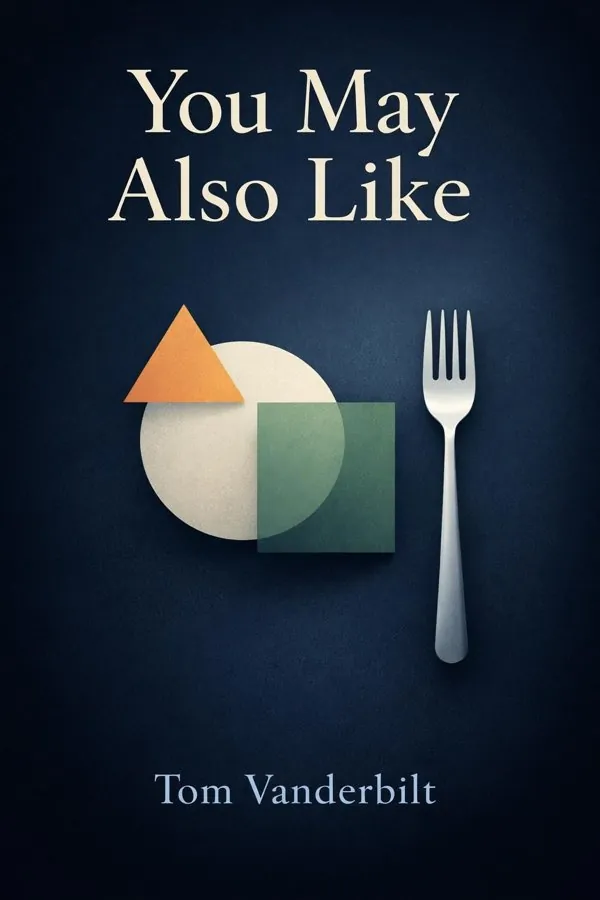
You May Also Like: Taste in an Age of Endless Choice: Summary & Key Insights
 10 min9 chaptersAudio available
What Is You May Also Like: Taste in an Age of Endless Choice About?
You May Also Like: Taste in an Age of Endless Choice by Tom Vanderbilt is a psychology book spanning 9 pages. A witty and insightful exploration of the science and psychology of taste, 'You May Also Like' examines why we like the things we like and what our preferences reveal about us. Drawing on research from psychology, neuroscience, marketing, and philosophy, Tom Vanderbilt investigates how our choices are shaped by context, culture, and cognitive biases in an age of infinite options.
This FizzRead summary covers all 9 key chapters of You May Also Like: Taste in an Age of Endless Choice in approximately 10 minutes, distilling the most important ideas, arguments, and takeaways from Tom Vanderbilt's work. Also available as an audio summary and Key Quotes Podcast.
You May Also Like: Taste in an Age of Endless Choice
A witty and insightful exploration of the science and psychology of taste, 'You May Also Like' examines why we like the things we like and what our preferences reveal about us. Drawing on research from psychology, neuroscience, marketing, and philosophy, Tom Vanderbilt investigates how our choices are shaped by context, culture, and cognitive biases in an age of infinite options.
Who Should Read You May Also Like: Taste in an Age of Endless Choice?
This book is perfect for anyone interested in psychology and looking to gain actionable insights in a short read. Whether you're a student, professional, or lifelong learner, the key ideas from You May Also Like: Taste in an Age of Endless Choice by Tom Vanderbilt will help you think differently.
- ✓Readers who enjoy psychology and want practical takeaways
- ✓Professionals looking to apply new ideas to their work and life
- ✓Anyone who wants the core insights of You May Also Like: Taste in an Age of Endless Choice in just 10 minutes
Want the full summary?
Get instant access to this book summary and 100K+ more with Fizz Moment.
Get Free SummaryAvailable on App Store • Free to download
Key Chapters
At first glance, taste feels intimate and singular—a private feeling stirred by music, flavor, or design. But as I explored, taste reveals itself to be deeply social. It operates not as a static property but as a dynamic interplay of biology and culture. Our sensory apparatus gives us a baseline: the bittersweet receptors on our tongue, the wiring of our auditory system, the texture of memory. But these biological elements are continuously annotated by experience and social learning.
When we say we 'like' something, we are performing a kind of social act. We announce belonging. Every cultural gesture, from fashion choices to food preferences, carries a subtle code of identity and aspiration. The neuroscience of taste confirms this complexity: pleasure centers respond more strongly when we expect to enjoy something, when it aligns with our social category or when others around us share our enjoyment. Thus, the idea that taste simply arises from 'within' dissolves under scrutiny—the self is never an isolated palate but an ever-adjusting sensor woven into cultural feedback.
Freedom of choice seems an unquestionable good. But as psychologist Barry Schwartz and others have demonstrated, abundance can undermine happiness. I saw this paradox unfold everywhere—from diners staring at endless menus to users scrolling through near-infinite playlists. The more options we confront, the harder it becomes to commit. Choice overload does not merely overwhelm cognitively; it erodes satisfaction. Every chosen item stands beside the ghost of what we did not choose.
Modern consumers inhabit ecosystems of infinite variation, yet the mind craves simplification. We oscillate between autonomy and surrender—hoping algorithms or expert reviews will trim the forest of possibilities. This paradox reveals a core tension in taste formation: we yearn to define ourselves through our likes, yet the proliferation of choice reduces the coherence of those likes. Understanding this allows us to see why restraint, curation, and context matter more than the illusion of boundless freedom.
+ 7 more chapters — available in the FizzRead app
All Chapters in You May Also Like: Taste in an Age of Endless Choice
About the Author
Tom Vanderbilt is an American journalist and author known for his works on design, technology, and human behavior. He has written for publications such as The New York Times, Wired, and The Wall Street Journal, and is also the author of the bestselling book 'Traffic: Why We Drive the Way We Do'.
Get This Summary in Your Preferred Format
Read or listen to the You May Also Like: Taste in an Age of Endless Choice summary by Tom Vanderbilt anytime, anywhere. FizzRead offers multiple formats so you can learn on your terms — all free.
Available formats: App · Audio · PDF · EPUB — All included free with FizzRead
Download You May Also Like: Taste in an Age of Endless Choice PDF and EPUB Summary
Key Quotes from You May Also Like: Taste in an Age of Endless Choice
“At first glance, taste feels intimate and singular—a private feeling stirred by music, flavor, or design.”
“Freedom of choice seems an unquestionable good.”
Frequently Asked Questions about You May Also Like: Taste in an Age of Endless Choice
You May Also Like: Taste in an Age of Endless Choice by Tom Vanderbilt is a psychology book that explores key ideas across 9 chapters. A witty and insightful exploration of the science and psychology of taste, 'You May Also Like' examines why we like the things we like and what our preferences reveal about us. Drawing on research from psychology, neuroscience, marketing, and philosophy, Tom Vanderbilt investigates how our choices are shaped by context, culture, and cognitive biases in an age of infinite options.
More by Tom Vanderbilt
You Might Also Like
The Body Keeps the Score
Bessel van der Kolk
10 min
Surrounded by Idiots
Thomas Erikson
10 min
Emotional Intelligence
Daniel Goleman
10 min
Attached
Amir Levine
10 min
Why Does He Do That
Lundy Bancroft
10 min
Women Who Run with the Wolves
Clarissa Pinkola Estés
10 minBrowse by Category
Ready to read You May Also Like: Taste in an Age of Endless Choice?
Get the full summary and 100K+ more books with Fizz Moment.