
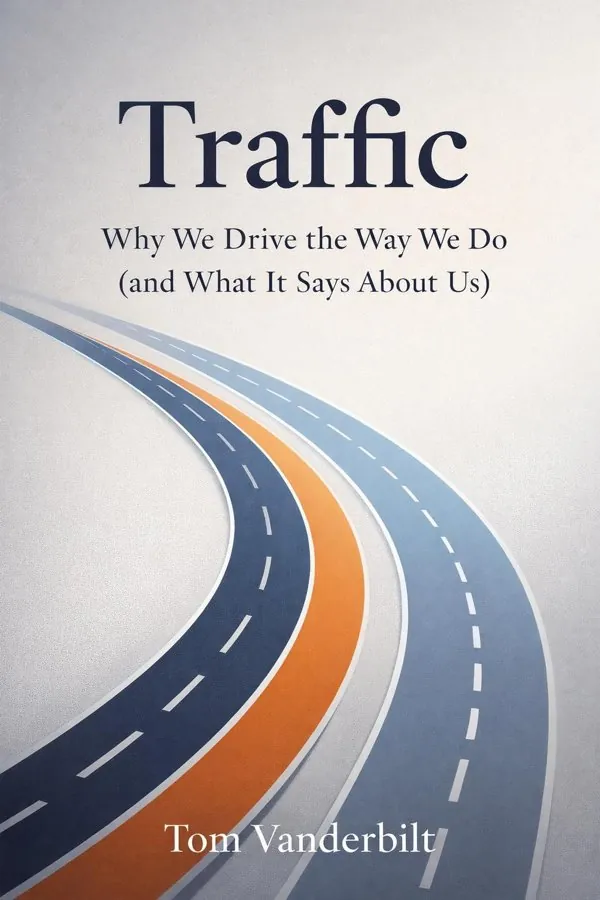
Traffic: Why We Drive the Way We Do (and What It Says About Us): Summary & Key Insights
 10 min9 chaptersAudio available
What Is Traffic: Why We Drive the Way We Do (and What It Says About Us) About?
Traffic: Why We Drive the Way We Do (and What It Says About Us) by Tom Vanderbilt is a popular_sci book spanning 9 pages. In this engaging and insightful exploration, Tom Vanderbilt delves into the psychology, sociology, and engineering of driving. He examines how human perception, decision-making, and social behavior shape the way we drive, revealing surprising truths about traffic flow, risk, and road safety. The book combines research from cognitive science, urban planning, and behavioral economics to explain why driving is one of the most complex and revealing human activities.
This FizzRead summary covers all 9 key chapters of Traffic: Why We Drive the Way We Do (and What It Says About Us) in approximately 10 minutes, distilling the most important ideas, arguments, and takeaways from Tom Vanderbilt's work. Also available as an audio summary and Key Quotes Podcast.
Traffic: Why We Drive the Way We Do (and What It Says About Us)
In this engaging and insightful exploration, Tom Vanderbilt delves into the psychology, sociology, and engineering of driving. He examines how human perception, decision-making, and social behavior shape the way we drive, revealing surprising truths about traffic flow, risk, and road safety. The book combines research from cognitive science, urban planning, and behavioral economics to explain why driving is one of the most complex and revealing human activities.
Who Should Read Traffic: Why We Drive the Way We Do (and What It Says About Us)?
This book is perfect for anyone interested in popular_sci and looking to gain actionable insights in a short read. Whether you're a student, professional, or lifelong learner, the key ideas from Traffic: Why We Drive the Way We Do (and What It Says About Us) by Tom Vanderbilt will help you think differently.
- ✓Readers who enjoy popular_sci and want practical takeaways
- ✓Professionals looking to apply new ideas to their work and life
- ✓Anyone who wants the core insights of Traffic: Why We Drive the Way We Do (and What It Says About Us) in just 10 minutes
Want the full summary?
Get instant access to this book summary and 100K+ more with Fizz Moment.
Get Free SummaryAvailable on App Store • Free to download
Key Chapters
Traffic is far more than a collection of cars—it is a living, self-organizing system governed by countless interwoven decisions. Each driver operates with limited information, interpreting signals and reacting to others’ movements, creating patterns that resemble flocking birds or schooling fish. As I explored this, I realized that traffic behaves like a dynamic ecosystem: it evolves and stabilizes based on feedback loops between individual motives and collective consequences.
This complexity is why small changes—like reducing a lane or placing a roundabout—can produce disproportionately large effects. Engineers study this through models that track flow rates, congestion points, and reaction times, but these models are always filtered through human behavior. We follow too closely because we want to save time; we hesitate because we fear collision; we multitask because we underestimate risk. Every decision sends signals down the line, prompting reactions from those around us. What looks like chaos on a busy freeway is, in truth, a continuous negotiation among thousands of minds.
Understanding this complexity helps us see why traditional fixes often fail. More lanes can actually slow traffic; clearer signs can cause distraction. The key insight is that traffic’s complexity cannot be engineered away—it must be understood through psychology as much as through physics. The shape of a road must account for the shape of human thought.
Driving is an ongoing contest between what we see and what we think we see. Our eyes gather vast amounts of information—speed, distance, color, movement—but the brain filters ruthlessly, often missing crucial details. I found that drivers’ attention is both powerful and fragile; it narrows under stress, fragments under monotony, and deceives us through optical illusions. Blind spots are not just mechanical—they’re cognitive. We fail to notice hazards because our minds are preoccupied by expectations.
One revealing experiment shows how drivers look directly at motorcyclists yet fail to register them—a lapse known as ‘looked but failed to see’. This blindness arises because the brain economizes: it notices what it expects (cars, trucks) and discounts anomalies. Similarly, we suffer from the ‘illusion of control’, feeling safer behind the wheel than as passengers, even though our perception of risk is skewed. Distractions compound these limits; a phone call or a glance at a GPS divides our focus, elongating reaction time and multiplying errors.
To drive well is to accept our cognitive frailty. Roads, signs, and layouts must compensate for attention’s imperfections. Wide open lanes may seem safer but invite speed and inattentiveness; complex intersections demand attention but may slow us enough to notice others. Good driving, then, is not about confidence but humility—recognizing how easily we can overlook what matters most.
+ 7 more chapters — available in the FizzRead app
All Chapters in Traffic: Why We Drive the Way We Do (and What It Says About Us)
About the Author
Tom Vanderbilt is an American journalist and author who writes on design, technology, science, and culture. His work has appeared in publications such as Wired, The New York Times Magazine, and The Wall Street Journal. He is best known for his books on human behavior and systems, including 'Traffic' and 'You May Also Like.'
Get This Summary in Your Preferred Format
Read or listen to the Traffic: Why We Drive the Way We Do (and What It Says About Us) summary by Tom Vanderbilt anytime, anywhere. FizzRead offers multiple formats so you can learn on your terms — all free.
Available formats: App · Audio · PDF · EPUB — All included free with FizzRead
Download Traffic: Why We Drive the Way We Do (and What It Says About Us) PDF and EPUB Summary
Key Quotes from Traffic: Why We Drive the Way We Do (and What It Says About Us)
“Traffic is far more than a collection of cars—it is a living, self-organizing system governed by countless interwoven decisions.”
“Driving is an ongoing contest between what we see and what we think we see.”
Frequently Asked Questions about Traffic: Why We Drive the Way We Do (and What It Says About Us)
Traffic: Why We Drive the Way We Do (and What It Says About Us) by Tom Vanderbilt is a popular_sci book that explores key ideas across 9 chapters. In this engaging and insightful exploration, Tom Vanderbilt delves into the psychology, sociology, and engineering of driving. He examines how human perception, decision-making, and social behavior shape the way we drive, revealing surprising truths about traffic flow, risk, and road safety. The book combines research from cognitive science, urban planning, and behavioral economics to explain why driving is one of the most complex and revealing human activities.
More by Tom Vanderbilt
You Might Also Like

Structures: Or Why Things Don"t Fall Down
J.E. Gordon
10 min
The Road to Wigan Pier
George Orwell
10 min
Bonk: The Curious Coupling of Science and Sex
Mary Roach
10 min
First Bite: How We Learn to Eat
Bee Wilson
10 min
In Pursuit Of The Unknown: 17 Equations That Changed The World
Ian Stewart
10 min
Napoleon's Buttons: 17 Molecules That Changed History
Penny Le Couteur and Jay Burreson
10 minBrowse by Category
Ready to read Traffic: Why We Drive the Way We Do (and What It Says About Us)?
Get the full summary and 100K+ more books with Fizz Moment.