
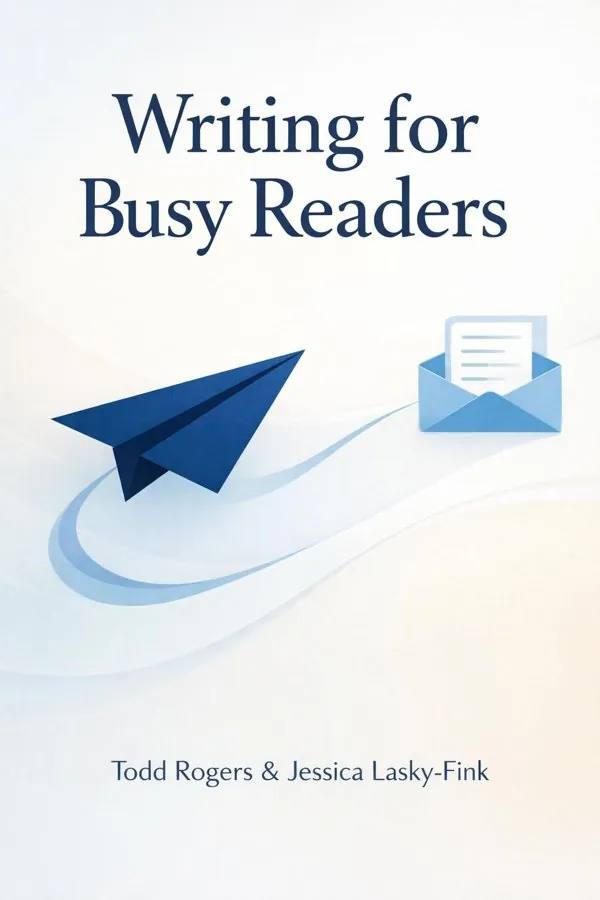
Writing for Busy Readers: Communicate More Effectively in the Real World: Summary & Key Insights
by Todd Rogers; Jessica Lasky-Fink
 10 min9 chaptersAudio available
What Is Writing for Busy Readers: Communicate More Effectively in the Real World About?
Writing for Busy Readers: Communicate More Effectively in the Real World by Todd Rogers; Jessica Lasky-Fink is a communication book spanning 9 pages. A practical guide that teaches readers how to write clearly and effectively in today’s fast-paced digital world. Drawing on behavioral science, the authors present six key principles to help professionals, educators, and communicators craft messages that are easier to read, understand, and act upon. The book includes real-world examples, checklists, and tools to make writing more efficient and impactful.
This FizzRead summary covers all 9 key chapters of Writing for Busy Readers: Communicate More Effectively in the Real World in approximately 10 minutes, distilling the most important ideas, arguments, and takeaways from Todd Rogers; Jessica Lasky-Fink's work. Also available as an audio summary and Key Quotes Podcast.
Writing for Busy Readers: Communicate More Effectively in the Real World
A practical guide that teaches readers how to write clearly and effectively in today’s fast-paced digital world. Drawing on behavioral science, the authors present six key principles to help professionals, educators, and communicators craft messages that are easier to read, understand, and act upon. The book includes real-world examples, checklists, and tools to make writing more efficient and impactful.
Who Should Read Writing for Busy Readers: Communicate More Effectively in the Real World?
This book is perfect for anyone interested in communication and looking to gain actionable insights in a short read. Whether you're a student, professional, or lifelong learner, the key ideas from Writing for Busy Readers: Communicate More Effectively in the Real World by Todd Rogers; Jessica Lasky-Fink will help you think differently.
- ✓Readers who enjoy communication and want practical takeaways
- ✓Professionals looking to apply new ideas to their work and life
- ✓Anyone who wants the core insights of Writing for Busy Readers: Communicate More Effectively in the Real World in just 10 minutes
Want the full summary?
Get instant access to this book summary and 100K+ more with Fizz Moment.
Get Free SummaryAvailable on App Store • Free to download
Key Chapters
Before we can write effectively, we must understand who we’re writing for. Our research, and the larger body of behavioral science it draws from, shows that most people do not read — they skim. They are not lazy; they are overloaded. Every time you send a message, your reader is juggling dozens of competing priorities. Reading your words is rarely their main task.
The human attention span is limited, and when people are busy or distracted, they rely on shortcuts. They glance at the first few lines, scan for headings, and look for cues that tell them whether your message deserves their time. This means that traditional writing habits — long paragraphs, indirect introductions, unnecessary background — create friction. Readers drop off not because they don’t care, but because we made it too hard for them to care.
Through years of field experiments across government agencies, hospitals, and businesses, we found that small changes in how information is presented can dramatically affect comprehension and compliance. For instance, patient communication that used plain language and clear calls to action improved adherence to appointments and medications. Similarly, government notices rewritten for readability led to higher response rates across programs. These are not trivial improvements — they change how institutions serve people.
When you start from an honest acknowledgment of your reader’s cognitive reality, you become a better communicator. The challenge of our age is not producing more words, but producing fewer that matter more. Understanding busy readers reframes writing as an act of service: how can we make it effortless for someone else to get what they need from us?
Imagine reading as a physical act: every extra word, every unfamiliar term, every complex sentence adds weight to the reader’s load. Making reading easy means removing those unnecessary weights. Clarity is not about dumbing down your message; it’s about reducing cognitive load so that your reader can focus on the content that truly matters.
Research in behavioral science shows that even small barriers deter action. We apply the same concept to reading: each moment of confusion, each ambiguous phrase, is a barrier. Instead of assuming readers will work through difficulty, assume they won’t. Simplify language, break long sentences, replace jargon with concrete words. Our studies found that rewriting text to a sixth-grade reading level often increased engagement among educated professionals — because plain language communicates speed and respect.
When I write, I imagine sitting beside the reader, speaking naturally. If my sentence doesn’t sound like something I would say aloud, I revise it. Simplicity is not simplification; it’s generosity. It allows your message to travel from your mind to theirs without unnecessary friction. And in today’s attention economy, that friction makes the difference between being read and being ignored.
+ 7 more chapters — available in the FizzRead app
All Chapters in Writing for Busy Readers: Communicate More Effectively in the Real World
About the Author
Todd Rogers is a behavioral scientist and professor at Harvard Kennedy School, known for his research on communication and decision-making. Jessica Lasky-Fink is a behavioral scientist and researcher specializing in applied behavioral insights for public policy and communication.
Get This Summary in Your Preferred Format
Read or listen to the Writing for Busy Readers: Communicate More Effectively in the Real World summary by Todd Rogers; Jessica Lasky-Fink anytime, anywhere. FizzRead offers multiple formats so you can learn on your terms — all free.
Available formats: App · Audio · PDF · EPUB — All included free with FizzRead
Download Writing for Busy Readers: Communicate More Effectively in the Real World PDF and EPUB Summary
Key Quotes from Writing for Busy Readers: Communicate More Effectively in the Real World
“Before we can write effectively, we must understand who we’re writing for.”
“Imagine reading as a physical act: every extra word, every unfamiliar term, every complex sentence adds weight to the reader’s load.”
Frequently Asked Questions about Writing for Busy Readers: Communicate More Effectively in the Real World
Writing for Busy Readers: Communicate More Effectively in the Real World by Todd Rogers; Jessica Lasky-Fink is a communication book that explores key ideas across 9 chapters. A practical guide that teaches readers how to write clearly and effectively in today’s fast-paced digital world. Drawing on behavioral science, the authors present six key principles to help professionals, educators, and communicators craft messages that are easier to read, understand, and act upon. The book includes real-world examples, checklists, and tools to make writing more efficient and impactful.
You Might Also Like
Magic Words: The Science and Secrets Behind Seven Words That Motivate, Engage, and Influence
Tim David
10 min
Talking Across The Divide: How to Communicate with People You Disagree with and Maybe Even Change the World
Justin Lee
10 min
The Exceptional Presenter: A Proven Formula to Open Up! and Own the Room
Timothy J. Koegel
10 min
4 Essential Keys to Effective Communication in Love, Life, Work--Anywhere!: Including the 12-Day Communication Challenge!
Bento C. Leal III
10 min
Active Listening Techniques: 30 Practical Tools to Hone Your Communication Skills
Nisha Gupta
10 min
Bargaining for Advantage: Negotiation Strategies for Reasonable People
G. Richard Shell
10 minBrowse by Category
Ready to read Writing for Busy Readers: Communicate More Effectively in the Real World?
Get the full summary and 100K+ more books with Fizz Moment.