
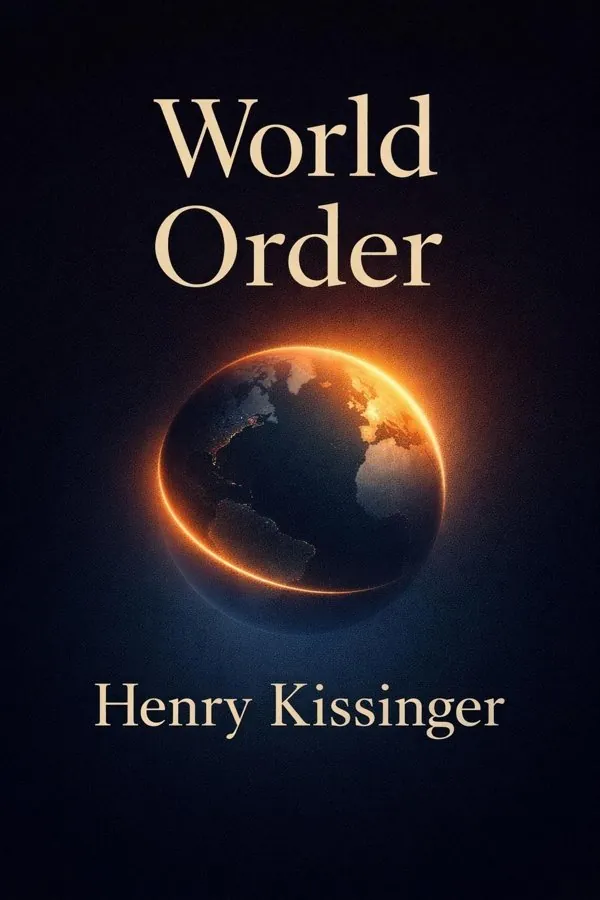
World Order: Summary & Key Insights
 10 min11 chaptersAudio available
What Is World Order About?
World Order by Henry Kissinger is a politics book spanning 11 pages. In 'World Order', Henry Kissinger explores the evolution of the international system and the balance of power that has shaped global politics from the Peace of Westphalia to the modern era. Drawing on his experience as a diplomat and historian, Kissinger analyzes the differing concepts of order in Western, Islamic, Chinese, and American traditions, and discusses the challenges of creating a stable world order in the 21st century amid technological change, terrorism, and shifting alliances.
This FizzRead summary covers all 11 key chapters of World Order in approximately 10 minutes, distilling the most important ideas, arguments, and takeaways from Henry Kissinger's work. Also available as an audio summary and Key Quotes Podcast.
World Order
In 'World Order', Henry Kissinger explores the evolution of the international system and the balance of power that has shaped global politics from the Peace of Westphalia to the modern era. Drawing on his experience as a diplomat and historian, Kissinger analyzes the differing concepts of order in Western, Islamic, Chinese, and American traditions, and discusses the challenges of creating a stable world order in the 21st century amid technological change, terrorism, and shifting alliances.
Who Should Read World Order?
This book is perfect for anyone interested in politics and looking to gain actionable insights in a short read. Whether you're a student, professional, or lifelong learner, the key ideas from World Order by Henry Kissinger will help you think differently.
- ✓Readers who enjoy politics and want practical takeaways
- ✓Professionals looking to apply new ideas to their work and life
- ✓Anyone who wants the core insights of World Order in just 10 minutes
Want the full summary?
Get instant access to this book summary and 100K+ more with Fizz Moment.
Get Free SummaryAvailable on App Store • Free to download
Key Chapters
Europe’s conception of world order emerged out of its most devastating bloodshed — the Thirty Years’ War. When I study the 1648 Treaty of Westphalia, I see not merely a historical settlement but the birth of a revolution in political thought. For the first time, sovereignty was enshrined as an inviolable principle: every state, large or small, had the right to govern itself without interference from external authority. Religion, which had once been the unifying aspiration of Christendom, was now separated from governance. Diplomacy became the art of managing equilibrium.
This Westphalian system was inherently pragmatic. It accepted conflict as permanent and sought not to eliminate it but to temper its consequences. In practice, this required constant vigilance. The balance of power became Europe’s guiding mechanism — a pendulum moving ceaselessly between rivalry and restraint. Britain balanced France; Austria countered Prussia; alliances shifted according to necessity rather than ideology. Out of this emerged a civilization unmatched in its ability to conduct diplomacy, yet one constantly haunted by its own fragility.
From the eighteenth to the twentieth century, the logic of balance shaped Europe’s destiny. When equilibrium was maintained — as after the Congress of Vienna — peace endured for decades. When it faltered — as in 1914 — catastrophe followed. The tragedy of modern Europe is that it never fully reconciled power with legitimacy. Its nations understood how to preserve stability through alliances and deterrence, but they lacked a shared moral narrative. Thus, the very same system that produced statesmanship also produced world wars. It taught the lesson that no order can survive on mechanics alone; it must rest on common values and limits recognized by all.
For much of history, the Islamic world’s vision of order was inseparable from faith. When I reflect on its early centuries, I see a civilization that united spiritual truth with political authority — a contrast that stands in sharp relief against Europe’s secular evolution. The Caliph was both the ruler and the protector of divine law; governance was not the negotiation of interests, but the execution of sacred obligation.
This unity gave Islamic civilization coherence and vitality, spreading from Spain to India. Yet it also meant that the political and religious spheres were never fully distinct. When Western colonial structures imposed new borders and secular governments, they disrupted an older cosmic unity. The modern Middle East inherited institutions that did not align with its historical imagination. Thus, what today appears as instability is partly the legacy of a profound philosophical dislocation.
The question of legitimacy in much of the Islamic world remains intertwined with authenticity — the demand to restore governance consistent with divine order. Attempts at modernization often clash with this legacy. As I have observed, the effort to adapt the Westphalian model to these societies has been fraught with tension: state sovereignty competes with transnational religious identity, while borders drawn by imperial powers fail to reflect the sociopolitical realities beneath. The result is a region searching not just for stability but for meaning, where every contest for power is simultaneously a contest for spiritual renewal.
+ 9 more chapters — available in the FizzRead app
All Chapters in World Order
About the Author
Henry Kissinger (1923–2023) was a German-born American diplomat, political scientist, and Nobel Peace Prize laureate. He served as U.S. Secretary of State and National Security Advisor under Presidents Richard Nixon and Gerald Ford, playing a key role in U.S. foreign policy during the Cold War. Kissinger authored numerous influential works on diplomacy and international relations.
Get This Summary in Your Preferred Format
Read or listen to the World Order summary by Henry Kissinger anytime, anywhere. FizzRead offers multiple formats so you can learn on your terms — all free.
Available formats: App · Audio · PDF · EPUB — All included free with FizzRead
Download World Order PDF and EPUB Summary
Key Quotes from World Order
“Europe’s conception of world order emerged out of its most devastating bloodshed — the Thirty Years’ War.”
“For much of history, the Islamic world’s vision of order was inseparable from faith.”
Frequently Asked Questions about World Order
World Order by Henry Kissinger is a politics book that explores key ideas across 11 chapters. In 'World Order', Henry Kissinger explores the evolution of the international system and the balance of power that has shaped global politics from the Peace of Westphalia to the modern era. Drawing on his experience as a diplomat and historian, Kissinger analyzes the differing concepts of order in Western, Islamic, Chinese, and American traditions, and discusses the challenges of creating a stable world order in the 21st century amid technological change, terrorism, and shifting alliances.
More by Henry Kissinger
You Might Also Like
Antifa: The Anti-Fascist Handbook
Mark Bray
10 min
Attack from Within: How Disinformation Is Sabotaging America
Barbara McQuade
10 min
Coercion, Capital, and European States, AD 990–1992
Charles Tilly
10 min
Digital Democracy: Concepts, Methodologies, Tools, and Applications
Various Authors
10 min
Fascism
Stanley G. Payne
10 min
Fire And Fury: Inside The Trump White House
Michael Wolff
10 minBrowse by Category
Ready to read World Order?
Get the full summary and 100K+ more books with Fizz Moment.