
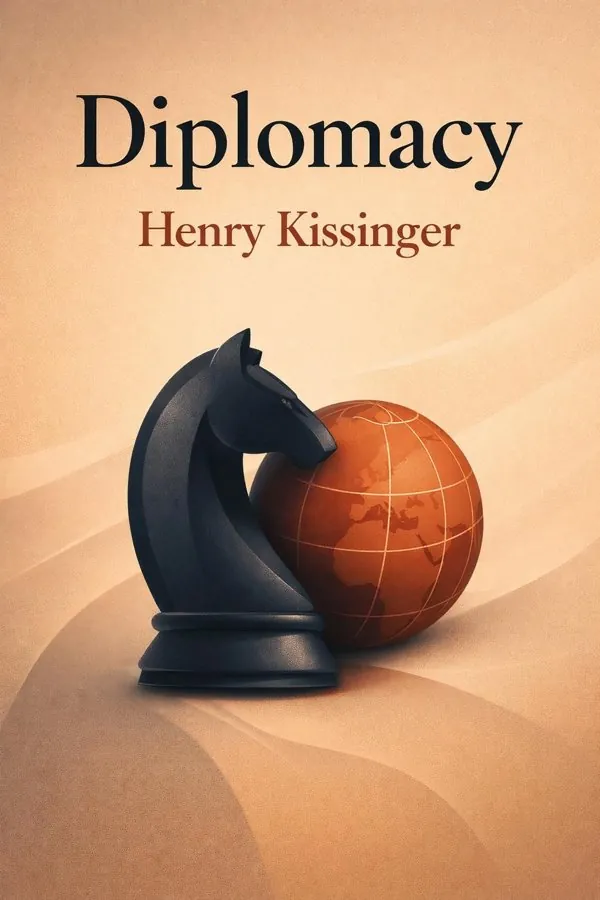
Diplomacy: Summary & Key Insights
 10 min10 chaptersAudio available
What Is Diplomacy About?
Diplomacy by Henry Kissinger is a politics book spanning 10 pages. In this comprehensive work, Henry Kissinger explores the history and practice of international relations from the seventeenth century to the end of the Cold War. Drawing on his experience as a diplomat and scholar, Kissinger analyzes the strategies of major powers, the evolution of the balance of power, and the principles that have shaped modern diplomacy. The book offers both historical insight and theoretical reflection on the art of statecraft.
This FizzRead summary covers all 10 key chapters of Diplomacy in approximately 10 minutes, distilling the most important ideas, arguments, and takeaways from Henry Kissinger's work. Also available as an audio summary and Key Quotes Podcast.
Diplomacy
In this comprehensive work, Henry Kissinger explores the history and practice of international relations from the seventeenth century to the end of the Cold War. Drawing on his experience as a diplomat and scholar, Kissinger analyzes the strategies of major powers, the evolution of the balance of power, and the principles that have shaped modern diplomacy. The book offers both historical insight and theoretical reflection on the art of statecraft.
Who Should Read Diplomacy?
This book is perfect for anyone interested in politics and looking to gain actionable insights in a short read. Whether you're a student, professional, or lifelong learner, the key ideas from Diplomacy by Henry Kissinger will help you think differently.
- ✓Readers who enjoy politics and want practical takeaways
- ✓Professionals looking to apply new ideas to their work and life
- ✓Anyone who wants the core insights of Diplomacy in just 10 minutes
Want the full summary?
Get instant access to this book summary and 100K+ more with Fizz Moment.
Get Free SummaryAvailable on App Store • Free to download
Key Chapters
Modern diplomacy begins in 1648, with the Peace of Westphalia. The treaties that ended the Thirty Years’ War established more than territorial alignments; they created the principle that states are sovereign within their borders and that one power should not impose its will upon another in matters of faith or governance. This was a revolutionary notion after a century of religious wars that had devastated Europe. The Westphalian concept introduced a secular balance of power as the means to maintain order — a pragmatic alternative to ideological crusades.
In writing about Westphalia, I sought to emphasize that its genius lay not in moral purity but in restraint. Richelieu of France had already intuited the necessity of state interest as the guiding principle of foreign policy — raison d’État — even if this put him in conflict with his professed faith. The peace settlement acknowledged that moral consensus was unattainable; instead, it institutionalized the coexistence of differences. The system that emerged made diplomacy the guardian of equilibrium, not the handmaiden of universal truth.
This framework endured, in diverse forms, for more than two centuries. It gave Europe relative stability and permitted nations to pursue their ambitions within a predictable structure. Yet its success also depended on a shared understanding among elites, a kind of aristocratic fraternity of statesmen who accepted limits. The lesson of Westphalia still echoes: order cannot last if it rests on domination, nor can it survive if it insists on unanimity of belief. The balance of power, however imperfect, remained the central mechanism of peace.
The next great test of diplomacy came after the Napoleonic upheaval. Europe, exhausted by revolution and war, turned to restoration. Prince Metternich of Austria became its architect. His aim was not to return to a mythical past but to create a system flexible enough to absorb change without collapsing. The Congress of Vienna in 1815 established what became known as the Concert of Europe — an arrangement by which the major powers resolved to act jointly to preserve the equilibrium.
Metternich’s conservatism has often been misrepresented as reactionary paralysis. In reality, he recognized that Europe’s stability required legitimacy — that the social order threatened by revolution could endure only if diplomacy balanced power with moderation. He sought to isolate revolutionary France not by conquest but by integration into an order whose continuance would benefit all participants. The genius of the Metternich system lay in its recognition that cooperation among rivals, if based on restraint, could substitute for perpetual conflict.
Yet no system can indefinitely resist the forces of nationalism and technology. The century that followed saw the gradual erosion of the concert. Britain’s insular liberalism, Russia’s expansionism, and Germany’s rising might strained the bonds of consultation. Still, for most of the nineteenth century, Europe enjoyed its longest peace. Metternich’s model remains instructive because it demonstrated that diplomacy is not the abdication of national interest but its most sophisticated pursuit — the conversion of competition into cohabitation.
+ 8 more chapters — available in the FizzRead app
All Chapters in Diplomacy
About the Author
Henry Kissinger (1923–2023) was a German-born American diplomat, political scientist, and Nobel Peace Prize laureate. He served as U.S. Secretary of State and National Security Advisor under Presidents Richard Nixon and Gerald Ford, playing a key role in U.S. foreign policy during the Cold War. Kissinger was also a prolific author and lecturer on international relations and diplomacy.
Get This Summary in Your Preferred Format
Read or listen to the Diplomacy summary by Henry Kissinger anytime, anywhere. FizzRead offers multiple formats so you can learn on your terms — all free.
Available formats: App · Audio · PDF · EPUB — All included free with FizzRead
Download Diplomacy PDF and EPUB Summary
Key Quotes from Diplomacy
“Modern diplomacy begins in 1648, with the Peace of Westphalia.”
“The next great test of diplomacy came after the Napoleonic upheaval.”
Frequently Asked Questions about Diplomacy
Diplomacy by Henry Kissinger is a politics book that explores key ideas across 10 chapters. In this comprehensive work, Henry Kissinger explores the history and practice of international relations from the seventeenth century to the end of the Cold War. Drawing on his experience as a diplomat and scholar, Kissinger analyzes the strategies of major powers, the evolution of the balance of power, and the principles that have shaped modern diplomacy. The book offers both historical insight and theoretical reflection on the art of statecraft.
More by Henry Kissinger

You Might Also Like

Antifa: The Anti-Fascist Handbook
Mark Bray
10 min
Attack from Within: How Disinformation Is Sabotaging America
Barbara McQuade
10 min
Coercion, Capital, and European States, AD 990–1992
Charles Tilly
10 min
Digital Democracy: Concepts, Methodologies, Tools, and Applications
Various Authors
10 min
Fascism
Stanley G. Payne
10 min
Fire And Fury: Inside The Trump White House
Michael Wolff
10 minBrowse by Category
Ready to read Diplomacy?
Get the full summary and 100K+ more books with Fizz Moment.