
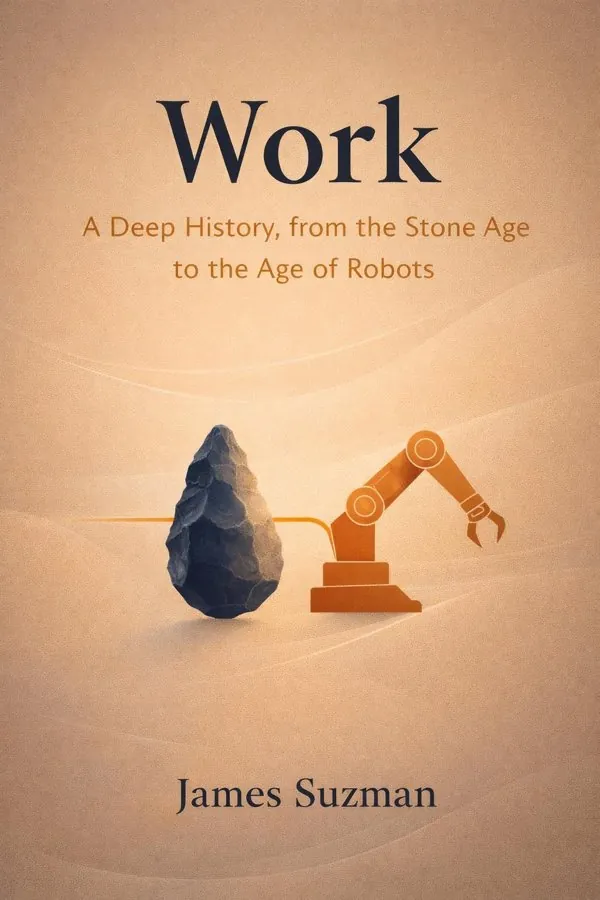
Work: A Deep History, from the Stone Age to the Age of Robots: Summary & Key Insights
by James Suzman
 10 min10 chaptersAudio available
What Is Work: A Deep History, from the Stone Age to the Age of Robots About?
Work: A Deep History, from the Stone Age to the Age of Robots by James Suzman is a civilization book spanning 10 pages. In this anthropological exploration, James Suzman traces the evolution of human labor from hunter-gatherer societies to the modern economy. Drawing on his fieldwork among the Ju/’hoansi people of southern Africa, Suzman examines how work has shaped human identity, social structures, and our relationship with time and purpose. The book challenges assumptions about productivity and progress, offering a deep reflection on what work means in the context of human history.
This FizzRead summary covers all 10 key chapters of Work: A Deep History, from the Stone Age to the Age of Robots in approximately 10 minutes, distilling the most important ideas, arguments, and takeaways from James Suzman's work. Also available as an audio summary and Key Quotes Podcast.
Work: A Deep History, from the Stone Age to the Age of Robots
In this anthropological exploration, James Suzman traces the evolution of human labor from hunter-gatherer societies to the modern economy. Drawing on his fieldwork among the Ju/’hoansi people of southern Africa, Suzman examines how work has shaped human identity, social structures, and our relationship with time and purpose. The book challenges assumptions about productivity and progress, offering a deep reflection on what work means in the context of human history.
Who Should Read Work: A Deep History, from the Stone Age to the Age of Robots?
This book is perfect for anyone interested in civilization and looking to gain actionable insights in a short read. Whether you're a student, professional, or lifelong learner, the key ideas from Work: A Deep History, from the Stone Age to the Age of Robots by James Suzman will help you think differently.
- ✓Readers who enjoy civilization and want practical takeaways
- ✓Professionals looking to apply new ideas to their work and life
- ✓Anyone who wants the core insights of Work: A Deep History, from the Stone Age to the Age of Robots in just 10 minutes
Want the full summary?
Get instant access to this book summary and 100K+ more with Fizz Moment.
Get Free SummaryAvailable on App Store • Free to download
Key Chapters
Among the Ju/’hoansi, I found a world that challenged everything I thought I knew about productivity. Their lives are often described as 'leisurely,' but that word hides the deeper truth that their system works because it is precisely balanced with ecological reality. Food acquisition takes a few hours a day at most; the rest is spent in conversation, craft, and community. They work only as much as their environment requires.
What fascinated me most was how this society functioned without scarcity as a moral principle. Sharing was not charity but structure. Resources were distributed according to need, and reputations were built on generosity, not accumulation. There were no stores to stockpile grains, no hierarchies to enforce labor. In this baseline society, work was understood not as a virtue but as necessity—and when that necessity was met, it ceased. This rhythm of demand and rest defined human life for tens of thousands of years.
When I lived among them, I realized that this equilibrium was not primitive but profoundly sophisticated. It kept greed in check and sustained resilience. Their relationship to time was elastic: there was no sense of workweek, no anxiety about tomorrow’s productivity. It was a revealing contrast to our own restless drive, and it foreshadowed the dramatic shift that occurred when humans began to cultivate plants and animals—a shift that transformed not only how we worked, but how we thought about ourselves.
The agricultural revolution marks one of humanity’s most consequential changes. Once people began to plant fields and domesticate livestock, they tethered themselves to cycles of sowing and harvest, ownership and obligation. Land became property, and property demanded defense and management. Suddenly, work was not merely about survival; it was about maintenance and expansion.
This change introduced a new social psychology. Time, once fluid, became structured by seasons and productivity metrics. People now labored for future yields rather than immediate needs. Surplus emerged—a blessing and a curse. While it allowed more predictable survival, it also introduced inequality. Some accumulated more food, land, or livestock than others, and social hierarchies developed around this accumulation.
From my anthropological lens, the agricultural revolution was both triumph and trap. For the first time, humans exchanged nomadic uncertainty for domestic stability. But that stability came with anxiety: storage meant the constant need to protect and increase resources. Scarcity became a future threat rather than a fleeting condition. The very act of cultivating the earth cultivated a new relationship with work—one defined not by sufficiency, but by ambition.
+ 8 more chapters — available in the FizzRead app
All Chapters in Work: A Deep History, from the Stone Age to the Age of Robots
About the Author
James Suzman is a social anthropologist and author known for his research on the Ju/’hoansi people of Namibia and Botswana. He has written extensively on labor, inequality, and the anthropology of work, combining academic insight with accessible storytelling.
Get This Summary in Your Preferred Format
Read or listen to the Work: A Deep History, from the Stone Age to the Age of Robots summary by James Suzman anytime, anywhere. FizzRead offers multiple formats so you can learn on your terms — all free.
Available formats: App · Audio · PDF · EPUB — All included free with FizzRead
Download Work: A Deep History, from the Stone Age to the Age of Robots PDF and EPUB Summary
Key Quotes from Work: A Deep History, from the Stone Age to the Age of Robots
“Among the Ju/’hoansi, I found a world that challenged everything I thought I knew about productivity.”
“The agricultural revolution marks one of humanity’s most consequential changes.”
Frequently Asked Questions about Work: A Deep History, from the Stone Age to the Age of Robots
Work: A Deep History, from the Stone Age to the Age of Robots by James Suzman is a civilization book that explores key ideas across 10 chapters. In this anthropological exploration, James Suzman traces the evolution of human labor from hunter-gatherer societies to the modern economy. Drawing on his fieldwork among the Ju/’hoansi people of southern Africa, Suzman examines how work has shaped human identity, social structures, and our relationship with time and purpose. The book challenges assumptions about productivity and progress, offering a deep reflection on what work means in the context of human history.
You Might Also Like

The Structure of Scientific Revolutions
Thomas S. Kuhn
10 min
Genius
Harold Bloom
10 min
A Cultural History of the Medieval Age
Various Editors
10 min
A History of God: The 4,000-Year Quest of Judaism, Christianity and Islam
Karen Armstrong
10 min
A History of the World in 10½ Chapters
Julian Barnes
10 min
A Short History of Progress
Ronald Wright
10 minBrowse by Category
Ready to read Work: A Deep History, from the Stone Age to the Age of Robots?
Get the full summary and 100K+ more books with Fizz Moment.