
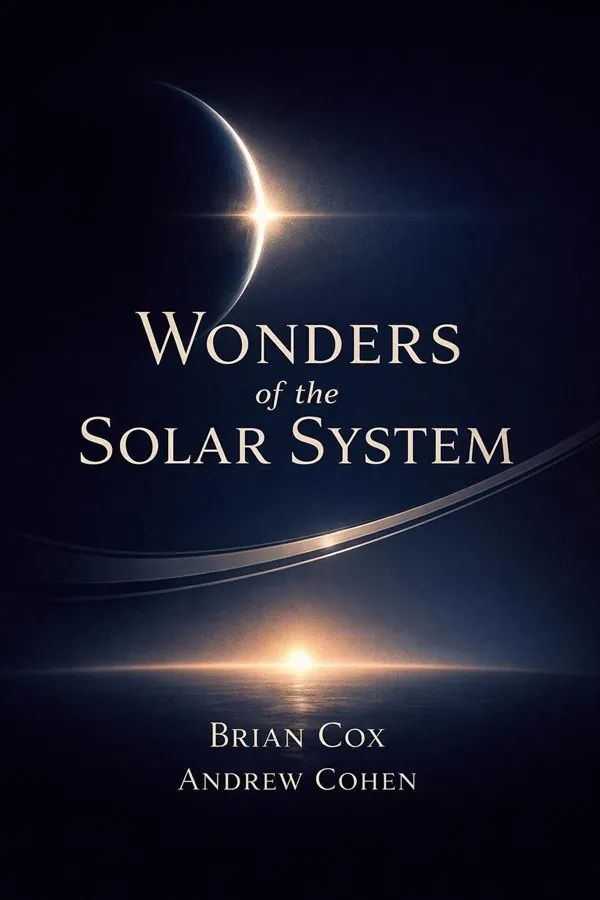
Wonders of the Solar System: Summary & Key Insights
 10 min13 chaptersAudio available
What Is Wonders of the Solar System About?
Wonders of the Solar System by Brian Cox, Andrew Cohen is a popular_sci book spanning 13 pages. Wonders of the Solar System explores the beauty and complexity of our planetary neighborhood, combining stunning imagery with scientific insight. Brian Cox and Andrew Cohen guide readers through the physics and phenomena that shape the planets, moons, and cosmic forces of the solar system, revealing how the laws of nature create extraordinary patterns and structures across space.
This FizzRead summary covers all 13 key chapters of Wonders of the Solar System in approximately 10 minutes, distilling the most important ideas, arguments, and takeaways from Brian Cox, Andrew Cohen's work. Also available as an audio summary and Key Quotes Podcast.
Wonders of the Solar System
Wonders of the Solar System explores the beauty and complexity of our planetary neighborhood, combining stunning imagery with scientific insight. Brian Cox and Andrew Cohen guide readers through the physics and phenomena that shape the planets, moons, and cosmic forces of the solar system, revealing how the laws of nature create extraordinary patterns and structures across space.
Who Should Read Wonders of the Solar System?
This book is perfect for anyone interested in popular_sci and looking to gain actionable insights in a short read. Whether you're a student, professional, or lifelong learner, the key ideas from Wonders of the Solar System by Brian Cox, Andrew Cohen will help you think differently.
- ✓Readers who enjoy popular_sci and want practical takeaways
- ✓Professionals looking to apply new ideas to their work and life
- ✓Anyone who wants the core insights of Wonders of the Solar System in just 10 minutes
Want the full summary?
Get instant access to this book summary and 100K+ more with Fizz Moment.
Get Free SummaryAvailable on App Store • Free to download
Key Chapters
Whenever we begin a journey through the solar system, we must begin where everything begins—with the Sun. It is both a symbol and a reality of creation. At the heart of this star, the simplest elements in nature—hydrogen atoms—fuse under unimaginable pressure and temperature to form helium, releasing enormous quantities of energy. This process, nuclear fusion, is the linchpin of almost every phenomenon we will encounter. It powers not just light but life, stabilizing planetary climates and driving the entire system’s chemistry and motion.
As a physicist, I find the Sun awe-inspiring because it sits at the intersection of human simplicity and cosmic grandeur. We understand the forces at play—gravity compressing matter, electromagnetic interactions enabling nuclear fusion—yet their scale defies easy comprehension. The Sun converts millions of tons of matter into energy every second, radiating across space in a continuous stream that defines the conditions for every nearby world.
By studying the Sun’s cycles and flares, we recognize its personality: a restless, dynamic body with magnetic fields so complex they create flares and storms visible across millions of miles. And yet, it is also a stabilizing father to all planets. Its energy allows atmospheres to flourish and keeps ice-bound moons potentially habitable. Understanding the Sun is understanding energy itself—how simplicity breeds complexity, how chaos becomes structure. Every dawn on Earth, every ripple in Mars’s dust storms, every flicker on Saturn’s rings traces back to this thermonuclear heart.
The solar system began not as a neat arrangement of planets but as chaos—a vast collapsing cloud of gas and dust roughly 4.6 billion years ago. From turbulence and gravitational instability arose the disk that would become our home. Dust particles clumped, forming larger masses in a process we call accretion, and out of this cosmic dance, the planets were born.
When I think about those first moments, I marvel at how universal laws transform disorder into harmony. Gravity acted as the artist, gathering matter, heating it, and igniting the Sun at the center. Meanwhile, the leftover materials spiraled outward, cooling and condensing to create planets with vastly differing compositions. The inner ones became dense and rocky, born from metals and silicates; the outer ones, immense and gaseous, captured lighter elements like hydrogen and helium.
Studying planetary formation tells us more than how planets came to be—it tells us why beauty exists in nature. The balance between chaos and order is not arbitrary; it’s fundamental physics asserting its timeless rhythm. As accretion strengthens, spherical forms emerge, symmetry takes root, and gravity sculpts every rough edge. This transition from a swirling cloud to a structured system embodies one of the most profound truths of science: simplicity and inevitability can give rise to infinite variety.
+ 11 more chapters — available in the FizzRead app
All Chapters in Wonders of the Solar System
About the Authors
Brian Cox is a British physicist and professor of particle physics at the University of Manchester, known for his work on the Large Hadron Collider and his popular science broadcasting. Andrew Cohen is a British television producer and writer specializing in science documentaries, collaborating with Cox on several BBC series.
Get This Summary in Your Preferred Format
Read or listen to the Wonders of the Solar System summary by Brian Cox, Andrew Cohen anytime, anywhere. FizzRead offers multiple formats so you can learn on your terms — all free.
Available formats: App · Audio · PDF · EPUB — All included free with FizzRead
Download Wonders of the Solar System PDF and EPUB Summary
Key Quotes from Wonders of the Solar System
“Whenever we begin a journey through the solar system, we must begin where everything begins—with the Sun.”
“The solar system began not as a neat arrangement of planets but as chaos—a vast collapsing cloud of gas and dust roughly 4.”
Frequently Asked Questions about Wonders of the Solar System
Wonders of the Solar System by Brian Cox, Andrew Cohen is a popular_sci book that explores key ideas across 13 chapters. Wonders of the Solar System explores the beauty and complexity of our planetary neighborhood, combining stunning imagery with scientific insight. Brian Cox and Andrew Cohen guide readers through the physics and phenomena that shape the planets, moons, and cosmic forces of the solar system, revealing how the laws of nature create extraordinary patterns and structures across space.
You Might Also Like

Structures: Or Why Things Don"t Fall Down
J.E. Gordon
10 min
The Road to Wigan Pier
George Orwell
10 min
Bonk: The Curious Coupling of Science and Sex
Mary Roach
10 min
First Bite: How We Learn to Eat
Bee Wilson
10 min
In Pursuit Of The Unknown: 17 Equations That Changed The World
Ian Stewart
10 min
Napoleon's Buttons: 17 Molecules That Changed History
Penny Le Couteur and Jay Burreson
10 minBrowse by Category
Ready to read Wonders of the Solar System?
Get the full summary and 100K+ more books with Fizz Moment.