
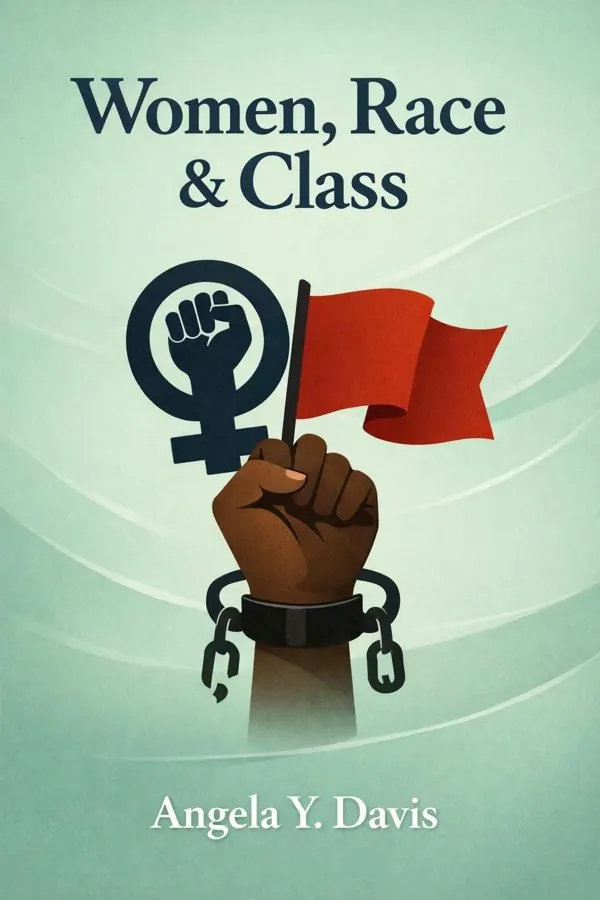
Women, Race & Class: Summary & Key Insights
 10 min10 chaptersAudio available
What Is Women, Race & Class About?
Women, Race & Class by Angela Y. Davis is a sociology book spanning 10 pages. In this groundbreaking work, Angela Y. Davis examines the intertwined histories of the women's liberation movement, the abolition of slavery, and the labor movement in the United States. She explores how race, class, and gender have shaped the struggle for equality, revealing the often-overlooked contributions of Black women to feminist and social justice movements. The book provides a critical analysis of the limitations of mainstream feminism and calls for a more inclusive and intersectional approach to liberation.
This FizzRead summary covers all 10 key chapters of Women, Race & Class in approximately 10 minutes, distilling the most important ideas, arguments, and takeaways from Angela Y. Davis's work. Also available as an audio summary and Key Quotes Podcast.
Women, Race & Class
In this groundbreaking work, Angela Y. Davis examines the intertwined histories of the women's liberation movement, the abolition of slavery, and the labor movement in the United States. She explores how race, class, and gender have shaped the struggle for equality, revealing the often-overlooked contributions of Black women to feminist and social justice movements. The book provides a critical analysis of the limitations of mainstream feminism and calls for a more inclusive and intersectional approach to liberation.
Who Should Read Women, Race & Class?
This book is perfect for anyone interested in sociology and looking to gain actionable insights in a short read. Whether you're a student, professional, or lifelong learner, the key ideas from Women, Race & Class by Angela Y. Davis will help you think differently.
- ✓Readers who enjoy sociology and want practical takeaways
- ✓Professionals looking to apply new ideas to their work and life
- ✓Anyone who wants the core insights of Women, Race & Class in just 10 minutes
Want the full summary?
Get instant access to this book summary and 100K+ more with Fizz Moment.
Get Free SummaryAvailable on App Store • Free to download
Key Chapters
When we look back at the early women’s rights movement of the nineteenth century, we are met with both inspiration and contradiction. Figures like Elizabeth Cady Stanton and Susan B. Anthony are remembered for their courage in demanding political rights, yet their feminism was often entangled with racial prejudice. The origins of the suffrage movement were deeply connected to the abolitionist cause. The same women who campaigned against the enslavement of Black people began to articulate the oppression of women as another form of bondage. But after the Civil War, these alliances fractured dramatically. White suffragists argued that educated white women deserved the vote before uneducated Black men, revealing how racial hierarchy infused even struggles for equality.
What I emphasize is that, far from being passive participants, Black women played active and transformative roles in the abolitionist and early feminist arenas. Sojourner Truth’s speech at the 1851 Women’s Convention in Akron, Ohio, stands as a testament to how Black women exposed the limits of white feminist rhetoric. When Truth asked, “Ain’t I a Woman?”, she wasn’t merely asserting her own humanity—she was questioning whether the feminist movement had space for women whose experience of womanhood differed profoundly from the white middle-class ideal. Her words laid bare the exclusion at the heart of the suffrage movement.
Throughout this period, the tension between universal ideals and partial practice was palpable. For many white feminists, womanhood was imagined through the lens of purity, leisure, and dependence on male protection—values that were completely alien to Black and working-class women. These differences were not superficial; they shaped the very foundation of feminist politics. The early women’s movement, by centering the experiences of the most privileged women, neglected the intertwined realities of racial and economic subjugation. That neglect would haunt feminism for generations.
The abolitionist movement did more than fight slavery—it awakened a new moral and political consciousness that would later inspire feminism. I write in this book that women’s emergence as political actors in the nineteenth century cannot be separated from the anti-slavery struggle. In the antebellum era, women developed organizing skills, oratory courage, and a deep sense of solidarity through their involvement in abolitionist work. Yet this movement also revealed the gendered inequalities within reform itself. Women were expected to serve as auxiliaries, not leaders. The irony of women advocating freedom for others while being denied the right to speak publicly or participate equally was profound.
For many white women, the fight against slavery became the awakening that illuminated their own subjugation. They began to draw parallels between the status of the enslaved and their own legal invisibility under patriarchy. But for Black women, these connections had always been clear—not as metaphor, but as lived experience. Enslaved women suffered the combined degradation of racism and sexism: they were exploited as laborers, denied maternity over their children, and subjected to sexual violence that went unacknowledged by society.
The abolitionist era, then, must be understood as the crucible in which Black feminists forged their distinct analysis of oppression. Harriet Tubman’s heroism, Ida Wells’s later anti-lynching activism, Frances Ellen Watkins Harper’s eloquent appeals for a holistic freedom—all reveal how racial justice and gender justice were never separate projects for Black women. Their vision of liberation was inherently intersectional, even before such language existed. In contrast, many of their white counterparts could envision gender equality only within the constraints of racial privilege. This divergence shaped not just political alliances, but the very meaning of freedom itself in the American imagination.
+ 8 more chapters — available in the FizzRead app
All Chapters in Women, Race & Class
About the Author
Angela Yvonne Davis is an American political activist, scholar, and author. Born in Birmingham, Alabama, she became known internationally for her involvement in the civil rights and Black liberation movements. Davis has written extensively on class, feminism, race, and the U.S. prison system, and she continues to be a leading voice in social justice and critical theory.
Get This Summary in Your Preferred Format
Read or listen to the Women, Race & Class summary by Angela Y. Davis anytime, anywhere. FizzRead offers multiple formats so you can learn on your terms — all free.
Available formats: App · Audio · PDF · EPUB — All included free with FizzRead
Download Women, Race & Class PDF and EPUB Summary
Key Quotes from Women, Race & Class
“When we look back at the early women’s rights movement of the nineteenth century, we are met with both inspiration and contradiction.”
“The abolitionist movement did more than fight slavery—it awakened a new moral and political consciousness that would later inspire feminism.”
Frequently Asked Questions about Women, Race & Class
Women, Race & Class by Angela Y. Davis is a sociology book that explores key ideas across 10 chapters. In this groundbreaking work, Angela Y. Davis examines the intertwined histories of the women's liberation movement, the abolition of slavery, and the labor movement in the United States. She explores how race, class, and gender have shaped the struggle for equality, revealing the often-overlooked contributions of Black women to feminist and social justice movements. The book provides a critical analysis of the limitations of mainstream feminism and calls for a more inclusive and intersectional approach to liberation.
More by Angela Y. Davis
You Might Also Like
Between the World and Me
Ta-Nehisi Coates
10 min
Half the Sky
Nicholas D. Kristof, Sheryl WuDunn
10 min
Men Explain Things To Me
Rebecca Solnit
10 min
Rational Ritual
Michael Suk-Young Chwe
10 min
The New Jim Crow
Michelle Alexander
10 min
Beyond Culture
Edward T. Hall
10 minBrowse by Category
Ready to read Women, Race & Class?
Get the full summary and 100K+ more books with Fizz Moment.