
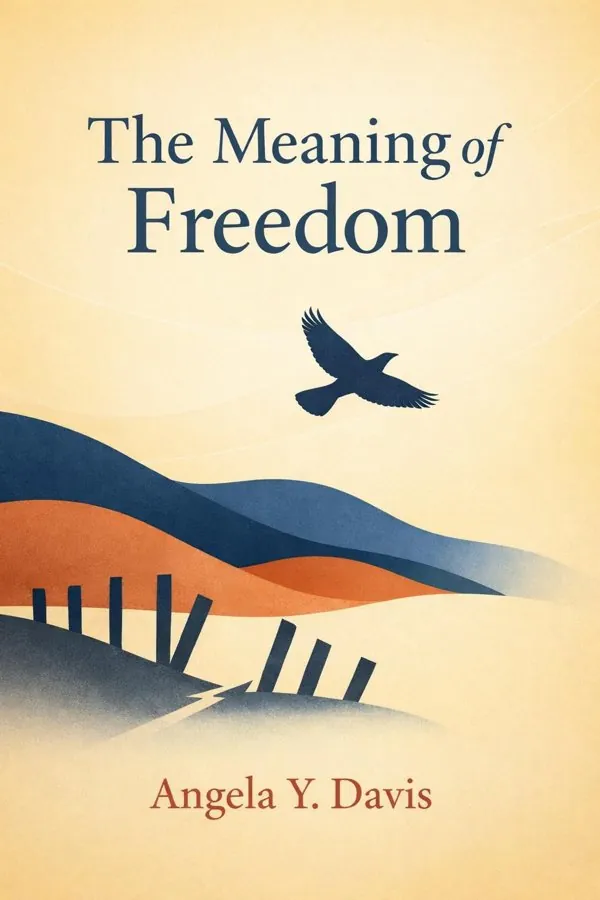
The Meaning of Freedom: Summary & Key Insights
 10 min8 chaptersAudio available
Key Takeaways from The Meaning of Freedom
One of the book’s most provocative insights is that freedom is not simply the absence of chains; it is the presence of conditions that allow people to live with dignity.
A powerful thread running through The Meaning of Freedom is the idea that racism is not just a matter of prejudice between individuals; it is embedded in institutions.
Few ideas in the book are more challenging than Davis’s argument that prisons are treated as solutions to problems they actually help obscure.
Davis repeatedly shows that struggles for freedom fail when they ignore the people most burdened by overlapping forms of oppression.
A central contribution of Davis’s political thought is her insistence that feminism loses its transformative force when it becomes detached from race and class.
What Is The Meaning of Freedom About?
The Meaning of Freedom by Angela Y. Davis is a politics book. The Meaning of Freedom is a powerful collection of speeches, interviews, and essays in which Angela Y. Davis asks one of the most urgent political questions of modern life: what does freedom actually mean, and who gets to claim it? Rather than treating freedom as a vague ideal or a purely personal feeling, Davis examines it as a collective struggle shaped by racism, prisons, capitalism, gender inequality, and international solidarity. The book brings together her reflections on political repression, Black liberation, feminism, prison abolition, and the unfinished work of democracy, showing how systems of domination are connected and why resistance must be equally interconnected. What makes this book so important is its insistence that freedom cannot be separated from justice. Davis challenges readers to move beyond symbolic progress and confront the institutions that continue to produce inequality. Her authority comes not only from scholarship, but from lived experience as a philosopher, organizer, former political prisoner, and one of the most influential radical thinkers of the last half-century. For readers trying to understand liberation in a deeper, more structural way, The Meaning of Freedom offers both a rigorous political framework and a moral call to action.
This FizzRead summary covers all 8 key chapters of The Meaning of Freedom in approximately 10 minutes, distilling the most important ideas, arguments, and takeaways from Angela Y. Davis's work. Also available as an audio summary and Key Quotes Podcast.
The Meaning of Freedom
The Meaning of Freedom is a powerful collection of speeches, interviews, and essays in which Angela Y. Davis asks one of the most urgent political questions of modern life: what does freedom actually mean, and who gets to claim it? Rather than treating freedom as a vague ideal or a purely personal feeling, Davis examines it as a collective struggle shaped by racism, prisons, capitalism, gender inequality, and international solidarity. The book brings together her reflections on political repression, Black liberation, feminism, prison abolition, and the unfinished work of democracy, showing how systems of domination are connected and why resistance must be equally interconnected.
What makes this book so important is its insistence that freedom cannot be separated from justice. Davis challenges readers to move beyond symbolic progress and confront the institutions that continue to produce inequality. Her authority comes not only from scholarship, but from lived experience as a philosopher, organizer, former political prisoner, and one of the most influential radical thinkers of the last half-century. For readers trying to understand liberation in a deeper, more structural way, The Meaning of Freedom offers both a rigorous political framework and a moral call to action.
Who Should Read The Meaning of Freedom?
This book is perfect for anyone interested in politics and looking to gain actionable insights in a short read. Whether you're a student, professional, or lifelong learner, the key ideas from The Meaning of Freedom by Angela Y. Davis will help you think differently.
- ✓Readers who enjoy politics and want practical takeaways
- ✓Professionals looking to apply new ideas to their work and life
- ✓Anyone who wants the core insights of The Meaning of Freedom in just 10 minutes
Want the full summary?
Get instant access to this book summary and 100K+ more with Fizz Moment.
Get Free SummaryAvailable on App Store • Free to download
Key Chapters
One of the book’s most provocative insights is that freedom is not simply the absence of chains; it is the presence of conditions that allow people to live with dignity. Angela Y. Davis argues that formal rights, while important, do not automatically produce meaningful freedom. A person may technically have the right to vote, work, or move freely, yet still live under crushing poverty, racial profiling, underfunded schools, and permanent economic insecurity. In that sense, legal equality can coexist with lived unfreedom.
Davis asks readers to distinguish between symbolic inclusion and substantive liberation. A society may celebrate civil rights victories or point to individual success stories while ignoring institutions that continue to produce racial and social hierarchy. Freedom, in her account, must be measured by whether people have housing, healthcare, education, safety from state violence, and the power to shape the conditions of their lives. This expands freedom from an individual possession into a social reality.
A practical way to see this is to compare two communities with the same constitutional protections but radically different access to public resources. If one has clean water, quality schools, and fair treatment by law enforcement while the other does not, their freedoms are not equal in any meaningful sense. The same principle applies in workplaces, universities, and neighborhoods where official rules seem neutral but actual outcomes remain unequal.
Davis pushes readers to ask harder questions: not only “What rights exist?” but “Who can genuinely use them?” and “What structures prevent people from enjoying them?” Her vision refuses shallow triumphalism and calls for sustained institutional change.
Actionable takeaway: Evaluate freedom in your community by looking beyond formal rights to material realities such as housing, education, healthcare, and protection from violence.
A powerful thread running through The Meaning of Freedom is the idea that racism is not just a matter of prejudice between individuals; it is embedded in institutions. Davis insists that if we only focus on personal bias, we miss the deeper machinery that organizes unequal life chances. Courts, schools, policing systems, labor markets, housing policies, and prisons can all reproduce racism even when they claim neutrality.
This perspective changes how we understand injustice. Instead of asking whether a particular actor had racist intentions, Davis encourages us to examine patterns and outcomes. Who is stopped, searched, jailed, underpaid, excluded, or left unprotected? Who benefits from those arrangements? Institutional racism persists because it is normalized through policy, bureaucracy, and public narratives about crime, merit, and social worth.
Davis is especially compelling when she links contemporary inequality to historical systems such as slavery and segregation. She shows that racial domination did not disappear; it adapted. Practices once openly justified by racist ideology now often operate through coded language, legal discretion, and economic restructuring. That is why progress can appear visible on the surface while inequality deepens below it.
This idea has practical applications everywhere. In education, disparities in discipline may reflect institutional assumptions rather than isolated incidents. In employment, recruitment systems based on informal networks can preserve exclusion without explicit discrimination. In criminal justice, sentencing patterns and police presence often reveal structural bias long before anyone admits it.
Davis teaches readers to think structurally, not sentimentally. Anti-racism, in her view, is not just about better attitudes; it requires transforming the systems that sort populations into the protected and the disposable.
Actionable takeaway: When assessing inequality, examine recurring patterns in institutions—budgets, policies, outcomes, and enforcement—not just the intentions of individuals.
Davis repeatedly shows that struggles for freedom fail when they ignore the people most burdened by overlapping forms of oppression. Her vision of liberation is deeply intersectional, even when she is not using the term in a narrowly academic way. Race, gender, class, sexuality, and state violence do not operate separately in people’s lives. Because of that, movements cannot afford to fight one form of domination while sidelining others.
This is one of the book’s most practical and strategic lessons. A movement focused only on race may ignore gendered violence. One centered only on gender may overlook racism and poverty. Labor struggles can become narrow if they fail to include domestic workers, incarcerated workers, migrants, or those pushed into informal economies. Davis insists that liberation must be expansive enough to include those who have historically been treated as marginal even within progressive politics.
Her perspective also challenges the habit of ranking oppressions or treating solidarity as an optional extra. For Davis, connected systems require connected resistance. This means listening to those at the intersections, not merely adding them symbolically after the fact. It means asking whose suffering is most easily overlooked and whose leadership is least likely to be recognized.
In practical terms, intersectional politics can change how organizations operate. A university campaign against discrimination becomes stronger when it addresses disability access, worker conditions, campus policing, sexual violence, and racial bias together. A local housing campaign becomes more effective when it includes survivors of domestic violence, queer youth, undocumented tenants, and formerly incarcerated residents.
Davis’s point is not that movements should become vague or limitless. It is that they should become more accurate about how power works. Real solidarity sharpens political analysis rather than diluting it.
Actionable takeaway: In any campaign or organization, ask who is excluded from the agenda and redesign goals so the most marginalized are centered, not added later.
A central contribution of Davis’s political thought is her insistence that feminism loses its transformative force when it becomes detached from race and class. In The Meaning of Freedom, she resists versions of women’s liberation that focus mainly on access to elite power while ignoring the realities of poor women, Black women, incarcerated women, migrant women, and women whose labor remains hidden or devalued.
Davis broadens feminism beyond representation. She asks whether having more women in visible positions actually changes the conditions under which most women live. If corporate boards become more gender-balanced while care work remains unpaid or underpaid, if prisons continue to punish survivors, or if welfare policy stigmatizes poor mothers, then symbolic feminist gains can leave deep structures untouched. A feminism worthy of the name must confront the economic and racial systems that shape vulnerability.
This analysis remains strikingly relevant. Public discussions often celebrate individual breakthroughs—firsts, appointments, awards—without asking who remains excluded. Davis challenges readers to move from aspiration to transformation. Who cleans, cares, cooks, and sustains life? Who experiences the state as punishment rather than protection? Which women are imagined by mainstream feminism, and which are erased?
In practice, an expansive feminism might support paid family leave, universal childcare, reproductive justice, protections for domestic workers, decarceration, and accessible healthcare. It also means recognizing that freedom from sexism cannot be achieved while racism and exploitation continue to organize daily life.
Davis’s feminism is not a rejection of gender equality; it is a demand that gender equality be understood in full social context. She argues for a feminism that is anti-racist, anti-capitalist, and accountable to the lives of ordinary people.
Actionable takeaway: Judge feminist progress not only by who gains visibility, but by whether policies improve the material lives of the most economically and racially marginalized women.
Another striking idea in the book is that freedom cannot be understood within national borders alone. Davis argues that struggles against racism, militarism, colonialism, and political repression are connected across countries. If injustice is global in its structures and consequences, then solidarity must also be international. This means seeing domestic inequality not as an isolated national problem, but as part of wider systems of empire, war, labor exploitation, and resource extraction.
Davis’s internationalism challenges the narrow belief that democracy at home can be separated from violence abroad. She encourages readers to connect police militarization, foreign policy, incarceration, immigration controls, and economic exploitation. Nations often present themselves as protectors of freedom while supporting forms of domination elsewhere. That contradiction matters because the language of liberty can be used to justify war, surveillance, and the suppression of dissent.
This perspective also expands moral imagination. It asks readers to learn from movements in other parts of the world and to understand solidarity not as charity, but as mutual political commitment. Anti-apartheid activism, Palestinian solidarity, labor struggles, and campaigns against political imprisonment all become part of a shared horizon of freedom. Internationalism, in Davis’s hands, is not abstract idealism. It is a practical method for understanding how power circulates.
A practical application might involve linking local campaigns to global supply chains, military spending, migration policies, or detention systems. Student activists, union organizers, and community groups can deepen their work by asking how their local issue connects to transnational structures.
Davis reminds us that isolation narrows politics. Solidarity across borders helps people recognize common enemies and shared possibilities.
Actionable takeaway: Connect one local political concern you care about to a global system—labor, migration, militarism, or policing—and seek alliances beyond your immediate context.
Davis shows that freedom struggles depend on historical memory. One of the ways domination sustains itself is by making injustice seem natural, recent, or disconnected from prior systems. When histories of slavery, colonialism, labor exploitation, and political repression are forgotten or sanitized, present inequalities appear accidental. Memory, then, becomes a political resource. It reveals that current arrangements were made, and what was made can be changed.
In The Meaning of Freedom, Davis does more than recount events; she models a way of thinking historically. She treats past struggles not as museum pieces but as living archives of strategy, courage, contradiction, and unfinished work. This matters because movements are often pressured to act as though they are starting from nothing. Historical memory counters despair by reminding people that resistance has always existed, even under brutal conditions.
At the same time, Davis does not romanticize the past. Remembering responsibly means studying mistakes as well as victories. Which coalitions endured? Which demands were absorbed without transforming institutions? Which voices were marginalized within movements? By asking such questions, memory becomes a guide for sharper practice rather than mere celebration.
In practical terms, communities can use history to challenge present narratives. A school curriculum that includes local histories of segregation, labor organizing, or displacement can change how students understand their city. Activists can learn from previous campaigns about messaging, coalition-building, repression, and internal accountability. Even personal reading and discussion groups can create political memory where institutions have erased it.
For Davis, remembering is not passive. It is a refusal of political amnesia, and political amnesia always serves power.
Actionable takeaway: Study one historical movement related to a current issue you care about and identify at least two lessons that can inform action today.
Davis offers a vision of hope that is far more demanding than optimism. In her political framework, hope is not the feeling that things will naturally improve; it is the discipline of acting despite uncertainty. This distinction matters because social movements often face repression, fatigue, fragmentation, and long periods with no obvious victory. If hope depends on quick results, it collapses easily. If it is grounded in collective struggle, it becomes durable.
This is one of the most emotionally important ideas in the book. Davis understands that confronting prisons, racism, sexism, and global injustice can feel overwhelming. Rather than minimizing that reality, she reframes political commitment. Change is often nonlinear. Setbacks do not prove that struggle is meaningless; they reveal the scale of what must be transformed. Hope, then, is built through organization, analysis, memory, and solidarity—not through wishful thinking.
This concept has practical value for anyone engaged in public life. A community campaign that loses a legislative battle may still build relationships, political education, and leadership that matter later. A classroom discussion that does not change minds immediately may still plant a framework that reshapes future choices. A book like this one itself can be part of hopeful practice by equipping readers with language and perspective.
Davis’s approach also guards against cynicism, which often presents itself as realism. Cynicism can feel intelligent because it anticipates failure, but it usually protects inaction. Hope as discipline refuses both naivete and resignation. It accepts difficulty while insisting on responsibility.
Actionable takeaway: Choose one issue that feels overwhelming and commit to a small, sustained practice—reading, organizing, donating, or showing up monthly—so hope becomes a habit of action.
All Chapters in The Meaning of Freedom
About the Author
Angela Y. Davis is an American philosopher, activist, educator, and author whose work has shaped global conversations on race, gender, prisons, and liberation. Born in Birmingham, Alabama, she came of age in the context of segregation and the civil rights movement, experiences that deeply informed her politics. She studied philosophy and later became a prominent scholar and public intellectual. Davis gained international attention in the early 1970s during a highly publicized legal case that ended in her acquittal, solidifying her status as a symbol of political resistance. Over the decades, she has written influential books on feminism, abolition, Black freedom struggles, and state violence, while teaching at major universities and supporting movements for social transformation around the world.
Get This Summary in Your Preferred Format
Read or listen to the The Meaning of Freedom summary by Angela Y. Davis anytime, anywhere. FizzRead offers multiple formats so you can learn on your terms — all free.
Available formats: App · Audio · PDF · EPUB — All included free with FizzRead
Download The Meaning of Freedom PDF and EPUB Summary
Key Quotes from The Meaning of Freedom
“One of the book’s most provocative insights is that freedom is not simply the absence of chains; it is the presence of conditions that allow people to live with dignity.”
“A powerful thread running through The Meaning of Freedom is the idea that racism is not just a matter of prejudice between individuals; it is embedded in institutions.”
“Few ideas in the book are more challenging than Davis’s argument that prisons are treated as solutions to problems they actually help obscure.”
“Davis repeatedly shows that struggles for freedom fail when they ignore the people most burdened by overlapping forms of oppression.”
“A central contribution of Davis’s political thought is her insistence that feminism loses its transformative force when it becomes detached from race and class.”
Frequently Asked Questions about The Meaning of Freedom
The Meaning of Freedom by Angela Y. Davis is a politics book that explores key ideas across 8 chapters. The Meaning of Freedom is a powerful collection of speeches, interviews, and essays in which Angela Y. Davis asks one of the most urgent political questions of modern life: what does freedom actually mean, and who gets to claim it? Rather than treating freedom as a vague ideal or a purely personal feeling, Davis examines it as a collective struggle shaped by racism, prisons, capitalism, gender inequality, and international solidarity. The book brings together her reflections on political repression, Black liberation, feminism, prison abolition, and the unfinished work of democracy, showing how systems of domination are connected and why resistance must be equally interconnected. What makes this book so important is its insistence that freedom cannot be separated from justice. Davis challenges readers to move beyond symbolic progress and confront the institutions that continue to produce inequality. Her authority comes not only from scholarship, but from lived experience as a philosopher, organizer, former political prisoner, and one of the most influential radical thinkers of the last half-century. For readers trying to understand liberation in a deeper, more structural way, The Meaning of Freedom offers both a rigorous political framework and a moral call to action.
More by Angela Y. Davis
You Might Also Like

Antifa: The Anti-Fascist Handbook
Mark Bray
10 min
Attack from Within: How Disinformation Is Sabotaging America
Barbara McQuade
10 min
Coercion, Capital, and European States, AD 990–1992
Charles Tilly
10 min
Digital Democracy: Concepts, Methodologies, Tools, and Applications
Various Authors
10 min
Fascism
Stanley G. Payne
10 min
Fire And Fury: Inside The Trump White House
Michael Wolff
10 minBrowse by Category
Ready to read The Meaning of Freedom?
Get the full summary and 100K+ more books with Fizz Moment.