
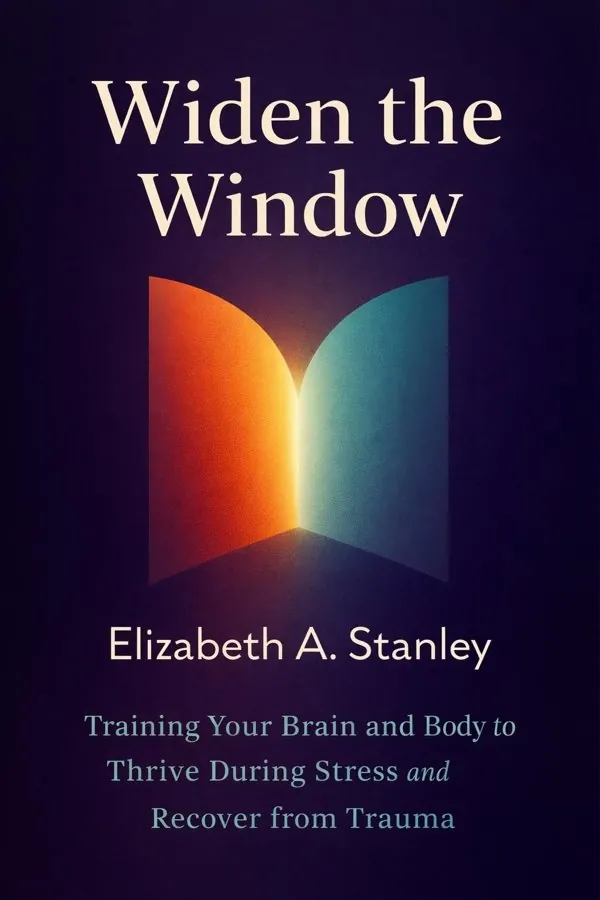
Widen the Window: Training Your Brain and Body to Thrive During Stress and Recover from Trauma: Summary & Key Insights
 10 min11 chaptersAudio available
What Is Widen the Window: Training Your Brain and Body to Thrive During Stress and Recover from Trauma About?
Widen the Window: Training Your Brain and Body to Thrive During Stress and Recover from Trauma by Elizabeth A. Stanley is a mental_health book spanning 11 pages. In this groundbreaking book, Elizabeth A. Stanley, PhD, combines cutting-edge neuroscience, psychology, and mindfulness research to explain how stress and trauma affect the body and mind. Drawing on her own experiences as a U.S. Army veteran and scholar, she offers practical tools to help readers expand their 'window of tolerance'—the zone in which they can function effectively under stress. Through evidence-based techniques, Stanley shows how to build resilience, recover from trauma, and cultivate greater well-being in everyday life.
This FizzRead summary covers all 11 key chapters of Widen the Window: Training Your Brain and Body to Thrive During Stress and Recover from Trauma in approximately 10 minutes, distilling the most important ideas, arguments, and takeaways from Elizabeth A. Stanley's work. Also available as an audio summary and Key Quotes Podcast.
Widen the Window: Training Your Brain and Body to Thrive During Stress and Recover from Trauma
In this groundbreaking book, Elizabeth A. Stanley, PhD, combines cutting-edge neuroscience, psychology, and mindfulness research to explain how stress and trauma affect the body and mind. Drawing on her own experiences as a U.S. Army veteran and scholar, she offers practical tools to help readers expand their 'window of tolerance'—the zone in which they can function effectively under stress. Through evidence-based techniques, Stanley shows how to build resilience, recover from trauma, and cultivate greater well-being in everyday life.
Who Should Read Widen the Window: Training Your Brain and Body to Thrive During Stress and Recover from Trauma?
This book is perfect for anyone interested in mental_health and looking to gain actionable insights in a short read. Whether you're a student, professional, or lifelong learner, the key ideas from Widen the Window: Training Your Brain and Body to Thrive During Stress and Recover from Trauma by Elizabeth A. Stanley will help you think differently.
- ✓Readers who enjoy mental_health and want practical takeaways
- ✓Professionals looking to apply new ideas to their work and life
- ✓Anyone who wants the core insights of Widen the Window: Training Your Brain and Body to Thrive During Stress and Recover from Trauma in just 10 minutes
Want the full summary?
Get instant access to this book summary and 100K+ more with Fizz Moment.
Get Free SummaryAvailable on App Store • Free to download
Key Chapters
To understand stress, we must first understand our autonomic nervous system—the elegant, automatic machinery that regulates heart rate, breathing, digestion, and emotional responses. When we perceive a threat, this system mobilizes through the fight-or-flight response, activating the sympathetic branch to ready the body for action. Once the danger passes, the parasympathetic branch restores equilibrium. In theory, this rhythmic balance keeps us resilient. In practice, chronic exposure to threat or pressure keeps the system activated long past the moment of genuine danger.
From a neuroscientific viewpoint, the stress response begins in the amygdala, the brain’s alarm center, which signals the hypothalamus to flood the body with stress hormones—adrenaline and cortisol. When the prefrontal cortex, our reasoning brain, loses influence under stress, our perceptions narrow. Decisions become reactive rather than thoughtful. This physiological contraction mirrors the narrowing of our window of tolerance. The body feels wired, the mind restless, and we lose touch with the steady awareness that helps us respond wisely.
Recognizing this dynamic doesn’t just explain why we feel overwhelmed—it restores compassion toward ourselves. Our stress reactions are not moral failings; they are adaptive patterns designed for survival. But survival mode should be temporary. When it becomes our baseline, the body pays a heavy cost. Understanding the science lets us see stress as a process we can train—much like physical fitness—rather than an enemy to eliminate. This is the foundation on which mindful resilience is built.
Trauma isn’t just in our memories—it’s etched into our physiology. When an experience overwhelms the nervous system’s capacity to integrate it, the body stores that intensity in patterns of tension, posture, breath, and even immune function. The body remembers, even when the conscious mind tries to move on. Many of the soldiers and civilians I’ve worked with show this clearly: their bodies remain in a state of readiness long after the danger has passed, flinching at sudden sounds or freezing in emotional situations. These are not signs of weakness; they’re evidence of a nervous system still trying to complete an unfinished cycle of protection.
In this book, I ask readers to consider trauma as the residue of stress that couldn’t be digested. Left unresolved, it narrows the window of tolerance by making the body hypersensitive to triggers. Healing begins not with suppressing those responses but with safely re-engaging the sensations of the body. By noticing—and gently allowing—physical sensations, we start signaling to the brain that it’s safe again. This integration between body and mind restores the capacity to process experiences in the present rather than reliving them unconsciously.
+ 9 more chapters — available in the FizzRead app
All Chapters in Widen the Window: Training Your Brain and Body to Thrive During Stress and Recover from Trauma
About the Author
Elizabeth A. Stanley, PhD, is an associate professor of security studies at Georgetown University and a U.S. Army veteran. She is the creator of Mindfulness-based Mind Fitness Training (MMFT) and has taught resilience and stress-reduction programs to military personnel, first responders, and corporate leaders worldwide.
Get This Summary in Your Preferred Format
Read or listen to the Widen the Window: Training Your Brain and Body to Thrive During Stress and Recover from Trauma summary by Elizabeth A. Stanley anytime, anywhere. FizzRead offers multiple formats so you can learn on your terms — all free.
Available formats: App · Audio · PDF · EPUB — All included free with FizzRead
Download Widen the Window: Training Your Brain and Body to Thrive During Stress and Recover from Trauma PDF and EPUB Summary
Key Quotes from Widen the Window: Training Your Brain and Body to Thrive During Stress and Recover from Trauma
“To understand stress, we must first understand our autonomic nervous system—the elegant, automatic machinery that regulates heart rate, breathing, digestion, and emotional responses.”
“Trauma isn’t just in our memories—it’s etched into our physiology.”
Frequently Asked Questions about Widen the Window: Training Your Brain and Body to Thrive During Stress and Recover from Trauma
Widen the Window: Training Your Brain and Body to Thrive During Stress and Recover from Trauma by Elizabeth A. Stanley is a mental_health book that explores key ideas across 11 chapters. In this groundbreaking book, Elizabeth A. Stanley, PhD, combines cutting-edge neuroscience, psychology, and mindfulness research to explain how stress and trauma affect the body and mind. Drawing on her own experiences as a U.S. Army veteran and scholar, she offers practical tools to help readers expand their 'window of tolerance'—the zone in which they can function effectively under stress. Through evidence-based techniques, Stanley shows how to build resilience, recover from trauma, and cultivate greater well-being in everyday life.
You Might Also Like

Big Feelings: How to Be Okay When Things Are Not Okay
Liz Fosslien, Mollie West Duffy
10 min
Creative Arts Therapies Handbook: Art, Music and Dance Therapy Practices for Wellbeing
Susan I. Buchalter
10 min
Emotional First Aid: Healing Rejection, Guilt, Failure, and Other Everyday Hurts
Guy Winch
10 min
Lost Connections: Why You're Depressed and How to Find Hope
Johann Hari
10 min
No Time to Panic: How to Stop Worrying and Embrace Life
Matt Gutman
10 min
Overcoming Mobbing: A Recovery Guide for Workplace Aggression and Bullying
Maureen Duffy, Len Sperry
10 minBrowse by Category
Ready to read Widen the Window: Training Your Brain and Body to Thrive During Stress and Recover from Trauma?
Get the full summary and 100K+ more books with Fizz Moment.