
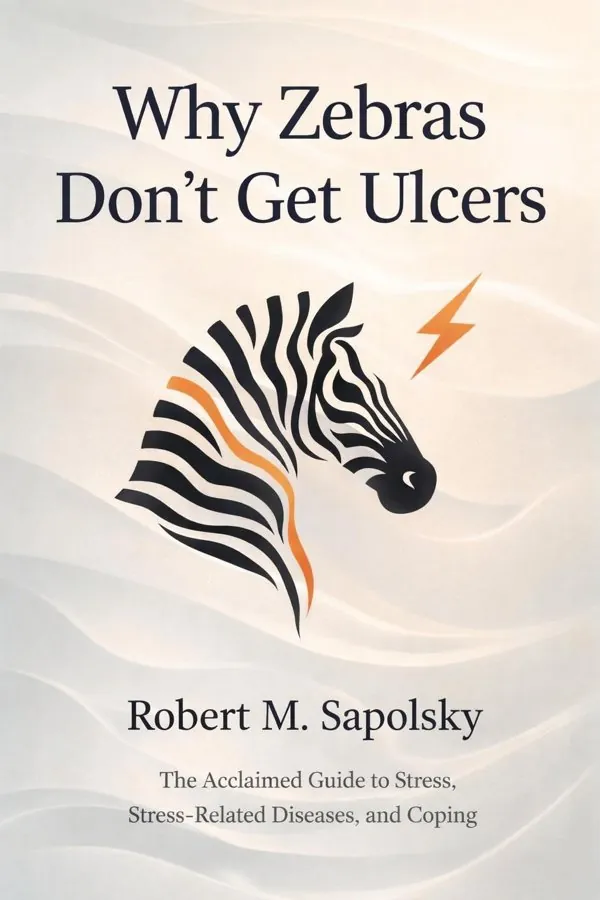
Why Zebras Don’t Get Ulcers: The Acclaimed Guide to Stress, Stress-Related Diseases, and Coping: Summary & Key Insights
 10 min9 chaptersAudio available
Key Takeaways from Why Zebras Don’t Get Ulcers: The Acclaimed Guide to Stress, Stress-Related Diseases, and Coping
Stress feels emotional, but it begins as biology.
Not all stress is harmful; the real danger is stress that never gets a clean ending.
The body can survive emergencies; it struggles when forced to live inside them.
Stress is not only something the brain manages; over time, it is something that can remodel the brain.
Some of the most damaging stressors are invisible because they are social.
What Is Why Zebras Don’t Get Ulcers: The Acclaimed Guide to Stress, Stress-Related Diseases, and Coping About?
Why Zebras Don’t Get Ulcers: The Acclaimed Guide to Stress, Stress-Related Diseases, and Coping by Robert M. Sapolsky is a neuroscience book spanning 9 pages. Why do humans get sick from thoughts, deadlines, status anxiety, and imagined futures while wild animals usually recover once a threat has passed? In Why Zebras Don’t Get Ulcers, Robert M. Sapolsky answers that question with unusual clarity, wit, and scientific depth. The book explores how the stress response evolved to help animals survive immediate physical danger, yet in modern human life it is repeatedly activated by psychological and social pressures that never fully end. The result is a body designed for short bursts of emergency activation being forced into chronic overdrive. Sapolsky explains the biology behind stress hormones, the brain circuits that trigger them, and the damage they can cause when stress becomes constant: cardiovascular disease, weakened immunity, metabolic problems, anxiety, depression, and impaired memory. Just as importantly, he shows why stress is not only biological but also social, shaped by hierarchy, predictability, control, and connection. A renowned neuroendocrinologist and Stanford professor whose work spans neuroscience, primate behavior, and human health, Sapolsky brings authoritative science together with vivid examples and practical insight. The book matters because it helps readers understand stress not as a vague feeling, but as a measurable force that can profoundly shape health and behavior.
This FizzRead summary covers all 9 key chapters of Why Zebras Don’t Get Ulcers: The Acclaimed Guide to Stress, Stress-Related Diseases, and Coping in approximately 10 minutes, distilling the most important ideas, arguments, and takeaways from Robert M. Sapolsky's work. Also available as an audio summary and Key Quotes Podcast.
Why Zebras Don’t Get Ulcers: The Acclaimed Guide to Stress, Stress-Related Diseases, and Coping
Why do humans get sick from thoughts, deadlines, status anxiety, and imagined futures while wild animals usually recover once a threat has passed? In Why Zebras Don’t Get Ulcers, Robert M. Sapolsky answers that question with unusual clarity, wit, and scientific depth. The book explores how the stress response evolved to help animals survive immediate physical danger, yet in modern human life it is repeatedly activated by psychological and social pressures that never fully end. The result is a body designed for short bursts of emergency activation being forced into chronic overdrive.
Sapolsky explains the biology behind stress hormones, the brain circuits that trigger them, and the damage they can cause when stress becomes constant: cardiovascular disease, weakened immunity, metabolic problems, anxiety, depression, and impaired memory. Just as importantly, he shows why stress is not only biological but also social, shaped by hierarchy, predictability, control, and connection. A renowned neuroendocrinologist and Stanford professor whose work spans neuroscience, primate behavior, and human health, Sapolsky brings authoritative science together with vivid examples and practical insight. The book matters because it helps readers understand stress not as a vague feeling, but as a measurable force that can profoundly shape health and behavior.
Who Should Read Why Zebras Don’t Get Ulcers: The Acclaimed Guide to Stress, Stress-Related Diseases, and Coping?
This book is perfect for anyone interested in neuroscience and looking to gain actionable insights in a short read. Whether you're a student, professional, or lifelong learner, the key ideas from Why Zebras Don’t Get Ulcers: The Acclaimed Guide to Stress, Stress-Related Diseases, and Coping by Robert M. Sapolsky will help you think differently.
- ✓Readers who enjoy neuroscience and want practical takeaways
- ✓Professionals looking to apply new ideas to their work and life
- ✓Anyone who wants the core insights of Why Zebras Don’t Get Ulcers: The Acclaimed Guide to Stress, Stress-Related Diseases, and Coping in just 10 minutes
Want the full summary?
Get instant access to this book summary and 100K+ more with Fizz Moment.
Get Free SummaryAvailable on App Store • Free to download
Key Chapters
Stress feels emotional, but it begins as biology. Sapolsky shows that the stress response starts deep in the brain, especially in the hypothalamus, which acts like a command center when a threat is detected. Once activated, it triggers two major systems. The first is the sympathetic nervous system, which rapidly releases adrenaline-like signals that increase heart rate, blood pressure, and alertness. The second is the hypothalamic-pituitary-adrenal axis, or HPA axis, which culminates in the release of glucocorticoids such as cortisol. These hormones mobilize energy, suppress nonessential functions like digestion and reproduction, and help the body focus on immediate survival.
In the short term, this system is brilliant. If you are fleeing danger, you want glucose released into the bloodstream, pain temporarily muted, and attention narrowed. The problem is that the human brain can trigger the same machinery in response to a humiliating email, financial uncertainty, workplace politics, or a sleepless night spent anticipating disaster. The body often cannot distinguish between a physical emergency and a psychologically meaningful threat.
This is why stress is more than a mood. When you feel chronically pressured, you are not simply “thinking too much.” Your cardiovascular, endocrine, and immune systems are all being instructed to behave as if survival is at stake. Understanding this mechanism helps explain why long-term stress can feel exhausting even when nothing visibly dramatic is happening.
A practical application is to notice the earliest signs of activation: shallow breathing, clenched muscles, racing thoughts, or irritability. These are clues that your stress machinery has turned on. Actionable takeaway: learn to recognize your body’s stress signals early and interrupt the cycle with deliberate pauses, slow breathing, movement, or other calming routines before activation becomes chronic.
Not all stress is harmful; the real danger is stress that never gets a clean ending. Sapolsky’s zebra metaphor captures this perfectly. A zebra on the savanna experiences intense but brief stress when chased by a predator. Once the danger passes, the stress response shuts off. For humans, however, the same response can be activated for hours, days, or years by abstract worries, unresolved conflicts, or social insecurities.
Evolution shaped the stress response for acute physical challenges. It is highly adaptive when it helps an organism escape, fight, or endure a brief crisis. In those moments, the body redirects resources away from long-term maintenance and toward immediate action. That trade-off works well if the crisis is short. But if your body remains on alert because of debt, caregiving strain, job instability, or chronic loneliness, those deferred maintenance systems begin to fail.
This difference between acute and chronic stress explains why people can survive intense short-term challenges yet be worn down by persistent uncertainty. A demanding week may energize performance, but months of unpredictability and no recovery can impair sleep, mood, digestion, and immune function. Even positive events, such as a promotion or a move, can become harmful if they bring sustained overload without restoration.
The practical lesson is not to aim for a stress-free life, which is impossible, but to distinguish productive challenge from endless activation. Useful stress tends to be bounded, purposeful, and followed by recovery. Harmful stress is repetitive, uncontrollable, and unrelieved. Actionable takeaway: after demanding periods, intentionally schedule recovery windows, because resilience depends not just on how well you activate under pressure, but on how fully you can return to baseline.
The body can survive emergencies; it struggles when forced to live inside them. One of Sapolsky’s central arguments is that chronic stress does not merely feel unpleasant. It contributes to real physical wear and tear across multiple organ systems. Elevated stress hormones over time can increase blood pressure, alter fat storage, disrupt insulin regulation, weaken digestion, impair reproductive function, and contribute to inflammation. What helps in a crisis becomes costly when it turns into a lifestyle.
Take cardiovascular health. During stress, the heart beats faster and blood vessels constrict to deliver fuel where it is needed most. Repeated activation can leave the cardiovascular system under constant strain, raising the risk of hypertension and heart disease. The same pattern appears elsewhere. Stress can suppress some immune functions, making the body less effective at fighting infection, while also promoting inflammatory processes linked to disease. It can worsen gastrointestinal problems, disturb fertility, and interfere with tissue repair.
Sapolsky does not claim stress explains every illness or acts alone. Genetics, behavior, environment, and access to care all matter. But chronic stress is a powerful amplifier. It can worsen vulnerability, slow recovery, and make healthy choices harder to maintain. Someone under prolonged strain may sleep poorly, eat impulsively, skip exercise, and become less socially connected, creating a feedback loop between physiology and behavior.
In practical terms, many stress-related illnesses begin as subtle shifts rather than dramatic breakdowns: recurring headaches, digestive trouble, elevated blood pressure, frequent colds, or fatigue that never quite lifts. These are signals worth taking seriously. Actionable takeaway: treat persistent stress symptoms as health information, not inconveniences, and respond early with medical checkups, recovery habits, and changes to chronic stressors where possible.
Stress is not only something the brain manages; over time, it is something that can remodel the brain. Sapolsky explains that prolonged exposure to stress hormones affects key regions involved in memory, emotion, and self-control. The hippocampus, crucial for forming and retrieving memories, is especially vulnerable. Chronic glucocorticoid exposure can impair its functioning, making concentration harder and memory less reliable. This is one reason highly stressed people often feel forgetful, mentally foggy, or unable to think clearly.
The amygdala, which helps detect threat and generate fear responses, may become more reactive under chronic stress. That can make neutral events feel loaded, criticism feel dangerous, and uncertainty feel unbearable. Meanwhile, the prefrontal cortex, which supports planning, impulse control, and rational decision-making, may function less effectively under sustained pressure. This creates a painful paradox: stress makes us need our best thinking while simultaneously undermining the systems that support it.
These changes help explain everyday experiences. A person under long-term pressure may misread social situations, struggle to focus at work, overreact emotionally, or feel trapped in habitual responses. Students may blank during exams despite studying well. Caregivers may become mentally exhausted even when deeply committed. Chronic stress narrows flexibility.
The hopeful point is that brains remain plastic. Better sleep, exercise, therapy, meaningful social support, and reduced exposure to unrelenting stress can improve cognitive and emotional functioning. Understanding the neuroscience also reduces shame. Difficulty concentrating under stress is often not a moral failure but a biological consequence. Actionable takeaway: if stress is impairing your thinking, stop relying on willpower alone and build brain-protective routines such as sleep consistency, exercise, focused work blocks, and support for emotional regulation.
The same event can crush one person, sharpen another, and barely disturb a third. Sapolsky emphasizes that stress is never just about the external stressor. Individual differences matter enormously, including genetics, temperament, early life experiences, social support, learned coping styles, and personal meaning. This helps explain why there is no universal stress threshold and why comparisons between people are often misleading.
Early experiences are especially important. Repeated instability, neglect, or trauma can calibrate the stress system toward hypervigilance, making later life feel more threatening. On the other hand, supportive caregiving and opportunities to build mastery can foster a more flexible response. Personality also matters. People who interpret uncertainty as catastrophe, ruminate heavily, or feel chronically powerless may experience stronger and more prolonged stress activation. Those who can reframe challenges, seek support, and maintain perspective often recover more quickly.
Importantly, this is not a simplistic division between strong and weak people. A person may seem highly competent while privately carrying an overactive stress response shaped by years of adversity. Another may appear calm because their environment consistently gives them safety, control, and validation. Recognizing individual differences encourages compassion and makes coping more effective because strategies must fit the person.
In practice, this means your stress plan should be personal. One person benefits most from exercise, another from journaling, another from therapy, structure, or reducing social overload. The goal is not to imitate someone else’s resilience but to understand your own triggers and recovery patterns. Actionable takeaway: track what reliably activates and settles your stress response, then design coping methods around your actual biology, history, and circumstances rather than generic advice.
Chronic stress rarely stays in one lane. Sapolsky shows how prolonged physiological stress can intersect with mental health and disease in ways that are mutually reinforcing. Stress can contribute to anxiety by keeping the body and brain in a state of persistent vigilance. It can contribute to depression by altering motivation, sleep, energy, cognition, and neurochemistry. At the same time, anxiety and depression can make stress harder to escape by narrowing perception, reducing problem-solving capacity, and increasing withdrawal.
This is one of the book’s most important contributions: it dissolves the false boundary between mind and body. A person with chronic stress may develop insomnia, blood pressure problems, headaches, panic, low mood, and immune disruptions all at once, not because they are imagining symptoms, but because shared biological pathways are affecting multiple systems. Likewise, existing illness can itself become a major stressor, producing a cycle in which disease increases stress and stress worsens disease.
Consider someone caring for an ill parent while managing work pressure and little sleep. Over time, they may become irritable, anxious, physically run down, and emotionally numb. No single symptom tells the whole story. The problem is cumulative load. Understanding this helps people seek integrated help rather than treating every symptom as isolated.
The practical implication is to take mental and physical symptoms seriously together. Therapy, medication, medical care, lifestyle changes, and social support are not competing approaches; they often work best in combination. Actionable takeaway: if stress is affecting mood, sleep, or physical health, address it as a whole-system issue and seek support that considers both psychological and biological dimensions.
People often wait to manage stress until they are already overwhelmed, but Sapolsky makes clear that the most effective coping starts earlier. Because chronic stress accumulates gradually, prevention and interruption matter more than heroic recovery attempts after collapse. Coping is not about pretending stress is harmless. It is about changing how often stress is triggered, how intensely it peaks, and how quickly the body returns to equilibrium.
Sapolsky points to several helpful buffers. Exercise can metabolize stress activation and improve mood regulation. Social support can reduce the sense of threat and increase resilience. Predictability and routines can make life feel less chaotic. Cognitive reframing can help people distinguish genuine danger from exaggerated interpretation. Sleep, although often sacrificed under stress, is one of the most important biological reset mechanisms. Even small increases in control, such as organizing a difficult task into steps or setting boundaries around availability, can reduce allostatic load.
Coping is also more effective when it is realistic. A parent with little free time may not be able to meditate for an hour, but they may be able to walk for ten minutes, ask for help, or create a no-phone transition between work and home. A burned-out employee may not be able to quit immediately, but they may renegotiate deadlines, take proper breaks, or reconnect with supportive colleagues.
The point is not perfection. It is building friction against chronic activation. Helpful coping lowers baseline stress and preserves capacity before symptoms become severe. Actionable takeaway: choose two or three coping practices you can repeat consistently under real-life conditions, and use them proactively rather than waiting until stress becomes unmanageable.
Many modern health problems make more sense when seen through evolution. Sapolsky argues that the stress response is not flawed in itself; it is mismatched with the kinds of threats humans now face. Our bodies evolved for environments where danger was often immediate, physical, and time-limited. Modern stressors are often psychological, symbolic, and prolonged: traffic, performance reviews, social comparison, caregiving strain, loneliness, and uncertainty about the future. The old machinery still turns on, but the conditions no longer fit its design.
This evolutionary lens is powerful because it explains why highly intelligent humans can become sick from thought alone. We have the cognitive capacity to remember the past, imagine the future, rehearse conversations, compare ourselves endlessly, and interpret status threats as existential. Those abilities support culture and planning, but they also allow stress to continue long after the original trigger is gone.
The integrative strength of the book lies here. Sapolsky combines neuroscience, endocrinology, psychology, and behavioral ecology to show that stress is neither purely mental nor purely physical. It is an adaptive system whose costs and benefits depend on timing, context, and recovery. This perspective encourages more humane responses to illness and behavior. It reminds us that bodies are carrying ancient programs in modern environments.
In practical terms, this means designing life in ways that better fit human biology: movement, social connection, sleep, periods of safety, and less continuous artificial urgency. We may not be zebras, but we can create conditions that stop us from living as if the lion is always nearby. Actionable takeaway: reduce chronic mismatch by building daily habits and environments that signal safety, recovery, and connection to your stress system.
All Chapters in Why Zebras Don’t Get Ulcers: The Acclaimed Guide to Stress, Stress-Related Diseases, and Coping
About the Author
Robert M. Sapolsky is an American neuroendocrinologist, biologist, professor, and bestselling author known for making complex science vivid and accessible. He has served as a professor of biology, neurology, and neurosurgery at Stanford University, where his work has explored stress, the brain, and behavior. Sapolsky is especially recognized for his research on how stress hormones affect the body and mind, as well as for his long-term field studies of wild baboons, which helped illuminate the links between social hierarchy, health, and physiology. His writing blends neuroscience, evolutionary biology, psychology, and medicine with unusual clarity and humor. Through books, lectures, and essays, he has become one of the most respected public intellectuals explaining how biology shapes human behavior, suffering, resilience, and compassion.
Get This Summary in Your Preferred Format
Read or listen to the Why Zebras Don’t Get Ulcers: The Acclaimed Guide to Stress, Stress-Related Diseases, and Coping summary by Robert M. Sapolsky anytime, anywhere. FizzRead offers multiple formats so you can learn on your terms — all free.
Available formats: App · Audio · PDF · EPUB — All included free with FizzRead
Download Why Zebras Don’t Get Ulcers: The Acclaimed Guide to Stress, Stress-Related Diseases, and Coping PDF and EPUB Summary
Key Quotes from Why Zebras Don’t Get Ulcers: The Acclaimed Guide to Stress, Stress-Related Diseases, and Coping
“Stress feels emotional, but it begins as biology.”
“Not all stress is harmful; the real danger is stress that never gets a clean ending.”
“The body can survive emergencies; it struggles when forced to live inside them.”
“Stress is not only something the brain manages; over time, it is something that can remodel the brain.”
“Some of the most damaging stressors are invisible because they are social.”
Frequently Asked Questions about Why Zebras Don’t Get Ulcers: The Acclaimed Guide to Stress, Stress-Related Diseases, and Coping
Why Zebras Don’t Get Ulcers: The Acclaimed Guide to Stress, Stress-Related Diseases, and Coping by Robert M. Sapolsky is a neuroscience book that explores key ideas across 9 chapters. Why do humans get sick from thoughts, deadlines, status anxiety, and imagined futures while wild animals usually recover once a threat has passed? In Why Zebras Don’t Get Ulcers, Robert M. Sapolsky answers that question with unusual clarity, wit, and scientific depth. The book explores how the stress response evolved to help animals survive immediate physical danger, yet in modern human life it is repeatedly activated by psychological and social pressures that never fully end. The result is a body designed for short bursts of emergency activation being forced into chronic overdrive. Sapolsky explains the biology behind stress hormones, the brain circuits that trigger them, and the damage they can cause when stress becomes constant: cardiovascular disease, weakened immunity, metabolic problems, anxiety, depression, and impaired memory. Just as importantly, he shows why stress is not only biological but also social, shaped by hierarchy, predictability, control, and connection. A renowned neuroendocrinologist and Stanford professor whose work spans neuroscience, primate behavior, and human health, Sapolsky brings authoritative science together with vivid examples and practical insight. The book matters because it helps readers understand stress not as a vague feeling, but as a measurable force that can profoundly shape health and behavior.
More by Robert M. Sapolsky
You Might Also Like
Anxious
Joseph LeDoux
10 min
Hallucinations
Oliver Sacks
10 min
The Biological Mind: How Brain, Body, and Environment Collaborate to Make Us Who We Are
Alan Jasanoff
10 min
The Feeling of Life Itself: Why Consciousness Is Widespread but Can't Be Computed
Christof Koch
10 min
The No-Nonsense Meditation Book
Steven Laureys
10 min
A General Theory of Love
Thomas Lewis, Fari Amini, Richard Lannon
10 minBrowse by Category
Ready to read Why Zebras Don’t Get Ulcers: The Acclaimed Guide to Stress, Stress-Related Diseases, and Coping?
Get the full summary and 100K+ more books with Fizz Moment.