
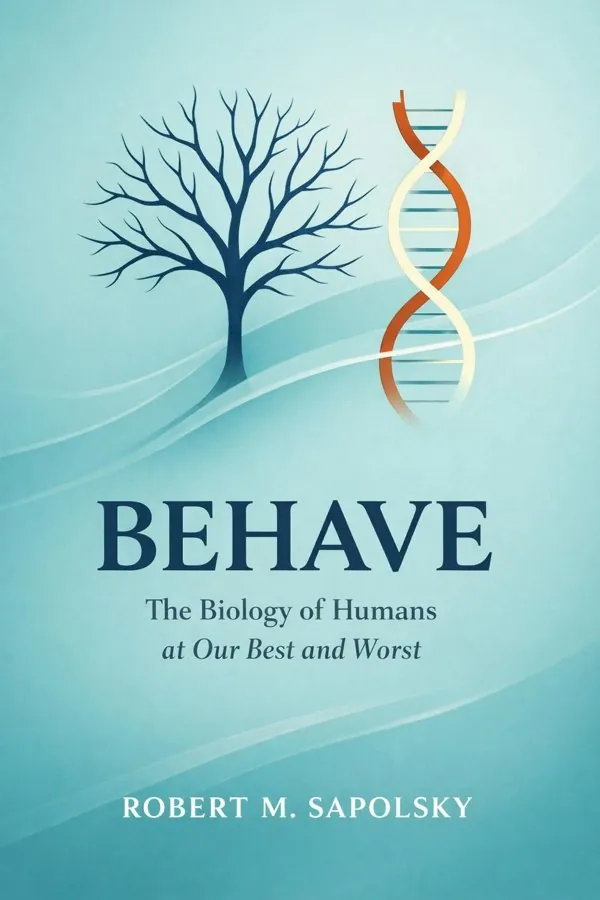
Behave: The Biology of Humans at Our Best and Worst: Summary & Key Insights
 10 min12 chaptersAudio available
What Is Behave: The Biology of Humans at Our Best and Worst About?
Behave: The Biology of Humans at Our Best and Worst by Robert M. Sapolsky is a neuroscience book spanning 12 pages. A monumental synthesis of neuroscience, psychology, and anthropology, 'Behave' explores the biological and environmental factors that shape human behavior. Robert Sapolsky examines how hormones, genes, culture, and evolution interact to influence our actions, from moments before a decision to millennia of evolutionary history. The book offers a comprehensive look at why humans act the way they do, bridging science and the humanities with wit and depth.
This FizzRead summary covers all 12 key chapters of Behave: The Biology of Humans at Our Best and Worst in approximately 10 minutes, distilling the most important ideas, arguments, and takeaways from Robert M. Sapolsky's work. Also available as an audio summary and Key Quotes Podcast.
Behave: The Biology of Humans at Our Best and Worst
A monumental synthesis of neuroscience, psychology, and anthropology, 'Behave' explores the biological and environmental factors that shape human behavior. Robert Sapolsky examines how hormones, genes, culture, and evolution interact to influence our actions, from moments before a decision to millennia of evolutionary history. The book offers a comprehensive look at why humans act the way they do, bridging science and the humanities with wit and depth.
Who Should Read Behave: The Biology of Humans at Our Best and Worst?
This book is perfect for anyone interested in neuroscience and looking to gain actionable insights in a short read. Whether you're a student, professional, or lifelong learner, the key ideas from Behave: The Biology of Humans at Our Best and Worst by Robert M. Sapolsky will help you think differently.
- ✓Readers who enjoy neuroscience and want practical takeaways
- ✓Professionals looking to apply new ideas to their work and life
- ✓Anyone who wants the core insights of Behave: The Biology of Humans at Our Best and Worst in just 10 minutes
Want the full summary?
Get instant access to this book summary and 100K+ more with Fizz Moment.
Get Free SummaryAvailable on App Store • Free to download
Key Chapters
The story of behavior begins in the milliseconds before it occurs. In those moments, neurons in the prefrontal cortex, amygdala, and other parts of the brain are engaged in a conversation that decides what we do next. The prefrontal cortex—the seat of planning and impulse control—often acts as the adult in the room, weighing consequences and restraining impulse. The amygdala, by contrast, registers threat and fuels our emotional reactions. Whether you lash out in anger or hold back depends on which of these neural voices gains the upper hand.
Yet neurons do not act in isolation. Neurotransmitters like dopamine, serotonin, and oxytocin shape their dialogue. Dopamine propels us toward reward; serotonin modulates mood and anxiety; oxytocin fosters bonding and trust. Even within seconds, the state of these molecules can shift dramatically, nudging behavior one way or another. Hormones, too, play a profound role. A sudden jolt of testosterone can amplify dominance behaviors, while cortisol, released in stress, can either sharpen focus or push a fragile system into panic.
By examining the biological choreography of those split seconds, we learn that the line between reason and impulse is porous. What feels like a moral or rational choice might, in fact, be a competition between brain structures built not for modern life but for survival in a far different past.
Step back from the moment of action, and we see that behavior is not born from nowhere. The minutes before any act are filled with sensory input, emotional priming, and hormonal tides that prepare the stage. Suppose you have been insulted: your heart rate quickens, your sympathetic nervous system activates, and hormones like adrenaline surge, narrowing your attention toward the perceived threat. The decision to retaliate or walk away is shaped by this physiological state long before you consciously deliberate.
Our sensory world also sculpts behavior. Tone of voice, facial expression, and posture—all are data streaming into the brain. Mirror neurons reflect these signals, allowing us to feel what others feel, but also to misread their intentions under stress. A hungry person, for example, interprets ambiguous faces as more hostile, an echo of the physiological state of scarcity.
In these moments, biology does not dictate fate, but it biases probability. It tilts the playing field. Recognizing these biases is the first step toward mastering them—toward realizing that gaining even a few seconds of awareness can tip behavior away from reflex and toward choice.
+ 10 more chapters — available in the FizzRead app
All Chapters in Behave: The Biology of Humans at Our Best and Worst
About the Author
Robert M. Sapolsky is an American neuroendocrinologist, biologist, and author. He is a professor of biology, neurology, and neurosurgery at Stanford University and a research associate at the National Museums of Kenya. His work focuses on stress, primate behavior, and the biology of human conduct. Sapolsky is also known for his accessible science writing and lectures that connect biology with human experience.
Get This Summary in Your Preferred Format
Read or listen to the Behave: The Biology of Humans at Our Best and Worst summary by Robert M. Sapolsky anytime, anywhere. FizzRead offers multiple formats so you can learn on your terms — all free.
Available formats: App · Audio · PDF · EPUB — All included free with FizzRead
Download Behave: The Biology of Humans at Our Best and Worst PDF and EPUB Summary
Key Quotes from Behave: The Biology of Humans at Our Best and Worst
“The story of behavior begins in the milliseconds before it occurs.”
“Step back from the moment of action, and we see that behavior is not born from nowhere.”
Frequently Asked Questions about Behave: The Biology of Humans at Our Best and Worst
Behave: The Biology of Humans at Our Best and Worst by Robert M. Sapolsky is a neuroscience book that explores key ideas across 12 chapters. A monumental synthesis of neuroscience, psychology, and anthropology, 'Behave' explores the biological and environmental factors that shape human behavior. Robert Sapolsky examines how hormones, genes, culture, and evolution interact to influence our actions, from moments before a decision to millennia of evolutionary history. The book offers a comprehensive look at why humans act the way they do, bridging science and the humanities with wit and depth.
More by Robert M. Sapolsky
You Might Also Like
Anxious
Joseph LeDoux
10 min
Hallucinations
Oliver Sacks
10 min
The Biological Mind: How Brain, Body, and Environment Collaborate to Make Us Who We Are
Alan Jasanoff
10 min
The Feeling of Life Itself: Why Consciousness Is Widespread but Can't Be Computed
Christof Koch
10 min
The No-Nonsense Meditation Book
Steven Laureys
10 min
A General Theory of Love
Thomas Lewis, Fari Amini, Richard Lannon
10 minBrowse by Category
Ready to read Behave: The Biology of Humans at Our Best and Worst?
Get the full summary and 100K+ more books with Fizz Moment.