
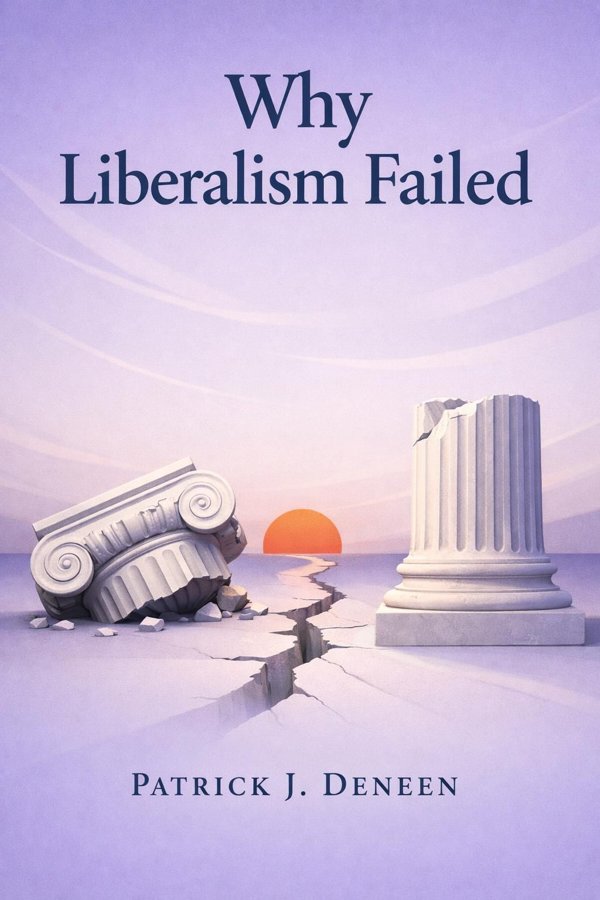
Why Liberalism Failed: Summary & Key Insights
 10 min3 chaptersAudio available
What Is Why Liberalism Failed About?
Why Liberalism Failed by Patrick J. Deneen is a politics book spanning 3 pages. In this provocative work, political theorist Patrick J. Deneen argues that liberalism—the dominant political philosophy of the modern West—has failed because it has succeeded. By emphasizing individual autonomy and the liberation from traditional constraints, liberalism has eroded the social, cultural, and moral foundations that make freedom sustainable. Deneen traces the intellectual roots of liberalism and explores how its internal contradictions have led to political polarization, economic inequality, and cultural fragmentation.
This FizzRead summary covers all 3 key chapters of Why Liberalism Failed in approximately 10 minutes, distilling the most important ideas, arguments, and takeaways from Patrick J. Deneen's work. Also available as an audio summary and Key Quotes Podcast.
Why Liberalism Failed
In this provocative work, political theorist Patrick J. Deneen argues that liberalism—the dominant political philosophy of the modern West—has failed because it has succeeded. By emphasizing individual autonomy and the liberation from traditional constraints, liberalism has eroded the social, cultural, and moral foundations that make freedom sustainable. Deneen traces the intellectual roots of liberalism and explores how its internal contradictions have led to political polarization, economic inequality, and cultural fragmentation.
Who Should Read Why Liberalism Failed?
This book is perfect for anyone interested in politics and looking to gain actionable insights in a short read. Whether you're a student, professional, or lifelong learner, the key ideas from Why Liberalism Failed by Patrick J. Deneen will help you think differently.
- ✓Readers who enjoy politics and want practical takeaways
- ✓Professionals looking to apply new ideas to their work and life
- ✓Anyone who wants the core insights of Why Liberalism Failed in just 10 minutes
Want the full summary?
Get instant access to this book summary and 100K+ more with Fizz Moment.
Get Free SummaryAvailable on App Store • Free to download
Key Chapters
Liberalism did not emerge fully formed. It arose from the intellectual ferment of early modern Europe, a time when old hierarchies and certainties were collapsing under the weight of scientific discovery, religious upheaval, and new economic realities. Thinkers like Thomas Hobbes, John Locke, and Jean-Jacques Rousseau each advanced a vision of human nature and political order that sought to overcome the chaos of tradition and establish a new foundation based on reason and consent.
Hobbes began by asserting that man, in his natural state, is driven by fear and self-preservation. For Hobbes, freedom was not found in communal virtue but in security under a powerful sovereign who could contain the violent competition of autonomous individuals. Locke softened this vision, presenting humans as rational and capable of governing themselves through social contracts oriented toward protecting their rights—chiefly life, liberty, and property. Rousseau, while rejecting Hobbesian pessimism, also contributed to this shift by defining freedom as obedience to one’s own will, abstracted from social and inherited ties.
In all these thinkers, we see a common departure: the rejection of the idea that human beings are naturally embedded in families, communities, and traditions that define their purpose. Instead, the individual is imagined as prior to society, and the political order arises from a contractual agreement among these autonomous beings. This intellectual revolution set the West on a new course—away from the classical and Christian notion that liberty requires virtue and toward the modern principle that liberty is the absence of restraint.
The historical roots of liberalism matter because they reveal how deeply its assumptions have penetrated our cultural consciousness. Long before nations declared independence or parliaments enshrined rights, the groundwork was laid for a society organized around individuals pursuing their own ends, regulated only by laws and markets. What began as a remedy for tyranny and corruption would, centuries later, produce a new form of alienation—one far subtler, but no less binding.
One of liberalism’s most seductive promises is the ideal of autonomy—the belief that we can be self-governing and free from external limitations. Yet the pursuit of autonomy has yielded its opposite: a deep dependence on systems and institutions that mediate nearly every aspect of our existence.
In liberal societies, individuals are liberated from traditional bonds—family, religion, local community, and nature itself. But this liberation leaves them vulnerable, isolated, and dependent. Where once people found meaning and support in local networks, they now rely on impersonal bureaucracies, technological infrastructures, and market mechanisms to fulfill even the simplest of needs. The state steps in to regulate behavior, the market to satisfy desires, and technology to ease the burdens of life—all in the name of freedom. Yet each of these powers expands in inverse proportion to our capacity for self-governance.
Consider the notion of freedom in consumer society. The ability to choose endlessly among products and lifestyles is celebrated as the pinnacle of liberty. But this freedom is not creative; it is reactive. We are conditioned by advertising, data, and social algorithms that shape our preferences long before we act upon them. Similarly, political freedom has devolved into a cycle of individual expression and institutional dependence—citizens turn to state programs and expert systems for solutions they no longer believe they can create collectively.
This paradox runs deep because liberalism defines freedom negatively—as freedom from, not freedom for. The classical and Christian view held that liberty was cultivated through virtue, through disciplined participation in community and the pursuit of moral excellence. Liberalism replaced this with freedom as absence: absence of constraint, absence of obligation, absence of given purpose. As those absences multiplied, the institutions meant to protect liberty grew immense and, ironically, coercive.
Today, the liberal citizen experiences freedom as choice but lacks the stability of belonging. We are free to move anywhere, love anyone, say anything—but increasingly incapable of forming relations of genuine fidelity. In this way, the liberal experiment in autonomy has succeeded astonishingly well—and thereby failed, delivering a society of liberated individuals who no longer know how to live in common.
+ 1 more chapters — available in the FizzRead app
All Chapters in Why Liberalism Failed
About the Author
Patrick J. Deneen is a professor of political science at the University of Notre Dame. His research focuses on political philosophy, American political thought, and the history of political ideas. He is known for his critical engagement with liberal theory and his contributions to contemporary debates on democracy and community.
Get This Summary in Your Preferred Format
Read or listen to the Why Liberalism Failed summary by Patrick J. Deneen anytime, anywhere. FizzRead offers multiple formats so you can learn on your terms — all free.
Available formats: App · Audio · PDF · EPUB — All included free with FizzRead
Download Why Liberalism Failed PDF and EPUB Summary
Key Quotes from Why Liberalism Failed
“One of liberalism’s most seductive promises is the ideal of autonomy—the belief that we can be self-governing and free from external limitations.”
Frequently Asked Questions about Why Liberalism Failed
Why Liberalism Failed by Patrick J. Deneen is a politics book that explores key ideas across 3 chapters. In this provocative work, political theorist Patrick J. Deneen argues that liberalism—the dominant political philosophy of the modern West—has failed because it has succeeded. By emphasizing individual autonomy and the liberation from traditional constraints, liberalism has eroded the social, cultural, and moral foundations that make freedom sustainable. Deneen traces the intellectual roots of liberalism and explores how its internal contradictions have led to political polarization, economic inequality, and cultural fragmentation.
More by Patrick J. Deneen
You Might Also Like
Antifa: The Anti-Fascist Handbook
Mark Bray
10 min
Attack from Within: How Disinformation Is Sabotaging America
Barbara McQuade
10 min
Coercion, Capital, and European States, AD 990–1992
Charles Tilly
10 min
Digital Democracy: Concepts, Methodologies, Tools, and Applications
Various Authors
10 min
Fascism
Stanley G. Payne
10 min
Fire And Fury: Inside The Trump White House
Michael Wolff
10 minBrowse by Category
Ready to read Why Liberalism Failed?
Get the full summary and 100K+ more books with Fizz Moment.