
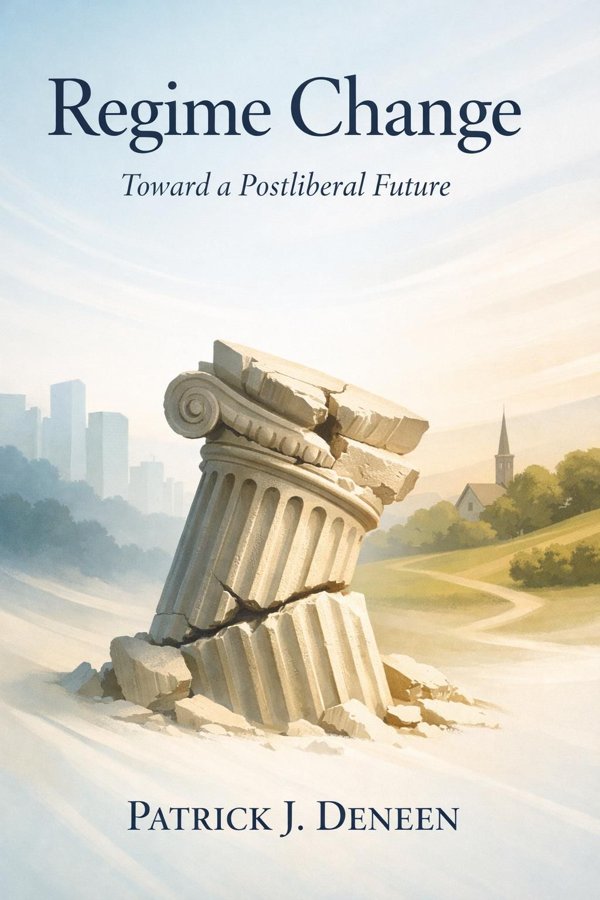
Regime Change: Toward a Postliberal Future: Summary & Key Insights
 10 min8 chaptersAudio available
What Is Regime Change: Toward a Postliberal Future About?
Regime Change: Toward a Postliberal Future by Patrick J. Deneen is a politics book spanning 8 pages. In this provocative work, political theorist Patrick J. Deneen argues that liberalism has reached its end as a governing philosophy. He contends that the liberal order, built on individual autonomy and market freedom, has paradoxically produced inequality, cultural fragmentation, and civic decline. Deneen calls for a postliberal future grounded in community, virtue, and the common good, offering a vision of political renewal beyond the failures of both progressive and conservative liberalism.
This FizzRead summary covers all 8 key chapters of Regime Change: Toward a Postliberal Future in approximately 10 minutes, distilling the most important ideas, arguments, and takeaways from Patrick J. Deneen's work. Also available as an audio summary and Key Quotes Podcast.
Regime Change: Toward a Postliberal Future
In this provocative work, political theorist Patrick J. Deneen argues that liberalism has reached its end as a governing philosophy. He contends that the liberal order, built on individual autonomy and market freedom, has paradoxically produced inequality, cultural fragmentation, and civic decline. Deneen calls for a postliberal future grounded in community, virtue, and the common good, offering a vision of political renewal beyond the failures of both progressive and conservative liberalism.
Who Should Read Regime Change: Toward a Postliberal Future?
This book is perfect for anyone interested in politics and looking to gain actionable insights in a short read. Whether you're a student, professional, or lifelong learner, the key ideas from Regime Change: Toward a Postliberal Future by Patrick J. Deneen will help you think differently.
- ✓Readers who enjoy politics and want practical takeaways
- ✓Professionals looking to apply new ideas to their work and life
- ✓Anyone who wants the core insights of Regime Change: Toward a Postliberal Future in just 10 minutes
Want the full summary?
Get instant access to this book summary and 100K+ more with Fizz Moment.
Get Free SummaryAvailable on App Store • Free to download
Key Chapters
Liberalism arose as a remarkable promise—the belief that human beings, freed from the constraints of tradition and authority, could govern themselves through reason and contract. Its two central ideals, freedom and equality, inspired revolutions and built modern societies. Yet these very principles produced the opposite of what they intended. Freedom, conceived as personal autonomy, eroded the shared moral framework that makes true liberty possible. Equality, pursued through abstraction and individual rights, paved the way for deeper social inequalities as market forces rewarded the few while hollowing out the many. The liberal project fragmented what once bound society together: family, faith, local community, and civic devotion. We became consumers before we were citizens, self-creators before we were inheritors of a common moral tradition. A regime premised on endless liberation inevitably dismantles all forms of constraint—even those vital for human flourishing. As liberalism promised to free us from domination, it quietly installed a new form of domination—the soft tyranny of markets and bureaucracies that shape our desires and constrain our choices. My critique is not nostalgic. I do not call for a return to a past impossible to fully recover. Rather, I insist that liberalism’s failure reveals something enduring about the human condition: freedom without virtue collapses into chaos; equality without hierarchy leads to despair. The question we must now face is what kind of political order can sustain freedom once liberalism has destroyed its own foundations.
One of the most visible consequences of liberalism’s decay is the emergence of a new ruling class—the managerial elite. This class governs not through democratic accountability but through claims of expertise. Under liberalism’s guise of neutrality, these elites administer everything: policy, economy, education, and culture. Their dominance manifests not in overt coercion but in subtle systems of control—technocratic, bureaucratic, and cultural. Liberalism made expertise the new authority. As traditional forms of wisdom—moral, religious, and communal—were delegitimized, society turned to professional administrators and technical managers. These elites present themselves as custodians of progress, claiming to serve the public through rational governance. Yet the very structure of their rule separates them from the people they claim to serve. They are the heirs of liberalism’s abstraction: detached from locality, rooted in global institutions, and loyal to a class identity rather than a civic one. The managerial elite’s ascendance has hollowed out democratic engagement. Citizens are reduced to clients, policies are crafted through algorithmic analysis rather than deliberation, and political participation is redefined as consumption of narratives designed to pacify rather than empower. This is not an accident; it is liberalism’s logical conclusion. A society built on autonomous individuals inevitably requires managerial oversight to maintain order. Thus, freedom demands supervision, and the regime transforms into a system that promises choice yet controls the conditions of every choice we make. The task before us is to recover genuine self-rule—not through the mechanisms of technocracy, but through renewed forms of ethical and civic leadership grounded in common life.
+ 6 more chapters — available in the FizzRead app
All Chapters in Regime Change: Toward a Postliberal Future
About the Author
Patrick J. Deneen is an American political theorist and professor of political science at the University of Notre Dame. His scholarship focuses on political philosophy, classical thought, and critiques of modern liberalism. He is also the author of the influential book 'Why Liberalism Failed'.
Get This Summary in Your Preferred Format
Read or listen to the Regime Change: Toward a Postliberal Future summary by Patrick J. Deneen anytime, anywhere. FizzRead offers multiple formats so you can learn on your terms — all free.
Available formats: App · Audio · PDF · EPUB — All included free with FizzRead
Download Regime Change: Toward a Postliberal Future PDF and EPUB Summary
Key Quotes from Regime Change: Toward a Postliberal Future
“Liberalism arose as a remarkable promise—the belief that human beings, freed from the constraints of tradition and authority, could govern themselves through reason and contract.”
“One of the most visible consequences of liberalism’s decay is the emergence of a new ruling class—the managerial elite.”
Frequently Asked Questions about Regime Change: Toward a Postliberal Future
Regime Change: Toward a Postliberal Future by Patrick J. Deneen is a politics book that explores key ideas across 8 chapters. In this provocative work, political theorist Patrick J. Deneen argues that liberalism has reached its end as a governing philosophy. He contends that the liberal order, built on individual autonomy and market freedom, has paradoxically produced inequality, cultural fragmentation, and civic decline. Deneen calls for a postliberal future grounded in community, virtue, and the common good, offering a vision of political renewal beyond the failures of both progressive and conservative liberalism.
More by Patrick J. Deneen
You Might Also Like
Antifa: The Anti-Fascist Handbook
Mark Bray
10 min
Attack from Within: How Disinformation Is Sabotaging America
Barbara McQuade
10 min
Coercion, Capital, and European States, AD 990–1992
Charles Tilly
10 min
Digital Democracy: Concepts, Methodologies, Tools, and Applications
Various Authors
10 min
Fascism
Stanley G. Payne
10 min
Fire And Fury: Inside The Trump White House
Michael Wolff
10 minBrowse by Category
Ready to read Regime Change: Toward a Postliberal Future?
Get the full summary and 100K+ more books with Fizz Moment.