
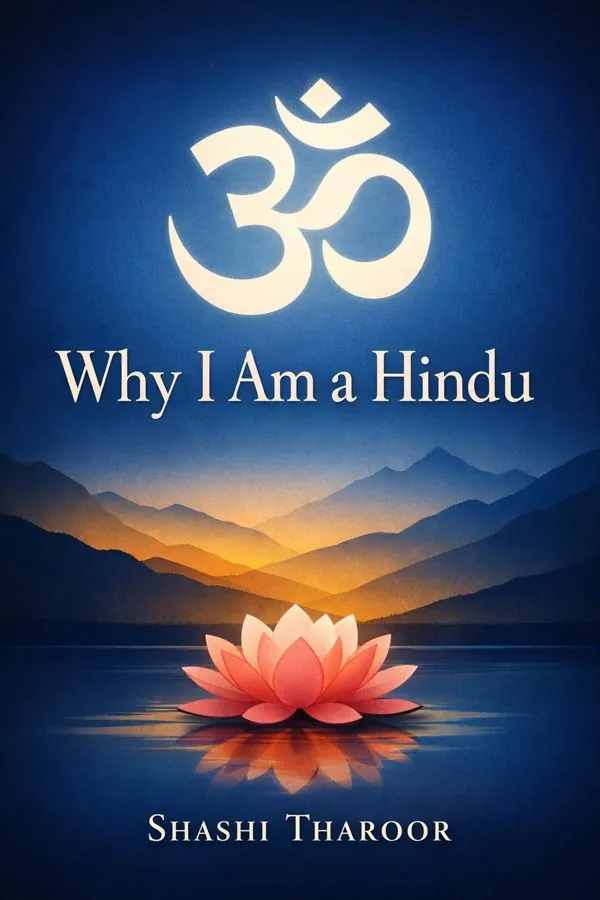
Why I Am a Hindu: Summary & Key Insights
 10 min10 chaptersAudio available
Key Takeaways from Why I Am a Hindu
The most revealing way to understand Hinduism may be to notice how stubbornly it refuses confinement.
A faith endures not merely because it offers rituals, but because it gives people a framework for living well.
One of Hinduism’s most radical contributions to religious thought is the idea that truth can be approached in multiple ways.
Religions survive across centuries not by remaining frozen, but by adapting without losing their philosophical core.
Religion becomes real not in abstract definitions but in the rhythms of lived experience.
What Is Why I Am a Hindu About?
Why I Am a Hindu by Shashi Tharoor is a eastern_wisdom book spanning 9 pages. In Why I Am a Hindu, Shashi Tharoor offers far more than a personal declaration of faith. He presents a thoughtful, persuasive exploration of Hinduism as a civilizational tradition built on openness, diversity, and a willingness to embrace many paths to truth. Published in 2018, the book arrives at a crucial moment in India’s public life, when religion is often invoked for political ends and Hindu identity is increasingly conflated with ideological nationalism. Tharoor argues that this fusion distorts the spirit of Hinduism itself. Drawing on scripture, philosophy, history, politics, and autobiography, Tharoor explains why he identifies deeply with Hinduism while firmly rejecting Hindutva, the political project that seeks to define India in narrow majoritarian terms. His authority comes from an unusual combination of lived experience, literary scholarship, historical knowledge, and political insight. As a public intellectual, diplomat, parliamentarian, and practicing Hindu shaped by both tradition and modernity, he is uniquely positioned to interpret the faith for contemporary readers. This book matters because it defends not only a religion, but also a plural vision of India and a humane way of engaging difference.
This FizzRead summary covers all 10 key chapters of Why I Am a Hindu in approximately 10 minutes, distilling the most important ideas, arguments, and takeaways from Shashi Tharoor's work. Also available as an audio summary and Key Quotes Podcast.
Why I Am a Hindu
In Why I Am a Hindu, Shashi Tharoor offers far more than a personal declaration of faith. He presents a thoughtful, persuasive exploration of Hinduism as a civilizational tradition built on openness, diversity, and a willingness to embrace many paths to truth. Published in 2018, the book arrives at a crucial moment in India’s public life, when religion is often invoked for political ends and Hindu identity is increasingly conflated with ideological nationalism. Tharoor argues that this fusion distorts the spirit of Hinduism itself.
Drawing on scripture, philosophy, history, politics, and autobiography, Tharoor explains why he identifies deeply with Hinduism while firmly rejecting Hindutva, the political project that seeks to define India in narrow majoritarian terms. His authority comes from an unusual combination of lived experience, literary scholarship, historical knowledge, and political insight. As a public intellectual, diplomat, parliamentarian, and practicing Hindu shaped by both tradition and modernity, he is uniquely positioned to interpret the faith for contemporary readers. This book matters because it defends not only a religion, but also a plural vision of India and a humane way of engaging difference.
Who Should Read Why I Am a Hindu?
This book is perfect for anyone interested in eastern_wisdom and looking to gain actionable insights in a short read. Whether you're a student, professional, or lifelong learner, the key ideas from Why I Am a Hindu by Shashi Tharoor will help you think differently.
- ✓Readers who enjoy eastern_wisdom and want practical takeaways
- ✓Professionals looking to apply new ideas to their work and life
- ✓Anyone who wants the core insights of Why I Am a Hindu in just 10 minutes
Want the full summary?
Get instant access to this book summary and 100K+ more with Fizz Moment.
Get Free SummaryAvailable on App Store • Free to download
Key Chapters
The most revealing way to understand Hinduism may be to notice how stubbornly it refuses confinement. Unlike religions organized around a single prophet, one definitive scripture, or a uniform creed, Hinduism evolved as a vast and layered tradition that welcomes multiplicity. Tharoor emphasizes that this is not a weakness or a sign of disorder. It is one of Hinduism’s greatest strengths. It allows room for devotion, philosophy, ritual, skepticism, renunciation, household life, temple worship, meditation, and even disagreement.
This plural character explains why Hinduism can contain the Upanishadic search for ultimate reality, the devotional love of Krishna or Shiva, the discipline of yoga, village-level customs, and philosophical schools that differ sharply from one another. A Hindu may worship one deity, many deities, or none in a conventional sense. What binds the tradition is not rigid conformity but a shared civilizational framework shaped by inquiry, practice, memory, and ethical orientation.
In modern life, this has practical significance. It offers a model for identity without exclusion. A person can be rooted without becoming intolerant. Families already live this reality when different generations practice faith differently yet still remain within the same broad tradition. In diverse societies, Hinduism’s elasticity can teach us how to hold conviction and openness together.
Tharoor’s larger point is that whenever anyone tries to reduce Hinduism to a single slogan or political agenda, they betray its essence. Actionable takeaway: when thinking about Hinduism, begin with humility and plurality rather than fixed definitions.
A faith endures not merely because it offers rituals, but because it gives people a framework for living well. Tharoor highlights dharma as one of Hinduism’s central ideas: a concept far richer than religion in the narrow sense. Dharma includes duty, righteousness, moral order, responsibility, and the right way of being in relation to others and the world. It is not always a fixed rulebook. Often it requires judgment, self-awareness, and sensitivity to context.
This makes dharma deeply practical. It asks not only, “What do I want?” but also, “What is the right thing for me to do in this situation?” A parent, teacher, public servant, friend, or citizen may each face duties that demand integrity over convenience. Hindu thought recognizes that life is morally complex, which is why epics like the Mahabharata remain so compelling. They show that ethical life often involves conflict between competing obligations rather than easy choices between good and evil.
Tharoor also links dharma with the pursuit of truth, self-discipline, and compassion. It complements other key concepts such as karma and moksha, reminding us that our actions matter and shape both personal character and the world around us. In today’s terms, dharma can guide everything from professional ethics to civic responsibility to how we care for family members.
Rather than treating spirituality as separate from ordinary life, dharma embeds it in daily conduct. Actionable takeaway: choose one role you occupy today and ask what acting with dharma would require in that role.
One of Hinduism’s most radical contributions to religious thought is the idea that truth can be approached in multiple ways. Tharoor returns to this again and again because it explains Hinduism’s historic capacity for tolerance. The insight is not that all beliefs are identical or that distinctions do not matter. Rather, it is that ultimate reality exceeds any single human formulation. Different minds, temperaments, cultures, and spiritual disciplines may approach the divine differently.
This perspective is embedded in famous Hindu formulations such as the idea that the truth is one though the wise describe it in many ways. Such a worldview naturally softens the impulse to condemn outsiders. If no single path has a monopoly on transcendence, then humility becomes a religious virtue. Dialogue becomes possible. Coexistence becomes principled rather than merely strategic.
This matters profoundly in divided societies. A plural spiritual outlook can reduce the need to dominate or erase others. In everyday terms, it encourages people to engage neighbors of other faiths without fear that respect equals compromise. A Hindu can remain deeply committed to personal practice while recognizing sincerity and holiness in traditions beyond Hinduism. This is one reason Tharoor sees Hinduism as especially suited to democratic and multicultural life.
Of course, pluralism does not mean passivity. One can still criticize injustice, coercion, or hatred. But the critique emerges from ethics, not from theological arrogance. Actionable takeaway: in your next disagreement about belief or values, try replacing the urge to win with the effort to understand another person’s path.
Religions survive across centuries not by remaining frozen, but by adapting without losing their philosophical core. Tharoor presents Hinduism as a living tradition shaped over millennia through encounter, absorption, reform, and reinterpretation. What we now call Hinduism did not emerge all at once. It developed through Vedic ritual culture, Upanishadic speculation, epic narratives, devotional movements, temple traditions, local customs, and philosophical debate. This long evolution helps explain both its complexity and durability.
Far from being a static inheritance, Hinduism changed as society changed. New deities rose in prominence, devotional practices spread across regions, vernacular languages deepened access, and reformers challenged rigidities when they became oppressive. Interaction with Buddhism, Jainism, Islam, Christianity, colonial scholarship, and modern politics further reshaped Hindu self-understanding. For Tharoor, this adaptability is evidence of intellectual vitality rather than dilution.
Understanding this history also protects against simplistic claims that there was once a pure, uniform Hinduism that can now be mechanically restored. Traditions are always layered. Their strength lies in reinterpretation grounded in continuity. In contemporary life, this means religious identity can remain meaningful even in the face of science, democracy, gender reform, and global exchange. Hinduism has repeatedly shown an ability to converse with new realities.
Readers can apply this insight personally by seeing tradition not as a prison but as a resource. One can inherit rituals, stories, and values while still questioning, revising, and learning. Actionable takeaway: explore one historical layer of Hinduism you know little about and notice how change has always been part of continuity.
Religion becomes real not in abstract definitions but in the rhythms of lived experience. Tharoor’s book is compelling partly because he does not write only as a scholar or politician. He writes as someone shaped by Hindu culture, stories, symbols, and habits of thought. His account of faith is personal without being narrow. He shows how Hinduism can be inherited through family, festivals, language, moral imagination, and emotional memory, even when one’s intellectual understanding deepens over time.
This is important because many people relate to religion less through systematic theology than through practice and belonging. Lighting a lamp, visiting a temple, reading an epic, hearing a devotional song, or participating in a household ritual may form identity more deeply than doctrinal statements ever could. Tharoor demonstrates that one can be a modern, cosmopolitan, English-speaking intellectual and still find sincere meaning in inherited traditions.
He also models a reflective faith. He does not accept every custom uncritically, nor does he reject religion because some aspects are inconsistent or historically burdened. Instead, he engages the tradition as an adult: with affection, scrutiny, and responsibility. This approach is useful for readers who feel torn between devotion and modern reason. One does not need to choose between blind observance and complete detachment.
The practical lesson is that spiritual identity can be honest, evolving, and self-aware. You can ask questions without abandoning reverence. Actionable takeaway: identify one ritual, story, or symbol from your background and reflect on what value it still holds in your life today.
A tradition proves its character not when times are peaceful, but when differences become uncomfortable. Tharoor argues that tolerance is not an optional liberal add-on to Hinduism. It is rooted in the tradition’s deepest assumptions about truth, human diversity, and the nature of spiritual seeking. Because Hinduism has historically accepted multiple schools of thought, forms of worship, and philosophical positions, it has developed an instinct for accommodation rather than uniformity.
This does not mean Hindu societies have always been perfectly tolerant. Tharoor is not romanticizing history. Social exclusion, caste injustice, and communal tensions have all existed. But he insists that these failures should be judged against Hinduism’s higher philosophical ideals rather than mistaken for those ideals. The proper response to intolerance is not to narrow the tradition further, but to return to its more generous sources.
Tolerance here means more than passive coexistence. It includes curiosity, respect, and willingness to let others flourish. In a family, it may mean honoring different levels of religiosity. In public life, it means defending equal citizenship regardless of faith. In education, it means teaching complexity rather than caricature. For Tharoor, a Hindu secure in their own tradition does not need hostility to affirm identity.
This insight matters globally, not just in India. In a polarized world, religious maturity may be measured by how well people live with principled difference. Hinduism, at its best, offers a framework for that coexistence. Actionable takeaway: practice tolerance as an active discipline by engaging one person or perspective you usually dismiss with patience and respect.
One of the book’s boldest and most urgent claims is that Hinduism and Hindutva are fundamentally different things. Tharoor draws a sharp distinction between a spiritual tradition and a political ideology. Hinduism, as he describes it, is expansive, interpretive, internally diverse, and open to multiple truths. Hindutva, by contrast, is a modern political construction that seeks to turn Hindu identity into a tool of majoritarian nationalism. It thrives on boundary-making, cultural anxiety, and the demand for conformity.
This distinction matters because many contemporary debates blur the two. When political movements speak in the name of religion, they often borrow sacred symbols while discarding the ethical and philosophical subtleties that gave those symbols meaning. Tharoor argues that Hindutva reduces Hindu identity to a slogan of power. It frames belonging in oppositional terms: who is inside, who is outside, who is suspect. That logic is alien to a tradition comfortable with complexity.
A practical way to understand this is to compare motives. A religious seeker asks how to live truthfully. An ideological partisan asks how to mobilize identity for political ends. The vocabulary may overlap, but the spirit differs dramatically. Tharoor’s defense of Hinduism therefore requires criticism of Hindutva, not because he is anti-Hindu, but because he believes Hinduism deserves protection from politicized distortion.
For readers, the broader lesson extends beyond India. Any faith can be manipulated when symbols become instruments of exclusion. Actionable takeaway: whenever religion appears in politics, ask whether it is deepening moral responsibility or merely inflaming group identity.
When faith becomes a weapon in electoral politics, both religion and democracy suffer. Tharoor examines how Hindutva has shaped Indian public life by transforming Hindu identity into a majoritarian political force. The result is not simply a change in rhetoric, but a shift in the moral climate. Citizens begin to be judged by religious belonging. National identity becomes narrower. Public discourse rewards grievance, suspicion, and symbolic aggression over constitutional equality.
Tharoor is especially concerned that this development undermines India’s founding pluralism. The Indian republic was not designed as a state for one religion, even though Hindu civilization profoundly shaped its culture. Its constitutional promise rests on equal citizenship in a diverse nation. A politics that privileges one religious community as more authentically national threatens that balance. It can normalize intolerance toward minorities and pressure the majority into more rigid self-definition.
This analysis also helps readers understand how identity politics works more broadly. Once political legitimacy depends on mobilizing cultural insecurity, nuanced religious traditions are flattened into simplified narratives. Complex history gets rewritten into mythic victimhood or triumphalism. Social media, propaganda, and selective memory accelerate the process.
The practical application is civic vigilance. Democracies require citizens who can distinguish cultural pride from exclusionary nationalism. It is possible to honor majority traditions without eroding minority rights. Tharoor’s warning is that the line between the two must be actively defended. Actionable takeaway: evaluate political appeals to religion by asking whether they expand justice and belonging, or divide citizens into favored and suspect communities.
Open traditions do not survive automatically; they must be articulated, taught, and defended. Tharoor’s project is ultimately constructive. He is not content merely to criticize Hindutva. He wants to reclaim a liberal, humane, intellectually serious Hinduism grounded in inquiry, tolerance, and ethical self-restraint. This is a Hinduism that can coexist with secular democracy, respect religious minorities, and welcome internal debate without feeling threatened.
Why does this require active defense? Because ambiguity and generosity are often politically weaker than certainty and anger. Ideologues speak in slogans, while pluralists speak in nuances. But nuance is not weakness. It is fidelity to reality. Tharoor believes Hindus who value the tradition’s inclusiveness must stop allowing others to define it in narrower terms. Silence can amount to surrender.
In practical terms, defending liberal Hinduism means teaching its philosophical depth, celebrating its diversity, and rejecting hate done in its name. It means supporting institutions that uphold constitutionalism, academic freedom, and interfaith coexistence. It also means confronting uncomfortable truths inside the tradition, including caste and social prejudice, because honesty strengthens rather than weakens moral legitimacy.
For individual readers, this chapter of the argument is especially relevant. Values survive when ordinary people embody them in speech, relationships, and public choices. If a tradition truly honors many paths, its followers must model that honor. Actionable takeaway: speak up once this week against a misrepresentation of your tradition or identity, and replace it with a more truthful, inclusive account.
A tradition remains alive only if it can speak meaningfully to the present. Tharoor concludes, in effect, that Hinduism’s future depends on its ability to engage the modern world without surrendering its soul. The question is not whether Hinduism can survive modernity, but what form of Hinduism will thrive within it. He argues for a version that is intellectually open, ethically self-critical, spiritually rich, and fully compatible with democracy, science, and global interconnectedness.
This means refusing two temptations. The first is fossilization: treating tradition as untouchable and therefore irrelevant. The second is dilution: reducing spirituality to vague sentiment with no moral or philosophical seriousness. Hinduism has resources to avoid both extremes. Its long history of debate, reinterpretation, and synthesis equips it to address contemporary concerns such as environmental ethics, gender justice, identity conflict, and the search for meaning in a materialist age.
For example, ideas about interconnectedness can inform ecological responsibility. The discipline of self-reflection can counter distracted modern living. The acceptance of multiple paths can support plural democracies. But these resources must be consciously renewed, not merely admired from a distance. Younger generations especially need forms of religious understanding that are both authentic and intellectually credible.
Tharoor’s vision is hopeful: Hinduism can contribute powerfully to modern life if it remains true to its capacious spirit. Actionable takeaway: engage one contemporary issue you care about and ask what resources, values, or cautions Hindu thought might offer in addressing it.
All Chapters in Why I Am a Hindu
About the Author
Shashi Tharoor is an Indian author, parliamentarian, and former international civil servant known for his eloquence, scholarship, and wide-ranging writing. He spent nearly three decades at the United Nations, where he rose to the rank of Under-Secretary-General, before entering Indian politics as a Member of Parliament. Over the years, he has become one of India’s most recognizable public intellectuals, writing on history, nationalism, colonialism, democracy, and culture. Tharoor is the author of numerous acclaimed books, including works on Indian civilization and Britain’s colonial legacy. His writing blends literary flair with political and historical insight. In Why I Am a Hindu, he brings together personal conviction, theological curiosity, and civic concern to present a thoughtful defense of Hinduism’s plural and inclusive spirit.
Get This Summary in Your Preferred Format
Read or listen to the Why I Am a Hindu summary by Shashi Tharoor anytime, anywhere. FizzRead offers multiple formats so you can learn on your terms — all free.
Available formats: App · Audio · PDF · EPUB — All included free with FizzRead
Download Why I Am a Hindu PDF and EPUB Summary
Key Quotes from Why I Am a Hindu
“The most revealing way to understand Hinduism may be to notice how stubbornly it refuses confinement.”
“A faith endures not merely because it offers rituals, but because it gives people a framework for living well.”
“One of Hinduism’s most radical contributions to religious thought is the idea that truth can be approached in multiple ways.”
“Religions survive across centuries not by remaining frozen, but by adapting without losing their philosophical core.”
“Religion becomes real not in abstract definitions but in the rhythms of lived experience.”
Frequently Asked Questions about Why I Am a Hindu
Why I Am a Hindu by Shashi Tharoor is a eastern_wisdom book that explores key ideas across 10 chapters. In Why I Am a Hindu, Shashi Tharoor offers far more than a personal declaration of faith. He presents a thoughtful, persuasive exploration of Hinduism as a civilizational tradition built on openness, diversity, and a willingness to embrace many paths to truth. Published in 2018, the book arrives at a crucial moment in India’s public life, when religion is often invoked for political ends and Hindu identity is increasingly conflated with ideological nationalism. Tharoor argues that this fusion distorts the spirit of Hinduism itself. Drawing on scripture, philosophy, history, politics, and autobiography, Tharoor explains why he identifies deeply with Hinduism while firmly rejecting Hindutva, the political project that seeks to define India in narrow majoritarian terms. His authority comes from an unusual combination of lived experience, literary scholarship, historical knowledge, and political insight. As a public intellectual, diplomat, parliamentarian, and practicing Hindu shaped by both tradition and modernity, he is uniquely positioned to interpret the faith for contemporary readers. This book matters because it defends not only a religion, but also a plural vision of India and a humane way of engaging difference.
You Might Also Like
A New Earth
Eckhart Tolle
10 min
The Daily Stoic
Ryan Holiday, Stephen Hanselman
10 min
Buddhism: Plain and Simple
Steve Hagen
10 min
Enchiridion
Epictetus
10 min
The Book of Tea
Kakuzō Okakura
10 min
The Light We Give: How Sikh Wisdom Can Transform Your Life
Simran Jeet Singh
10 minBrowse by Category
Ready to read Why I Am a Hindu?
Get the full summary and 100K+ more books with Fizz Moment.