
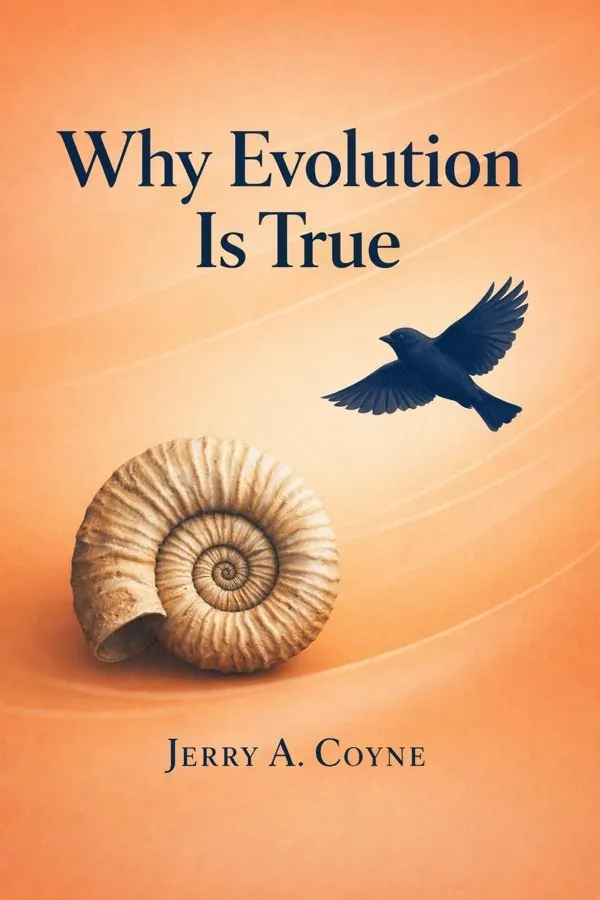
Why Evolution Is True: Summary & Key Insights
 10 min10 chaptersAudio available
Key Takeaways from Why Evolution Is True
Stone remembers what human memory cannot.
To watch an embryo develop is to witness history hidden inside growth.
Location tells a story that anatomy alone cannot.
Evolution is often dismissed as too slow to witness, yet Coyne emphasizes that natural selection can be seen in real time.
If fossils are evolution’s historical documents, DNA is its molecular archive.
What Is Why Evolution Is True About?
Why Evolution Is True by Jerry A. Coyne is a life_science book spanning 10 pages. Why Evolution Is True is Jerry A. Coyne’s clear, forceful case for one of science’s most important conclusions: life on Earth changed over time through evolution, and the evidence for that conclusion is overwhelming. Rather than asking readers to accept evolution on authority, Coyne assembles proof from multiple fields—fossils, genetics, embryology, anatomy, biogeography, and direct observation—to show how independent lines of evidence converge on the same answer. The result is not a narrow academic argument, but a vivid tour of how scientists know what they know. The book matters because evolution is often misunderstood. Many people hear the word “theory” and assume uncertainty, when in science a theory is a well-supported explanatory framework. Coyne carefully distinguishes the fact of evolution from the mechanisms that explain it, especially natural selection. He also addresses common objections, from claims about missing fossils to attacks from creationism and intelligent design. Coyne writes with unusual authority. A distinguished evolutionary biologist and professor, he combines deep expertise in speciation and genetics with a gift for making complex evidence accessible. This book is both an introduction to evolutionary science and a defense of scientific reasoning itself.
This FizzRead summary covers all 10 key chapters of Why Evolution Is True in approximately 10 minutes, distilling the most important ideas, arguments, and takeaways from Jerry A. Coyne's work. Also available as an audio summary and Key Quotes Podcast.
Why Evolution Is True
Why Evolution Is True is Jerry A. Coyne’s clear, forceful case for one of science’s most important conclusions: life on Earth changed over time through evolution, and the evidence for that conclusion is overwhelming. Rather than asking readers to accept evolution on authority, Coyne assembles proof from multiple fields—fossils, genetics, embryology, anatomy, biogeography, and direct observation—to show how independent lines of evidence converge on the same answer. The result is not a narrow academic argument, but a vivid tour of how scientists know what they know.
The book matters because evolution is often misunderstood. Many people hear the word “theory” and assume uncertainty, when in science a theory is a well-supported explanatory framework. Coyne carefully distinguishes the fact of evolution from the mechanisms that explain it, especially natural selection. He also addresses common objections, from claims about missing fossils to attacks from creationism and intelligent design.
Coyne writes with unusual authority. A distinguished evolutionary biologist and professor, he combines deep expertise in speciation and genetics with a gift for making complex evidence accessible. This book is both an introduction to evolutionary science and a defense of scientific reasoning itself.
Who Should Read Why Evolution Is True?
This book is perfect for anyone interested in life_science and looking to gain actionable insights in a short read. Whether you're a student, professional, or lifelong learner, the key ideas from Why Evolution Is True by Jerry A. Coyne will help you think differently.
- ✓Readers who enjoy life_science and want practical takeaways
- ✓Professionals looking to apply new ideas to their work and life
- ✓Anyone who wants the core insights of Why Evolution Is True in just 10 minutes
Want the full summary?
Get instant access to this book summary and 100K+ more with Fizz Moment.
Get Free SummaryAvailable on App Store • Free to download
Key Chapters
Stone remembers what human memory cannot. One of Coyne’s strongest points is that the fossil record preserves a chronological history of life, allowing us to see not just what existed, but when it existed and how major groups changed through time. Fossils do not appear randomly in rock layers. Simple organisms occur in older strata, while more complex and more familiar forms appear later, exactly what evolution predicts if life diversified gradually over immense spans of time.
Coyne explains that fossils are especially persuasive when they show transitional features. These are not “half-formed” creatures in a crude sense, but organisms combining traits of ancestral and descendant groups. Archaeopteryx, for example, links reptiles and birds with its feathers, claws, and bony tail. Whale evolution is another striking case: ancient land mammals gradually acquired aquatic adaptations, with fossils documenting shifts in limbs, ears, and skull structure. Human ancestry, too, is represented by a branching sequence of hominins with changing brain size, posture, and dentition.
Importantly, Coyne addresses the complaint that the fossil record is incomplete. Of course it is—fossilization is rare. But incompleteness does not erase the pattern. In fact, the broad order of appearance, the nested progression of traits, and the many discovered transitional forms together form a coherent historical narrative.
In practical terms, this chapter teaches readers how to think historically about biology. Evolution is not inferred from one dramatic fossil, but from converging sequences spread across geology and anatomy. Actionable takeaway: when evaluating claims about evolution, ask whether they explain the ordered pattern of fossils better than common descent does. Few alternatives can.
Location tells a story that anatomy alone cannot. Coyne uses biogeography—the geographic distribution of species—to show that life’s diversity reflects descent, migration, and isolation rather than independent creation. Species are not scattered across the globe wherever conditions happen to suit them. Instead, they appear in patterns tied to geological history and ancestry.
Oceanic islands offer some of the clearest examples. Islands often contain species found nowhere else, yet those species resemble nearby mainland forms more than organisms living in similar climates elsewhere. The Galápagos mockingbirds and finches, for example, are closely related to South American ancestors, not to birds from ecologically similar African or Pacific environments. That is exactly what evolution predicts: colonists arrive from nearby regions, then diversify in isolation.
Marsupials in Australia provide another powerful case. Why do pouched mammals dominate there while placental mammals dominate most other continents? Coyne explains that continental drift and long isolation shaped which lineages were present and able to diversify. The pattern fits historical separation, not optimal design.
Biogeography also explains why extinct and living species in the same region often resemble one another. Fossil armadillo-like glyptodonts in South America are related to modern armadillos from that same continent. This continuity across time and place supports local descent with modification.
For everyday readers, biogeography sharpens scientific thinking: to understand life, ask not only what works in an environment, but how organisms got there. History matters as much as habitat.
Actionable takeaway: when considering why a species lives where it does, include geography, migration, and isolation in your explanation. Evolutionary patterns make far more sense when viewed on a map as well as in a lab.
Evolution is often dismissed as too slow to witness, yet Coyne emphasizes that natural selection can be seen in real time. Selection occurs whenever individuals differ, those differences are heritable, and some variants leave more offspring than others. Given enough generations, populations change. This is not an abstract idea; it has been observed repeatedly in the wild and in the laboratory.
Coyne highlights examples such as antibiotic resistance in bacteria, where microbes carrying mutations that help them survive treatment quickly become common. Insects evolve pesticide resistance by the same logic. He also discusses the famous Galápagos finches studied by Peter and Rosemary Grant: changes in climate altered food availability, and birds with beaks better suited to the available seeds survived and reproduced more successfully. Within a relatively short time, average beak characteristics shifted measurably.
These cases matter because they show the mechanism of adaptation at work. Natural selection does not strive toward perfection or long-term goals. It simply favors traits that improve reproductive success in a particular environment. That environment can change, making previously useful traits less advantageous.
The practical implications are enormous. Medicine, agriculture, and conservation all depend on evolutionary thinking. Overuse of antibiotics speeds resistance. Crop pests can adapt to control methods. Threatened species may struggle if environmental change outpaces their ability to respond.
Actionable takeaway: apply evolutionary thinking to recurring real-world problems. Whenever a population is exposed to pressure—drugs, predators, climate, competition—expect adaptation. Policies and personal choices work better when they account for evolution instead of ignoring it.
If fossils are evolution’s historical documents, DNA is its molecular archive. Coyne explains that genetics provides some of the most decisive evidence for common descent because all living things use the same basic genetic code and share many of the same genes. The closer two species are related, the more similar their DNA tends to be. This pattern is not vague resemblance; it can be measured precisely.
Humans and chimpanzees, for example, share a remarkable proportion of their DNA, matching the expectation that they diverged from a recent common ancestor. More distant relatives, such as humans and mice, share fewer similarities, while organisms separated by much deeper time share the oldest and most fundamental genetic machinery. These nested layers of similarity mirror the branching tree inferred from anatomy and fossils.
Coyne also points to genetic “mistakes” as powerful evidence. Shared pseudogenes—broken genes inherited by multiple species—make little sense under separate creation, because there would be no reason to independently install the same nonfunctional errors in related organisms. Likewise, endogenous viral sequences and chromosomal patterns preserve historical traces of descent.
Genetics has practical uses beyond proving evolution. It helps reconstruct ancestry, track disease, guide breeding, and identify conservation priorities. Molecular data also allow scientists to test evolutionary hypotheses rather than merely propose them.
For readers, the larger lesson is that evolution is not resting on one kind of evidence. The same family tree appears whether we compare bones, embryos, or genomes.
Actionable takeaway: when assessing claims about the origin of species, look for genetic evidence. DNA offers a direct, testable way to evaluate relatedness, and it consistently supports common descent.
A common challenge to evolution asks: if species change, how do entirely new species arise? Coyne, whose own scientific work focuses on speciation, answers this by showing that species form when populations become reproductively isolated and then diverge genetically. Evolution does not require sudden leaps from one mature form to another. Instead, small differences accumulate until interbreeding becomes impossible or unproductive.
Geographic separation is one major route. A river, mountain range, island, or migration event can split a population, exposing each branch to different environments, mutations, and selective pressures. Over time, these groups may evolve distinct mating behaviors, body structures, or genetic incompatibilities. Even if they later meet again, they may no longer mate successfully. Coyne draws on examples from fruit flies, birds, and other organisms to show that these barriers can be studied experimentally.
Speciation can also occur through ecological specialization or sexual selection. If some members of a population prefer different foods, habitats, or mates, they may gradually become isolated without obvious physical barriers. This helps explain life’s extraordinary branching diversity.
The concept has practical importance in conservation and medicine. Recognizing distinct species affects legal protection, habitat management, and biodiversity policy. In agriculture and epidemiology, understanding divergence helps us track pests and pathogens as they split and adapt.
Coyne’s deeper point is that biodiversity is not static. The world’s variety is generated by ordinary evolutionary processes acting over long stretches of time.
Actionable takeaway: stop thinking of species as fixed boxes. Instead, view them as evolving populations on branches of a tree, with new branches forming whenever isolation and divergence persist long enough.
Perfection would be poor evidence for evolution; awkwardness is often better. Coyne argues that many biological features make sense not as optimal designs but as inherited compromises shaped by history. Evolution can only modify what already exists, so organisms often carry jury-rigged solutions that work well enough without being ideal.
The recurrent laryngeal nerve is a classic example. In mammals, this nerve travels from the brain to the larynx by taking an absurd detour around major blood vessels, a route that becomes especially dramatic in giraffes. Why would an engineer choose such a path? Evolution explains it: the nerve’s arrangement reflects ancestral body plans that were gradually modified as necks lengthened. The vertebrate eye also contains quirks, including a blind spot caused by the way the retina is wired. Human backs, knees, and childbirth difficulties similarly reveal compromises produced by upright walking imposed on a body not originally built for it.
Coyne’s point is not that organisms are badly made. Many are exquisitely adapted. But adaptation is constrained by lineage. Natural selection improves what is available; it does not scrap the old system and start over. This is why imperfections are scientifically informative.
In practical terms, recognizing evolutionary constraint improves medicine and biomechanics. Vulnerabilities in the spine, teeth, or circulatory system often reflect trade-offs rather than failures of modern living alone.
Actionable takeaway: when you encounter a strange or inefficient biological feature, ask what historical path could have produced it. Apparent flaws are often among the clearest windows into evolution’s tinkering process.
Few ideas provoke stronger reactions than the claim that humans are part of the same evolutionary process as every other species. Coyne insists that human evolution is not a special exception but one of evolution’s best-supported examples. Fossils, comparative anatomy, genetics, and behavior all place humans firmly within the primate lineage.
The fossil record documents a branching history of hominins showing changes in walking posture, skull shape, teeth, and brain size. Species such as Australopithecus, Homo habilis, and Homo erectus display combinations of traits that illuminate the path toward modern humans. At the same time, DNA leaves little doubt about our close relationship to other apes, especially chimpanzees and bonobos.
Coyne is careful to reject simplistic misunderstandings. Humans did not evolve from modern monkeys or chimpanzees; rather, we share common ancestors with them. Nor does evolution imply that humans are “just animals” in a trivial sense. Our language, culture, symbolism, and cumulative learning are extraordinary. But extraordinary does not mean exempt from nature.
This chapter has practical and philosophical significance. Evolutionary perspectives help explain aspects of human anatomy, disease, social behavior, and cognition. They also encourage intellectual humility by placing humanity within a larger living continuum.
For many readers, this is the emotional center of the book. Accepting human evolution can feel unsettling, but it can also be liberating: it roots our story in the same lawful, discoverable history that shaped all life.
Actionable takeaway: approach human uniqueness without denying human continuity. You can appreciate what is distinctive about our species while still accepting the evidence that we emerged through evolution.
Bad arguments often survive not because they are strong, but because they are repeated. Coyne devotes significant attention to common misconceptions about evolution and to the cultural opposition that keeps them alive. He distinguishes legitimate scientific debate about details from attacks on the basic fact of evolution, which are often driven by religious or ideological commitments rather than evidence.
One recurring misunderstanding is that evolution is “just a theory.” Coyne explains that in science, a theory is a well-supported explanatory framework, not a casual guess. Another misconception is that accepting evolution means denying meaning, morality, or beauty. Evolutionary science addresses how life diversified, not how individuals should construct ethical lives. Coyne also counters claims that gaps in the fossil record, complexity in organisms, or probability arguments somehow overturn common descent.
He is particularly critical of intelligent design when it presents itself as science without producing testable mechanisms or research programs. Science advances through evidence, prediction, and revision, not by pointing to current ignorance and calling it design.
The practical value of this chapter lies in scientific literacy. Readers learn how to evaluate claims, separate evidence from rhetoric, and recognize false equivalence in public debates. In classrooms and civic life, this matters deeply because confusion about evolution often reflects broader misunderstandings about how science works.
Actionable takeaway: when encountering objections to evolution, ask whether they offer testable evidence and a better explanatory framework. If they rely mainly on doubt, semantics, or personal belief, they are not scientific alternatives.
A scientific idea earns trust not merely by fitting old facts, but by guiding us toward new ones. Coyne emphasizes that evolution has predictive power: it tells scientists what kinds of patterns they should expect to find if common descent and natural selection are true. Those expectations have repeatedly been confirmed.
If species share ancestry, then transitional fossils should occur in rocks of appropriate age, and they do. If related organisms inherited genetic material from common ancestors, then their DNA should form nested patterns of similarity, and it does. If populations face strong selective pressures, then measurable adaptation should sometimes be observable within human timescales, and it is. If island species descend from nearby mainland ancestors, then their relationships should reflect geographic proximity more than ecological similarity to distant species, and they do.
This predictive quality is what makes evolution more than a story about the past. It actively shapes ongoing research. Paleontologists search specific strata for expected intermediates. Geneticists infer relatedness from shared mutations. Epidemiologists anticipate how viruses and bacteria may evolve. Conservation biologists use evolutionary principles to protect genetic diversity.
Coyne’s broader message is methodological: strong theories unify separate observations and help generate fruitful questions. Evolution does both extraordinarily well. It is not a fragile doctrine threatened by each new discovery; it is the framework that makes those discoveries intelligible.
Actionable takeaway: judge scientific explanations by what they can predict and organize, not by whether they satisfy intuition. Evolution’s strength lies in its ability to connect evidence across disciplines and forecast what researchers will find next.
All Chapters in Why Evolution Is True
About the Author
Jerry A. Coyne is an American evolutionary biologist and professor emeritus in the Department of Ecology and Evolution at the University of Chicago. He is best known for his research on speciation, the process by which new species arise, and for his broader work explaining evolutionary science to public audiences. Over the course of his academic career, Coyne published influential scientific papers on genetics, reproductive isolation, and evolutionary mechanisms. He also became a prominent voice in debates about science education, creationism, and the public understanding of evolution. In his writing, Coyne combines rigorous scientific expertise with a direct, accessible style that helps non-specialists understand complex biological ideas. Why Evolution Is True remains one of his most widely read books, valued for its clear synthesis of the evidence for evolution.
Get This Summary in Your Preferred Format
Read or listen to the Why Evolution Is True summary by Jerry A. Coyne anytime, anywhere. FizzRead offers multiple formats so you can learn on your terms — all free.
Available formats: App · Audio · PDF · EPUB — All included free with FizzRead
Download Why Evolution Is True PDF and EPUB Summary
Key Quotes from Why Evolution Is True
“Stone remembers what human memory cannot.”
“To watch an embryo develop is to witness history hidden inside growth.”
“Location tells a story that anatomy alone cannot.”
“Evolution is often dismissed as too slow to witness, yet Coyne emphasizes that natural selection can be seen in real time.”
“If fossils are evolution’s historical documents, DNA is its molecular archive.”
Frequently Asked Questions about Why Evolution Is True
Why Evolution Is True by Jerry A. Coyne is a life_science book that explores key ideas across 10 chapters. Why Evolution Is True is Jerry A. Coyne’s clear, forceful case for one of science’s most important conclusions: life on Earth changed over time through evolution, and the evidence for that conclusion is overwhelming. Rather than asking readers to accept evolution on authority, Coyne assembles proof from multiple fields—fossils, genetics, embryology, anatomy, biogeography, and direct observation—to show how independent lines of evidence converge on the same answer. The result is not a narrow academic argument, but a vivid tour of how scientists know what they know. The book matters because evolution is often misunderstood. Many people hear the word “theory” and assume uncertainty, when in science a theory is a well-supported explanatory framework. Coyne carefully distinguishes the fact of evolution from the mechanisms that explain it, especially natural selection. He also addresses common objections, from claims about missing fossils to attacks from creationism and intelligent design. Coyne writes with unusual authority. A distinguished evolutionary biologist and professor, he combines deep expertise in speciation and genetics with a gift for making complex evidence accessible. This book is both an introduction to evolutionary science and a defense of scientific reasoning itself.
More by Jerry A. Coyne
You Might Also Like
The Selfish Gene
Richard Dawkins
10 min
Awakenings
Oliver Sacks
10 min
Parasite Rex: Inside the Bizarre World of Nature's Most Dangerous Creatures
Carl Zimmer
10 min
The Atlas of Life on Earth
Various
10 min
The Book of Humans: The Story of How We Became Us
Adam Rutherford
10 min
The Horse
Wendy Williams
10 minBrowse by Category
Ready to read Why Evolution Is True?
Get the full summary and 100K+ more books with Fizz Moment.