
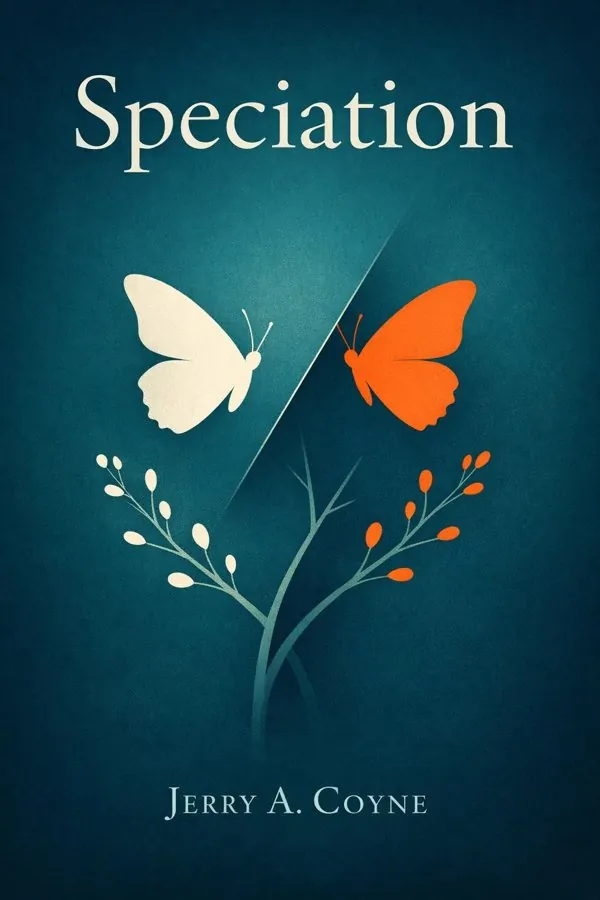
Speciation: Summary & Key Insights
 10 min6 chaptersAudio available
What Is Speciation About?
Speciation by Jerry A. Coyne is a life_science book spanning 6 pages. This comprehensive work explores the biological process of speciation—the formation of new and distinct species in the course of evolution. Coyne and Orr synthesize decades of research, presenting theoretical frameworks and empirical evidence from genetics, ecology, and evolutionary biology. The book is widely regarded as a definitive reference on how species originate and diverge.
This FizzRead summary covers all 6 key chapters of Speciation in approximately 10 minutes, distilling the most important ideas, arguments, and takeaways from Jerry A. Coyne's work. Also available as an audio summary and Key Quotes Podcast.
Speciation
This comprehensive work explores the biological process of speciation—the formation of new and distinct species in the course of evolution. Coyne and Orr synthesize decades of research, presenting theoretical frameworks and empirical evidence from genetics, ecology, and evolutionary biology. The book is widely regarded as a definitive reference on how species originate and diverge.
Who Should Read Speciation?
This book is perfect for anyone interested in life_science and looking to gain actionable insights in a short read. Whether you're a student, professional, or lifelong learner, the key ideas from Speciation by Jerry A. Coyne will help you think differently.
- ✓Readers who enjoy life_science and want practical takeaways
- ✓Professionals looking to apply new ideas to their work and life
- ✓Anyone who wants the core insights of Speciation in just 10 minutes
Want the full summary?
Get instant access to this book summary and 100K+ more with Fizz Moment.
Get Free SummaryAvailable on App Store • Free to download
Key Chapters
To build a coherent theory of speciation, we must first define what a species actually is. Throughout biology’s history, this deceptively simple question has sparked intense debate. The viewpoint that I, following Ernst Mayr, find most fruitful is the *biological species concept*: species are groups of interbreeding natural populations that are reproductively isolated from other such groups.
This definition emphasizes the process, not just the pattern, of separation. Species are not simply clusters of similar individuals—they are reproductively cohesive groups bounded by barriers to gene flow. Yet, the reality of life’s diversity demands nuance. There are cases where a strict biological definition fails: asexually reproducing organisms, hybridizing plants, and microbial clades that do not fit neatly into reproductive categories. Consequently, we explore alternative models, such as morphological, ecological, and phylogenetic species concepts. Each adds a dimension to our understanding—morphological concepts focus on form, ecological ones on niche usage, and phylogenetic definitions on ancestry and diagnosable differences.
By navigating through the conceptual landscape, we arrive at a flexible yet rigorous framework. The biological species concept remains central because it connects directly to the mechanisms of speciation—the evolution of reproductive isolation. This lens unites the book’s themes: if species are defined by their inability to interbreed, then the origins of reproductive barriers become the heartbeat of speciation research.
Every instance of speciation begins with populations that once exchanged genes freely but now cannot. The transition from shared gene flow to reproductive isolation defines the birth of a new species. But isolation is not a monolithic barrier; it is composed of layered mechanisms that act before and after fertilization.
Prezygotic isolation prevents mating or fertilization altogether. Populations may diverge in behavior—courtship rituals, songs, or pheromones—so that potential mates no longer recognize each other. Temporal and ecological differences, such as breeding at different times or exploiting distinct habitats, can also prevent interbreeding. The famous studies of *Drosophila*, which my collaborator H. Allen Orr and I have long explored, reveal the evolutionary dynamics underlying these barriers. In some cases, reinforcing selection strengthens prezygotic isolation when hybridization produces unfit offspring, further ensuring distinct lineages.
Postzygotic isolation, in contrast, occurs after mating. Hybrids may fail to develop properly, die prematurely, or be sterile—like the mule, born of horse and donkey parentage. The genetic basis of such incompatibilities is a central focus of speciation genetics. The Dobzhansky–Muller model provides a powerful explanation: when two populations accumulate distinct genetic changes in isolation, these differences can interact negatively when combined in hybrids, producing inviability or sterility. These effects arise not from maladaptive mutations in either lineage, but from the incompatibility of genes that have never before met.
Through both prezygotic and postzygotic forms, isolation grows gradually, often unevenly across populations. Understanding how these barriers evolve—through selection, drift, or other forces—is essential to grasping how new species maintain their integrity.
+ 4 more chapters — available in the FizzRead app
All Chapters in Speciation
About the Author
Jerry A. Coyne is an American evolutionary biologist and professor emeritus at the University of Chicago. He is known for his research on speciation and evolutionary genetics, as well as for his writings on science and secularism.
Get This Summary in Your Preferred Format
Read or listen to the Speciation summary by Jerry A. Coyne anytime, anywhere. FizzRead offers multiple formats so you can learn on your terms — all free.
Available formats: App · Audio · PDF · EPUB — All included free with FizzRead
Download Speciation PDF and EPUB Summary
Key Quotes from Speciation
“To build a coherent theory of speciation, we must first define what a species actually is.”
“Every instance of speciation begins with populations that once exchanged genes freely but now cannot.”
Frequently Asked Questions about Speciation
Speciation by Jerry A. Coyne is a life_science book that explores key ideas across 6 chapters. This comprehensive work explores the biological process of speciation—the formation of new and distinct species in the course of evolution. Coyne and Orr synthesize decades of research, presenting theoretical frameworks and empirical evidence from genetics, ecology, and evolutionary biology. The book is widely regarded as a definitive reference on how species originate and diverge.
More by Jerry A. Coyne
You Might Also Like
The Selfish Gene
Richard Dawkins
10 min
Awakenings
Oliver Sacks
10 min
Parasite Rex: Inside the Bizarre World of Nature's Most Dangerous Creatures
Carl Zimmer
10 min
The Atlas of Life on Earth
Various
10 min
The Book of Humans: The Story of How We Became Us
Adam Rutherford
10 min
The Horse
Wendy Williams
10 minBrowse by Category
Ready to read Speciation?
Get the full summary and 100K+ more books with Fizz Moment.