
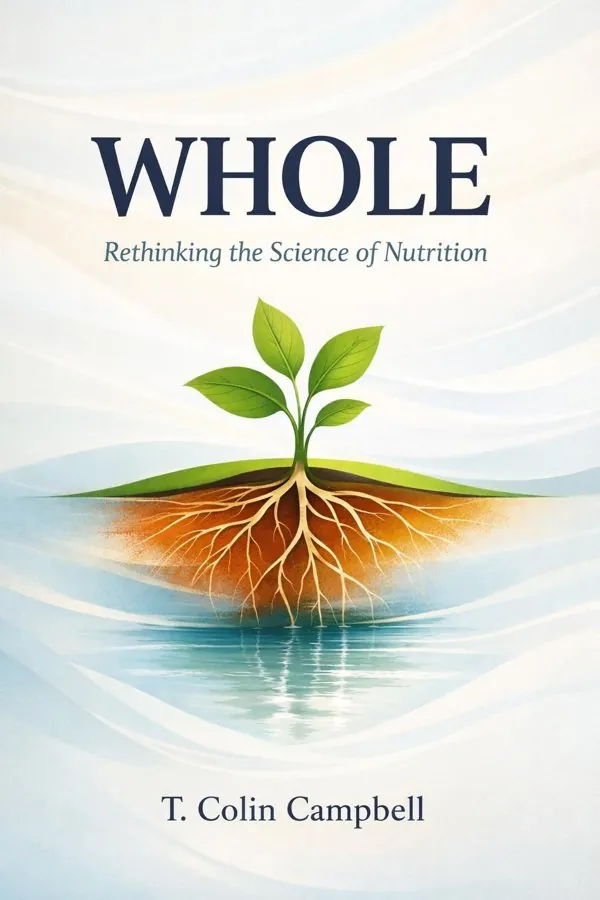
Whole: Rethinking the Science of Nutrition: Summary & Key Insights
 10 min6 chaptersAudio available
What Is Whole: Rethinking the Science of Nutrition About?
Whole: Rethinking the Science of Nutrition by T. Colin Campbell is a health_med book spanning 6 pages. In this groundbreaking work, T. Colin Campbell expands upon the ideas introduced in 'The China Study' to challenge reductionist approaches to nutrition science. He argues that health cannot be understood through isolated nutrients or supplements but must be viewed holistically, emphasizing the interconnectedness of food, body, and environment. The book advocates for a whole-food, plant-based diet and explores how scientific paradigms and industry interests shape public understanding of nutrition.
This FizzRead summary covers all 6 key chapters of Whole: Rethinking the Science of Nutrition in approximately 10 minutes, distilling the most important ideas, arguments, and takeaways from T. Colin Campbell's work. Also available as an audio summary and Key Quotes Podcast.
Whole: Rethinking the Science of Nutrition
In this groundbreaking work, T. Colin Campbell expands upon the ideas introduced in 'The China Study' to challenge reductionist approaches to nutrition science. He argues that health cannot be understood through isolated nutrients or supplements but must be viewed holistically, emphasizing the interconnectedness of food, body, and environment. The book advocates for a whole-food, plant-based diet and explores how scientific paradigms and industry interests shape public understanding of nutrition.
Who Should Read Whole: Rethinking the Science of Nutrition?
This book is perfect for anyone interested in health_med and looking to gain actionable insights in a short read. Whether you're a student, professional, or lifelong learner, the key ideas from Whole: Rethinking the Science of Nutrition by T. Colin Campbell will help you think differently.
- ✓Readers who enjoy health_med and want practical takeaways
- ✓Professionals looking to apply new ideas to their work and life
- ✓Anyone who wants the core insights of Whole: Rethinking the Science of Nutrition in just 10 minutes
Want the full summary?
Get instant access to this book summary and 100K+ more with Fizz Moment.
Get Free SummaryAvailable on App Store • Free to download
Key Chapters
Before we can embrace a holistic vision of nutrition, we must understand how the opposite worldview came to define modern science. Reductionism, the reigning paradigm, has served us well in many areas. It taught us to identify viruses, isolate DNA, and engineer technologies that have transformed the world. But in the realm of nutrition and biology, its limitations are stark. Reductionism promises clarity by narrowing focus — one gene, one nutrient, one disease — but in doing so it often severs the living links that make meaning possible.
In nutrition, reductionism manifests in the search for the 'magic bullet.' Scientists design experiments to test single variables — a vitamin here, a protein there — as if the intricate orchestra of metabolism could be understood one note at a time. The logic is seductive: if we can isolate what causes disease, we can isolate what cures it. But biology is not a laboratory flask. Every system within us, from immune response to hormone regulation, is entwined in feedback loops beyond our comprehension.
During my own years of study, I saw how this approach distorted our understanding. Nutrients were measured out, stripped from food, and studied as though their effects could be summed independently. Yet in real life, nutrients coexist in relationships as intimate as those between organs in the body. As a researcher, I began to see results that didn’t fit the reductionist model — results that suggested the body was operating not according to single pathways, but to patterns of coordination and adaptation.
The tragedy of reductionism is not malicious intent; it is habit and inertia. We value what we can measure, fund what we can patent, and teach what we can quantify. It gives us the comforting illusion of control, but it also imprisons us within the boundaries of our instruments. And nowhere is this more dangerous than in the science of what we eat and how we live.
The modern nutrition industry thrives on simplification. From the cereal box boasting its vitamin content to the supplement aisle promising immunity in a pill, our culture has come to believe that nutrients are health. But this focus on isolated nutrients, however scientifically rigorous it may appear, fundamentally misunderstands how food operates within the body.
We have been taught to believe that if vitamin C prevents scurvy, then megadoses of antioxidants can prevent cancer. If calcium builds bones, then taking calcium supplements will make them stronger. But this is a logical fallacy born of reductionism. Each nutrient is part of a vast network of interactions in food and in the body. Pull one strand of the web and you alter the tension of the whole.
When I reviewed decades of research — from controlled laboratory experiments to broad epidemiological surveys like those in 'The China Study' — the pattern was unmistakable. Populations thriving on diets rich in whole, plant-based foods consistently exhibited lower rates of chronic disease, irrespective of specific nutrients. The synergy of the foods themselves, not any single nutrient, explained these outcomes.
Nutrient-centric thinking not only misleads consumers but also misguides science. It invites us to chase isolated markers — cholesterol, sugar, protein intake — and to believe that managing each separately can ensure health. But the human organism doesn’t work through isolated levers. It works through networks. When we adopt a dietary philosophy centered on whole foods rather than nutrient counts, we align ourselves more closely with the way our bodies actually function.
+ 4 more chapters — available in the FizzRead app
All Chapters in Whole: Rethinking the Science of Nutrition
About the Author
T. Colin Campbell is an American biochemist specializing in the effect of nutrition on long-term health. He is Professor Emeritus of Nutritional Biochemistry at Cornell University and co-author of 'The China Study'. His research has focused on the relationship between diet and disease, particularly the benefits of plant-based nutrition.
Get This Summary in Your Preferred Format
Read or listen to the Whole: Rethinking the Science of Nutrition summary by T. Colin Campbell anytime, anywhere. FizzRead offers multiple formats so you can learn on your terms — all free.
Available formats: App · Audio · PDF · EPUB — All included free with FizzRead
Download Whole: Rethinking the Science of Nutrition PDF and EPUB Summary
Key Quotes from Whole: Rethinking the Science of Nutrition
“Before we can embrace a holistic vision of nutrition, we must understand how the opposite worldview came to define modern science.”
“The modern nutrition industry thrives on simplification.”
Frequently Asked Questions about Whole: Rethinking the Science of Nutrition
Whole: Rethinking the Science of Nutrition by T. Colin Campbell is a health_med book that explores key ideas across 6 chapters. In this groundbreaking work, T. Colin Campbell expands upon the ideas introduced in 'The China Study' to challenge reductionist approaches to nutrition science. He argues that health cannot be understood through isolated nutrients or supplements but must be viewed holistically, emphasizing the interconnectedness of food, body, and environment. The book advocates for a whole-food, plant-based diet and explores how scientific paradigms and industry interests shape public understanding of nutrition.
More by T. Colin Campbell
You Might Also Like

On Immunity
Eula Biss
10 min
The Three-Body Problem
Liu Cixin
10 min
Community Health Volunteer Toolkit: Training and Practical Activities
World Health Organization
10 min
Healing Back Pain: The Mind-Body Connection
John E. Sarno
10 min
Health Literacy for All: Practical Guides to Communicate Health Information (Compilations)
World Health Organization
10 min
The Complete Guide to Sports Supplements: An Evidence-Based Review
Anita Bean
10 minBrowse by Category
Ready to read Whole: Rethinking the Science of Nutrition?
Get the full summary and 100K+ more books with Fizz Moment.