
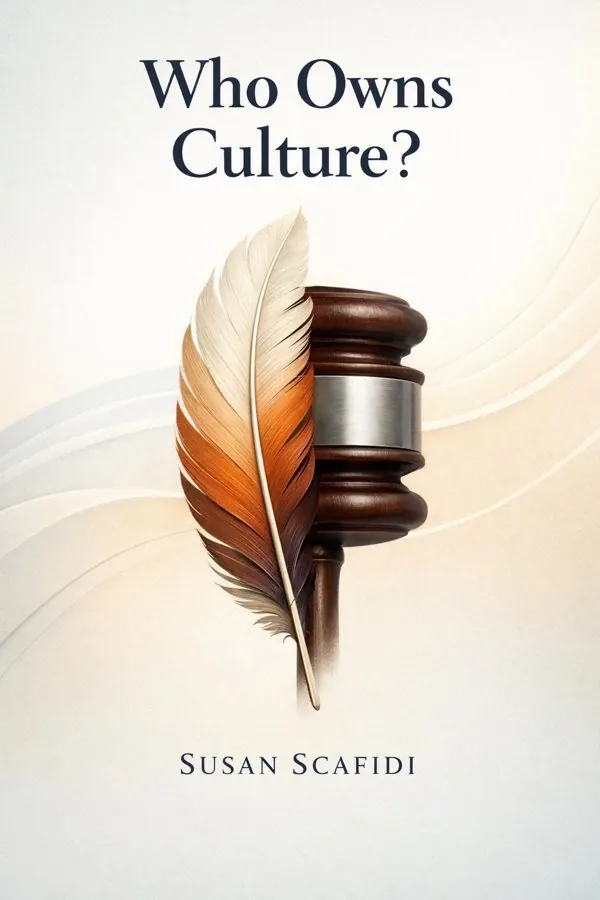
Who Owns Culture?: Appropriation and Authenticity in American Law: Summary & Key Insights
 10 min10 chaptersAudio available
What Is Who Owns Culture?: Appropriation and Authenticity in American Law About?
Who Owns Culture?: Appropriation and Authenticity in American Law by Susan Scafidi is a law_crime book spanning 10 pages. This book explores the legal and cultural debates surrounding cultural appropriation, authenticity, and ownership in the United States. Susan Scafidi examines how American law addresses the protection of cultural expressions, from fashion and folklore to art and music, and questions who has the right to control cultural symbols and traditions. The work bridges law, anthropology, and cultural studies to illuminate the complexities of identity and creativity in a multicultural society.
This FizzRead summary covers all 10 key chapters of Who Owns Culture?: Appropriation and Authenticity in American Law in approximately 10 minutes, distilling the most important ideas, arguments, and takeaways from Susan Scafidi's work. Also available as an audio summary and Key Quotes Podcast.
Who Owns Culture?: Appropriation and Authenticity in American Law
This book explores the legal and cultural debates surrounding cultural appropriation, authenticity, and ownership in the United States. Susan Scafidi examines how American law addresses the protection of cultural expressions, from fashion and folklore to art and music, and questions who has the right to control cultural symbols and traditions. The work bridges law, anthropology, and cultural studies to illuminate the complexities of identity and creativity in a multicultural society.
Who Should Read Who Owns Culture?: Appropriation and Authenticity in American Law?
This book is perfect for anyone interested in law_crime and looking to gain actionable insights in a short read. Whether you're a student, professional, or lifelong learner, the key ideas from Who Owns Culture?: Appropriation and Authenticity in American Law by Susan Scafidi will help you think differently.
- ✓Readers who enjoy law_crime and want practical takeaways
- ✓Professionals looking to apply new ideas to their work and life
- ✓Anyone who wants the core insights of Who Owns Culture?: Appropriation and Authenticity in American Law in just 10 minutes
Want the full summary?
Get instant access to this book summary and 100K+ more with Fizz Moment.
Get Free SummaryAvailable on App Store • Free to download
Key Chapters
To understand how America arrived at its current view of cultural ownership, we must first trace the history of property itself. American law inherited from Europe a fundamentally individualistic conception of creation—rooted in Enlightenment ideas that prized originality and personal genius. When colonists and lawmakers began building legal systems, ownership was primarily defined in terms of land, patents, and tangible goods. Culture, in all its collective and fluid splendor, fit poorly within this model.
Unlike indigenous traditions, where creation often stemmed from communal participation and ancestry, American intellectual property law preferred the signature of one identifiable author. The collective creativity of folklore, craft, and ritual songs had no clear place. During the 19th century, scholars and collectors would claim to 'preserve' folk traditions by recording them, often forgetting that the community itself was the creative owner. By the 20th century, this heritage logic persisted—folklore was seen as public domain, a treasure available to all, rather than something deserving of protection for its source communities.
This historical foundation shapes everything that comes after. It reveals how the ideals of liberty and property intertwined to privilege individual authorship over collective culture. And while this approach encouraged boundless innovation, it also opened doors to exploitation—allowing dominant groups to adopt, market, and profit from cultures without acknowledgment. Understanding this lineage is essential because law does not emerge in a vacuum; it carries the moral assumptions of centuries. In America’s case, those assumptions have historically undervalued community-based creativity.
Our trip through the legal landscape begins with the core framework of American intellectual property: copyright, trademark, and patent law. Each of these systems serves a different purpose. Copyright protects expression, trademark guards identity and reputation, and patent defends innovation. Yet each one operates primarily around individual ownership and expression—a logic that often clashes with how culture actually works.
For example, copyright law demands originality and fixation—meaning a work must be uniquely expressed and recorded to be protected. Traditional songs, dances, and designs, passed orally or visually across generations, rarely meet those criteria. Trademark law, though crucial for brands, only incidentally protects cultural symbols when attached to commercial use. Patent law, intended for technological innovation, barely touches creative expression.
This triad of laws reflects how American imagination values innovation over inheritance. The community itself, unless incorporated or framed within private enterprise, usually falls outside the circle of protection. That is why cultural borrowing—from indigenous patterns to African-American musical forms—occurs largely unchecked. Legally speaking, appropriation often looks like freedom—until we confront its ethical dimensions.
In exploring these foundations, I want you to see the paradox embedded in American law: our legal system both celebrates creativity and erases the collective sources of cultural inspiration. It operates on a model that enshrines the lone author, not the storytelling community. Thus, cultural property—unlike private property—remains vulnerable to redefinition by those with economic power and legal literacy.
+ 8 more chapters — available in the FizzRead app
All Chapters in Who Owns Culture?: Appropriation and Authenticity in American Law
About the Author
Susan Scafidi is an American legal scholar and professor specializing in intellectual property and cultural heritage law. She is the founder of the Fashion Law Institute at Fordham University School of Law and a leading authority on the intersection of law, culture, and fashion.
Get This Summary in Your Preferred Format
Read or listen to the Who Owns Culture?: Appropriation and Authenticity in American Law summary by Susan Scafidi anytime, anywhere. FizzRead offers multiple formats so you can learn on your terms — all free.
Available formats: App · Audio · PDF · EPUB — All included free with FizzRead
Download Who Owns Culture?: Appropriation and Authenticity in American Law PDF and EPUB Summary
Key Quotes from Who Owns Culture?: Appropriation and Authenticity in American Law
“To understand how America arrived at its current view of cultural ownership, we must first trace the history of property itself.”
“Our trip through the legal landscape begins with the core framework of American intellectual property: copyright, trademark, and patent law.”
Frequently Asked Questions about Who Owns Culture?: Appropriation and Authenticity in American Law
Who Owns Culture?: Appropriation and Authenticity in American Law by Susan Scafidi is a law_crime book that explores key ideas across 10 chapters. This book explores the legal and cultural debates surrounding cultural appropriation, authenticity, and ownership in the United States. Susan Scafidi examines how American law addresses the protection of cultural expressions, from fashion and folklore to art and music, and questions who has the right to control cultural symbols and traditions. The work bridges law, anthropology, and cultural studies to illuminate the complexities of identity and creativity in a multicultural society.
You Might Also Like
Abortion and the Law in America: Roe v. Wade to the Present
Mary Ziegler
10 min
Black Edge: Inside Information, Dirty Money, and the Quest to Bring Down the Most Wanted Man on Wall Street
Sheelah Kolhatkar
10 min
Blood Feud: The Man Who Blew the Whistle on One of the Deadliest Prescription Drugs Ever
Kathleen Sharp
10 min
Catch and Kill: Lies, Spies, and a Conspiracy to Protect Predators
Ronan Farrow
10 min
Chaos: Charles Manson, the CIA, and the Secret History of the Sixties
Tom O'Neill with Dan Piepenbring
10 min
Code and Other Laws of Cyberspace
Lawrence Lessig
10 minBrowse by Category
Ready to read Who Owns Culture?: Appropriation and Authenticity in American Law?
Get the full summary and 100K+ more books with Fizz Moment.