
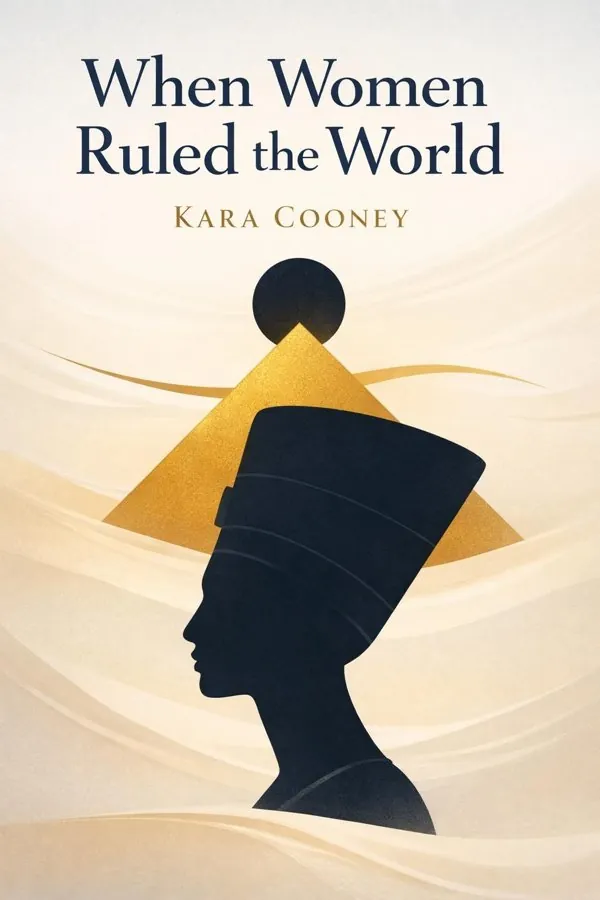
When Women Ruled the World: Six Queens of Egypt: Summary & Key Insights
by Kara Cooney
 10 min9 chaptersAudio available
What Is When Women Ruled the World: Six Queens of Egypt About?
When Women Ruled the World: Six Queens of Egypt by Kara Cooney is a world_history book spanning 9 pages. In this historical study, Egyptologist Kara Cooney explores the reigns of six powerful queens of ancient Egypt—Merneith, Neferusobek, Hatshepsut, Nefertiti, Tawosret, and Cleopatra—examining how they rose to power, ruled, and were remembered. The book investigates the social, political, and religious conditions that allowed women to assume leadership roles in a patriarchal society, offering insights into gender, authority, and legacy in ancient civilizations.
This FizzRead summary covers all 9 key chapters of When Women Ruled the World: Six Queens of Egypt in approximately 10 minutes, distilling the most important ideas, arguments, and takeaways from Kara Cooney's work. Also available as an audio summary and Key Quotes Podcast.
When Women Ruled the World: Six Queens of Egypt
In this historical study, Egyptologist Kara Cooney explores the reigns of six powerful queens of ancient Egypt—Merneith, Neferusobek, Hatshepsut, Nefertiti, Tawosret, and Cleopatra—examining how they rose to power, ruled, and were remembered. The book investigates the social, political, and religious conditions that allowed women to assume leadership roles in a patriarchal society, offering insights into gender, authority, and legacy in ancient civilizations.
Who Should Read When Women Ruled the World: Six Queens of Egypt?
This book is perfect for anyone interested in world_history and looking to gain actionable insights in a short read. Whether you're a student, professional, or lifelong learner, the key ideas from When Women Ruled the World: Six Queens of Egypt by Kara Cooney will help you think differently.
- ✓Readers who enjoy world_history and want practical takeaways
- ✓Professionals looking to apply new ideas to their work and life
- ✓Anyone who wants the core insights of When Women Ruled the World: Six Queens of Egypt in just 10 minutes
Want the full summary?
Get instant access to this book summary and 100K+ more with Fizz Moment.
Get Free SummaryAvailable on App Store • Free to download
Key Chapters
Merneith stands at the dawn of Egyptian kingship, around 2900 BCE, during the First Dynasty. Our evidence for her power comes mostly from her tomb at Abydos—a monumental complex similar in scale and design to those of kings—and from a funerary stela bearing her name. The absence of her title "king" on some records and its presence on others have long puzzled Egyptologists. Embedded in this ambiguity lies the story of Egypt’s earliest female ruler.
Merneith appears to have acted as regent for her son Den, possibly ruling in his stead until he came of age. Egypt at this time was defining its concept of kingship, merging divine ideology with political control. In such formative turmoil, a mother’s authority could be construed as a form of continuity, bridging the gap between deceased and young monarchs. Merneith’s power thus emerged not through rebellion or election, but through kinship and caretaking.
Her tomb reveals that her inclusion in the royal lineage was no mere administrative necessity—it represented a theological adaptation. The people of early Egypt accepted her regency because she symbolized the motherly life-force that sustained the cosmos when the masculine principle faltered. In this sense, Merneith’s reign was both a solution and a warning: women could take the throne, but only when necessary, only to restore balance.
I often think of Merneith as the architect of a pattern that would echo across millennia. Every subsequent female ruler in Egyptian history arose from some version of crisis—dynastic uncertainty, looming chaos, or broken succession. Merneith’s story sets the template: legitimacy through lineage and divine maternal connection. Her tomb, hidden for centuries beneath desert sands, remains one of the few tangible proofs that even in Egypt’s origins, female authority was possible, if not durable.
By the Twelfth Dynasty, Egypt had evolved into a formidable state governed by bureaucratic precision and centralized power. It was in this system’s final act that Neferusobek rose to the throne. The daughter of Amenemhat III and likely sister of Amenemhat IV, she ruled in a moment when succession faltered and dynastic confidence eroded. And yet she became Egypt’s first confirmed female pharaoh whose royal name was preserved completely in the king lists.
Neferusobek’s strategies of legitimacy reveal her acute understanding of Egyptian political theology. She adopted full kingly titulary, but unlike Hatshepsut a few generations later, she maintained visual imagery that retained her femininity; she is sometimes depicted wearing both dress and the traditional kilt, signifying a dual nature. She did not disguise herself as male but instead extended kingship’s boundaries to include the female.
Her reign lasted a brief four years, yet in that time she completed projects begun by her predecessors and stabilized Egypt long enough for the Middle Kingdom’s institutions to function before its inevitable decline. For me, Neferusobek represents a sophisticated kind of realism. She accepted kingship’s conventions but reframed them through moderation rather than confrontation.
Her story also underscores Egypt’s recurring tension between innovation and conservatism. The Middle Kingdom’s collapse following her death was not the result of her gender but of dynastic fragility—the same fragility that often opened doors for women only to shut them again. Neferusobek’s reign, therefore, was both culmination and closing act. When disorder loomed, her leadership provided reprieve; yet history, ever cyclical, once again erased the female king as stability returned.
+ 7 more chapters — available in the FizzRead app
All Chapters in When Women Ruled the World: Six Queens of Egypt
About the Author
Kara Cooney is an American Egyptologist, archaeologist, and professor of Egyptian Art and Architecture at the University of California, Los Angeles (UCLA). She is known for her research on ancient Egyptian social structures, gender, and power, as well as for her public scholarship through books and documentaries.
Get This Summary in Your Preferred Format
Read or listen to the When Women Ruled the World: Six Queens of Egypt summary by Kara Cooney anytime, anywhere. FizzRead offers multiple formats so you can learn on your terms — all free.
Available formats: App · Audio · PDF · EPUB — All included free with FizzRead
Download When Women Ruled the World: Six Queens of Egypt PDF and EPUB Summary
Key Quotes from When Women Ruled the World: Six Queens of Egypt
“Merneith stands at the dawn of Egyptian kingship, around 2900 BCE, during the First Dynasty.”
“By the Twelfth Dynasty, Egypt had evolved into a formidable state governed by bureaucratic precision and centralized power.”
Frequently Asked Questions about When Women Ruled the World: Six Queens of Egypt
When Women Ruled the World: Six Queens of Egypt by Kara Cooney is a world_history book that explores key ideas across 9 chapters. In this historical study, Egyptologist Kara Cooney explores the reigns of six powerful queens of ancient Egypt—Merneith, Neferusobek, Hatshepsut, Nefertiti, Tawosret, and Cleopatra—examining how they rose to power, ruled, and were remembered. The book investigates the social, political, and religious conditions that allowed women to assume leadership roles in a patriarchal society, offering insights into gender, authority, and legacy in ancient civilizations.
You Might Also Like
The Age of Capital
Eric Hobsbawm
10 min
The Gulag Archipelago
Aleksandr Solzhenitsyn
10 min
Jerusalem: The Biography
Simon Sebag Montefiore
10 min
The Anglo-Saxons
James Campbell
10 min
The Boer War
Thomas Pakenham
10 min
The Industrial Revolutionaries: The Making of the Modern World 1776–1914
Gavin Weightman
10 minBrowse by Category
Ready to read When Women Ruled the World: Six Queens of Egypt?
Get the full summary and 100K+ more books with Fizz Moment.