
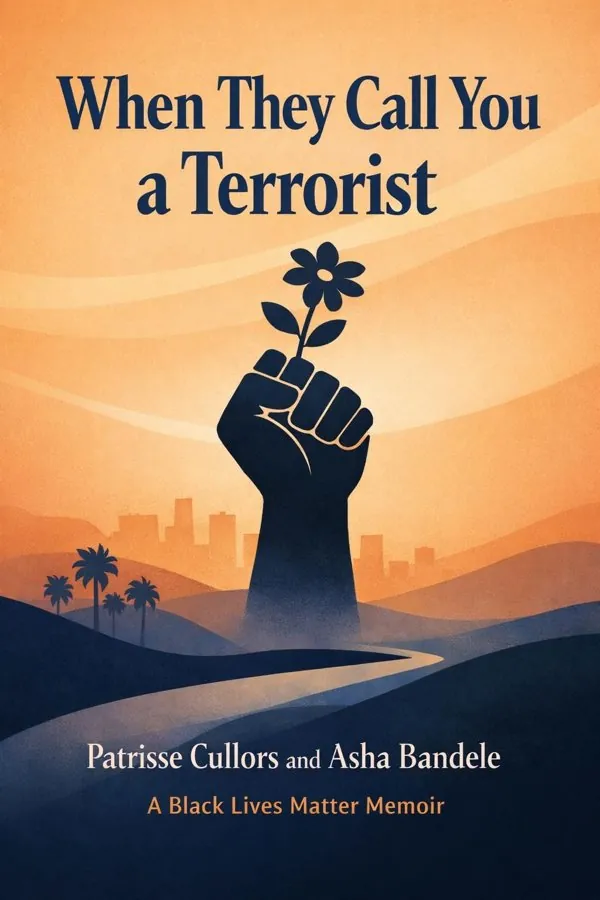
When They Call You a Terrorist: A Black Lives Matter Memoir: Summary & Key Insights
by Patrisse Cullors, Asha Bandele
 10 min9 chaptersAudio available
Key Takeaways from When They Call You a Terrorist: A Black Lives Matter Memoir
A child does not need policy language to recognize injustice; she only needs to notice who is safe, who is watched, and who is abandoned.
Families do not break apart in a vacuum; many are fractured by systems that punish vulnerability instead of supporting it.
Finding language for who you are can feel like stepping into sunlight after years in a locked room.
Awakening often begins when private pain is revealed to be public pattern.
Prisons do not only confine the incarcerated; they extend fear, grief, and instability into entire families and neighborhoods.
What Is When They Call You a Terrorist: A Black Lives Matter Memoir About?
When They Call You a Terrorist: A Black Lives Matter Memoir by Patrisse Cullors and Asha Bandele is a biographies book spanning 11 pages. When They Call You a Terrorist is both a personal memoir and a political testimony. In it, Patrisse Cullors recounts her childhood in Los Angeles, the pressures placed on her family by poverty, policing, mental illness, and incarceration, and the experiences that shaped her into one of the co-founders of the Black Lives Matter movement. Written with journalist and author Asha Bandele, the book moves beyond headlines and slogans to show the lived reality behind activism: grief, rage, love, organizing, and the relentless work of imagining freedom. What makes this memoir so powerful is its refusal to separate the personal from the political. Cullors shows how systems often discussed in abstract terms—mass incarceration, state violence, racial profiling, and social neglect—are felt intimately in homes, schools, hospitals, and neighborhoods. The book matters because it humanizes a movement often misrepresented by critics and misunderstood by outsiders. Cullors writes with the authority of someone who did not merely observe injustice but survived it, studied it, and helped build one of the most consequential social justice movements of the 21st century.
This FizzRead summary covers all 9 key chapters of When They Call You a Terrorist: A Black Lives Matter Memoir in approximately 10 minutes, distilling the most important ideas, arguments, and takeaways from Patrisse Cullors and Asha Bandele's work. Also available as an audio summary and Key Quotes Podcast.
When They Call You a Terrorist: A Black Lives Matter Memoir
When They Call You a Terrorist is both a personal memoir and a political testimony. In it, Patrisse Cullors recounts her childhood in Los Angeles, the pressures placed on her family by poverty, policing, mental illness, and incarceration, and the experiences that shaped her into one of the co-founders of the Black Lives Matter movement. Written with journalist and author Asha Bandele, the book moves beyond headlines and slogans to show the lived reality behind activism: grief, rage, love, organizing, and the relentless work of imagining freedom.
What makes this memoir so powerful is its refusal to separate the personal from the political. Cullors shows how systems often discussed in abstract terms—mass incarceration, state violence, racial profiling, and social neglect—are felt intimately in homes, schools, hospitals, and neighborhoods. The book matters because it humanizes a movement often misrepresented by critics and misunderstood by outsiders. Cullors writes with the authority of someone who did not merely observe injustice but survived it, studied it, and helped build one of the most consequential social justice movements of the 21st century.
Who Should Read When They Call You a Terrorist: A Black Lives Matter Memoir?
This book is perfect for anyone interested in biographies and looking to gain actionable insights in a short read. Whether you're a student, professional, or lifelong learner, the key ideas from When They Call You a Terrorist: A Black Lives Matter Memoir by Patrisse Cullors and Asha Bandele will help you think differently.
- ✓Readers who enjoy biographies and want practical takeaways
- ✓Professionals looking to apply new ideas to their work and life
- ✓Anyone who wants the core insights of When They Call You a Terrorist: A Black Lives Matter Memoir in just 10 minutes
Want the full summary?
Get instant access to this book summary and 100K+ more with Fizz Moment.
Get Free SummaryAvailable on App Store • Free to download
Key Chapters
A child does not need policy language to recognize injustice; she only needs to notice who is safe, who is watched, and who is abandoned. Cullors begins her story in Van Nuys, Los Angeles, where daily life reveals the contradictions of America. Her community is rich in culture, family bonds, and resilience, yet it is also shaped by overpolicing, underinvestment, and constant exposure to instability. The memoir makes clear that inequality is not an accidental backdrop. It structures childhood itself—where children can play, how schools treat them, what police assume about them, and what futures seem possible.
Cullors helps readers understand that systemic racism is not simply about individual prejudice. It appears in broken public systems, punitive school environments, racialized suspicion, and neighborhoods treated as threats rather than communities worthy of care. Her early life demonstrates how Black children are often taught to navigate danger before they are old enough to fully understand it. That awareness becomes both a burden and a kind of political education.
For readers, this chapter offers a practical way to rethink social problems. Instead of asking why some communities struggle, ask what systems have been designed to constrain them. Instead of focusing only on personal choices, examine housing, schooling, policing, and access to healthcare. In everyday life, this means listening more carefully to people’s conditions before judging their outcomes.
Actionable takeaway: when evaluating any social issue, begin with the environment people are forced to survive in, not the stereotypes attached to them.
Families do not break apart in a vacuum; many are fractured by systems that punish vulnerability instead of supporting it. One of the memoir’s most painful and revealing threads is Cullors’s account of her family, especially the ways incarceration, surveillance, and untreated trauma shaped the people she loved. Her father’s repeated involvement with prison and the struggles of other relatives are not presented as moral failure stories. They are shown as outcomes of a social order that criminalizes Black life while withholding the resources needed to heal it.
Cullors writes with tenderness about the complexity of family. Love exists alongside instability. Care exists alongside hurt. This complexity matters because it resists simplistic narratives that divide people into innocent victims and guilty perpetrators. The book insists that people can be harmed by systems and still be deeply human, flawed, loving, frightened, and redeemable.
This perspective has practical implications. It asks readers to reconsider how they talk about addiction, mental illness, poverty, and incarceration in their own communities. If a loved one is struggling, punishment alone rarely produces transformation. Support networks, therapy, community accountability, and economic stability often matter far more. On a broader level, Cullors invites us to see policies on prisons and policing as family policies too, because they determine who gets to come home, who gets labeled dangerous, and who lives under constant fear.
Actionable takeaway: replace snap judgments about “broken families” with deeper questions about what institutions, policies, and absences have placed those families under impossible pressure.
Finding language for who you are can feel like stepping into sunlight after years in a locked room. Cullors’s journey into self-understanding—racial, political, emotional, and queer—becomes a crucial part of the memoir’s moral and political core. Her discovery of identity is not portrayed as a private branding exercise. It is an act of survival in a world that constantly tries to define Black people through fear, limitation, and suspicion.
The memoir shows that identity can be both deeply personal and socially contested. To name oneself as Black, queer, and worthy in a culture that marginalizes those identities is to resist erasure. Cullors learns that resilience is not simply enduring pain; it is refusing to accept degrading narratives about who you are. That refusal becomes foundational to her activism. People who understand their own dignity are harder to silence.
This idea is practical for readers far beyond the memoir’s specific context. Many people live under labels imposed by family, institutions, or dominant culture. Cullors’s story suggests that self-definition is a political act when the world has a vested interest in your confusion or shame. In classrooms, workplaces, and communities, making room for people to name their own realities creates conditions for trust and solidarity. It also reminds us that liberation movements are strengthened when people are not asked to fragment themselves to belong.
Actionable takeaway: identify one narrative about yourself that was imposed by others, and consciously replace it with language that reflects your full humanity and agency.
Awakening often begins when private pain is revealed to be public pattern. As Cullors grows older, education becomes more than academic instruction; it becomes a framework for understanding why her family and community endure so much harm. Through mentors, political study, organizing spaces, and lived observation, she learns to connect personal suffering to larger systems: racism, criminalization, capitalism, and state power. This shift is transformative because it turns confusion into analysis and helplessness into direction.
The memoir shows that political consciousness is not merely about learning facts. It is about discovering that what seemed isolated or inevitable is in fact designed and therefore can be challenged. Once Cullors sees the logic behind police violence and incarceration, she can no longer accept them as normal features of society. Education, in this sense, becomes liberatory. It equips people with vocabulary, historical context, and collective memory.
Readers can apply this lesson by treating learning as a civic responsibility, not just a private achievement. If an issue feels overwhelming—whether policing, homelessness, or healthcare inequity—study its history, who benefits from the current arrangement, and what alternatives exist. Join reading groups, attend public forums, or follow organizers and scholars directly affected by the issue. Political awareness grows through sustained engagement, not occasional outrage.
Actionable takeaway: choose one social issue that troubles you, spend a week learning its history and policy roots, and notice how quickly blame-based thinking gives way to structural understanding.
Prisons do not only confine the incarcerated; they extend fear, grief, and instability into entire families and neighborhoods. Cullors’s memoir offers a devastatingly intimate account of the prison-industrial complex, especially through the treatment of her brother Monte, whose mental health struggles are met not with care but with brutality and criminalization. The system appears not as a place of safety or rehabilitation, but as a machine that manages social problems through punishment while intensifying human suffering.
What makes this section so effective is its specificity. Rather than discussing mass incarceration in abstract numbers alone, Cullors shows its everyday consequences: frantic phone calls, humiliating visits, bureaucratic indifference, untreated illness, and the constant dread that a loved one might not survive contact with law enforcement or jail staff. The memoir exposes how prisons and policing often become default responses to conditions that should be addressed through healthcare, housing, and community support.
This idea has direct relevance to current debates. When communities lack mental health services, addiction care, crisis response teams, and stable housing, police are sent to manage crises they are neither trained nor designed to resolve humanely. Cullors challenges readers to imagine safety differently—not as more force, but as more support. Evaluating local budgets, crisis response systems, and jail conditions is one practical way to bring this insight into public life.
Actionable takeaway: examine one institution in your community—jail, police, school discipline, or emergency response—and ask whether it solves harm or simply punishes people already in pain.
Movements are often born when grief refuses to remain private. Cullors recounts the origins of Black Lives Matter in the aftermath of George Zimmerman’s acquittal for the killing of Trayvon Martin. Along with Alicia Garza and Opal Tometi, she helped transform heartbreak and fury into a political declaration: Black lives matter. The phrase was not a branding invention or a media strategy. It was an urgent response to a society that repeatedly signaled the opposite.
The memoir clarifies an essential truth: Black Lives Matter emerged not because Black people wanted special treatment, but because the routine devaluation of Black life had become impossible to ignore. Cullors explains how the phrase created a language of affirmation and resistance powerful enough to unite people across geography, generation, and experience. It offered both diagnosis and demand. It named the problem—anti-Blackness—and asserted a moral baseline that should never have needed asserting.
For readers, this story illustrates how effective movements often start with clear, emotionally resonant language rooted in lived reality. A compelling public message does not simplify injustice into emptiness; it distills truth into something people can carry, repeat, and organize around. In workplaces, schools, or local organizing, the lesson is to communicate values plainly and courageously.
Actionable takeaway: if you care about a cause, articulate its core moral claim in one clear sentence that ordinary people can understand, remember, and rally behind.
Outrage can start a movement, but only disciplined relationships can sustain one. Cullors emphasizes that movement building is not a spontaneous stream of protest alone. It is labor: meetings, coalition work, travel, listening, conflict management, training, fundraising, and constant adaptation. The memoir pushes against the fantasy of the lone heroic activist by showing how social transformation depends on networks of ordinary people willing to do unglamorous, repetitive, collective work.
A major strength of this section is its attention to local and national connection. Black Lives Matter became influential not only because it named a moral crisis, but because organizers built structures that linked communities dealing with police violence, incarceration, displacement, and anti-Black racism in different forms. Cullors also highlights the importance of leadership that is feminist, queer-inclusive, and decentralized, expanding who gets seen as a legitimate architect of change.
This lesson applies beyond activism. Whether in community work, nonprofit leadership, education, or business, durable change requires trust, process, and shared ownership. Organizations fail when they rely only on charisma or urgency. They grow when they cultivate communication norms, develop new leaders, and create spaces where people feel valued rather than used.
Actionable takeaway: if you want to build lasting change, invest as much energy in relationships, structure, and leadership development as you do in public-facing moments of action.
To fight for human dignity while remaining fully human yourself is one of the hardest balances any activist must learn. Cullors does not romanticize organizing. She writes candidly about the personal cost of public struggle: exhaustion, danger, scrutiny, burnout, and the emotional toll of carrying communal grief while also living one’s own unresolved pain. Being visible in a polarizing movement means becoming a target for distortion, hostility, and dehumanization—the very dynamic suggested by the book’s title.
Yet the memoir does not end with sacrifice. It insists on healing as part of political work, not a retreat from it. Community care, spiritual practice, rest, art, and spaces of affirmation are presented as essential, especially for people resisting systems that depend on their depletion. Cullors argues, implicitly and explicitly, that movements cannot be sustained by trauma alone. People need rituals of restoration if they are to remain courageous and imaginative.
This insight is especially practical in a culture that often praises overwork and martyrdom. Whether someone is an organizer, caregiver, teacher, or advocate, the lesson is clear: burnout is not proof of commitment. Sustainable work requires boundaries, support systems, and the humility to acknowledge limits. Communities, too, must learn not only how to mobilize in crisis but how to care for those doing the labor.
Actionable takeaway: pair every form of service or advocacy in your life with a deliberate practice of restoration, because endurance without healing eventually becomes another form of harm.
A freedom movement that saves only the most socially acceptable among the oppressed is not freedom at all. One of the memoir’s most important contributions is its insistence on intersectionality—the understanding that race, gender, sexuality, class, disability, and immigration status overlap in shaping vulnerability and power. Cullors brings this framework not as academic jargon but as lived necessity. As a Black queer woman organizer, she understands that movements must include those historically pushed to the margins even within justice struggles themselves.
The book argues that solidarity is strongest when it is expansive rather than selective. If a movement centers only cisgender men, only the middle class, or only those seen as conventionally sympathetic, it reproduces exclusion. Cullors instead envisions a politics rooted in the lives of those most targeted by state violence and social abandonment. This makes the movement more honest and more transformative.
Readers can apply this by examining whose experiences are absent from the causes they support. In a workplace diversity effort, are disabled and queer voices included? In criminal justice reform, are women, trans people, and those with mental illness visible in the conversation? In community action, are leadership pathways open to those most affected? Intersectionality is not about adding categories for appearance’s sake; it is about designing justice that actually reaches people.
Actionable takeaway: when supporting any cause, ask who is still at the edges of the room, and adjust your priorities so the most marginalized are not treated as an afterthought.
All Chapters in When They Call You a Terrorist: A Black Lives Matter Memoir
About the Authors
Patrisse Cullors is an American artist, organizer, and activist widely known as one of the co-founders of the Black Lives Matter movement. Her work centers abolition, racial justice, healing, and the experiences of Black communities impacted by policing and incarceration. She has also worked across art, performance, and public advocacy to expand conversations about freedom and care. Asha Bandele is an American author, journalist, and cultural critic whose writing often explores race, family, incarceration, and social justice. Known for her emotional depth and narrative precision, Bandele has contributed to major publications and authored several acclaimed books. Together, Cullors and Bandele bring lived experience, political insight, and literary strength to this memoir, making it both a personal testimony and a powerful social document.
Get This Summary in Your Preferred Format
Read or listen to the When They Call You a Terrorist: A Black Lives Matter Memoir summary by Patrisse Cullors and Asha Bandele anytime, anywhere. FizzRead offers multiple formats so you can learn on your terms — all free.
Available formats: App · Audio · PDF · EPUB — All included free with FizzRead
Download When They Call You a Terrorist: A Black Lives Matter Memoir PDF and EPUB Summary
Key Quotes from When They Call You a Terrorist: A Black Lives Matter Memoir
“A child does not need policy language to recognize injustice; she only needs to notice who is safe, who is watched, and who is abandoned.”
“Families do not break apart in a vacuum; many are fractured by systems that punish vulnerability instead of supporting it.”
“Finding language for who you are can feel like stepping into sunlight after years in a locked room.”
“Awakening often begins when private pain is revealed to be public pattern.”
“Prisons do not only confine the incarcerated; they extend fear, grief, and instability into entire families and neighborhoods.”
Frequently Asked Questions about When They Call You a Terrorist: A Black Lives Matter Memoir
When They Call You a Terrorist: A Black Lives Matter Memoir by Patrisse Cullors and Asha Bandele is a biographies book that explores key ideas across 9 chapters. When They Call You a Terrorist is both a personal memoir and a political testimony. In it, Patrisse Cullors recounts her childhood in Los Angeles, the pressures placed on her family by poverty, policing, mental illness, and incarceration, and the experiences that shaped her into one of the co-founders of the Black Lives Matter movement. Written with journalist and author Asha Bandele, the book moves beyond headlines and slogans to show the lived reality behind activism: grief, rage, love, organizing, and the relentless work of imagining freedom. What makes this memoir so powerful is its refusal to separate the personal from the political. Cullors shows how systems often discussed in abstract terms—mass incarceration, state violence, racial profiling, and social neglect—are felt intimately in homes, schools, hospitals, and neighborhoods. The book matters because it humanizes a movement often misrepresented by critics and misunderstood by outsiders. Cullors writes with the authority of someone who did not merely observe injustice but survived it, studied it, and helped build one of the most consequential social justice movements of the 21st century.
You Might Also Like
An American Marriage
Tayari Jones
10 min
Benjamin Franklin: An American Life
Walter Isaacson
10 min
I Know Why The Caged Bird Sings
Maya Angelou
10 min
Long Walk to Freedom
Nelson Mandela
10 min
Persepolis
Marjane Satrapi
10 min
Surely You're Joking, Mr. Feynman!
Richard P. Feynman
10 minBrowse by Category
Ready to read When They Call You a Terrorist: A Black Lives Matter Memoir?
Get the full summary and 100K+ more books with Fizz Moment.