
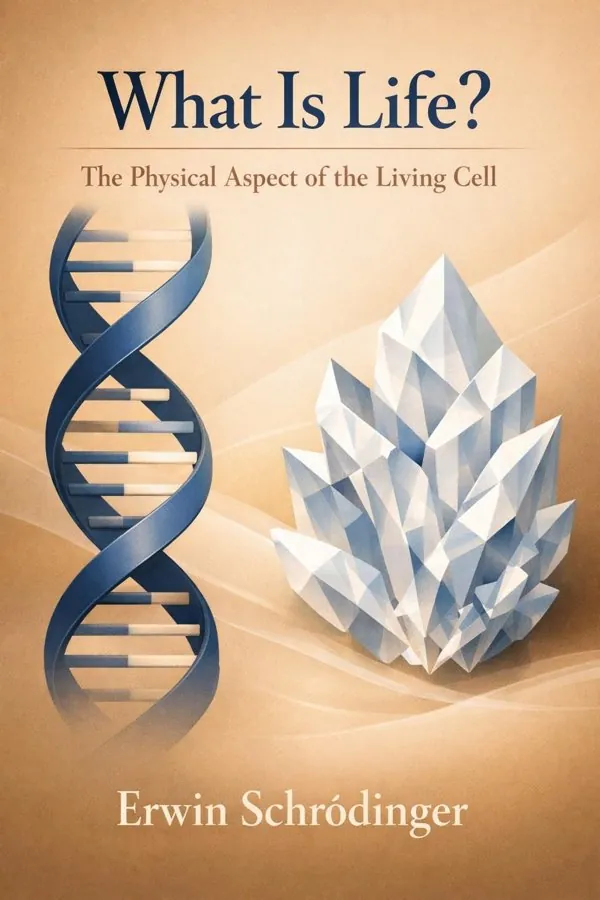
What Is Life? The Physical Aspect of the Living Cell: Summary & Key Insights
 10 min9 chaptersAudio available
Key Takeaways from What Is Life? The Physical Aspect of the Living Cell
The most striking fact about life is that it constantly avoids the fate that overtakes everything else.
Life survives not by escaping entropy, but by managing it.
The secret of heredity must be stable enough to endure and varied enough to encode differences.
Inheritance is remarkable because it is both conservative and creative.
Living systems depend on precision that classical physics alone struggles to explain.
What Is What Is Life? The Physical Aspect of the Living Cell About?
What Is Life? The Physical Aspect of the Living Cell by Erwin Schrödinger is a life_science book spanning 9 pages. What Is Life? The Physical Aspect of the Living Cell is one of the rare books that changed the direction of science by asking a deceptively simple question: can life be explained by the laws of physics? In this short but intellectually explosive work, Erwin Schrödinger examines how living organisms maintain order, preserve hereditary information, and resist the drift toward disorder that governs ordinary matter. Rather than treating biology as separate from physics, he argues that the living cell must ultimately obey physical law, even if it does so in ways that seem astonishingly precise and highly organized. The book matters because it helped inspire the birth of molecular biology. Schrödinger’s famous idea that genetic material might be an “aperiodic crystal” anticipated the later discovery of DNA as an information-bearing molecule. Though some scientific details are dated, the book remains remarkable for its conceptual power and ambition. Schrödinger was uniquely qualified to write it: a Nobel Prize-winning physicist and one of the founders of quantum mechanics, he brought unusual rigor and imagination to the mystery of life. This is a classic for anyone interested in biology, physics, information, or the deep logic of living systems.
This FizzRead summary covers all 9 key chapters of What Is Life? The Physical Aspect of the Living Cell in approximately 10 minutes, distilling the most important ideas, arguments, and takeaways from Erwin Schrödinger's work. Also available as an audio summary and Key Quotes Podcast.
What Is Life? The Physical Aspect of the Living Cell
What Is Life? The Physical Aspect of the Living Cell is one of the rare books that changed the direction of science by asking a deceptively simple question: can life be explained by the laws of physics? In this short but intellectually explosive work, Erwin Schrödinger examines how living organisms maintain order, preserve hereditary information, and resist the drift toward disorder that governs ordinary matter. Rather than treating biology as separate from physics, he argues that the living cell must ultimately obey physical law, even if it does so in ways that seem astonishingly precise and highly organized.
The book matters because it helped inspire the birth of molecular biology. Schrödinger’s famous idea that genetic material might be an “aperiodic crystal” anticipated the later discovery of DNA as an information-bearing molecule. Though some scientific details are dated, the book remains remarkable for its conceptual power and ambition. Schrödinger was uniquely qualified to write it: a Nobel Prize-winning physicist and one of the founders of quantum mechanics, he brought unusual rigor and imagination to the mystery of life. This is a classic for anyone interested in biology, physics, information, or the deep logic of living systems.
Who Should Read What Is Life? The Physical Aspect of the Living Cell?
This book is perfect for anyone interested in life_science and looking to gain actionable insights in a short read. Whether you're a student, professional, or lifelong learner, the key ideas from What Is Life? The Physical Aspect of the Living Cell by Erwin Schrödinger will help you think differently.
- ✓Readers who enjoy life_science and want practical takeaways
- ✓Professionals looking to apply new ideas to their work and life
- ✓Anyone who wants the core insights of What Is Life? The Physical Aspect of the Living Cell in just 10 minutes
Want the full summary?
Get instant access to this book summary and 100K+ more with Fizz Moment.
Get Free SummaryAvailable on App Store • Free to download
Key Chapters
The most striking fact about life is that it constantly avoids the fate that overtakes everything else. Left alone, physical systems tend to run down: metals rust, heat disperses, structures erode, and organized forms fall into disorder. A living organism, however, keeps rebuilding itself. It repairs damage, replaces components, regulates temperature and chemistry, and preserves a recognizable form over time. Schrödinger begins here because this resistance to decay is the central puzzle of biology when viewed through physics.
He does not claim that living things violate physical law. On the contrary, they obey it completely. The mystery is how they manage to maintain internal order while existing in a universe where disorder is statistically favored. The answer, he suggests, is that organisms are open systems. They do not remain orderly by being isolated, but by continuously exchanging matter and energy with their surroundings. A plant draws in sunlight and nutrients; an animal eats, breathes, and excretes. In doing so, the organism preserves its own structure while exporting disorder to the environment.
This idea has practical echoes everywhere in modern biology. Cells use metabolism to sustain highly improbable molecular arrangements. Human health depends on maintaining delicate internal balances despite external fluctuations. Even habits like sleep, nutrition, and exercise can be seen as ways the body restores and maintains order.
Actionable takeaway: when thinking about life, health, or systems design, start with a simple principle: lasting order requires continual maintenance, energy input, and intelligent exchange with the environment.
Life survives not by escaping entropy, but by managing it. Schrödinger’s most famous phrase is that organisms “feed on negative entropy,” meaning they draw order from their surroundings in order to preserve their own organization. In ordinary physical systems, randomness tends to increase. Yet living things seem to do the opposite locally: they build tissues, maintain chemical gradients, and coordinate complex internal processes with extraordinary reliability.
What Schrödinger means is not that life creates perfect order out of nothing. Rather, an organism takes in low-entropy resources and transforms them. Food, sunlight, oxygen, and structured molecules become part of a larger process that supports the organism’s internal stability. The price is paid externally: disorder is expelled as heat, waste, and dissipation. So the second law of thermodynamics is not defeated; it is satisfied globally while life maintains local order.
This idea remains deeply useful. A refrigerator keeps food cool only by consuming electricity and releasing heat elsewhere. A city remains functional only by importing energy, materials, and information while exporting waste. A company can stay organized only if it continually replenishes resources and reduces internal chaos. In biology, metabolism is precisely this disciplined flow of energy and matter that preserves structure against breakdown.
Schrödinger’s insight also helps explain why exhaustion, malnutrition, and stress matter so much. When energy and resources are insufficient, the organism’s capacity to maintain order weakens. Repair slows, regulation falters, and decay begins to show.
Actionable takeaway: protect any living or complex system by asking where its usable order comes from, how it processes that order, and where the resulting disorder goes.
The secret of heredity must be stable enough to endure and varied enough to encode differences. Schrödinger saw that this combination could not be explained by ordinary repeating structures alone. Crystals were already known in physics as highly ordered arrangements of atoms, but ordinary crystals repeat the same pattern over and over. Such regularity gives stability, yet it carries little information. To explain genes, Schrödinger proposed something more subtle: an “aperiodic crystal,” a stable molecular structure whose arrangement does not simply repeat and can therefore store a complex code.
This was a visionary leap. He was searching for a physical model that could explain how hereditary instructions persist across generations while allowing for immense variety. The idea pointed directly toward what DNA would later be shown to be: a chemically stable molecule whose sequence stores biological information. Although Schrödinger did not discover DNA’s structure, his framing encouraged scientists to look for a molecular basis of heredity grounded in physics and chemistry rather than vague vital forces.
The broader relevance of this idea is enormous. Information requires a medium. A melody needs notation or memory; software needs code; heredity needs a structure capable of both persistence and specificity. In cells, that structure is molecular. The insight helped shift biology from descriptive natural history toward the study of encoded instructions.
For modern readers, the aperiodic crystal is also a lesson in interdisciplinary thinking. A physicist, by asking what sort of material could embody biological order, helped open a new scientific frontier.
Actionable takeaway: when confronting a mystery, ask what physical form could store the information required to make the system work.
Inheritance is remarkable because it is both conservative and creative. Children resemble their parents, yet no two individuals are exactly alike. Schrödinger approached this problem by treating genes not as abstract biological “factors,” but as real physical entities. If heredity is reliable, then genes must possess a stable material basis. If traits can vary, then that basis must also permit small changes with large consequences.
This way of thinking transformed heredity from a statistical pattern into a molecular mechanism. Genes became carriers of instruction, not mystical essences. Their role is to preserve a code that guides development and cellular function. A mutation, then, is not merely a biological curiosity but a physical alteration in that code. This makes heredity intelligible in the language of matter, structure, and law.
The practical implications are now obvious to us because modern genetics has confirmed the importance of coded molecular instructions. A tiny change in DNA can alter eye color, enzyme function, disease risk, or how an organism responds to its environment. Genetic testing, gene therapy, crop breeding, and evolutionary biology all rest on the idea that inherited differences arise from material modifications in a stable information-bearing system.
Schrödinger’s contribution was to insist that life’s continuity depends on an extraordinarily reliable mechanism of storage and transmission. In everyday terms, a family resemblance exists not because nature vaguely repeats itself, but because precise biological instructions are copied with high fidelity.
Actionable takeaway: whenever you observe consistency across generations, teams, or systems, look for the underlying code, process, or template that preserves information over time.
Living systems depend on precision that classical physics alone struggles to explain. Schrödinger argued that the reliability of hereditary structures points toward the importance of quantum theory. At the microscopic scale, atoms do not behave like tiny billiard balls. Their stability, bonding patterns, and discrete energy states are governed by quantum laws. Without this atomic stability, biological molecules would not hold together long enough to support life.
This matters because genes must remain remarkably intact across immense numbers of molecular interactions. If matter were too flimsy or noisy, hereditary information would dissolve. Quantum mechanics provides a basis for the durability of chemical bonds and the regularity of molecular structures. In that sense, the existence of life is not separate from modern physics; it depends on it at the deepest level.
Schrödinger did not mean that cells are magical quantum mysteries in every ordinary function. His point was more foundational: the ordered architecture of life rests on physical principles discovered in atomic theory. The same laws that explain electron configurations and molecular stability also make possible proteins, enzymes, chromosomes, and ultimately organisms.
Today, biochemistry, molecular genetics, and structural biology all rely on this insight. Drug design depends on molecular shape and binding. Photosynthesis and electron transport involve quantum-level processes. Even the stability of DNA itself is a quantum-physical fact expressed through chemistry.
Actionable takeaway: do not treat levels of explanation as rivals. To understand complex phenomena well, connect the visible function of a system to the invisible physical principles that make that function possible.
Physics often explains the world through averages, but life depends on crucial individual events. In gases, for example, we can predict pressure and temperature without tracking every molecule. Statistical laws work because enormous numbers smooth out microscopic irregularities. Schrödinger points out that biology is different in a significant way: a single mutation in a gene, a single fertilization event, or a single molecular defect can have major consequences for an organism.
This creates an important conceptual tension. Many physical systems can be understood statistically because no one microscopic event matters much on its own. But in living systems, some tiny events are amplified into large outcomes. One change in hereditary material can alter development, produce disease, or create evolutionary novelty. This means biology cannot rely only on broad averages; it must also account for highly specific, structurally important events.
The distinction is still relevant. Public health uses statistics to understand populations, but medicine must also treat individual patients. Evolutionary theory studies trends across generations, but new traits often begin with rare mutations. In technology, average performance may look acceptable even while one failure in a critical component causes catastrophe.
Schrödinger’s insight helps explain why biology feels both law-governed and contingent. Organisms obey physics, yet their futures can hinge on singular molecular facts. Life is not chaos, but neither is it fully captured by crude averaging.
Actionable takeaway: when analyzing any complex system, combine two lenses: the statistical patterns of the whole and the high-impact individual events that can reshape everything.
One temptation in thinking about life is to assume that living things require a special category of explanation beyond physics and chemistry. Schrödinger resists that temptation. He argues that however extraordinary organisms appear, they must still be understandable within the framework of natural law. If a cell grows, repairs itself, and reproduces, then these processes must ultimately arise from material structures and lawful interactions.
This argument was bold because biology had long retained traces of vitalism, the belief that living beings possess some special life-force not found in nonliving matter. Schrödinger does not deny that life is astonishingly organized. He denies that mystery is an explanation. Instead, he challenges science to discover what kind of lawful organization could produce life’s distinctive features.
This mindset became foundational for molecular biology. It encouraged researchers to investigate metabolism, genes, enzymes, and cell structures as physical systems rather than as expressions of an irreducible vital essence. The result was not a diminished view of life, but a deeper one. To explain life physically is not to make it less wondrous; it is to understand more of how it works.
The same principle applies far beyond biology. When a phenomenon seems uniquely complex, we often retreat into vague language. But progress usually begins when we insist that complexity still has structure, causes, and constraints. That is true in neuroscience, ecology, economics, and organizational behavior.
Actionable takeaway: replace appeals to mystery with disciplined curiosity. Assume that even the most complex phenomenon has discoverable mechanisms, then ask what laws and structures could account for it.
A scientific account of life raises an uncomfortable question: if organisms are governed by physical law, what becomes of freedom, consciousness, and personal agency? Schrödinger does not resolve this tension in a simple way, but he confronts it directly. If the body is a physical system, then its operations should be lawful. Yet our inner experience feels immediate, unified, and self-directing. This creates one of the deepest philosophical problems at the border of science and self-understanding.
In discussing determinism and free will, Schrödinger invites readers to see that a lawful world need not make human experience meaningless. The fact that bodily processes obey natural laws does not erase the reality of thought, decision, or moral responsibility as lived phenomena. Instead, it pushes us to ask how subjective experience relates to objective description.
This section matters because the book is not merely about genes and molecules. It is also about the implications of a physical worldview. If life can be explained materially, then we must rethink what it means to be a self within nature. Modern neuroscience, cognitive science, and philosophy of mind continue to wrestle with versions of the same issue.
In practical terms, this perspective can produce humility. We are embodied beings shaped by biology, yet we are also reflective creatures capable of examining our motives and changing our behavior. Understanding causes does not eliminate responsibility; it can improve it.
Actionable takeaway: hold two truths together: your actions arise from lawful conditions, and your capacity for reflection remains one of the most important forces shaping what you do next.
Some books matter less for the details they get exactly right than for the questions they make unavoidable. What Is Life? is one of those books. Schrödinger’s broader legacy lies in his conviction that the future of biology would be molecular, informational, and deeply connected to physics. He helped shift attention from visible traits and organism-level description toward the coded structures and physical processes inside the cell.
This was historically transformative. The book inspired many young scientists, including some who later helped uncover the structure and function of DNA. It encouraged a generation to ask how hereditary information is stored, copied, and expressed at the molecular level. In that sense, Schrödinger did not merely comment on biology; he helped set its agenda.
The modern life sciences reflect this vision everywhere. Genomics reads biological code. Bioinformatics analyzes information-rich sequences. Synthetic biology engineers new genetic systems. Systems biology studies how physical and informational processes interact across networks. Even medicine has become more molecular, moving from symptom categories toward mechanistic understanding.
At the same time, Schrödinger’s example reminds us that scientific revolutions often come from crossing boundaries. A physicist entered biology not to dominate it, but to ask a fresh question in a rigorous way. The result was catalytic.
For readers today, the enduring lesson is that great progress often begins with conceptual reframing. A field changes when someone asks not only “what happens?” but “what kind of lawful structure would make this possible?”
Actionable takeaway: if you want to do original thinking, study the borders between disciplines, because breakthroughs often emerge where established languages overlap.
All Chapters in What Is Life? The Physical Aspect of the Living Cell
About the Author
Erwin Schrödinger (1887–1961) was an Austrian theoretical physicist whose work helped define modern quantum mechanics. He is most famous for the Schrödinger equation, which describes the behavior of quantum systems, and for the thought experiment known as Schrödinger’s cat. He received the Nobel Prize in Physics in 1933, shared with Paul Dirac. Beyond his major contributions to physics, Schrödinger was deeply interested in philosophy, consciousness, and the unity of scientific knowledge. That broad intellectual range led him to write What Is Life?, a short but influential book that brought physical reasoning to biological questions and helped inspire the rise of molecular biology. His work remains important not only for its technical brilliance, but also for its bold interdisciplinary imagination.
Get This Summary in Your Preferred Format
Read or listen to the What Is Life? The Physical Aspect of the Living Cell summary by Erwin Schrödinger anytime, anywhere. FizzRead offers multiple formats so you can learn on your terms — all free.
Available formats: App · Audio · PDF · EPUB — All included free with FizzRead
Download What Is Life? The Physical Aspect of the Living Cell PDF and EPUB Summary
Key Quotes from What Is Life? The Physical Aspect of the Living Cell
“The most striking fact about life is that it constantly avoids the fate that overtakes everything else.”
“Life survives not by escaping entropy, but by managing it.”
“The secret of heredity must be stable enough to endure and varied enough to encode differences.”
“Inheritance is remarkable because it is both conservative and creative.”
“Living systems depend on precision that classical physics alone struggles to explain.”
Frequently Asked Questions about What Is Life? The Physical Aspect of the Living Cell
What Is Life? The Physical Aspect of the Living Cell by Erwin Schrödinger is a life_science book that explores key ideas across 9 chapters. What Is Life? The Physical Aspect of the Living Cell is one of the rare books that changed the direction of science by asking a deceptively simple question: can life be explained by the laws of physics? In this short but intellectually explosive work, Erwin Schrödinger examines how living organisms maintain order, preserve hereditary information, and resist the drift toward disorder that governs ordinary matter. Rather than treating biology as separate from physics, he argues that the living cell must ultimately obey physical law, even if it does so in ways that seem astonishingly precise and highly organized. The book matters because it helped inspire the birth of molecular biology. Schrödinger’s famous idea that genetic material might be an “aperiodic crystal” anticipated the later discovery of DNA as an information-bearing molecule. Though some scientific details are dated, the book remains remarkable for its conceptual power and ambition. Schrödinger was uniquely qualified to write it: a Nobel Prize-winning physicist and one of the founders of quantum mechanics, he brought unusual rigor and imagination to the mystery of life. This is a classic for anyone interested in biology, physics, information, or the deep logic of living systems.
You Might Also Like
The Selfish Gene
Richard Dawkins
10 min
Awakenings
Oliver Sacks
10 min
Parasite Rex: Inside the Bizarre World of Nature's Most Dangerous Creatures
Carl Zimmer
10 min
The Atlas of Life on Earth
Various
10 min
The Book of Humans: The Story of How We Became Us
Adam Rutherford
10 min
The Horse
Wendy Williams
10 minBrowse by Category
Ready to read What Is Life? The Physical Aspect of the Living Cell?
Get the full summary and 100K+ more books with Fizz Moment.