
Erwin Schrödinger Books
Erwin Schrödinger (1887–1961) was an Austrian theoretical physicist best known for his contributions to quantum mechanics, particularly the Schrödinger equation. His interdisciplinary curiosity led him to explore the intersection of physics, philosophy, and biology, influencing both scientific and philosophical thought in the 20th century.
Known for: What Is Life? The Physical Aspect of the Living Cell
Books by Erwin Schrödinger
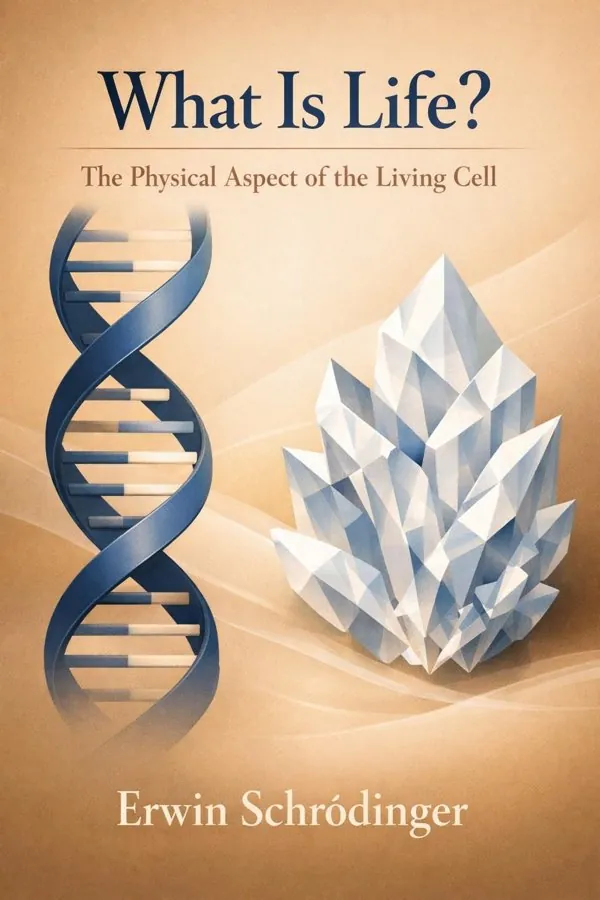
What Is Life? The Physical Aspect of the Living Cell
What Is Life? The Physical Aspect of the Living Cell is one of the rare books that changed the direction of science by asking a deceptively simple question: can life be explained by the laws of physics? In this short but intellectually explosive work, Erwin Schrödinger examines how living organisms maintain order, preserve hereditary information, and resist the drift toward disorder that governs ordinary matter. Rather than treating biology as separate from physics, he argues that the living cell must ultimately obey physical law, even if it does so in ways that seem astonishingly precise and highly organized. The book matters because it helped inspire the birth of molecular biology. Schrödinger’s famous idea that genetic material might be an “aperiodic crystal” anticipated the later discovery of DNA as an information-bearing molecule. Though some scientific details are dated, the book remains remarkable for its conceptual power and ambition. Schrödinger was uniquely qualified to write it: a Nobel Prize-winning physicist and one of the founders of quantum mechanics, he brought unusual rigor and imagination to the mystery of life. This is a classic for anyone interested in biology, physics, information, or the deep logic of living systems.
Read SummaryKey Insights from Erwin Schrödinger
Life Resists the Drift Toward Decay
The most striking fact about life is that it constantly avoids the fate that overtakes everything else. Left alone, physical systems tend to run down: metals rust, heat disperses, structures erode, and organized forms fall into disorder. A living organism, however, keeps rebuilding itself. It repair...
From What Is Life? The Physical Aspect of the Living Cell
Organisms Feed on Negative Entropy
Life survives not by escaping entropy, but by managing it. Schrödinger’s most famous phrase is that organisms “feed on negative entropy,” meaning they draw order from their surroundings in order to preserve their own organization. In ordinary physical systems, randomness tends to increase. Yet livin...
From What Is Life? The Physical Aspect of the Living Cell
The Aperiodic Crystal Carries Heredity
The secret of heredity must be stable enough to endure and varied enough to encode differences. Schrödinger saw that this combination could not be explained by ordinary repeating structures alone. Crystals were already known in physics as highly ordered arrangements of atoms, but ordinary crystals r...
From What Is Life? The Physical Aspect of the Living Cell
Genes Function as Molecular Instructions
Inheritance is remarkable because it is both conservative and creative. Children resemble their parents, yet no two individuals are exactly alike. Schrödinger approached this problem by treating genes not as abstract biological “factors,” but as real physical entities. If heredity is reliable, then ...
From What Is Life? The Physical Aspect of the Living Cell
Quantum Stability Makes Life Possible
Living systems depend on precision that classical physics alone struggles to explain. Schrödinger argued that the reliability of hereditary structures points toward the importance of quantum theory. At the microscopic scale, atoms do not behave like tiny billiard balls. Their stability, bonding patt...
From What Is Life? The Physical Aspect of the Living Cell
Statistical Laws Meet Singular Biological Events
Physics often explains the world through averages, but life depends on crucial individual events. In gases, for example, we can predict pressure and temperature without tracking every molecule. Statistical laws work because enormous numbers smooth out microscopic irregularities. Schrödinger points o...
From What Is Life? The Physical Aspect of the Living Cell
About Erwin Schrödinger
Erwin Schrödinger (1887–1961) was an Austrian theoretical physicist best known for his contributions to quantum mechanics, particularly the Schrödinger equation. His interdisciplinary curiosity led him to explore the intersection of physics, philosophy, and biology, influencing both scientific and p...
Read more
Erwin Schrödinger (1887–1961) was an Austrian theoretical physicist best known for his contributions to quantum mechanics, particularly the Schrödinger equation. His interdisciplinary curiosity led him to explore the intersection of physics, philosophy, and biology, influencing both scientific and p...
Erwin Schrödinger (1887–1961) was an Austrian theoretical physicist best known for his contributions to quantum mechanics, particularly the Schrödinger equation. His interdisciplinary curiosity led him to explore the intersection of physics, philosophy, and biology, influencing both scientific and philosophical thought in the 20th century.


Frequently Asked Questions
Erwin Schrödinger (1887–1961) was an Austrian theoretical physicist best known for his contributions to quantum mechanics, particularly the Schrödinger equation. His interdisciplinary curiosity led him to explore the intersection of physics, philosophy, and biology, influencing both scientific and philosophical thought in the 20th century.
Read Erwin Schrödinger's books in 15 minutes
Get AI-powered summaries with key insights from 1 book by Erwin Schrödinger.