
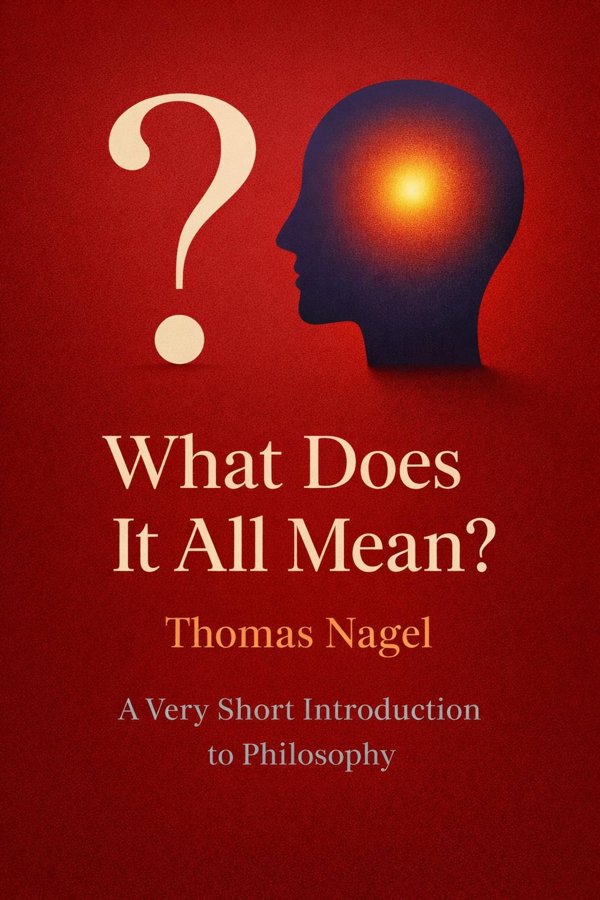
What Does It All Mean?: A Very Short Introduction to Philosophy: Summary & Key Insights
by Thomas Nagel
 10 min9 chaptersAudio available
Key Takeaways from What Does It All Mean?: A Very Short Introduction to Philosophy
This tension between the subjective and the objective sits at the heart of Nagel’s book.
The moment you seriously ask whether the world outside your mind truly exists, philosophy stops feeling abstract.
One of philosophy’s oldest puzzles is also one of its most intimate: how can a physical body produce a conscious mind?
We usually live as if our choices are up to us, yet we also believe that everything in nature has causes.
Moral disagreement feels personal, but Nagel argues that ethics is not merely a matter of taste.
What Is What Does It All Mean?: A Very Short Introduction to Philosophy About?
What Does It All Mean?: A Very Short Introduction to Philosophy by Thomas Nagel is a western_phil book spanning 8 pages. Thomas Nagel’s What Does It All Mean? is one of the clearest and most inviting introductions to philosophy ever written. Rather than beginning with jargon, schools of thought, or historical disputes, Nagel starts where philosophy really begins: with ordinary questions that suddenly become puzzling when we think about them seriously. How do you know the world outside your mind is real? Are you just a body, or something more? Do you truly choose your actions? What makes something right or wrong? Why does death matter so much, and can life have meaning at all? What makes this short book powerful is its combination of simplicity and depth. Nagel does not offer easy answers or pretend that philosophy can eliminate uncertainty. Instead, he shows how careful reasoning can sharpen confusion into insight. His examples are concrete, his language is accessible, and his questions remain intellectually demanding. Nagel is uniquely qualified to guide this journey. A major American philosopher known for influential work on consciousness, ethics, and the limits of objectivity, he brings both scholarly authority and unusual clarity. This book matters because it teaches readers not what to think, but how to think.
This FizzRead summary covers all 9 key chapters of What Does It All Mean?: A Very Short Introduction to Philosophy in approximately 10 minutes, distilling the most important ideas, arguments, and takeaways from Thomas Nagel's work. Also available as an audio summary and Key Quotes Podcast.
What Does It All Mean?: A Very Short Introduction to Philosophy
Thomas Nagel’s What Does It All Mean? is one of the clearest and most inviting introductions to philosophy ever written. Rather than beginning with jargon, schools of thought, or historical disputes, Nagel starts where philosophy really begins: with ordinary questions that suddenly become puzzling when we think about them seriously. How do you know the world outside your mind is real? Are you just a body, or something more? Do you truly choose your actions? What makes something right or wrong? Why does death matter so much, and can life have meaning at all?
What makes this short book powerful is its combination of simplicity and depth. Nagel does not offer easy answers or pretend that philosophy can eliminate uncertainty. Instead, he shows how careful reasoning can sharpen confusion into insight. His examples are concrete, his language is accessible, and his questions remain intellectually demanding.
Nagel is uniquely qualified to guide this journey. A major American philosopher known for influential work on consciousness, ethics, and the limits of objectivity, he brings both scholarly authority and unusual clarity. This book matters because it teaches readers not what to think, but how to think.
Who Should Read What Does It All Mean?: A Very Short Introduction to Philosophy?
This book is perfect for anyone interested in western_phil and looking to gain actionable insights in a short read. Whether you're a student, professional, or lifelong learner, the key ideas from What Does It All Mean?: A Very Short Introduction to Philosophy by Thomas Nagel will help you think differently.
- ✓Readers who enjoy western_phil and want practical takeaways
- ✓Professionals looking to apply new ideas to their work and life
- ✓Anyone who wants the core insights of What Does It All Mean?: A Very Short Introduction to Philosophy in just 10 minutes
Want the full summary?
Get instant access to this book summary and 100K+ more with Fizz Moment.
Get Free SummaryAvailable on App Store • Free to download
Key Chapters
Many philosophical problems begin with a simple but unsettling fact: each of us experiences the world from the inside, yet we also believe there is a world that exists independently of our private viewpoint. This tension between the subjective and the objective sits at the heart of Nagel’s book. You know what it feels like to be you—your pains, perceptions, hopes, and fears—but philosophy asks whether you can step back from that personal perspective and understand reality as it really is.
Nagel shows that ordinary life constantly moves between these standpoints. If you are insulted, the event feels intensely personal and subjective. But if you later describe it to a friend, you begin to adopt a more objective view: what happened, what was said, and whether your reaction was justified. Science pushes this movement even further by trying to describe the world without relying on any particular person’s point of view.
Yet objectivity has limits. Some things, especially conscious experience, cannot be fully captured from the outside. There is a difference between knowing that someone is in pain and feeling pain yourself. This is why philosophy resists simple reduction. We want a view from nowhere, but we remain beings who always begin from somewhere.
In practical life, this tension appears whenever you ask whether your current feelings are distorting your judgment. In conflicts, politics, relationships, and moral decisions, we must learn to balance personal experience with impartial reflection.
Actionable takeaway: When facing a difficult judgment, ask two questions: What does this look like from my point of view, and what does it look like from a more objective distance?
The moment you seriously ask whether the world outside your mind truly exists, philosophy stops feeling abstract. Nagel uses skepticism to show how fragile our claims to knowledge can be. You believe there is a table in front of you because you see and touch it. But how do you know you are not dreaming? How do you know your senses are reliable? How do you know the world is not an elaborate illusion?
These skeptical questions matter because they expose the assumptions hidden inside everyday certainty. Most of the time, we move through life trusting perception, memory, and testimony. If a friend says it is raining outside, you tend to believe them. If you remember locking your door, you act on that memory. But Nagel points out that each of these sources of knowledge can fail. Senses deceive. Memories fade. Testimony can be false.
Still, skepticism does not simply destroy knowledge. It forces us to notice that certainty may be too demanding a standard. In real life, we often rely on reasons that are strong without being absolute. You cannot prove with mathematical certainty that your coffee is not poisoned, but you have good reason to drink it if it came from a trusted source and nothing seems wrong.
Nagel’s point is not that we know nothing. It is that knowing may be more complicated than it first appears. Philosophy teaches intellectual humility: our confidence should be proportioned to our evidence.
In practical terms, this matters in an age of misinformation. Claims online, political rhetoric, and even personal assumptions should be examined rather than accepted automatically.
Actionable takeaway: Before treating something as certain, ask what your evidence is, what could count against it, and whether your confidence matches the strength of your reasons.
One of philosophy’s oldest puzzles is also one of its most intimate: how can a physical body produce a conscious mind? Nagel explores the problem by distinguishing between what can be observed from the outside and what can only be known from the inside. A brain can be studied scientifically. Neurons fire, chemicals circulate, and bodies behave in measurable ways. But your inner experience—what it feels like to taste coffee, to fear loss, or to remember childhood—seems different from any physical description.
This is the mind-body problem. If humans are purely physical organisms, then thoughts, feelings, and consciousness must somehow be physical too. But that conclusion feels incomplete because no external description seems to capture subjective experience itself. A doctor can describe the neural basis of pain, yet that still does not convey what pain feels like to the person suffering.
Nagel does not offer an easy solution, and that is part of the lesson. Some philosophical questions endure because both sides seem compelling. Materialism has power because bodies clearly affect minds: injury changes memory, drugs alter mood, sleep deprivation clouds judgment. Yet dualism, the idea that mind is distinct from body, appeals because consciousness seems irreducibly first-person.
This issue matters practically whenever we think about mental health, AI, medicine, or personal identity. Is depression just chemistry? Can a machine really be conscious? Are you still the same person after major cognitive change?
Philosophy here deepens compassion. If inner life cannot be reduced to external behavior, then listening to another person’s experience becomes essential.
Actionable takeaway: When considering any human problem, include both levels of explanation: what is happening physically and what it feels like from the inside.
We usually live as if our choices are up to us, yet we also believe that everything in nature has causes. Nagel uses this tension to frame the problem of free will. If every event has prior causes—your genes, upbringing, brain states, social pressures, and immediate circumstances—then in what sense could you have done otherwise? And if you could not have done otherwise, can you really be responsible for your actions?
The puzzle becomes sharp in everyday examples. Imagine someone loses their temper in traffic. On one hand, we blame them because they chose to yell and drive aggressively. On the other hand, we might explain their behavior through stress, lack of sleep, learned habits, or personality traits shaped over decades. The more complete the explanation, the less room there seems to be for genuine freedom.
Nagel does not rush to resolve this contradiction. Instead, he shows why both perspectives remain compelling. From the inside, deliberation feels real. You weigh reasons, resist impulses, and decide. From the outside, your action can be seen as part of a causal chain. Philosophy asks whether these views can be reconciled or whether free will is partly an illusion.
This matters because moral life depends on it. Praise, blame, punishment, self-improvement, and regret all assume that our choices are somehow ours. At the same time, understanding causal influences can make us less self-righteous and more humane.
In practical life, the free will problem encourages a balanced approach. Hold yourself accountable, but also examine the conditions shaping behavior. Better habits, environments, and institutions can improve choices without pretending people act in a vacuum.
Actionable takeaway: Treat your decisions as meaningful, but whenever you judge yourself or others, also ask what causes and circumstances helped produce the action.
Moral disagreement feels personal, but Nagel argues that ethics is not merely a matter of taste. Saying that cruelty is wrong is not like saying you dislike olives. Moral judgments claim a kind of general validity: they imply that anyone in relevantly similar circumstances has reason to act the same way. This is what makes ethics philosophical rather than merely emotional.
Nagel examines the structure of moral reasoning by asking why your own interests should count more than someone else’s. If you can recognize that your pain matters because it is pain, then you can also recognize that another person’s pain matters for the same reason. Ethics pushes us beyond self-interest toward impartiality. It requires seeing ourselves as one person among many, not the center of the universe.
This does not mean morality is easy. Real situations involve conflicts between loyalty and fairness, honesty and kindness, self-protection and compassion. Suppose you can advance your career by taking credit for a coworker’s idea. Your ambition may tempt you, but moral reflection asks whether you could justify the action from a standpoint that gives equal weight to everyone affected.
Nagel’s treatment helps explain why moral argument is possible even when agreement is hard. We appeal to consistency, fairness, and reasons others could in principle accept. That is why ethical life involves more than feelings; it involves justification.
Practically, this framework helps in daily decisions, from workplace conduct to family tensions to civic life. Moral maturity means asking not only what benefits me, but what can be defended as fair.
Actionable takeaway: In any moral choice, test your reasoning by asking whether you would still accept the rule if you were in the position of the other person affected.
Questions of justice arise when we move from individual morality to the organization of society. Nagel asks how benefits and burdens should be distributed, what rights people have, and what makes political arrangements fair rather than merely efficient or traditional. Justice is difficult because society contains competing interests, unequal talents, different needs, and limited resources.
One temptation is to define justice in terms of personal advantage: a system seems fair when it serves us. But philosophy challenges that instinct. A rich person may prefer low taxes; a poor person may need public support. A majority may favor a policy that harms a minority. Justice requires more than bargaining power or custom. It asks what people could reasonably accept if they were not designing society from a position of self-interest.
Nagel’s discussion invites readers to think impersonally about political life. Why should the accident of birth determine opportunity? Why should strength, wealth, or popularity settle what is right? The moral move toward objectivity reappears here at the social level. To think justly is to consider institutions from a point of view broader than one’s private benefit.
Examples are everywhere: school funding, healthcare access, criminal punishment, voting rights, and freedom of expression. In each case, justice requires balancing liberty, equality, order, and human dignity. Philosophy does not deliver a simple formula, but it clarifies the values in conflict.
This has practical force because democratic life depends on citizens who can reason about fairness, not only defend their tribe. Justice begins when we stop asking only, “What do I want?” and start asking, “What arrangement could be justified to everyone?”
Actionable takeaway: When evaluating a social issue, imagine you did not know your own position in society, and then ask what rules would still seem fair.
Few facts are more certain than death, yet few are harder to understand emotionally. Nagel explores why death troubles us so deeply. Is death bad because it is painful? Not necessarily, since the state of being dead is not itself experienced. Is it bad because it ends our projects, relationships, pleasures, and possibilities? That seems closer to the truth. Death matters because it deprives us of the goods of life.
This raises a philosophical puzzle. If death means nonexistence, and nonexistence contains no suffering, why fear it? Nagel’s answer points toward deprivation: something can be bad for a person not because it feels bad at the time, but because it removes what would otherwise have been valuable. A child dying young is tragic not only because of any pain involved, but because of the life not lived.
At the same time, philosophy can temper fear. We often dread death as if it were a terrible experience awaiting us, but Nagel helps separate the event from the anticipation. Much of the terror belongs to the living imagination, not to death itself.
This discussion matters practically because awareness of mortality shapes priorities. People delay what matters, assume they have time, or avoid difficult conversations until loss makes delay impossible. Reflection on death need not be morbid. It can be clarifying.
Nagel does not romanticize mortality, but he shows that thinking clearly about death can illuminate life. The finiteness of existence sharpens the value of attention, love, work, and presence.
Actionable takeaway: Use mortality as a guide, not a source of paralysis. Ask what you would regret leaving undone, and let that answer influence how you spend your time now.
Human life can feel intensely important from the inside and strangely small from a wider perspective. Nagel explores this tension in his discussion of meaning. We make plans, build careers, fall in love, raise families, fight for causes, and suffer losses as though everything matters enormously. Yet when we step back, our lives can appear tiny within history, nature, or the universe. Philosophy asks how both perspectives can be true at once.
Nagel’s treatment of meaning is subtle. He does not say life is meaningless just because it is finite or cosmically insignificant. Instead, he notes that the search for ultimate justification can become endless. If you work to support your family, that seems meaningful. But if someone asks why family matters, and then why love matters, and then why anything matters at all, ordinary reasons may begin to feel incomplete.
This does not force despair. It reveals that human beings occupy two standpoints: engaged participants in life and detached observers capable of questioning everything. Meaning arises within life—from commitments, relationships, projects, and understanding—even if no final cosmic endorsement appears.
This is highly practical. Many people expect meaning to arrive as a grand revelation, then feel lost when life remains ordinary. Nagel suggests a different approach: meaning need not depend on metaphysical certainty. It can be sustained through serious participation in valuable activities while retaining a sense of perspective.
The challenge is not to eliminate doubt but to live intelligently with it. Humor, humility, and commitment can coexist.
Actionable takeaway: Stop waiting for a single ultimate answer to justify your existence. Instead, identify the relationships, practices, and responsibilities that make your life genuinely worth inhabiting today.
One of Nagel’s most important contributions is methodological: philosophy does not begin in specialist textbooks but in the ordinary capacity to be puzzled by familiar things. Children ask philosophical questions naturally: How do I know I’m not dreaming? Why should I be fair? Where was I before I was born? Adults often suppress these questions in the name of practicality, but Nagel restores their legitimacy.
This matters because many people imagine philosophy as a remote academic subject detached from life. Nagel shows the opposite. Philosophy starts when commonplace assumptions stop feeling obvious. A chair, a promise, a decision, an insult, a law, a funeral—each can become the site of a serious inquiry into reality, knowledge, selfhood, morality, and value.
Importantly, philosophy is not just opinion-sharing. It demands reasons, distinctions, and patience with uncertainty. You may not reach final answers, but the process itself refines thought. For example, if you argue with a friend about whether lying is ever justified, philosophy encourages you to clarify terms, test principles with examples, and examine hidden assumptions. This is a discipline of mind, not just a collection of doctrines.
In practical life, philosophical thinking improves judgment. It helps you resist slogans, question inherited beliefs, and see complexity where others see certainty. It also builds intellectual independence. Rather than borrowing conclusions from authority, you learn how to investigate them yourself.
Nagel’s broader message is empowering: serious thinking is not reserved for experts. Philosophy belongs to anyone willing to follow a question honestly.
Actionable takeaway: Once a day, pause over something you normally take for granted and ask what assumptions make it seem obvious. That habit is the beginning of philosophy.
All Chapters in What Does It All Mean?: A Very Short Introduction to Philosophy
About the Author
Thomas Nagel is an American philosopher renowned for his influential work in philosophy of mind, ethics, political philosophy, and epistemology. Educated at Cornell, Oxford, and Harvard, he taught at the University of California, Berkeley, Princeton University, and later New York University, where he became one of the most widely read contemporary philosophers. Nagel is especially known for exploring the limits of objectivity and for defending the importance of subjective experience in understanding consciousness. His celebrated essay “What Is It Like to Be a Bat?” became a landmark in debates about the mind-body problem. Across his writings, Nagel combines analytical precision with unusual clarity, making difficult ideas accessible without oversimplifying them. What Does It All Mean? reflects that rare talent, introducing beginners to philosophy through questions that are both timeless and deeply human.
Get This Summary in Your Preferred Format
Read or listen to the What Does It All Mean?: A Very Short Introduction to Philosophy summary by Thomas Nagel anytime, anywhere. FizzRead offers multiple formats so you can learn on your terms — all free.
Available formats: App · Audio · PDF · EPUB — All included free with FizzRead
Download What Does It All Mean?: A Very Short Introduction to Philosophy PDF and EPUB Summary
Key Quotes from What Does It All Mean?: A Very Short Introduction to Philosophy
“This tension between the subjective and the objective sits at the heart of Nagel’s book.”
“The moment you seriously ask whether the world outside your mind truly exists, philosophy stops feeling abstract.”
“One of philosophy’s oldest puzzles is also one of its most intimate: how can a physical body produce a conscious mind?”
“We usually live as if our choices are up to us, yet we also believe that everything in nature has causes.”
“Moral disagreement feels personal, but Nagel argues that ethics is not merely a matter of taste.”
Frequently Asked Questions about What Does It All Mean?: A Very Short Introduction to Philosophy
What Does It All Mean?: A Very Short Introduction to Philosophy by Thomas Nagel is a western_phil book that explores key ideas across 9 chapters. Thomas Nagel’s What Does It All Mean? is one of the clearest and most inviting introductions to philosophy ever written. Rather than beginning with jargon, schools of thought, or historical disputes, Nagel starts where philosophy really begins: with ordinary questions that suddenly become puzzling when we think about them seriously. How do you know the world outside your mind is real? Are you just a body, or something more? Do you truly choose your actions? What makes something right or wrong? Why does death matter so much, and can life have meaning at all? What makes this short book powerful is its combination of simplicity and depth. Nagel does not offer easy answers or pretend that philosophy can eliminate uncertainty. Instead, he shows how careful reasoning can sharpen confusion into insight. His examples are concrete, his language is accessible, and his questions remain intellectually demanding. Nagel is uniquely qualified to guide this journey. A major American philosopher known for influential work on consciousness, ethics, and the limits of objectivity, he brings both scholarly authority and unusual clarity. This book matters because it teaches readers not what to think, but how to think.
You Might Also Like
A Little History of Philosophy
Nigel Warburton
10 min
Areopagitica
John Milton
10 min
How To Think Like A Philosopher: Essential Principles For Clear Thinking
Peter Cave
10 min
Language, Truth and Logic
A. J. Ayer
10 min
The Age of Reason
Thomas Paine
10 min
The Essays
Michel De Montaigne
10 minBrowse by Category
Ready to read What Does It All Mean?: A Very Short Introduction to Philosophy?
Get the full summary and 100K+ more books with Fizz Moment.