
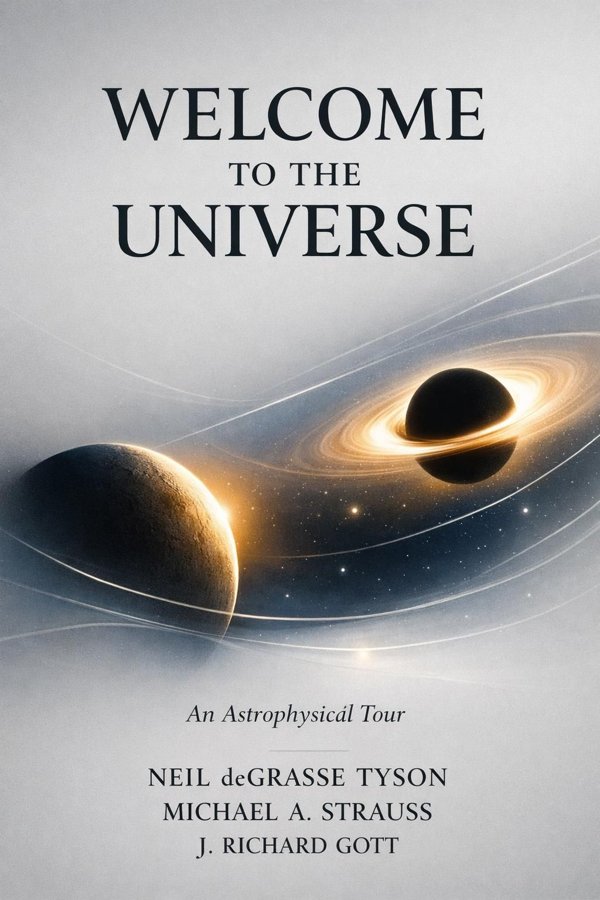
Welcome to the Universe: An Astrophysical Tour: Summary & Key Insights
by Neil deGrasse Tyson, Michael A. Strauss, J. Richard Gott
 10 min10 chaptersAudio available
What Is Welcome to the Universe: An Astrophysical Tour About?
Welcome to the Universe: An Astrophysical Tour by Neil deGrasse Tyson, Michael A. Strauss, J. Richard Gott is a popular_sci book spanning 10 pages. Welcome to the Universe is an expansive and engaging introduction to astrophysics, based on the popular Princeton University course taught by Neil deGrasse Tyson, Michael A. Strauss, and J. Richard Gott. The book takes readers on a grand tour of the cosmos, exploring topics such as the scale of the universe, the life cycles of stars, black holes, relativity, and the possibility of extraterrestrial life. Written in an accessible and humorous style, it invites readers to grasp the wonders and complexities of the universe through vivid explanations and thought-provoking insights.
This FizzRead summary covers all 10 key chapters of Welcome to the Universe: An Astrophysical Tour in approximately 10 minutes, distilling the most important ideas, arguments, and takeaways from Neil deGrasse Tyson, Michael A. Strauss, J. Richard Gott's work. Also available as an audio summary and Key Quotes Podcast.
Welcome to the Universe: An Astrophysical Tour
Welcome to the Universe is an expansive and engaging introduction to astrophysics, based on the popular Princeton University course taught by Neil deGrasse Tyson, Michael A. Strauss, and J. Richard Gott. The book takes readers on a grand tour of the cosmos, exploring topics such as the scale of the universe, the life cycles of stars, black holes, relativity, and the possibility of extraterrestrial life. Written in an accessible and humorous style, it invites readers to grasp the wonders and complexities of the universe through vivid explanations and thought-provoking insights.
Who Should Read Welcome to the Universe: An Astrophysical Tour?
This book is perfect for anyone interested in popular_sci and looking to gain actionable insights in a short read. Whether you're a student, professional, or lifelong learner, the key ideas from Welcome to the Universe: An Astrophysical Tour by Neil deGrasse Tyson, Michael A. Strauss, J. Richard Gott will help you think differently.
- ✓Readers who enjoy popular_sci and want practical takeaways
- ✓Professionals looking to apply new ideas to their work and life
- ✓Anyone who wants the core insights of Welcome to the Universe: An Astrophysical Tour in just 10 minutes
Want the full summary?
Get instant access to this book summary and 100K+ more with Fizz Moment.
Get Free SummaryAvailable on App Store • Free to download
Key Chapters
To understand the cosmos, we must first confront its scale—an exercise that simultaneously delights and humbles us. When you look up at the night sky, every point of light is a messenger from the past. Because light takes time to travel, when you observe a star a thousand light-years away, you are literally glimpsing a thousand-year-old image, a cosmic postcard delayed by distance itself.
In our lectures, we would often start by building the 'cosmic distance ladder'—a conceptual scaffold that helps astronomers climb from close-by celestial distances (such as the Moon) to the immeasurable gulfs beyond distant galaxies. That ladder begins with simple triangulation, exploiting parallax, the apparent motion of nearby stars against more distant backgrounds as Earth orbits the Sun. Once that rung is calibrated, more distant indicators—like Cepheid variable stars and supernovae—extend our reach deeper into space.
But even while our methods improve, our minds struggle to visualize these scales. The human brain evolved to recognize predators and fruits on the African savanna, not to intuit distances of millions of light-years. Yet embracing that vastness gives us perspective. In one sense, we discover our insignificance. In another, we discover our grandeur: the universe has become self-aware through our understanding of it. Measuring the cosmos is an act of connection as much as one of science.
Closer to home, our solar system is a masterpiece of diversity—an orchestration of physics, chemistry, and cosmic happenstance. The Sun, a G-type star born some 4.6 billion years ago, is both our parent and our power plant. Around it orbits a family of worlds whose variations tell the story of planetary formation.
From the rocky interiors of Mercury, Venus, Earth, and Mars to the gas and ice giants circling farther out, we witness the outcomes of gravity, temperature, and time. Our own Earth occupies a narrow habitable zone where liquid water can persist—a cosmic sweet spot that makes our existence possible. The outer planets, meanwhile, serve as archives of primordial material, preserving conditions from the solar system’s infancy.
We compare these worlds not just to understand them individually, but to comprehend the processes that gave rise to them all. Why does Venus sear under a runaway greenhouse effect while Mars shivers in a frozen desert? Why do comets—icy nomads from the Kuiper Belt—carry secrets about the building blocks of life? By exploring our solar system, we learn both the peculiarities of our neighborhood and the universality of planetary formation. Each crater, moon, and storm is a clue in the cosmic detective story of how solar systems arise everywhere in the galaxy.
+ 8 more chapters — available in the FizzRead app
All Chapters in Welcome to the Universe: An Astrophysical Tour
About the Authors
Neil deGrasse Tyson is an American astrophysicist, author, and science communicator, known for his work in popularizing science through books and television. Michael A. Strauss is a professor of astrophysical sciences at Princeton University, specializing in extragalactic astronomy. J. Richard Gott is a professor emeritus of astrophysical sciences at Princeton University, recognized for his contributions to cosmology and the theory of time travel.
Get This Summary in Your Preferred Format
Read or listen to the Welcome to the Universe: An Astrophysical Tour summary by Neil deGrasse Tyson, Michael A. Strauss, J. Richard Gott anytime, anywhere. FizzRead offers multiple formats so you can learn on your terms — all free.
Available formats: App · Audio · PDF · EPUB — All included free with FizzRead
Download Welcome to the Universe: An Astrophysical Tour PDF and EPUB Summary
Key Quotes from Welcome to the Universe: An Astrophysical Tour
“To understand the cosmos, we must first confront its scale—an exercise that simultaneously delights and humbles us.”
“Closer to home, our solar system is a masterpiece of diversity—an orchestration of physics, chemistry, and cosmic happenstance.”
Frequently Asked Questions about Welcome to the Universe: An Astrophysical Tour
Welcome to the Universe: An Astrophysical Tour by Neil deGrasse Tyson, Michael A. Strauss, J. Richard Gott is a popular_sci book that explores key ideas across 10 chapters. Welcome to the Universe is an expansive and engaging introduction to astrophysics, based on the popular Princeton University course taught by Neil deGrasse Tyson, Michael A. Strauss, and J. Richard Gott. The book takes readers on a grand tour of the cosmos, exploring topics such as the scale of the universe, the life cycles of stars, black holes, relativity, and the possibility of extraterrestrial life. Written in an accessible and humorous style, it invites readers to grasp the wonders and complexities of the universe through vivid explanations and thought-provoking insights.
You Might Also Like

Structures: Or Why Things Don"t Fall Down
J.E. Gordon
10 min
The Road to Wigan Pier
George Orwell
10 min
Bonk: The Curious Coupling of Science and Sex
Mary Roach
10 min
First Bite: How We Learn to Eat
Bee Wilson
10 min
In Pursuit Of The Unknown: 17 Equations That Changed The World
Ian Stewart
10 min
Napoleon's Buttons: 17 Molecules That Changed History
Penny Le Couteur and Jay Burreson
10 minBrowse by Category
Ready to read Welcome to the Universe: An Astrophysical Tour?
Get the full summary and 100K+ more books with Fizz Moment.